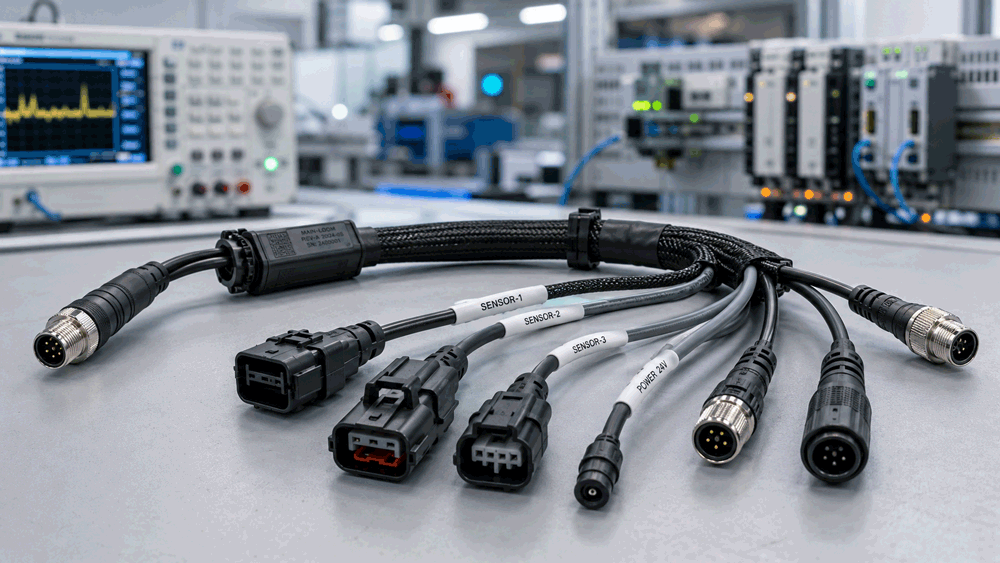
Sensor cable assemblies may look simple, but testing them only by appearance or basic continuity can create hidden risk. A wrong pinout, weak crimp, poor shield termination, unstable connector fit, or incomplete sealing structure may not be visible at first glance, but it can cause sensor failure after installation.
For OEM buyers, a sensor cable assembly test plan should be defined before sample approval and production release. The goal is not only to find defects after production, but to prevent repeat mistakes during prototype, pilot build, and batch supply.
Table of Contents
ToggleStart with Risk
A test plan should start with the real application risk.
Not every sensor cable assembly needs the same inspection standard. A short indoor cable for a simple switch signal may require a different test plan from a shielded M12 sensor cable used near motors, or a waterproof sensor cable used on outdoor agricultural equipment.
For OEM projects, the buyer and supplier should first understand what failure would mean. Would a wiring mistake stop equipment assembly? Could wrong polarity damage a sensor? Could poor shielding create unstable readings? Could water ingress cause field failure? Could a weak crimp create intermittent problems that are hard to diagnose?
These questions help define the correct test level. A low-risk cable may only need continuity, pinout, visual inspection, and dimensional checks. A higher-risk sensor cable may also need shield continuity, insulation resistance, pull-force checks, connector fit verification, sealing review, and pilot production validation.
Testing should not be treated as a final step only. A practical test plan covers incoming material checks, in-process inspection, final electrical testing, visual inspection, sample approval, pilot build review, and production records.
For broader sensor cable design, buyers can also review Sensor Cable Assemblies for OEM Equipment.
Define Function
The function of the cable decides what should be tested.
A sensor cable may carry digital signals, analog signals, pulse signals, encoder signals, communication signals, power, ground, or mixed power and signal. Each function creates different test priorities.
For simple digital sensor cables, continuity and pinout are usually essential. For analog or precision measurement cables, shielding, grounding, and insulation may become more important. For power-plus-signal cables, polarity, conductor size, and separation between circuits should be checked carefully. For waterproof sensor cables, sealing structure and connector fit may be as important as electrical testing.
The RFQ should state what the sensor cable does. If the supplier only receives a drawing without application context, it may apply a general inspection method. That may not be enough for the real equipment risk.
Function also affects test fixtures. A multi-pin M12 sensor cable, for example, should be tested with a fixture that confirms the correct relationship between every pin and conductor. A shielded cable should not only test signal wires, but also verify shield connection according to the approved design.
Before production release, the buyer and supplier should agree on what is tested, how it is tested, and what result is acceptable.
Check Continuity
Continuity testing is the most basic requirement for sensor cable assemblies.
Continuity testing confirms that each conductor is connected from one end to the correct destination. It helps detect broken wires, missing crimps, poor soldering, incorrect termination, or open circuits.
For OEM sensor cable projects, continuity testing should be based on the approved wiring table or drawing. It should not rely on memory or visual judgment. If the cable has multiple wires with similar colors or small terminals, a dedicated test fixture is strongly recommended.
Continuity should usually be checked 100% for production batches, especially when the assembly has multiple conductors, customized pinout, or field failure risk. A single wiring error can stop equipment assembly or create a difficult troubleshooting problem.
However, continuity testing alone is not enough. A cable can pass continuity testing but still have wrong pin assignment if the test only checks that wires are connected, not where they are connected. This is why pinout testing must be included.
Verify Pinout
Pinout testing confirms that every signal goes to the correct pin.
This is one of the most important checks for sensor cable assemblies. Many sensor cables use compact connectors such as M8, M12, circular connectors, board connectors, or molded plugs. The external appearance may not show the internal wiring. Two cables can look identical but have different pinouts.
For OEM buyers, pinout should be clearly defined in the drawing. The supplier should test each cable against that approved pinout before shipment. If the cable has one connector and one open end, the test should confirm which wire color or conductor connects to each pin. If the cable has connectors on both ends, the test should confirm the full end-to-end wiring relationship.
Wrong pinout can create serious problems. A sensor may not work, signal output may be unstable, communication may fail, or power may be connected to the wrong position. In some cases, wrong polarity or wrong power wiring can damage the sensor or equipment.
For repeat production, the pinout test method should be controlled. The same wiring table, test fixture, and inspection standard should be used from sample to production.
For connector-specific selection, buyers can also review M8 and M12 Sensor Cable Assemblies.
Test Polarity
Polarity testing is important when the cable carries power or directional signals.
Many sensor cables include positive, negative, ground, signal, output, or control lines. If polarity is wrong, the sensor may not power on, may output incorrect signals, or may be damaged.
Polarity errors are often caused by unclear drawings, similar wire colors, reversed connector orientation, or misunderstanding of pin numbering. These errors can be difficult to catch by appearance alone.
For OEM buyers, polarity should be marked clearly in the wiring table. The drawing should show power, ground, signal, shield, and any special lines. If the connector has a keyway or coding direction, the pin numbering should match the connector datasheet or approved diagram.
In production, polarity checks should be included in the electrical test. This is especially important for custom sensor cables, waterproof molded cables, M8/M12 cables, and cables with open leads.
Check Shorts
Short-circuit testing is necessary for multi-conductor sensor cable assemblies.
A short circuit may occur between adjacent conductors, between conductor and shield, between drain wire and signal wire, or between poorly insulated terminals. Small connectors and tight assemblies increase this risk.
A cable may pass a simple continuity check but still have an unintended short. This can lead to sensor malfunction, equipment shutdown, unstable signals, or component damage.
For shielded sensor cables, short testing is especially important. The drain wire or shield strands should not touch signal or power conductors unless the design specifically requires that connection. If shielding is connected to the wrong point, the cable may create noise problems or electrical faults.
For OEM production, short-circuit testing should be part of the final electrical inspection. The test fixture should confirm not only correct connections but also unwanted connections.
Verify Shielding
Shielded sensor cables need special inspection.
If shielding is a functional requirement, the supplier should test shield continuity and shield termination. It is not enough to write “shielded cable” and only test the internal conductors.
The test should confirm whether the shield is connected to the connector shell, drain wire, ground pin, one end, or both ends according to the approved design. If one end should remain floating, the test should also confirm that it is not accidentally connected.
Shield testing is important because shielding problems may not be obvious during normal continuity checks. A cable may look correct and pass conductor testing, but the shield may not be connected properly. In an industrial environment, this can lead to unstable sensor signals or intermittent faults.
Visual inspection is also useful. The supplier should check drain wire length, insulation, soldering or crimping quality, heat shrink position, and clearance from other conductors.
For more shielding-specific requirements, buyers can review Sensor Cable Shielding Guide.
Inspect Mechanics
Mechanical inspection is just as important as electrical testing.
A sensor cable can pass electrical tests but still fail during installation or field use because of poor mechanical quality. Common issues include weak crimping, loose connector fit, poor strain relief, damaged jacket, wrong cable length, incorrect label position, or sharp bending near the connector.
For cable assemblies with crimped terminals, pull-force checks may be required. Pull-force testing helps verify whether the terminal and conductor are joined strongly enough. This is especially important for cables used in vibration, mobile equipment, agricultural machines, or industrial automation.
Connector fit should also be checked. A connector may be electrically correct but difficult to mate, loose after connection, or incompatible with the equipment interface. For M8 and M12 sensor cables, thread quality, locking stability, pin alignment, and body orientation should be reviewed.
Dimensional inspection should confirm total cable length, branch length, stripping length, exposed conductor length, label position, and connector orientation. In compact equipment, even small length errors can create installation problems.
Review Sealing
Waterproof sensor cables need sealing-related inspection.
A waterproof cable assembly should not be judged only by connector appearance. Sealing performance depends on connector interface, cable jacket, rear seal, overmold, heat shrink, grommet, strain relief, and mating condition.
For waterproof sensor cable assemblies, inspection should check the connector sealing surface, rear cable exit, molded area, jacket damage, and strain relief. If the cable uses an M8 or M12 waterproof connector, the mating interface should also be checked.
The test plan should match the real environment. A cable exposed to occasional splash may not need the same validation as a cable used in washdown, outdoor rain, mud, or temporary immersion. If an IP target is required, the test condition should be agreed before production.
Sample testing is especially important for waterproof applications. The buyer should install the cable in the real equipment, route it as intended, tighten the connector, and check whether the sealing area is under mechanical stress.
For waterproof design details, see Waterproof Sensor Cable Assemblies.
Check Labels
Labels and markings are often underestimated in sensor cable projects.
For OEM equipment, cable labels may help production workers, service technicians, quality inspectors, and end users identify the correct cable. Labels may include part number, revision, serial number, batch number, direction mark, warning text, barcode, or customer logo.
A label problem may not stop the cable electrically, but it can create assembly confusion, service errors, or traceability gaps. If multiple sensor cables look similar, labels become especially important.
The test plan should include label content, position, orientation, durability, and readability. If the cable is used in wet, oily, outdoor, or high-wear environments, label material and printing method should be selected carefully.
For production control, label information should match the approved drawing and order requirement. If the buyer requires batch traceability, the label or packaging should support that requirement.
Validate Pilot
A good sample does not automatically mean production is ready.
Prototype samples prove that one or a few cables can be built. Pilot production proves whether the process can repeat. For OEM buyers, pilot validation is important before larger production release.
During pilot build, the supplier should confirm whether materials are stable, connectors are available, tooling works correctly, operators can follow work instructions, test fixtures are ready, and inspection records are complete.
The buyer should review whether pilot parts match the approved sample and drawing. If there are changes in connector source, cable jacket, shield termination, overmolding, label method, or test process, they should be approved before production.
Pilot validation is especially useful for custom sensor cables, shielded cables, waterproof cables, high-pin-count connectors, small terminals, and mixed power-signal assemblies.
For sample-to-production control, buyers can review Prototype to Production Guide.
Keep Records
Testing is more valuable when results are recorded.
For OEM sensor cable assemblies, records help confirm that the supplier followed the agreed process. They also help support troubleshooting if a problem appears later.
Useful records may include incoming material inspection, crimp pull-force results, electrical test results, visual inspection reports, dimensional checks, shield continuity checks, sealing inspection, pilot build notes, and batch traceability.
Not every project requires a full report for every cable. The required record level should match the application risk and customer requirement. A simple indoor cable may need less documentation than a waterproof shielded sensor cable used in industrial equipment.
For repeat orders, records also help support change control. If a material, connector, process, or test method changes, the buyer should know before production.
RFQ Checklist
A clear RFQ helps the supplier prepare the right test plan before quoting and sample production.
| Test Area | What OEM Buyers Should Define |
|---|---|
| Function | Sensor type, signal type, power and signal relationship |
| Continuity | 100% test requirement, wiring table, test fixture |
| Pinout | Pin numbering, wire color, connector end definition |
| Polarity | Power, ground, signal, output, directional lines |
| Short test | Conductor-to-conductor, conductor-to-shield risk |
| Shielding | Shield continuity, drain wire, shell or pin connection |
| Mechanics | Pull force, connector fit, strain relief, cable length |
| Waterproofing | Sealing review, IP target, mating condition, sample test |
| Labels | Content, position, barcode, serial number, durability |
| Records | Test report, inspection sheet, batch record, traceability |
If some testing requirements are not yet confirmed, buyers should mark them as “to be confirmed.” A capable supplier can then recommend a practical inspection plan based on cable complexity and application risk.
Avoid Mistakes
The most common mistake is treating continuity testing as the complete test plan.
Continuity is important, but it does not confirm pinout, polarity, shielding, sealing, connector fit, label accuracy, or mechanical strength. For sensor cable assemblies, these details can be just as important as electrical connection.
Another mistake is approving a sample without defining the production test standard. If the sample is accepted only by appearance, later batches may vary in wiring, material, label, or inspection method.
A third mistake is ignoring shield testing. A shielded cable that is not tested for shield continuity may fail to control EMI in the real equipment.
Waterproof testing is also often misunderstood. A cable can pass electrical testing but fail after exposure to moisture, washdown, or outdoor use. Waterproof requirements should be linked to the real environment.
Finally, buyers sometimes request test reports after production has already started. Test expectations should be defined before quotation or at least before sample approval.
Final View
A sensor cable assembly test plan should be designed around function, risk, and production repeatability.
For OEM buyers, the practical goal is to define what must be checked before the cable is approved for use. Continuity, pinout, polarity, short testing, shielding, mechanical inspection, sealing review, labels, pilot validation, and records should all be considered according to the application.
A capable supplier should help translate the cable drawing and application risk into a practical inspection plan. This is especially important for custom sensor cables, M8 and M12 sensor cables, shielded sensor cables, waterproof cable assemblies, and small-batch OEM projects moving from prototype to production.
At Infinite Harness, we support custom sensor cable assemblies with practical testing and inspection support, including continuity checks, pinout verification, visual inspection, shielding checks, connector fit review, and production records based on project requirements. If your project needs sensor cable assemblies, send us your drawing, application notes, testing expectations, and target quantity. We can help review the specification and prepare a manufacturable solution.
FAQ
What tests are common for sensor cable assemblies?
Common tests include continuity, pinout, polarity, short-circuit testing, visual inspection, connector fit, dimensional checks, shield continuity, insulation resistance, pull force, and sealing review when required.
Is continuity testing enough?
No. Continuity testing is important, but it does not confirm all risks. Sensor cable assemblies may also need pinout testing, polarity checks, short testing, shielding verification, mechanical inspection, and sample validation.
When should shield continuity be tested?
Shield continuity should be tested when shielding is a functional requirement. The test should confirm whether the shield is connected to the correct shell, drain wire, pin, one end, or both ends according to the approved design.
Do waterproof sensor cables need special testing?
Yes. In addition to electrical testing, waterproof sensor cables may need sealing review, connector fit checks, overmold inspection, jacket inspection, and application-based sample validation.
Should test reports be required for every order?
It depends on the application risk and customer requirement. Some projects need basic inspection records, while higher-risk OEM projects may require detailed test reports, batch records, or traceability documents.
Related Articles
Sensor Cable Assemblies for OEM Equipment
M8 and M12 Sensor Cable Assemblies
Sensor Cable Shielding Guide
Waterproof Sensor Cable Assemblies
Sensor Cable Assembly Mistakes