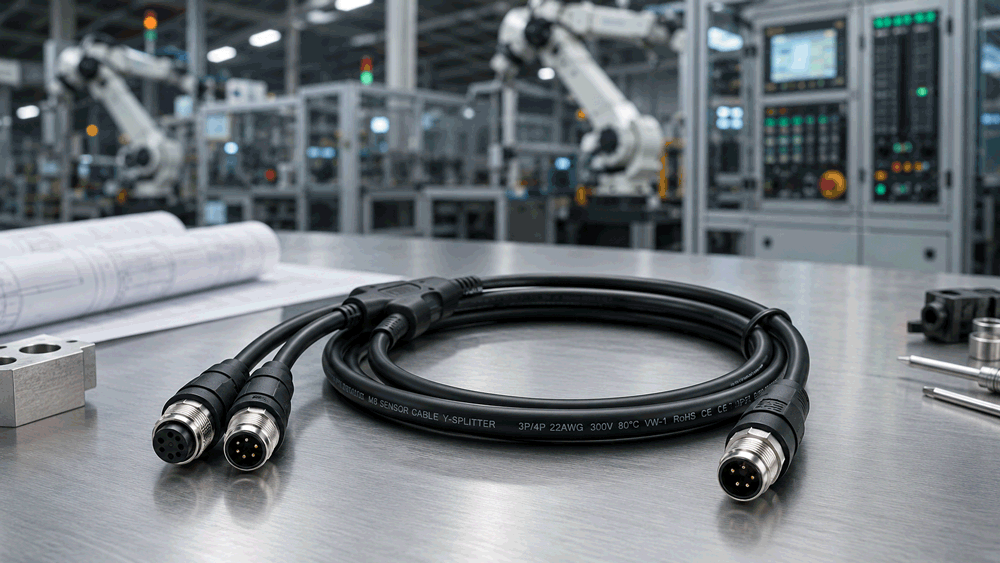
Sensor cable shielding is often requested when equipment has unstable signals, false triggers, noisy readings, or communication errors. But shielding is not simply adding a metal layer around a cable. For OEM projects, the shield type, grounding method, connector termination, cable routing, and test plan all affect whether the cable actually solves the problem.
For OEM buyers, the goal is not to ask for a “shielded cable” in a vague way. The goal is to define when shielding is needed, how the shield should be connected, how it should be built into the sensor cable assembly, and how it should be verified before production release.
Table of Contents
ToggleStart with EMI
Shielding should start with the noise problem, not with the material.
Many sensor cable assemblies work near motors, drives, pumps, switching power supplies, relays, solenoids, high-current cables, wireless modules, or other sources of electromagnetic interference. In these environments, an unshielded or poorly shielded sensor cable may cause unstable readings, false signals, intermittent faults, or difficult troubleshooting.
However, not every sensor cable needs shielding. If the signal is simple, the cable is short, and the installation environment is clean, shielding may add cost and complexity without much benefit. If the cable carries a low-level analog signal, encoder signal, measurement signal, or sensitive communication signal near electrical noise, shielding may be much more important.
OEM buyers should first define the real risk. Is the cable installed near a motor? Does it run parallel to power cables? Is the sensor output unstable during machine operation? Is the equipment used in an industrial cabinet, robotic system, agricultural machine, medical device, or outdoor monitoring unit? Does the cable move during operation?
These questions help the supplier understand whether shielding is a functional requirement or only a general preference. A capable sensor cable supplier should not only ask whether the cable is shielded, but also why shielding is needed and how the equipment will be grounded.
For broader sensor cable specification, buyers can also review Sensor Cable Assemblies for OEM Equipment.
Know the Signal
The signal type affects the shielding decision.
A sensor cable may carry digital switching signals, analog measurement signals, pulse signals, encoder signals, communication signals, or power and signal together. Each signal type has a different sensitivity to noise.
Analog signals are often more sensitive because small electrical noise can affect the measured value. Encoder or pulse signals may be affected by interference that creates false counts or unstable timing. Communication cables may need controlled structure and reliable shielding depending on the protocol and data rate. Simple on/off sensor signals may be more tolerant, but they can still be affected in harsh electrical environments.
When power and signal are combined in one cable assembly, layout becomes more important. If the power conductors generate noise or carry higher current, the signal conductors may need separation, twisting, shielding, or a different cable construction. In some designs, shielded pairs or twisted pairs are more suitable than a simple multi-core cable.
For OEM buyers, the RFQ should define the sensor output type and signal requirement when possible. If the buyer cannot share full electrical details, it is still useful to state whether the signal is analog, digital, pulse, data, or mixed power and signal.
The supplier should also know whether the signal is safety-critical, measurement-critical, or only general monitoring. A non-critical indicator cable may not need the same shielding attention as a cable used in precision measurement or machine control.
Choose Shield Type
Different shield structures serve different purposes.
Common shielding options include foil shield, braided shield, spiral shield, or a combination of foil and braid. The best choice depends on flexibility, noise environment, frequency range, cable diameter, cost, and manufacturing process.
Foil shielding usually provides good coverage and can be useful for many signal cable applications. It is often combined with a drain wire to make termination easier. However, foil may be less suitable for repeated movement if the cable flexes heavily.
Braided shielding provides mechanical strength and can perform well in many industrial applications. It may be more durable under movement than foil alone, but it can increase cable diameter, cost, and processing complexity.
A foil-and-braid combination can provide stronger overall shielding performance, but it may also make the cable more expensive and less flexible. This option should be used when the application risk justifies it.
For OEM buyers, the key point is simple: do not write “shielded cable” without enough detail when shielding is critical. The RFQ should define whether the supplier can select the shield structure, or whether a specific shield type is required.
If the project involves M8 or M12 sensor cables, buyers should also confirm whether the selected shield structure can be properly terminated inside the connector or molded structure. A good shield material is not useful if it cannot be connected consistently during assembly.
For related connector-based sensor cables, see M8 and M12 Sensor Cable Assemblies.
Use Drain Wires
A drain wire can make shield termination more practical and repeatable.
In many shielded sensor cables, the drain wire is placed in contact with the foil shield. It provides an easier way to connect the shield to ground or to a connector shell. Without a drain wire, the supplier may need a different method to terminate the shield, which can be more difficult or less consistent.
For OEM buyers, the drain wire should not be ignored. The RFQ should define whether a drain wire is required, where it should be connected, and whether it should be exposed, insulated, cut back, or connected to a specific pin or shell.
In some cable assemblies, the drain wire may connect to one side only. In others, it may connect through both ends. In some designs, the drain wire may be left unconnected at one end depending on the grounding strategy. These decisions should not be left to guesswork.
Drain wire treatment also affects workmanship. If the drain wire is too long, poorly insulated, or positioned incorrectly, it may create short-circuit risk or assembly inconsistency. If it is cut too short or not connected properly, shielding may not perform as expected.
For repeat production, drain wire handling should be documented in the work instruction. Inspectors should know what to check: length, connection point, insulation, soldering or crimping quality, and final position.
Define Grounding
Grounding is where many shielded sensor cable projects become unclear.
A shield can only work as intended when it is connected according to the system design. If the shield is not connected, poorly connected, or connected in the wrong way, it may not reduce noise effectively. In some cases, incorrect grounding can introduce new problems.
There is no single grounding method that fits every project. Some systems use single-end grounding to reduce ground-loop risk. Some systems use both-end grounding to improve high-frequency noise control. Some designs connect the shield to the connector shell. Others connect it to a specific ground pin, panel ground, or equipment chassis.
For OEM buyers, the grounding method should be defined by the equipment design team whenever possible. The cable supplier can help manufacture and verify the assembly, but the system-level grounding logic usually belongs to the equipment designer.
If the grounding method is not yet decided, the RFQ should say so clearly. The supplier can then help prepare options, such as shield connected to one end, shield connected to both ends, drain wire exposed at one end, or shield terminated to a metal connector shell.
The most important rule is to avoid silent assumptions. If the buyer assumes one grounding method and the supplier builds another, the sample may pass basic continuity checks but fail in the equipment.
Terminate Correctly
Shield termination is a production process, not only a design note.
Even if the shield type and grounding method are correct, poor termination can reduce performance and create quality risk. Shield termination may involve drain wire crimping, soldering, clamping, shell contact, conductive foil, heat shrink, overmolding, or connection to a specific terminal.
For small connectors, termination space may be limited. This is common in compact sensor cables, M8 connectors, board-side connectors, and molded assemblies. If the connector is too small or the cable is too thick, the shield may be difficult to terminate cleanly.
For waterproof sensor cable assemblies, shield termination may be even more complex. The supplier must maintain both electrical connection and sealing performance. Poor handling may damage the jacket, weaken the strain relief, or create leakage paths.
For OEM buyers, the drawing or production requirement should define the shield termination point. If the shield connects to the connector shell, this should be stated. If the drain wire connects to a pin, this should be shown in the pinout. If the shield is cut back and left floating at one end, this should also be defined.
For repeat production, termination quality should be inspected. The supplier should check connection consistency, mechanical stability, insulation clearance, and visual workmanship.
Control Routing
Shielding is not only a cable construction issue. Cable routing also affects noise performance.
A well-shielded sensor cable can still have problems if it is routed poorly in the equipment. If the cable runs tightly parallel to high-current power lines, motor cables, inverter cables, or switching devices, noise risk increases. If the cable is sharply bent, crushed, or installed near moving metal parts, mechanical damage may also occur.
OEM buyers should consider routing during sample testing. The cable should be tested in the real installation position, not only on a bench. A cable that works well in open air may behave differently when installed inside a cabinet or machine frame.
Separation from power cables can help reduce noise risk. Proper grounding points, stable connector mating, and clean cable routing can also support better signal stability. If the sensor signal is sensitive, routing should be part of the design review.
For moving applications, routing also affects shield durability. Repeated bending can damage foil shields, drain wires, or jacket structure if the cable is not designed for movement. If the cable is used on a robotic arm, mobile platform, sliding mechanism, or agricultural equipment, flexibility and bending radius should be discussed early.
A supplier can build the cable, but the buyer should validate routing in the equipment. This is why sample approval should include installation testing, not only electrical testing.
Test the Shield
Shielded sensor cables should be tested beyond basic continuity.
Continuity testing checks whether conductors are connected correctly, but it may not confirm whether the shield is terminated as required. For shielded sensor cable assemblies, the test plan should include shield continuity, drain wire connection, shell connection, insulation clearance, and visual inspection.
If the shield is connected to a connector shell, the supplier should verify that the connection is present and stable. If the drain wire connects to a pin, the test fixture should confirm the correct pin relationship. If the shield is connected only at one end, the test plan should confirm that the other end is not connected by mistake.
Short-circuit testing is also important. A drain wire or shield strand should not accidentally touch signal or power conductors. This is especially important in small connectors or tight assemblies.
For higher-risk projects, testing may also include insulation resistance or application-specific validation. In some cases, the buyer may need to test the cable inside the actual equipment to confirm noise performance. The cable supplier can verify construction, but system noise behavior often depends on the full machine design.
A clear inspection plan helps reduce batch variation. For related quality support, buyers can review Tests & Inspections and Quality Guarantee.
RFQ Checklist
A clear RFQ helps the supplier understand the shielding requirement before sample production.
| RFQ Item | What OEM Buyers Should Define |
|---|---|
| Sensor signal | Analog, digital, pulse, data, power + signal |
| Noise source | Motor, drive, pump, power cable, outdoor equipment |
| Shield type | Foil, braid, spiral, foil + braid, or supplier option |
| Drain wire | Required or not, connection point, treatment method |
| Grounding | One end, both ends, shell, chassis, or ground pin |
| Connector | Metal shell, plastic shell, M8, M12, board-side, custom |
| Termination | Shield to shell, drain to pin, cut back, insulated |
| Cable routing | Static, moving, drag, vibration, close to power cables |
| Testing | Shield continuity, short test, insulation, visual inspection |
| Records | Test report, batch record, inspection document |
If the buyer is unsure about some items, those points should be marked as “to be confirmed.” This allows the supplier to review the risk and propose practical options instead of making assumptions.
Avoid Mistakes
Many shielding problems come from unclear requirements.
One common mistake is asking for “shielded cable” without defining the grounding method. This may lead to different shield termination methods across samples and production batches.
Another mistake is assuming that shielding alone will solve all signal problems. If the equipment grounding is poor, cable routing is bad, or the sensor circuit is sensitive, shielding may only be one part of the solution.
A third mistake is not checking shield continuity. A cable may pass conductor continuity testing but fail to connect the shield correctly.
Drain wire handling is also a common risk. If the drain wire is exposed too much, it may create short-circuit risk. If it is not connected properly, shielding may not work as expected.
Connector choice can also create problems. Some plastic connectors may not support shell grounding. Some small connectors may not have enough space for clean shield termination. Some waterproof molded structures may make shield handling more difficult.
Finally, buyers sometimes approve a sample without documenting the shield construction. For repeat production, this creates risk. The approved drawing should define shield type, drain wire treatment, termination method, and test requirements.
Final View
Sensor cable shielding should be specified as part of the full equipment connection system, not as a simple material option.
For OEM buyers, the key questions are: what signal is being protected, what noise source exists, what shield type is needed, how the shield should be grounded, how it should be terminated, and how it should be tested. Without these answers, “shielded cable” remains too vague for reliable production.
A good sensor cable supplier should help review shielding requirements, confirm practical termination methods, control drain wire handling, and verify shield continuity during production. But the final grounding strategy should match the equipment design.
At Infinite Harness, we support custom shielded sensor cables, M8 and M12 sensor cable assemblies, waterproof sensor cables, and small-batch OEM cable assembly projects. If your sensor cable needs shielding, send us your drawing, connector requirement, signal type, application environment, and grounding notes. We can help review the specification and provide a manufacturable solution.
FAQ
What is sensor cable shielding?
Sensor cable shielding is a conductive layer or structure used to help reduce electromagnetic interference affecting sensor signals. It may include foil shield, braid shield, drain wire, or a combined shield structure.
When should a sensor cable be shielded?
A sensor cable should be shielded when the signal is sensitive, the cable runs near motors or power cables, or the equipment operates in a noisy electrical environment. Analog, encoder, pulse, and data signals often need more attention.
Is foil shield or braid shield better?
There is no single best option for every project. Foil shield can provide good coverage and is often used with a drain wire. Braid shield can provide better mechanical strength and may be more suitable for some industrial applications. The choice depends on signal, movement, cost, and environment.
Should the shield be grounded at one end or both ends?
It depends on the equipment grounding design and noise-control strategy. Some systems use single-end grounding to reduce ground-loop risk, while others use both-end grounding for high-frequency noise control. This should be defined by the equipment design team.
Is shield continuity testing necessary?
Yes, if shielding is a functional requirement. The supplier should verify shield connection, drain wire treatment, and short-circuit risk according to the approved drawing or test plan.
Related Articles
Sensor Cable Assemblies for OEM Equipment
M8 and M12 Sensor Cable Assemblies
Waterproof Sensor Cable Assemblies
Sensor Cable Assembly Test Plan
Sensor Cable Assembly Mistakes