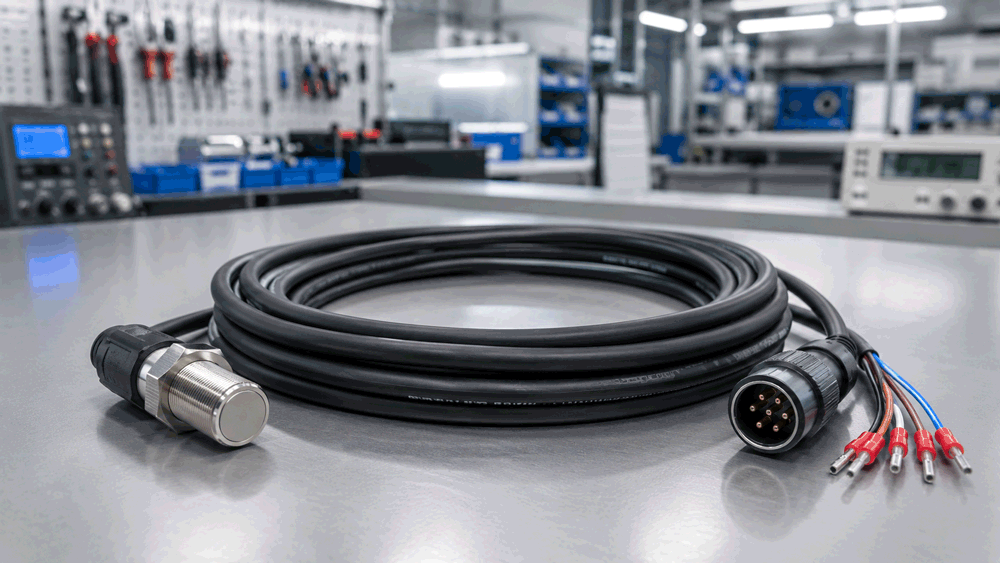
Sensor cable assemblies are small parts in many machines, but they can create large problems when they are poorly specified. A wrong connector, unclear pinout, weak shielding, stiff cable, or incomplete test plan can delay equipment assembly, create unstable sensor signals, or cause field failures after shipment.
For OEM buyers, sensor cable assemblies should not be treated as simple accessories. They should be defined as engineered connection parts that support signal stability, installation fit, environmental resistance, and repeatable production. This guide explains how engineering and procurement teams should specify sensor cable assemblies before sending an RFQ.
Table of Contents
ToggleStart with Sensors
The first step is to understand what type of sensor the cable assembly will support.
Sensor cable assemblies may be used with proximity sensors, photoelectric sensors, pressure sensors, temperature sensors, flow sensors, position sensors, encoders, medical sensors, agricultural sensors, or industrial monitoring devices. Each sensor type may have different requirements for signal type, connector interface, shielding, cable flexibility, and environmental protection.
A cable used for a simple switch signal is different from a cable used for analog measurement or high-speed data. A sensor cable inside a clean cabinet is different from one installed on outdoor machinery. A cable connected to a moving robotic arm is different from one fixed inside a static control box.
This is why the RFQ should not begin only with length and connector photos. It should begin with the sensor application. OEM buyers should explain what the sensor does, where it is installed, whether the cable moves, what environment it faces, and how important signal stability is to the equipment.
For example, a sensor cable used near motors, drives, or power cables may need shielding or better grounding control. A sensor cable used on outdoor equipment may need waterproof connectors, UV-resistant jacket material, or stronger strain relief. A sensor cable used in compact medical or electronic equipment may need a smaller diameter, higher flexibility, and clean routing.
The supplier does not need every engineering detail at the first discussion, but the more clearly the application is described, the easier it becomes to choose the right materials, connectors, and test plan.
Define the Signal
Sensor cable assemblies should be specified according to the signal they carry.
Some sensor cables carry low-voltage digital signals. Some carry analog signals that may be sensitive to electrical noise. Some carry power and signal together. Some may include shielded pairs, twisted pairs, or multiple conductors in one jacket. Without understanding the signal, the supplier may only copy the cable structure without knowing whether it is suitable for the real application.
For OEM projects, the drawing or RFQ should define voltage, current, signal type, conductor count, wire gauge, pinout, shielding requirement, and grounding method if available. If the buyer is not sure about all details, it is still useful to mark the uncertain items for supplier review.
Pinout is one of the most important items. Sensor cables often use small connectors with several pins, and the external appearance of the cable may not reveal the internal wiring. Two cable assemblies can look identical but have different pin assignments. If the pinout is wrong, the sensor may fail to communicate, send unstable signals, or damage equipment.
Wire color should also be controlled. In some projects, wire color helps technicians install and troubleshoot the system. If wire colors change between sample and production without approval, field service and internal assembly work may become more difficult.
For signal-sensitive applications, shielding should not be treated as a vague requirement. The buyer should define whether shielding is needed, whether the shield should connect to one end or both ends, and whether a drain wire is required. If this information is not available, the supplier should raise it during design review instead of making silent assumptions.
Choose Connectors
Connectors are often the most visible part of a sensor cable assembly, but they are also one of the most common sources of project risk.
Sensor cable assemblies may use M8 connectors, M12 connectors, circular connectors, waterproof connectors, board-side connectors, molded plugs, terminal blocks, or customer-specific interfaces. The correct connector depends on electrical rating, pin count, locking method, sealing level, installation space, mating interface, and availability.
For industrial automation, M8 and M12 sensor cable assemblies are common because they support compact installation and reliable field connection. However, buyers should still define the coding, pin count, male or female interface, straight or angled style, cable exit direction, and shielding requirement. A connector that looks similar may not mate correctly if the coding or pin arrangement is different.
Connector availability is also important. Some connectors are easy to source, while others may have long lead times or high minimum order quantities. If a project needs small-batch production, the supplier should confirm whether the selected connector is practical for prototype and pilot builds.
For waterproof sensor cable assemblies, connector sealing must be reviewed carefully. A waterproof connector alone does not guarantee the whole cable assembly is waterproof. The sealing structure also depends on cable jacket diameter, rear nut compression, grommet fit, overmolding quality, heat shrink, and strain relief design.
If the sensor cable needs to be connected and disconnected frequently, the connector’s mechanical durability should also be considered. Locking structure, mating cycle, thread quality, and strain relief can all affect field reliability.
For buyers who need broader custom support, the connector decision can be linked with the overall design on our Custom Cable Assemblies page.
Select Cable
The cable itself should match the working condition, not just the lowest material cost.
For sensor cable assemblies, buyers should consider conductor size, conductor count, insulation material, outer jacket, shielding, flexibility, diameter, bending radius, temperature range, and exposure to oil, moisture, abrasion, or chemicals.
PVC cable may be suitable for many indoor and standard industrial applications. PUR cable may be considered when better abrasion resistance, flexibility, or oil resistance is required. For harsh environments, the jacket material should be selected according to actual exposure, not only based on a general preference.
Cable flexibility is especially important when the sensor cable is installed on moving equipment. A cable that works well in a static cabinet may not survive repeated bending, vibration, or drag movement. If the cable is used near robotic arms, moving platforms, automated machines, or agricultural equipment, bending conditions should be discussed early.
Cable diameter also matters. A thicker cable may provide stronger protection, but it can create routing problems in compact equipment. A smaller cable may be easier to install, but it may have less mechanical strength or fewer shielding options. For OEM products, the best choice is usually a balance between performance, installation space, cost, and manufacturability.
For shielded sensor cables, the cable construction should match the signal requirement. Foil shielding, braid shielding, drain wire, twisted pairs, and shield coverage can all affect performance and production cost. If a buyer simply writes “shielded cable” without further detail, the supplier may need to clarify the expected performance and grounding method.
Control Shielding
Shielding is one of the most important design points for sensor cable assemblies used in industrial environments.
Sensors often work near motors, drives, pumps, power cables, switching devices, and other sources of electromagnetic interference. If the signal is sensitive and the cable is not properly shielded, the equipment may show unstable readings, intermittent errors, false triggering, or difficult-to-diagnose failures.
However, shielding should be designed carefully. Adding shielding does not automatically solve every noise problem. The shield type, grounding method, connector termination, drain wire, and cable routing all affect the result.
For OEM buyers, the first question is whether shielding is truly required. If the sensor signal is low-level analog, high precision, or installed near noise sources, shielding may be important. If the signal is simple and the cable is short and protected, shielding may not be necessary.
The second question is how the shield should be connected. In some applications, single-end grounding may be used to reduce ground-loop risk. In other applications, both-end grounding may be required for better high-frequency noise control. The correct approach depends on system design, equipment grounding, and sensor requirements.
The third question is how the shield is handled during assembly. A shield that is cut too short, poorly terminated, or not connected consistently may not provide the expected performance. For repeat production, the supplier should define the shielding process clearly in the work instruction.
If shielding is a major concern for your project, it is useful to connect the sensor cable specification with the broader design logic in Shielded Cable Assemblies.
Plan Protection
Many sensor cable assemblies are exposed to physical stress, moisture, dust, oil, vibration, or outdoor conditions.
Protection should be planned according to the real installation environment. A sensor cable inside a control box may only need neat routing and stable termination. A sensor cable on outdoor machinery may need waterproof connectors, UV-resistant jacket, stronger strain relief, and better abrasion protection.
Waterproofing is a common request, but it should be defined more carefully. Buyers should clarify whether the cable needs splash resistance, temporary immersion resistance, outdoor rain protection, washdown resistance, or long-term sealing in a harsh environment. These conditions are not the same.
The waterproof structure may include molded connectors, sealed rear ends, rubber gaskets, heat shrink, overmolding, or suitable jacket material. But the final performance depends on the full assembly structure. If the connector, cable jacket, seal, and strain relief do not match, the waterproof design may fail.
Vibration is another common issue. Sensor cables used on vehicles, mobile equipment, agricultural machines, or industrial machines may face repeated vibration. In these applications, the assembly should avoid weak strain relief, loose connectors, unsupported cable exits, and poor crimping.
Abrasion should also be considered. If the cable touches a metal edge, moving part, or rough surface, the jacket may wear over time. Protective sleeving, routing clips, grommets, or stronger jacket materials may be needed.
Build Samples
Samples should be used to verify more than appearance.
In many OEM projects, the first sensor cable sample is used only to check whether the connector fits and whether the cable length looks right. This is not enough. A sample should also verify pinout, signal stability, routing, bending, connector locking, label position, strain relief, and installation convenience.
The sample stage is the best time to find small problems. The cable may be too stiff. The connector may point in the wrong direction. The label may be hidden after installation. The cable may be too short after routing. The shield connection may not match the equipment grounding method. These problems are much easier to fix before pilot production.
OEM buyers should test the sample in the real equipment whenever possible. Bench testing can confirm electrical continuity, but installation testing can reveal routing and mechanical problems. If the cable will be used in a moving part, movement should be checked. If it will be used outdoors, sealing and jacket suitability should be reviewed.
Feedback should be specific. Instead of saying “the sample does not fit well,” it is better to mark the issue on the drawing, provide photos, and explain the required change. This helps the supplier revise the drawing and reduce misunderstanding.
After sample approval, the supplier should update the controlled drawing or specification. The approved sample should not be the only production reference. For repeat orders, drawing control is essential.
For sample-to-production workflow, buyers can also review our Prototype to Production Guide.
Test Correctly
Testing should match the risk level of the sensor cable assembly.
Basic continuity testing is useful, but it does not cover every risk. A sensor cable may pass continuity testing but still fail because of wrong shielding, weak crimping, poor sealing, incorrect label, or unstable connector mating.
A practical sensor cable test plan may include continuity, pinout, short-circuit check, polarity check, shield continuity, insulation resistance, connector fit, pull force, visual inspection, label check, and dimensional inspection. The exact test plan depends on the application.
For waterproof sensor cables, sealing-related checks may be required. For shielded sensor cables, shield connection should be verified. For high-reliability applications, pilot production should include repeatability checks, process inspection, and test records.
Testing should also be connected with production stage. Incoming materials should be checked before assembly. Crimping quality should be controlled during production. Final electrical testing should be done before shipment. Visual and dimensional inspections should confirm that the finished assembly matches the approved drawing.
The test plan should be clear before mass production. If the buyer expects specific test reports, sampling rules, or inspection records, these requirements should be included in the RFQ or purchase documents.
For more information on inspection support, buyers can refer to Tests & Inspections and Quality Guarantee.
Prepare RFQ
A good RFQ helps the supplier quote faster and build the sample more accurately.
For sensor cable assemblies, the RFQ should not be limited to “please quote this cable.” It should include enough technical and commercial information for the supplier to judge material selection, connector sourcing, process requirements, testing, and lead time.
| RFQ Item | What to Define |
|---|---|
| Sensor application | Sensor type, equipment type, installation location |
| Signal | Digital, analog, power + signal, shielded signal |
| Connector | Model, coding, pin count, male/female, straight/angled |
| Cable | Wire gauge, conductor count, jacket, shielding, flexibility |
| Environment | Indoor, outdoor, oil, moisture, abrasion, vibration |
| Protection | Waterproofing, strain relief, sleeving, overmolding |
| Testing | Continuity, pinout, shield, insulation, pull force |
| Quantity | Prototype, pilot run, annual forecast |
| Labels | Part number, serial number, barcode, direction mark |
| Packaging | Individual bag, kit packing, bulk packing |
If some information is not available, the buyer can mark it as “to be confirmed.” This is better than leaving it blank. A capable supplier can then review the missing items and suggest practical options.
For small-batch OEM projects, quantity information is also important. The supplier may choose different connector sourcing, tooling, packaging, and inspection methods depending on whether the order is for 20 pieces, 200 pieces, or 5,000 pieces per year.
Avoid Risks
Most sensor cable problems come from unclear specifications, not from the cable itself.
One common risk is unclear pinout. If the drawing does not define pin assignment clearly, the supplier may misinterpret the wiring. This can cause sensor failure or equipment damage.
Another risk is choosing a connector by appearance only. Similar-looking connectors may have different coding, pin layout, locking structure, or sealing performance. Buyers should use exact part numbers whenever possible.
Shielding mistakes are also common. If the shield is not connected correctly, the cable may not reduce noise as expected. In some cases, poor grounding may even create new problems.
Cable stiffness can also become a project issue. If the cable is too rigid, it may be difficult to install in compact equipment or may put stress on the sensor connector. This is especially important in small machines, handheld devices, medical equipment, and moving systems.
Waterproofing can be misunderstood as well. A waterproof connector does not automatically make the whole assembly waterproof. The complete assembly structure must support the required sealing level.
Testing risk should not be ignored. If the test plan only checks continuity, other defects may pass into production. For OEM projects, the test plan should match the application risk.
Final View
Sensor cable assemblies should be specified as functional parts of the equipment, not generic connection cables.
For OEM buyers, the most important work happens before sample production. The RFQ should define the sensor application, signal type, connector, pinout, cable material, shielding, protection, testing, quantity, and approval process. When these details are clear, the supplier can quote more accurately, build better samples, and support smoother pilot production.
A capable sensor cable assembly supplier should not only manufacture according to drawings. It should also help review incomplete specifications, identify hidden risks, suggest practical materials, and support the transition from prototype to production.
At Infinite Harness, we support custom sensor cables, OEM cable assemblies, and small-batch wire harness projects for industrial equipment, automation systems, medical devices, agricultural machines, and electronic products. If you need sensor cable assemblies for your equipment, send us your drawing, connector requirement, application notes, sample photos, and target quantity. We can help review the specification and provide a practical manufacturing solution.
FAQ
What are sensor cable assemblies?
Sensor cable assemblies are custom cables used to connect sensors with control systems, equipment, circuit boards, or external devices. They may carry power, signal, data, or mixed circuits depending on the sensor application.
What should buyers define first?
Buyers should first define the sensor type, signal type, installation environment, connector interface, pinout, cable length, shielding requirement, and testing needs. These details help the supplier select the right materials and process.
When should a sensor cable be shielded?
Shielding should be considered when the sensor signal is sensitive, the cable is installed near motors or power cables, or the equipment environment has electromagnetic noise. The grounding method should also be defined.
Are M8 and M12 sensor cables customizable?
Yes. M8 and M12 sensor cable assemblies can be customized by pin count, coding, cable length, straight or angled connector style, shielding, jacket material, and waterproof requirements.
Is continuity testing enough?
Continuity testing is useful but often not enough. Sensor cable assemblies may also need pinout checks, short-circuit tests, shield continuity, insulation resistance, pull force checks, connector fit checks, and visual inspection.
Related Articles
M8 and M12 Sensor Cable Assemblies
Sensor Cable Shielding Guide
Waterproof Sensor Cable Assemblies
Sensor Cable Assembly Test Plan
Sensor Cable Assembly Mistakes