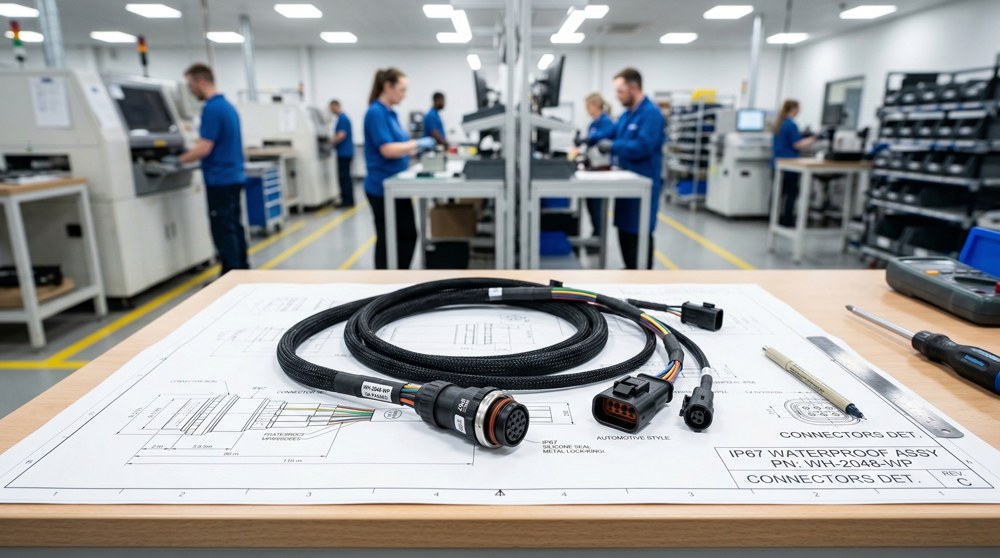
Custom power cords are often treated as simple accessories, but in OEM equipment they are part of the power-delivery system. A poorly specified cord can create heat risk, installation problems, certification delays, field failures, or repeated supplier clarification before the first sample is even built. A well-specified cord, on the other hand, helps the equipment receive power safely, fit the target market, survive the working environment, and pass incoming inspection with fewer surprises.
This is why custom power cords should not be defined only by length, plug type, and cable color. Buyers need to define the load, rating, wire gauge, insulation, termination method, grounding, strain relief, working environment, test plan, and production expectations. Your Custom Power Cord page already positions this product category around low- and high-voltage power harnesses, heat-resistant insulation, secure crimping, and full electrical testing for industrial machines, electric vehicles, energy storage systems, and heavy-duty electronics. That is the right commercial direction because OEM buyers are usually not buying a generic cord. They are buying a controlled power path.
Table of Contents
ToggleStart with Load
The first question is not “How long is the cord?” It is “What load must this cord support?” Voltage, current, power level, duty cycle, startup behavior, and operating temperature all influence the correct cable and termination design. Interpower’s power cord guidance makes this point clearly: voltage and amperage requirements are critical when selecting a cord or cord set, and amperage can affect both plug pattern and cable size.
For OEM buyers, this means a quotation request should explain what the power cord is actually feeding. A cord used for a small control device is not the same as a cord used for a heater, inverter, battery system, motor-driven unit, outdoor machine, or high-power appliance. Even if two cords look similar from the outside, their electrical and thermal requirements can be very different.
A good RFQ should state whether the load is continuous or intermittent, whether the equipment has a high startup current, and whether the cord is used as an external power input, an internal power harness, or a subassembly connection. These details let the supplier understand whether the design should prioritize current capacity, flexibility, heat resistance, compact routing, field-service durability, or compliance with market-specific power standards.
Define the Rating
A power cord rating is not decided by the strongest component. It is limited by the weakest one. Interpower explains that a power cord or cord set is rated by the lowest-rated component in the path, whether that component is the plug, cable, or connector. If one component is rated lower than the others, the whole cord set takes that lower rating.
This matters because OEM buyers sometimes focus on the cable size while under-defining the plug, connector, terminal, or molded end. That can create a false sense of safety. A heavier cable cannot compensate for a connector with a lower current rating. A suitable plug cannot fix an undersized cable. A good crimp cannot solve a mismatched terminal or poor contact interface.
The RFQ should therefore define the target rating for the complete assembly, not just the raw cable. The supplier should confirm that the plug, connector, conductor size, terminals, insulation, grounding method, and strain relief are consistent with that rating. If the final equipment will be sold into different markets, the rating logic should also be checked against the plug and cord-set requirements for those markets.
Choose Wire Gauge
Wire gauge should come from the load requirement, not from habit or price alone. If the conductor is too small, the power cord may suffer from heat rise, voltage drop, or premature aging. If the conductor is larger than needed, the cord may become too stiff, expensive, or difficult to route inside equipment. This is a practical engineering balance rather than a one-direction choice.
Interpower notes that amperage affects cable size, which is why the current requirement should be one of the earliest inputs in the specification. For OEM buyers, this means wire gauge should not be finalized after the supplier quotes the cheapest available construction. It should be selected after the supplier understands the current, voltage, duty cycle, operating temperature, and installation condition.
For example, a cord running in open air may behave differently from one routed inside a hot enclosure. A cord used in a movable machine may need more flexibility than one installed once and left untouched. A cord used in a compact device may need a smaller outer diameter, but that should not be achieved by sacrificing electrical margin. When the buyer provides the real equipment conditions, the supplier can make a more defensible wire-gauge recommendation.
Select Materials
Insulation and jacket material determine how the power cord behaves in the real working environment. They influence flexibility, heat resistance, oil resistance, abrasion resistance, chemical resistance, flame behavior, and service life. LAPP’s cable guide shows that cable materials are selected for different performance needs, including abrasion resistance, cut resistance, rubber flexibility, oil resistance, and halogen-free requirements.
This is where many OEM RFQs are too thin. Buyers may say “black jacket” or “PVC cable” without explaining what the cord will face. That is not enough for industrial equipment. A power cord near cutting oil, motors, compressors, heaters, outdoor cabinets, battery systems, charging equipment, or cleaning chemicals needs a material discussion, not just a color and length discussion.
The material requirement should describe the environment first. Will the cord see oil, water, dust, abrasion, high temperature, outdoor UV, repeated bending, cleaning agents, or cable bundling? Will it be stationary, occasionally moved, or frequently handled? Does the product require halogen-free material, flame-retardant behavior, low-temperature flexibility, or high-temperature endurance? Once those inputs are clear, the supplier can recommend a more suitable insulation and jacket system.
Match the Market
Power cord design is strongly affected by the target market. A product sold in North America may not use the same plug, rating assumptions, approval path, or frequency environment as a product sold in Europe, Australia, Japan, or another region. Interpower’s country-specific power cord guidance starts with the export country, then moves to rating, cable choice, and connector choice; it also notes that North America differs from much of the world in voltage, amperage, and frequency.
For OEM buyers, this means target market is not just a sales detail. It belongs in the technical RFQ. If the same equipment platform will be sold into several regions, the buyer should say so early. That may affect plug options, detachable cord-set strategy, labeling, documentation, and inventory planning.
This is also where a custom power cord supplier can help reduce SKU confusion. Instead of treating every market version as a separate last-minute request, buyers can build a regional cord plan around the equipment platform. This is especially useful for small and medium OEMs that need flexibility, low minimum order quantities, and practical support during early market development.
Define Terminations
The power cord termination is where many quality problems begin. A cord may use a molded plug, IEC connector, crimped terminal, ring terminal, spade terminal, quick disconnect, appliance connector, internal board connector, or customer-specific interface. Each choice affects rating, assembly method, serviceability, and reliability.
Your Custom Power Cord page emphasizes secure crimping and full electrical testing, which is exactly the right focus. The RFQ should define the termination style clearly, including connector type, terminal series, polarity, grounding, pinout, orientation, and whether the cord is detachable or permanently installed. If the power cord connects to a panel, enclosure, battery pack, inverter, power supply, or internal harness, the mating interface should be documented as early as possible.
The buyer should also define whether the termination will be installed at the factory, connected by the end user, or serviced later. A factory-installed terminal can be optimized differently from a field-service connector. A connector that is easy to assemble may not be ideal for repeated service. A terminal that fits mechanically may still be wrong if the pull strength, creepage distance, clearance, or contact area is not suitable for the equipment requirement.
Control Heat
Heat is one of the most important risks in power cord design because it often appears after a sample “works.” A cord can pass continuity and still run too warm under real load, especially if the conductor is undersized, the connector has poor contact resistance, the cable is tightly bundled, or the environment is hotter than expected.
This is why buyers should define operating temperature, duty cycle, enclosure conditions, and routing conditions. A power cord used in open air is not the same as one inside a sealed equipment cabinet. A cord routed near a heater, motor, power supply, inverter, compressor, or battery system may need a different material and rating strategy. Your Electric Wire Harness page already positions custom electric harnesses around safe and efficient power distribution, including high-voltage harnesses for industrial equipment and compact power connections for smart devices. That same logic applies directly to power cords.
Heat risk also connects to termination quality. Loose crimps, poor contact surfaces, weak strain relief, or underspecified terminals can create localized heating even when the conductor itself is large enough. That is why a power cord specification should treat conductor size, terminal selection, crimp quality, strain relief, and testing as one system.
Plan Testing
A custom power cord should have a test plan before samples are approved. At minimum, buyers should define continuity, polarity, visual inspection, dimensional inspection, and any application-specific checks such as insulation resistance, dielectric testing, pull-force testing, or strain-relief inspection. Your Tests & Inspections page already lists pull-force testing, continuity and short testing, crimp inspection, and other inspection methods as part of cable assembly quality control.
The phrase “100% tested” is not enough. It can mean different things to different suppliers. One supplier may mean continuity only. Another may include polarity, insulation, visual inspection, and pull-force sampling. A buyer who does not define the test scope may receive a product that passes the supplier’s internal interpretation but does not satisfy the equipment risk.
A stronger test plan separates prototype approval, pilot validation, and production release. During prototype approval, the buyer should confirm that the electrical design, termination method, fit, routing, and material choice are correct. During pilot validation, the buyer should check repeatability: crimp consistency, dimensions, marking, polarity, and test records. During production, the buyer should define routine release checks and traceability expectations. Your Prototype to Production Guide makes a similar point: validation should be proportional to risk, and the evidence should become a reusable baseline.
Check Strain Relief
Strain relief is often treated as a mechanical detail, but in power cords it is a reliability feature. A cord that is pulled, bent, dragged, handled, or serviced can transfer stress directly into the termination area if the strain relief is weak. Over time, that can create conductor breakage, terminal loosening, insulation damage, or intermittent faults.
The RFQ should define whether the cord will be stationary, moved occasionally, dragged during use, flexed during service, or installed in a tight enclosure. A cord used inside equipment may need a different strain-relief design from a cord used as an external cable. A molded strain relief may be useful for some applications, while a clamp, boot, grommet, or mechanical anchoring feature may be better for others.
Testing should reflect the risk. Pull-force testing, crimp inspection, and visual checks are not only production formalities. They help prove that the termination can survive expected handling. This is especially important for small-batch OEM programs because one failure in a demo unit, pilot build, or first customer shipment can create a disproportionate commercial impact.
Think About Routing
Power cords do not exist in open space. They are routed through housings, panels, battery compartments, control boxes, appliances, machinery, charging systems, or industrial equipment. Routing affects bend radius, heat buildup, abrasion exposure, service access, and assembly time.
A buyer should define where the cord enters and exits the equipment, whether it passes through a panel, whether it needs a grommet or sealing feature, whether it is tied to other cables, and whether it must avoid hot or moving parts. If the cord is part of a larger assembly, the buyer should also connect it to the broader harness design. Your Custom Cable Assemblies page positions power and energy equipment assemblies for inverters, batteries, and solar systems where high current and outdoor exposure matter. That makes routing and environmental exposure part of the design, not a production afterthought.
Clear routing details also help avoid overengineering. If a cord is protected inside a stable enclosure, it may not need the same jacket, flexibility, or mechanical protection as a cord used outdoors or near moving equipment. Good sourcing is not always about choosing the strongest possible construction. It is about choosing the right construction for the real risk.
Manage Documentation
Power cord sourcing often fails because documentation is incomplete. A buyer may provide a photo, a rough length, and a target price, but not the rating, market, wire gauge, terminal details, or test expectations. That forces the supplier to guess. In custom manufacturing, guessed specifications often create sample churn, late changes, and price revisions.
Useful documentation should include the equipment application, electrical load, target market, rating, conductor size, insulation and jacket expectations, termination drawings or part numbers, grounding, polarity, length reference, strain relief, labeling, packaging, and test records. Your Quality Guarantee page emphasizes that quality is built into every step from wire prep to final inspection, and that each order is treated with care because one faulty harness can cause delay, cost, or loss of trust.
This is especially important for repeat orders. A custom power cord should not depend on memory. Once the prototype is approved, the build specification, sample photos, test data, revision history, and packaging details should become a controlled baseline for future production.
Reduce Sourcing Risk
For OEM buyers, the value of a custom power cord supplier is not only production. It is also interpretation. Many buyers know the equipment requirement but do not have every cable detail finalized. A capable supplier should help convert load, market, routing, and environmental conditions into a practical build specification.
This is particularly relevant for small-batch OEMs, pilot builds, and new product introduction. Your homepage and capabilities pages position Infinite Harness around flexible OEM wire harness solutions, small-batch orders, custom cable assemblies, and responsive support. That is a useful differentiator for power cord projects because buyers often need help before the RFQ is fully mature.
The goal is not to overcomplicate every power cord. The goal is to remove hidden assumptions before they turn into heat problems, wrong-market cords, weak terminations, failed inspection, or late-stage sourcing changes. A clearer RFQ usually creates a more stable quote, a better sample, and a smoother path to production.
RFQ Checklist
A practical custom power cord RFQ should answer these questions:
| RFQ item | What to define |
|---|---|
| Application | Equipment type and power role |
| Load | Voltage, current, power, duty cycle |
| Market | Target country or region |
| Rating | Required cord or assembly rating |
| Wire | Gauge, conductor count, grounding |
| Material | Insulation, jacket, heat, oil, abrasion |
| Termination | Plug, connector, terminal, polarity |
| Routing | Length, entry point, bend, enclosure |
| Protection | Strain relief, grommet, sealing, overmold |
| Testing | Continuity, polarity, insulation, pull, records |
| Commercial | Prototype, pilot, volume, lead time |
This table is not a substitute for engineering review, but it gives buyers a clean starting point. If most of these items are answered before quotation, the supplier can quote with fewer assumptions and build the first sample with much higher confidence.
Final View
Custom power cords should be specified as power-delivery assemblies, not as commodity accessories. The buyer needs to define the electrical load, complete rating path, conductor size, insulation system, termination method, target market, heat conditions, routing, strain relief, testing, and documentation before expecting an accurate quote or reliable sample.
For OEM buyers, the practical rule is simple: start with the equipment requirement, then build the cord specification around it. A custom power cord is successful when it fits the product mechanically, supports the load electrically, survives the environment, matches the target market, and can be tested and repeated in production.
When those inputs are clear, the supplier can do more than provide a cable. They can help build a safe, stable, production-ready power path for the equipment.
FAQ
What should buyers define first for custom power cords?
Start with the equipment load, including voltage, current, power level, duty cycle, and target market. These inputs drive the cable size, plug or connector choice, rating, material selection, and test plan.
Why does wire gauge matter?
Wire gauge affects current capacity, heat rise, voltage drop, flexibility, cost, and routing behavior. The right gauge should be selected from the load and installation condition, not from price alone.
Can one component limit the whole cord rating?
Yes. A power cord or cord set is rated by its lowest-rated component, such as the plug, cable, or connector.
How should buyers choose insulation?
Buyers should define the working environment first, including heat, oil, abrasion, chemicals, UV exposure, cleaning agents, and movement. Jacket materials are selected for different performance properties such as abrasion resistance, oil resistance, and flexibility.
What should be in a power cord test plan?
A practical test plan should define continuity, polarity, visual inspection, dimensional checks, and any required insulation, dielectric, pull-force, or strain-relief checks.
CTA
If your equipment needs a custom power cord, do not start with only a length and connector photo. Define the load, market, rating, insulation, terminations, routing, and test plan first so the supplier can build the right power path from the first sample. For related capabilities, see Custom Power Cord, Electric Wire Harness, Tests & Inspections, Quality Guarantee, and Prototype to Production Guide.