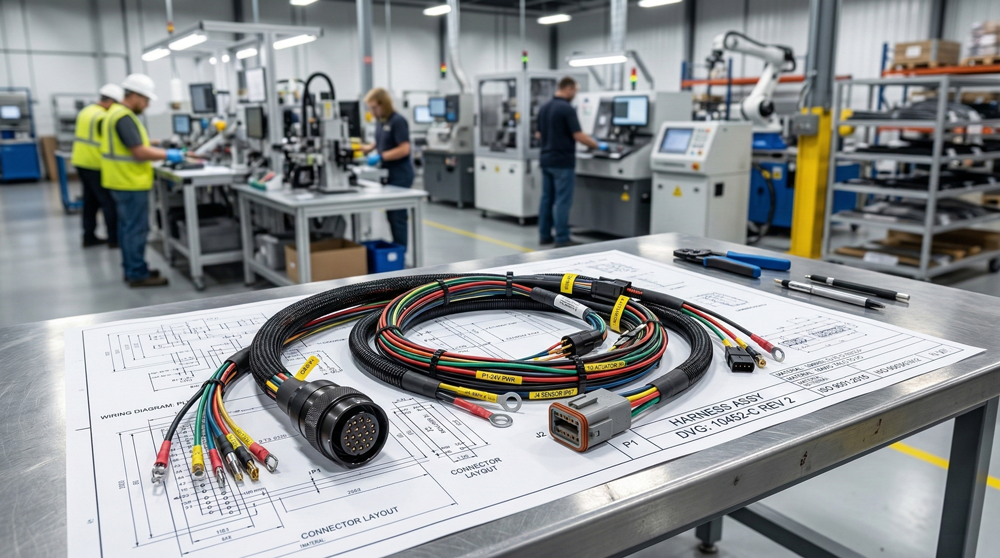
A power cord test plan should do more than confirm that a cord is electrically connected. In OEM equipment, the real purpose is to prove that the cord is safe, correctly wired, properly terminated, suitable for the target rating, and repeatable in production. A cord can pass a simple continuity check and still carry hidden risks if polarity is wrong, insulation is weak, strain relief is poor, markings are unclear, or the termination does not match the load.
This is why OEM buyers should define testing before approving samples, not after production problems appear. Your Custom Power Cord page already positions this product category around heat-resistant insulation, secure crimping, and full electrical testing. A good test plan turns that quality promise into specific checks, records, and release criteria.
Table of Contents
ToggleTest by Stage
The first mistake is treating all testing as one activity. Prototype testing, pilot validation, and production release should answer different questions. Prototype testing asks whether the design is right. Pilot testing asks whether the supplier can repeat the build. Production testing asks whether released units are screened against the most likely failure modes.
For a custom power cord, prototype approval should confirm rating logic, conductor size, insulation material, termination method, polarity, grounding, fit, routing, strain relief, and test scope. Pilot validation should confirm that multiple units can be built consistently with the same crimp quality, dimensions, markings, and electrical results. Production release should define which checks are performed on every cord and which are verified by sampling, first article, or lot records.
This staged approach is especially important for OEM programs because many power cord problems are not caused by total electrical failure. They come from weak termination, wrong market version, poor strain relief, unclear labeling, material substitution, or inconsistent assembly process. Your Prototype to Production Guide is a natural internal link here because power cord test planning should support the same transition from sample approval to repeatable manufacturing.
Start with Continuity
Continuity is the basic starting point. It confirms that the assembly is wired from one end to the other without an open circuit. Interpower describes continuity testing as a way to confirm the assembly is wired correctly and that there are no breaks in the wire from one end to the other.
For OEM buyers, continuity should be required, but it should not be the whole test plan. A power cord can show continuity and still be wrong if line, neutral, and ground are not assigned correctly. It can also pass continuity while having weak crimp strength, poor insulation, incorrect markings, or an unsuitable plug for the target market.
A stronger RFQ should state that continuity is required on the finished assembly and should define whether the supplier must test every unit, every sample, or specific production lots. For most OEM power cord programs, continuity should be a routine production check, not just a prototype check.
Check Polarity
Polarity testing verifies that each conductor is connected to the correct terminal or contact. This is critical for cord sets, equipment inputs, grounded systems, and region-specific plug configurations. Interpower’s international cord information says polarity and continuity are checked on each conductor to ensure line connects to line, neutral to neutral, and ground to ground.
For OEM buyers, polarity errors can be more serious than open circuits because the product may look assembled and may even power on under limited conditions. Wrong polarity can create safety, service, troubleshooting, or compliance problems. This is especially important when a cord has multiple regional versions, detachable connectors, molded ends, or internal equipment terminals.
The RFQ should define conductor color, terminal assignment, plug orientation, connector pinout, grounding location, and any labels or markings required for assembly and inspection. If the power cord connects into a larger Electric Wire Harness, polarity should be checked against the full equipment wiring logic, not only the cord itself.
Verify Grounding
Ground continuity or ground bond testing is important when the cord includes a protective earth conductor. Interpower’s international cord information states that ground continuity is determined at 25A for its listed test process. A broader electrical safety testing guide explains that ground continuity testing is used to ensure that safety ground connections have been made properly.
For OEM equipment, grounding should not be treated as a paperwork detail. The ground path may be part of the user’s protection against electric shock or fault conditions. If the ground conductor, plug, terminal, crimp, or enclosure connection is weak, the cord may pass simple continuity but still be unsuitable for safety-critical use.
Buyers should define when ground continuity or ground bond testing is required, especially for metal enclosures, grounded equipment, industrial machines, power supplies, energy systems, and high-power devices. If the power cord is part of a panel or cabinet, the grounding check should be aligned with the equipment-level safety plan.
Use Hipot Correctly
Hipot or dielectric withstand testing is used to verify insulation integrity under high voltage stress. UL describes the dielectric voltage withstand test as placing an extra-high voltage across an insulation barrier; if the insulation holds, the device passes, while breakdown indicates insufficient insulation and possible shock hazard. Interpower’s international cord information also lists high-voltage breakdown testing between primary conductors and ground conductor.
For custom power cords, hipot testing may be relevant when the application requires insulation integrity verification, higher voltage confidence, safety approval support, or production screening. It is especially important when the cord has molded plugs, overmolded connectors, crimped terminals, exposed transitions, or material choices that must be validated.
Buyers should not simply write “hipot test required” without defining the requirement. The test voltage, duration, leakage limit, test points, production frequency, and applicable standard or customer requirement should be clear. If the buyer does not know the exact parameters, the RFQ should ask the supplier to propose the appropriate test plan based on the rating and application.
Inspect Terminations
Termination quality is one of the most important power cord risks. A cord may use molded plugs, IEC connectors, ring terminals, spade terminals, quick disconnects, appliance connectors, internal equipment plugs, or custom interfaces. Each termination type creates its own inspection needs.
Interpower notes that pull testing ensures that a quality crimp exists, and that plugs, connectors, and cable are visually inspected for surface quality, molding flash, and markings. This matters because termination defects can produce heat, intermittent power loss, weak retention, incorrect mating, or field-service failures even when the cord passes basic electrical tests.
For OEM buyers, termination inspection should include crimp position, conductor insertion, insulation support, terminal deformation, contact surface, molded area, strain relief, and mating fit. Your Tests & Inspections page is a natural internal link because crimp inspection, pull-force testing, continuity testing, and visual inspection all belong in the same quality control framework.
Test Pull Strength
Pull-force testing helps verify that the wire, terminal, crimp, or strain relief can withstand expected handling. Interpower identifies pull testing as part of its power cord testing discussion, specifically connected to verifying crimp quality. Interpower’s older cord-set selection article also states that electrical testing includes Hipot, continuity, and pull for cords it manufactures.
For OEM power cords, pull testing is especially relevant when the assembly uses crimped terminals, ring terminals, quick-disconnect terminals, field-service connectors, molded strain relief, grommets, or external cords that may be pulled during use. A weak termination can pass continuity on day one and fail after handling, shipment, installation, or service.
The buyer should define whether pull testing is required for prototype validation, pilot review, or routine production. In some programs, pull testing may be destructive and performed by sample. In others, the supplier may use process controls, crimp inspection, and periodic pull-force verification. The RFQ should define the expectation instead of leaving it to assumption.
Check Dimensions
Dimensional inspection confirms that the finished cord matches the approved drawing or sample. This includes length, stripped length, terminal position, connector orientation, overmold shape, jacket OD, label placement, and tolerance limits. Interpower’s international cord information notes that cord length is checked on a random sample basis in its described process.
For OEM buyers, dimensions matter because power cords must fit equipment. A cord that is too short may strain the termination. A cord that is too long may create routing clutter. A terminal in the wrong position may not seat properly. A molded end that is too bulky may not fit the enclosure. A label in the wrong location may be unreadable after installation.
The test plan should therefore include dimensional checks for the features that matter to the equipment. If the cord routes through a panel, grommet, strain-relief clamp, or compact enclosure, the sample should be checked in the real product or a representative fixture.
Review Markings
Markings are part of power cord suitability. UL’s wire and cable guide explains that wire and cable suitability includes ratings, intended uses, and product identification. Interpower’s testing information also notes visual inspection of plugs, connectors, and cable for markings.
For OEM buyers, markings should not be left until packaging. Cable marking, plug marking, label content, rating, region, revision, lot code, and customer part number can all affect receiving inspection, compliance review, service, and repeat orders. If the cord has multiple market versions, markings become even more important.
A good test plan should include visual confirmation that the correct cable, plug, connector, and label are used. It should also define whether the supplier must provide photos, certificates, inspection reports, or lot traceability for each shipment.
Validate Materials
Material validation is important when the power cord must resist heat, oil, abrasion, chemicals, UV, flexing, or outdoor exposure. A cord may pass electrical tests but still be wrong if the jacket material does not match the environment. This is especially relevant for industrial machines, energy systems, outdoor equipment, and portable devices.
The material check should confirm that the approved insulation and jacket match the released specification. If the supplier changes cable source, compound, jacket material, overmold material, plug body, boot, or strain-relief component, the buyer should know whether reapproval is required.
This is where your Power Cord Insulation Guide article becomes a natural related article. Material selection and testing should not be separate conversations. A power cord test plan should confirm that the material chosen during design is actually used in production.
Confirm Fit
Fit testing is often overlooked because buyers focus on electrical tests. But OEM power cords must physically fit the equipment, enclosure, panel, cabinet, or service location. A cord can pass continuity, polarity, and hipot, yet still fail because the connector is too bulky, the cable is too stiff, the bend radius is too large, or the strain relief cannot seat correctly.
Fit should be checked during prototype approval and again during pilot validation when the design is sensitive to routing. The sample should be installed in the real machine, enclosure, or fixture when possible. If the cord connects to a larger Custom Cable Assemblies system, the full assembly route should be checked, not just the standalone cord.
Fit testing is especially important when the cord is used inside compact equipment, industrial cabinets, battery systems, inverters, chargers, appliances, or control panels. A bench-tested cord is not always a product-ready cord.
Separate Test Levels
Not every check needs to happen on every unit, but every required check should be defined. A practical power cord test plan should separate three levels.
At the prototype level, buyers should confirm rating logic, polarity, grounding, termination design, material, routing, fit, and required electrical tests. This is the stage for design confidence.
At the pilot level, buyers should review repeatability. Multiple units should show consistent length, crimp quality, markings, polarity, visual condition, and test results. This is the stage for process confidence.
At the production level, buyers should define the routine release plan. This may include 100% continuity and polarity, visual inspection, lot sampling for dimensions, periodic pull testing, or required hipot testing depending on risk and standard requirements.
This separation prevents over-testing low-risk items while also avoiding the opposite mistake: approving a safety-relevant power cord with only a vague “tested OK” statement.
Keep Test Records
A test plan is weak if it leaves no usable evidence. OEM buyers should define what records the supplier must keep or provide. Records may include continuity results, polarity confirmation, hipot data, pull-force results, inspection reports, material certificates, lot numbers, revision records, and shipment photos.
Your Quality Guarantee page is a useful internal link here because it emphasizes process control, inspection, and the cost of faulty harnesses. Your Tests & Inspections page also supports the idea that testing should be documented as part of a controlled quality process.
Records matter most when something goes wrong. If a customer reports a field issue, the buyer needs to know which lot shipped, which version was built, what tests were performed, and whether any material or process changed. Without records, troubleshooting becomes slow and uncertain.
Avoid Vague Claims
One of the biggest mistakes in power cord sourcing is writing “100% tested” without defining the actual tests. That phrase can mean different things. It may mean continuity only. It may mean continuity and polarity. It may include hipot, pull testing, visual inspection, dimensional checks, or none of those beyond internal supplier practice.
A stronger RFQ says exactly what is required. For example: 100% continuity and polarity testing, hipot according to agreed parameters, visual inspection for cable and plug markings, dimensional check per drawing, and pull-force verification during pilot or by lot sampling.
The point is not to overload every program with unnecessary tests. The point is to match the test plan to the real equipment risk. A low-voltage internal cord, a high-current machine cord, a grounded industrial input cord, and a market-specific cord set should not all be tested with the same one-line requirement.
RFQ Checklist
A useful RFQ for a power cord test plan should define the following items.
| Test item | What to define |
|---|---|
| Continuity | Every conductor, every unit, or sampling |
| Polarity | Line, neutral, ground, pinout, terminal assignment |
| Grounding | Ground continuity or ground bond requirement |
| Hipot | Voltage, duration, leakage limit, test points |
| Insulation | Insulation resistance or dielectric requirement |
| Pull force | Terminal, crimp, strain relief, sampling plan |
| Visual check | Markings, molded areas, surface defects, labels |
| Dimensions | Length, strip length, terminal position, tolerances |
| Fit | Product installation, enclosure, bend, strain relief |
| Records | Report format, lot traceability, photos, certificates |
This checklist helps buyers move from a vague quality statement to a measurable acceptance plan. It also helps suppliers quote more accurately because testing time, fixtures, records, and inspection depth all affect production cost.
Final View
A power cord test plan should protect the OEM from unsafe wiring, weak terminations, wrong polarity, insulation risk, poor fit, wrong markings, and inconsistent production. Continuity is only the starting point. Polarity, grounding, hipot, pull strength, dimensional checks, visual inspection, material confirmation, fit validation, and records may all matter depending on the application.
For OEM buyers, the practical rule is simple: define the test plan before sample approval. When testing is tied to the cord’s load, market, material, termination, routing, and production stage, the supplier can build and release the assembly with much less ambiguity. A good test plan does not just catch defects. It also prevents avoidable rework, delayed approval, and field reliability problems.
FAQ
What is the minimum test plan for a power cord?
At minimum, most OEM buyers should define continuity, polarity, visual inspection, dimensional checks, and termination inspection. Higher-risk cords may also need grounding, hipot, insulation, pull-force, and fit checks.
Is continuity enough for a power cord?
No. Continuity confirms the circuit is connected, but it does not prove correct polarity, grounding quality, insulation strength, termination retention, markings, or product fit. Interpower describes continuity as confirming correct wiring and no wire breaks, but its cord information also lists polarity, ground continuity, high-voltage testing, and visual inspection.
When should hipot testing be used?
Hipot testing should be considered when the application requires insulation integrity verification, safety approval support, or high-voltage production screening. UL explains that dielectric withstand testing stresses the insulation barrier to determine whether it holds or breaks down.
Why is pull testing important?
Pull testing helps verify crimp or termination quality, especially when the cord may be pulled, handled, serviced, or installed under strain. Interpower identifies pull testing as a way to confirm a quality crimp.
What records should suppliers provide?
Depending on the project, records may include continuity results, polarity confirmation, hipot data, pull-force results, visual inspection reports, dimensional checks, material traceability, lot numbers, and shipment photos.
CTA
If your equipment uses custom power cords, do not rely on a vague “100% tested” statement. Define continuity, polarity, grounding, insulation, pull strength, fit, markings, and records before sample approval. For related capabilities, see Custom Power Cord, Tests & Inspections, Quality Guarantee, Electric Wire Harness, and Prototype to Production Guide.