Low MOQ Cable Assemblies
Low MOQ cable assemblies are important for OEM projects that need custom wiring without committing to thousands of pieces at the beginning. Many diagnostic devices, laboratory instruments, test systems, industrial machines, and specialized electronic products are developed and produced in relatively small quantities. These projects still need reliable cable assemblies, but their purchasing pattern is very different from high-volume consumer products.
An OEM may need 10 cable assemblies for engineering prototypes, 50 pieces for a pilot build, and 200 pieces after the first production release. Another customer may produce only several hundred specialized instruments per year. A service department may need small replacement batches for older equipment. In these situations, a supplier with a high minimum order requirement may create unnecessary inventory and cash pressure.
However, low MOQ manufacturing should not mean informal production. A custom cable assembly built in 20 pieces still needs correct pinout, controlled materials, approved drawings, and reliable testing. If the first small batch becomes the reference for future production, mistakes made during the low-volume stage can continue into larger orders.
For OEM buyers, the real value of low MOQ support is flexibility combined with production control. This article explains how small-batch cable assembly projects should be managed and what buyers should look for when choosing a low-volume wire harness supplier.
Table of Contents
ToggleWhy OEMs Need Low MOQ
Not every OEM product is designed for mass-market volume. Many specialized products are sold in smaller quantities but have higher technical value.
Laboratory analyzers, diagnostic systems, test instruments, industrial control equipment, research devices, robotics, automation modules, and specialized machines may be produced in hundreds or a few thousand units per year. Some equipment models may remain in production for years with relatively stable but moderate demand.
New product development creates another low MOQ requirement. Before an OEM releases a product, the engineering team needs prototypes. After the design is technically validated, the company may build a pilot production batch. Only after market launch and production approval does the quantity become more predictable.
Ordering thousands of cable assemblies before the equipment design is stable creates unnecessary risk. If the connector changes, branch length is adjusted, or enclosure layout is modified, the old harness inventory may become unusable.
Low MOQ production gives the OEM more flexibility. The buyer can validate the cable assembly in real equipment, collect production feedback, and make controlled changes before increasing the order quantity.
For specialized equipment, small-batch production may not be a temporary stage. It may be the normal business model.
Prototype Is Not Production
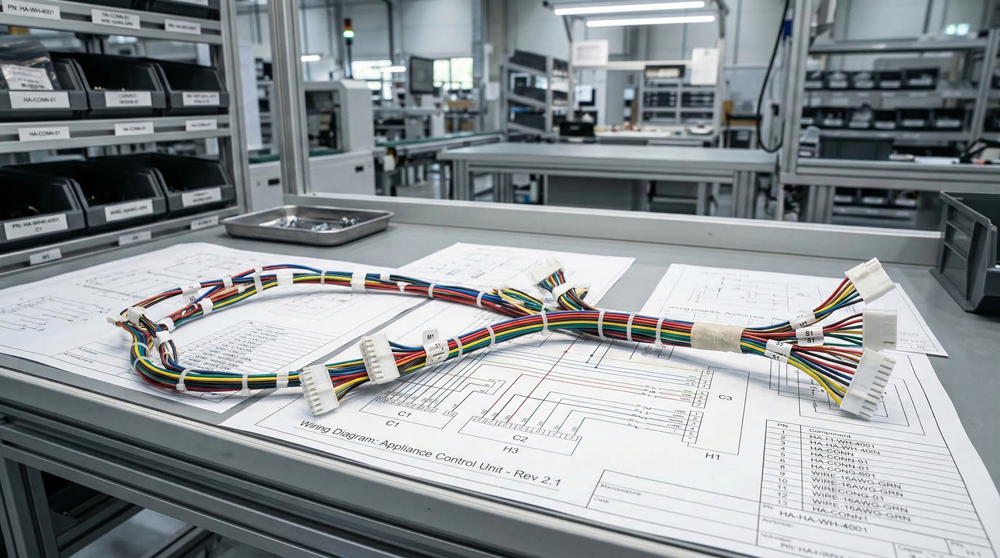
A prototype wire harness can often be built quickly by an experienced technician. The technician reads the drawing, cuts the wires, crimps the terminals, and manually adjusts the harness until it fits the equipment.
This is useful during early development, but a successful prototype does not automatically mean the harness is ready for repeat production.
The prototype may depend on one technician’s experience. Branch lengths may have been adjusted manually. The connector orientation may not be clearly shown on the drawing. Wire substitutions may have been made because the specified material was unavailable. The final sample may work perfectly, but the production information may still be incomplete.
When an OEM moves from prototype to low-volume production, the supplier should convert the sample into a controlled manufacturing package.
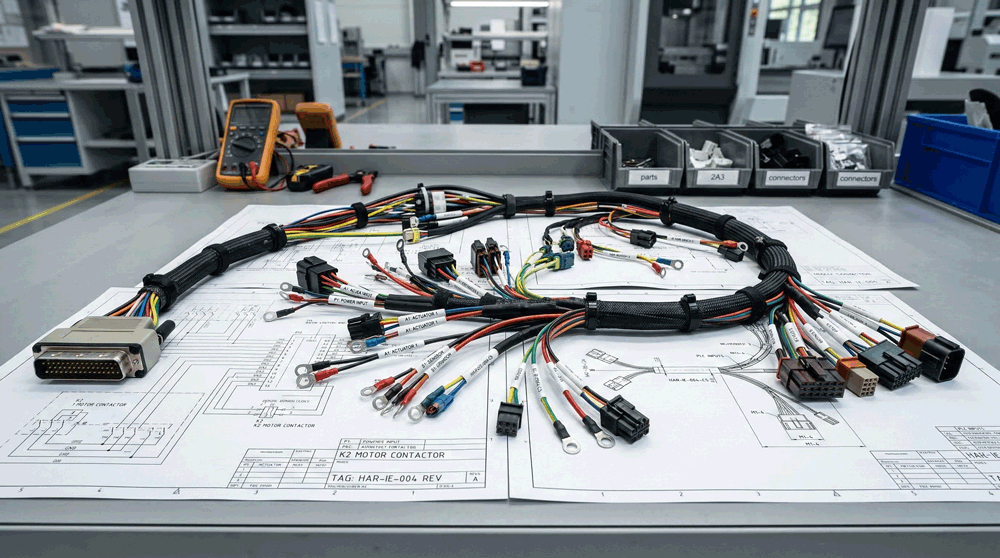
The drawing should reflect the approved dimensions. The BOM should show actual materials. The pinout should be confirmed. Label and protection requirements should be documented. Testing requirements should be defined.
This is especially important when the first order is only 50 or 100 pieces. It is easy to assume that small quantity does not require formal control. In reality, this batch may become the foundation for every future order.
Low-volume production should be treated as real production, not repeated prototype building.
Pilot Builds
A pilot build creates a bridge between prototype and production.
During prototype development, the main question is usually: does the cable work? During a pilot run, the question changes: can the supplier build the same cable consistently several times?
A pilot quantity may be 20, 50, 100, or another practical number depending on the equipment project. The exact quantity is less important than the purpose of the build.
The pilot batch can help verify branch length consistency, connector assembly, terminal crimping, labeling, cable routing, packaging, and electrical test results. It also allows the OEM production team to install multiple harnesses and identify repeated assembly issues.
One prototype may fit perfectly because it was carefully adjusted by hand. If ten production workers report that a branch is difficult to route, the design may need improvement.
Pilot production also tests the supplier’s process. Can the manufacturer follow the drawing consistently? Are labels placed in the same position? Are the correct connectors used? Does every harness pass the same electrical test?
For OEM buyers, pilot builds reduce the risk of moving directly from one approved sample to a larger production order.
Small-Batch Quality
A common misunderstanding is that small-batch wire harness production can use a simpler quality process because the quantity is low.
The opposite can sometimes be true.
In high-volume production, a factory may have dedicated fixtures, automated cutting equipment, established test programs, and stable material planning. In low-volume projects, the supplier may handle many different part numbers and frequent engineering changes. This creates more opportunities for mistakes if documentation is weak.
A 30-piece order may include five different connectors, several wire gauges, multiple branch lengths, labels, sleeves, and a complex pinout. The small quantity does not make the product technically simple.
The supplier should still control the drawing revision, BOM, work instructions, and test requirements.
For most custom cable assemblies, 100% continuity and pinout testing should be considered. A single wrong wire in a small batch can still stop equipment assembly or damage a module.
Visual inspection should also confirm connector orientation, terminal seating, wire color, label accuracy, branch length, sleeve position, and packaging.
Low MOQ should describe order flexibility. It should not describe a lower quality standard.
Drawing Control
Drawing control becomes especially important when cable assemblies are ordered in small batches over a long period.
Imagine an OEM ordering 50 harnesses in January, making a small design change in March, and ordering another 100 pieces in September. If the drawing revision is not controlled, the supplier may build the September order according to the January version.
This problem is common in custom equipment projects because changes happen gradually.
A connector may be replaced. A branch may become 50 mm longer. A label may change. A new sleeve may be added around an abrasion point. Each change seems small, but together they create a different production version.
The approved drawing should always show the current configuration.
The supplier and buyer should also use clear revision references in communication. Instead of asking the factory to “make it like the last sample,” the buyer should identify the approved drawing or revision.
Physical samples are useful references, but controlled technical files are better for repeat production.
For low-volume OEMs, good drawing control reduces the need to explain the project again every time a new order is placed.
BOM and Material Planning
Material planning is one of the biggest commercial challenges in low MOQ cable assembly production.
The buyer may need only 50 harnesses, but a connector supplier may sell terminals in reels or require a larger packaging quantity. A custom cable may have a supplier MOQ far higher than the harness order. Special labels, molded components, or protective materials may also create minimum purchase requirements.
This is why cable assembly MOQ and component MOQ are not always the same.
A wire harness manufacturer may be willing to build 50 pieces, but the material cost must still be managed realistically.
For repeat projects, the supplier and buyer may agree to purchase material for several future batches. The remaining material can be held for repeat orders. In other cases, the buyer may pay a one-time material MOQ cost. Approved alternative components may also help when the original part creates an unreasonable sourcing requirement.
The right solution depends on annual demand, material value, storage risk, and forecast reliability.
OEM buyers should provide estimated annual quantities whenever possible. The estimate does not need to be a binding commitment. It helps the supplier understand whether the project is a one-time 50-piece order or a program expected to reorder every few months.
This information can change the sourcing strategy.
Connector MOQ
Connectors often create the largest MOQ problem.
A cable assembly may use a standard connector housing that can be purchased in small quantities, but its terminal may be available only in larger packaging. Another project may use a specialized waterproof connector with a high supplier MOQ. Some branded components may have long lead times, which encourages distributors to sell only full packaging quantities.
For a low MOQ custom wiring harness project, the connector should be reviewed early.
If the OEM has already frozen the design, the supplier may need to source the exact connector and manage the material MOQ. If the project is still in development, connector availability can be considered before the design is finalized.
A more available connector may reduce cost and lead time for future small-batch orders.
However, connector changes should not be driven only by MOQ. Mating compatibility, electrical rating, current, voltage, locking, sealing, and mechanical fit remain important.
For existing equipment or replacement harnesses, exact connector compatibility may be required.
The supplier should explain the connector sourcing situation clearly during quotation. A buyer needs to know whether the price includes excess material, whether remaining parts will be held for future orders, and whether connector availability may affect future lead time.
Engineering Changes
Low MOQ cable assembly projects often involve more engineering changes than mature high-volume programs.
This is normal.
A startup may modify the enclosure after user testing. A laboratory equipment OEM may replace a pump. A diagnostic device may change the PCB layout. A test instrument may add a new sensor.
Every equipment change can affect the harness.
A flexible supplier should support reasonable revisions, but the change process still needs control.
The buyer should explain exactly what changed. The supplier should update the affected drawing, BOM, pinout, and quotation as necessary.
Changes should be confirmed before production starts.
A common problem occurs when the buyer sends several small changes through email, instant messages, and marked photos. The supplier may understand each message separately but fail to combine them into one final production version.
The approved file should become the single production reference.
For low-volume projects, revision discipline is one of the best ways to maintain quality while keeping the development process flexible.
Cost Structure
Low MOQ cable assemblies normally have a different cost structure from high-volume production.
The material cost per piece may be similar, but engineering review, drawing preparation, tooling setup, test programming, production setup, and purchasing work are distributed across fewer pieces.
For example, a supplier may spend several hours identifying connectors, preparing a BOM, creating a drawing, and setting up an electrical test. That work may support 50 pieces or 50,000 pieces.
When the quantity is low, the setup cost represents a larger percentage of the unit price.
This does not mean low MOQ projects should be excessively expensive. It means the buyer should understand why the price for 20 pieces is not simply the 5,000-piece price multiplied by twenty.
Material MOQ can also affect pricing. If the supplier must purchase 1,000 terminals to build 50 harnesses, the material strategy needs to be discussed.
A transparent quotation should explain important one-time costs, material assumptions, and quantity breaks.
For OEM buyers, it is often useful to request pricing for several quantity levels. For example, 50, 200, 1,000, and 5,000 pieces.
This helps the purchasing team understand how the cost changes as the project grows.
Lead Time
Low MOQ does not automatically mean immediate delivery.
A small cable assembly order can be produced quickly when drawings are clear and materials are available. But if the project uses a special connector with a six-week lead time, ordering only 20 pieces does not remove that delay.
The lead time should be divided into material preparation and production.
Standard wires, common connectors, sleeves, and labels are often easier to source. Special multi-core cable, custom molded parts, rare connectors, or customer-specific materials may require more time.
Engineering clarification also affects the schedule. An incomplete pinout or unclear connector can delay a 10-piece sample order longer than the actual manufacturing process.
For urgent low-volume projects, the buyer should provide the required delivery date early. The supplier can then check critical materials and identify the likely bottleneck.
Sometimes an available approved alternate can reduce lead time. In other cases, exact materials must be used and the buyer needs to accept a longer schedule.
A realistic supplier should communicate this clearly rather than promising a short lead time before checking materials.
Startups and New Products
Startups and new product teams often need low MOQ cable assemblies because the product is still evolving.
At this stage, the company may not know the final annual volume. The team may need samples for investor demonstrations, certification preparation, field testing, or initial customer units.
A high MOQ can create a major barrier.
However, new product teams should also avoid using the cable assembly supplier only as a quick prototype workshop. If the product is expected to reach production, the technical package should become more controlled as the design matures.
The early sample may be built from a sketch. The next version should have a clear drawing. The pilot batch should use an approved BOM and pinout. Production should follow revision-controlled documents and defined testing.
This gradual development path helps the startup avoid rebuilding the supply chain when volume grows.
Choosing a supplier that can support both prototype and production is useful. The supplier becomes familiar with the project, and engineering knowledge is not lost during the transition to manufacturing.
For OEM startups, the goal should be flexibility now and repeatability later.
Specialized Equipment
Low MOQ manufacturing is also important for established companies producing specialized equipment.
A manufacturer of laboratory analyzers may have several product models, with each model using different cable assemblies. A test equipment company may sell only a few hundred units of a high-value instrument each year. An industrial machine builder may produce equipment according to customer projects.
These companies are not necessarily small businesses. Their product volumes are simply different from consumer electronics.
They need suppliers that understand product variety.
One cable assembly may be ordered in 500 pieces. Another may be ordered in 50 pieces. A third may only be needed as a service part.
The supplier should be able to manage multiple part numbers and revisions without confusing materials or drawings.
Clear part number control, labels, packaging, and order documentation become important.
For specialized equipment OEMs, supply consistency may be more valuable than the lowest possible price.
A cable assembly that is unavailable at the right time can delay delivery of a much more expensive machine.
Repeat Orders
A low MOQ supplier should be evaluated not only on the first sample but also on repeat orders.
The first order receives a lot of attention. Engineers review the drawing, technicians build samples carefully, and the customer provides detailed feedback.
The real test comes six months later when the buyer orders the same part again.
Does the supplier still have the latest drawing? Are the approved materials used? Is the pinout test program unchanged? Are labels and packaging consistent?
This is why production records and document control matter.
A supplier should be able to reproduce the approved harness without asking the customer to send the same physical sample again.
If materials have changed or a connector is no longer available, the supplier should communicate before making a substitution.
For OEM buyers, repeatability is one of the main differences between a prototype source and a manufacturing supplier.
Low-volume projects still need long-term production discipline.
Packaging and Kitting
Small-batch cable assemblies are often used in specialized production lines where installation efficiency matters.
The OEM may need individual packaging, part number labels, branch identification, or complete harness kits for one machine.
Kitting can be useful when one equipment unit uses several cable assemblies. Instead of the assembly team collecting cables from different boxes, the supplier can prepare one kit for each machine.
This approach may reduce picking mistakes and improve assembly efficiency.
However, packaging requirements should be discussed before quotation.
Individual bags, printed labels, anti-static packaging, custom cartons, and kit preparation all affect labor and material cost.
For service parts, packaging may need to support distributors or field technicians rather than factory production.
The supplier should understand who receives the cable and how it is used.
Low MOQ projects often benefit from customized packaging because the customer may have a specialized assembly or service process.
Testing
Testing should not be reduced because the order quantity is small.
For most custom wire harness and cable assembly projects, continuity, short-circuit, and pinout testing are basic quality controls.
Complex multi-branch harnesses may have many circuits that are difficult to verify visually. An electrical test fixture can check every connection consistently.
Depending on the application, additional tests may include HiPot, insulation resistance, shielding continuity, terminal pull force, or functional testing.
The buyer should define the test requirements during RFQ review.
For prototype samples, some testing may also help identify design issues. For production, the agreed tests should become part of the controlled process.
The supplier and customer should understand the boundary between cable-level and equipment-level testing.
A cable assembly manufacturer may verify continuity, pinout, insulation, and shield connections. The OEM may still need to perform functional validation in the final machine.
Both levels are important.
Choosing a Low MOQ Supplier
A low MOQ supplier should offer more than a small minimum order number.
The supplier should understand custom projects, incomplete RFQs, prototype revisions, material sourcing, and repeat production.
During project review, the supplier should ask about the application, quantity, connector, pinout, wire specification, testing, and expected future demand.
These questions help determine whether the project is a one-time prototype or a developing OEM program.
The supplier should also communicate material MOQ clearly. If a special connector or cable requires a larger purchase, the buyer should know before placing the order.
Documentation capability matters. A supplier that can prepare or review drawings, BOMs, and pinout tables is more useful for OEM development than a workshop that simply copies one sample.
Testing capability is also important.
Finally, the buyer should consider whether the supplier can support increasing volumes. A project may start at 50 pieces and later grow to 5,000 or 50,000 pieces.
The best manufacturing partner should support the project as it develops.
How Infinite Possibilities Supports Low MOQ Projects
Infinite Possibilities supports low MOQ custom wire harness and cable assembly projects for OEM customers, specialized equipment manufacturers, engineering teams, and new product programs.
We understand that many projects do not begin with large production quantities. Customers may need prototype samples, pilot batches, small production runs, replacement parts, or periodic repeat orders.
We work with drawings, BOMs, samples, photos, sketches, and incomplete technical packages. Our team can help review connector requirements, harness structure, pinout information, branch dimensions, labels, and testing needs before production.
Our capabilities include terminal crimping, soldering, shielding, braided sleeve, heat shrink, overmolding, waterproof assembly, labeling, kitting, and other custom processes.
We support 100% continuity and pinout testing, visual inspection, and customer-specific quality requirements.
For projects that start in low volume and may grow later, we can support prototype, pilot, and production stages. The goal is to help customers maintain flexibility during development while creating clear documentation for repeat manufacturing.
If you need a small batch of custom cable assemblies, send us your drawings, sample photos, application, target quantity, expected future volume, and testing requirements.
We can review the project and help you identify a practical production plan.
Final View
Low MOQ cable assemblies are important for prototypes, pilot builds, specialized equipment, replacement parts, and low-volume OEM production.
Small quantity should provide purchasing flexibility, but it should not mean uncontrolled manufacturing. A 20-piece custom harness still needs correct pinout, approved materials, clear drawings, and suitable testing.
For OEM buyers, the best low MOQ process connects development with production. Prototype samples help confirm fit and function. Pilot builds verify repeatability. Controlled drawings, BOMs, and revisions support future orders.
Material MOQ, connector availability, setup cost, and lead time should also be discussed openly. A good supplier should explain the commercial and technical factors behind the quotation.
The value of a low MOQ cable assembly supplier is not simply the ability to accept a small order. The real value is the ability to support small quantities today while creating a stable manufacturing process for tomorrow.
FAQ
1. What is a low MOQ cable assembly?
A low MOQ cable assembly is a custom cable or wiring harness that can be produced in relatively small quantities. It is commonly used for prototypes, pilot builds, specialized equipment, service parts, and low-volume OEM production.
2. Can I order 10 or 50 custom cable assemblies?
It depends on the project and material requirements. Many custom cable assembly projects can start with small quantities, but connector, cable, or special material MOQs may affect pricing.
3. Are low-volume cable assemblies tested?
They should be. Continuity, short-circuit, and pinout testing are important for custom harnesses regardless of order quantity. Additional tests may be required depending on the application.
4. Why are small cable assembly orders more expensive per piece?
Engineering review, setup, purchasing, test preparation, and production preparation are spread across fewer pieces. Component supplier MOQs may also affect the cost of small orders.
5. Can a low MOQ project move into mass production later?
Yes. A project can start with prototypes or pilot batches and move into larger production quantities after design approval. Controlled drawings, BOMs, pinout data, and revision management make this transition easier.
CTA
Need low MOQ cable assemblies for an OEM project?
Send us your drawings, samples, photos, application details, target quantity, and expected future volume. Our team can review your project and support prototype, pilot, small-batch, or repeat production.
Contact Infinite Possibilities for Low MOQ Cable Assemblies
Related Articles
- Diagnostic Cable Assemblies
- Patient Monitoring Cable Assemblies
- Lab Equipment Wire Harnesses
- Test Equipment Cable Assemblies
Series
Medical, Laboratory and Test Equipment Cable Assembly Guide
This is the fifth article in the Medical, Laboratory and Test Equipment Cable Assembly Guide series. The five-article cluster covers diagnostic equipment, patient monitoring devices, laboratory instruments, test equipment, and low MOQ cable assembly sourcing for specialized OEM projects.