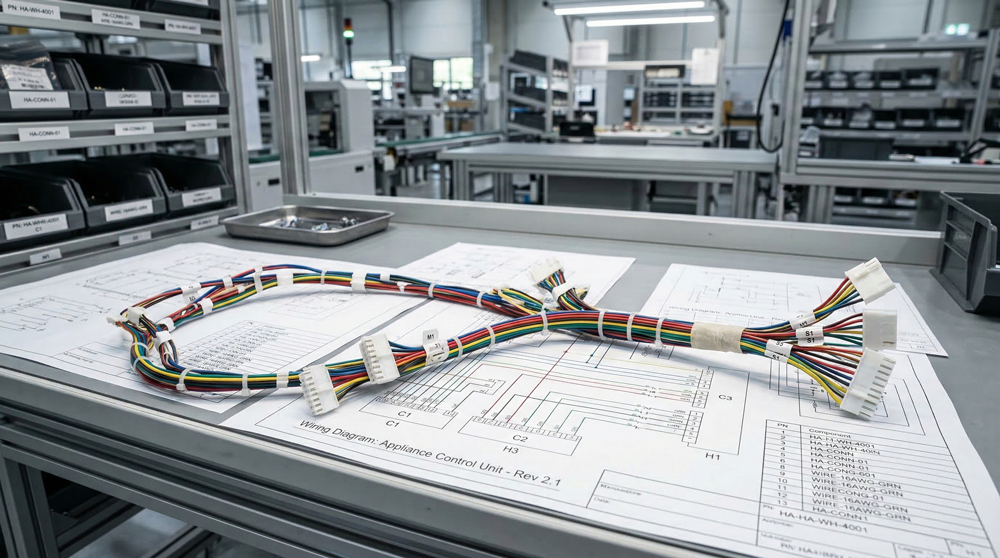
A flat ribbon cable test plan should prove more than simple electrical continuity. In OEM projects, the real goal is to confirm that the assembly matches the approved pitch, count, orientation, fit, and handling needs of the product. Your own site already supports this broader quality logic: the industrial page states that all builds follow 100% continuity testing, documentation, and traceability, while the quality page describes full electrical testing plus visual and dimensional inspection.
That broader approach matters because flat ribbon cable assemblies often fail in practical ways that a basic go or no-go continuity screen will not catch. Ept’s IDC installation instructions require component checks, correct connector-to-cable orientation, post-assembly dimensional inspection, and visual confirmation of the IDC contact engagement, while also recommending continuity and dielectric-strength checks depending on the application.
Table of Contents
ToggleTest by Stage
The most useful test plan separates prototype, pilot, and production goals. Your own pilot-run checklist exists because approval, repeatability, and release control are not the same question, and the same logic applies here. A prototype test asks whether the design is correct. A pilot test asks whether the build can be repeated cleanly. A production test asks which checks are practical and necessary for routine release.
For flat ribbon cable assemblies, that staged structure is especially helpful because geometry-related risks often appear before high-volume manufacturing starts. If the early plan does not separate design validation from release screening, the project can end up approving a cable that is electrically correct but awkward to install, easy to reverse, or inconsistent in final termination quality. That is a practical inference from the staged quality and traceability logic on your site plus the detailed IDC inspection requirements in the ept documentation.
Start with Basics
The baseline checks should include continuity, contact-position correctness, and visual confirmation that the assembly matches the intended build. Your quality page says every harness undergoes full electrical testing for continuity, insulation, and short-circuit protection, and your industrial page adds documentation and traceability. Ept’s IDC guide also recommends continuity and correct allocation of contact positions as part of electrical testing.
For OEM buyers, this means the minimum acceptance plan should never be just “continuity passed.” A better baseline is continuity plus conductor-count verification and contact-position correctness, because flat ribbon assemblies are especially vulnerable to mirrored layouts, reversed termination logic, and contact-position mistakes that may not show up as a total open circuit. That conclusion is supported by the IDC-specific inspection and position-allocation checks in the ept instructions.
Check Orientation
Orientation should be an explicit inspection item, not a casual operator assumption. TE’s AMP-LATCH documentation says the wire must be aligned with the IDC slot during termination, and ept’s installation instructions devote a dedicated step to ensuring the correct orientation of the connector to the ribbon cable. They also state that the a1 contact connects to the cable’s guide strand and require perpendicular cable alignment during assembly.
That means a flat ribbon cable test plan should include pin-1 or guide-strand verification at sample stage and during release checks whenever the risk justifies it. In practice, buyers should ask the supplier to verify not only that the connector is on the cable, but that it is on the cable in the intended direction, with the expected cable exit behavior. In flat ribbon projects, that is often where rework starts.
Verify Dimensions
Dimensional checks are more important in IDC ribbon assemblies than many buyers expect. Your quality page says visual and dimensional inspection covers connector placement, routing, length, and labeling against the drawing, and ept’s instructions require measurement of the connected connector to verify that the assembly is compressed enough to lock securely but not over-compressed. The document even provides a nominal dimension and inspection logic around that condition.
For OEM buyers, this is a reminder that a flat ribbon assembly can be electrically correct and still be mechanically wrong. If the connector height, end position, or cable flushness is off, the build may create fit problems, weak locking, or later mating trouble. That is why sample approval should include actual post-termination dimensions, not just a quick visual look from above.
Review the Fit
Fit checks should be part of the prototype plan whenever the assembly is used in compact electronics, control panels, or low-profile modules. Your own flat ribbon articles and industry pages consistently position these assemblies as space-saving internal interconnects, which means real installation geometry is usually part of the product requirement rather than an afterthought.
That is why a bench pass is not always enough. If the cable must stay flat through a narrow path, clear an adjacent cover, or exit a connector in a specific direction, the approved sample should be checked in the actual product or a representative mock-up. In flat ribbon work, “fits on the table” and “fits in the product” are not always the same result. This is an inference grounded in the way your site positions flat ribbon assemblies for space-constrained internal use.
Pilot for Repeatability
Pilot testing should answer a different question from prototype testing. The prototype proves the chosen design. The pilot proves that the supplier can build that design repeatedly without drift in orientation, dimension, locking condition, or documentation. Your pilot-run checklist and traceability pages both support this broader idea that repeatability and evidence quality matter before mass release.
For flat ribbon cable assemblies, pilot output should therefore be reviewed for repeated connector orientation, repeated dimensional conformity, stable continuity results, and consistency between the approved sample definition and the released build records. If the assembly depends on operator alignment or IDC compression quality, pilot review is where that risk should be surfaced before full production. That conclusion is supported by the ept process and inspection steps and by your own project-control content.
Define Production Checks
Routine production checks should be explicit. Your quality page says every harness undergoes full electrical testing plus visual and dimensional inspection, and your industrial page adds traceability and documentation. That gives buyers a practical model: production release should state which checks are performed on every unit and which are controlled at lot, first-article, or pilot level.
For many flat ribbon cable programs, the routine production plan will include 100% continuity, visual confirmation of connector seating and orientation, and dimensional checks where connector compression or height is critical. More complex projects may also require lot-linked records or first-article references. The point is not that every program needs the same depth, but that “100% tested” should be replaced with named checks.
Use Better Records
A strong test plan also defines the evidence that should exist after testing. Your recent article on wire-harness test reports argues that projects often suffer not from zero testing, but from weak, late, or disconnected records that cannot be tied to the shipped lot or approved state. That document-control logic applies to flat ribbon cable assemblies too, especially when multiple revisions or small-batch runs are involved.
For OEM buyers, this means the acceptance plan should say not only what gets checked, but what gets recorded. Continuity result, orientation confirmation, dimensional status, revision identity, and lot traceability can all matter later if a receiving issue or field question appears. Good records reduce approval delay and make later troubleshooting much faster.
Add More When Needed
Not every flat ribbon cable assembly needs the same level of validation. Some internal interconnects only need continuity, orientation, and dimensional checks. Others may need dielectric testing, added short-circuit checks, or tighter installation validation because of the application. Ept explicitly recommends continuity, dielectric strength, and contact-allocation checks depending on application, and your quality page includes insulation and short-circuit protection in routine electrical testing.
That means buyers should scale the plan to the real risk. A simple internal jumper and a compact service-access assembly should not automatically receive identical approval logic. The stronger method is to define the product conditions first, then decide which checks are mandatory at prototype, pilot, and production stages. This is a practical synthesis of the cited testing and quality sources.
Final View
A flat ribbon cable test plan works best when it is built around the real failure risks of the assembly. Continuity proves the basic circuit. Orientation checks control reversed builds. Dimensional inspection confirms proper IDC compression and connector position. Fit review confirms that the approved sample actually works in the product. Pilot review confirms that the build can be repeated, and production checks keep the released version under control.
For OEM buyers, the practical rule is simple: do not approve flat ribbon cable assemblies with a one-line test statement. Define what gets checked, at which stage, and what evidence should exist afterward. When the plan is written clearly, suppliers can build and release the right assembly with much less ambiguity and much lower rework risk.
FAQ
What is the minimum test plan for a flat ribbon cable assembly
At minimum, buyers should define continuity, contact-position correctness, connector orientation, and dimensional correctness after termination.
Is continuity enough for flat ribbon cable approval
Usually no. Continuity is necessary, but it does not prove correct orientation, compression, fit, or final connector geometry.
Why are dimensional checks important in IDC ribbon assemblies
Because post-termination dimensions help confirm that the connector is compressed enough to lock properly without being over-compressed or functionally compromised.
Should fit checks be part of sample approval
Yes, especially when the assembly is used in tight internal spaces, low-profile modules, or compact device geometries.
What is the biggest test-plan mistake buyers make
One of the biggest mistakes is using vague language such as “100% tested” without naming the actual checks or the records expected from those checks.
CTA
If your project uses ribbon or IDC-based internal interconnects, do not wait until receiving or assembly to discover orientation, fit, or compression problems. Define the test plan before samples are approved so the supplier can build and release against clear checks from the start.
Related articles
- How to Specify Flat Ribbon Cable Assemblies for OEM Projects
- IDC Ribbon Cable Assemblies: Pitch, Orientation, and Assembly Risks
- Flat Ribbon Cable Assemblies for Compact Electronics
- Flat Ribbon Cable Assemblies for Control Panels and Low-Profile Modules
- Common Flat Ribbon Cable Assembly Mistakes That Cause Misalignment and Rework