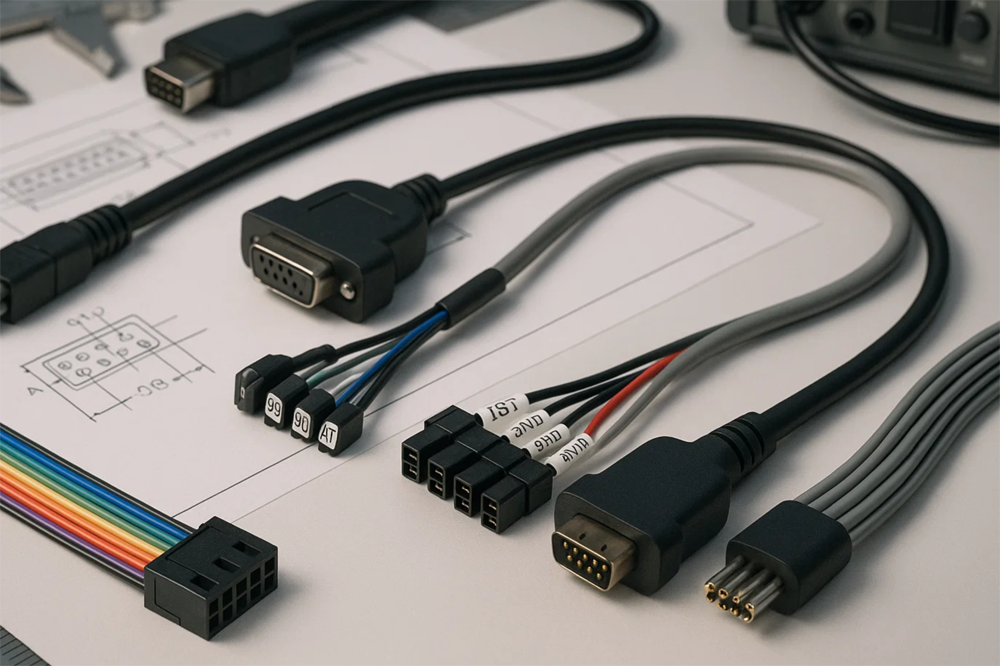

IDC ribbon cable assemblies look straightforward, but they are easier to get wrong than many OEM buyers expect. The cable is flat, the conductors are evenly spaced, and the connector family often looks standardized. That visual simplicity is exactly what creates risk. Your existing flat-cable content already highlights pitch, conductor count, polarity, keying, and strain relief as the main control points, and that is consistent with how major interconnect suppliers document IDC ribbon systems.
In real projects, IDC ribbon assemblies are usually chosen because they save space, keep internal wiring organized, and support quick cable-to-board or subsystem interconnects inside equipment. TE positions AMP-LATCH ribbon solutions as board-to-board and subsystem interconnects used heavily inside equipment, while your own site places flat ribbon cable assemblies in compact electronics, internal control panels, and low-profile modules. That makes this category highly specification-sensitive: a small definition gap can quickly turn into orientation mistakes, mating errors, or avoidable rework.
Table of Contents
ToggleWhy IDC Needs More Control
IDC termination is attractive because it is fast and repeatable. TE’s IDC process description explains that the wire must align with the IDC slot, then the insulation is displaced as insertion progresses until conductor contact is formed. Epec likewise explains that ribbon cable spacing makes mass termination through IDC practical, which is why IDC remains common in flat cable assemblies. But fast termination only helps if the cable, connector, and orientation are all defined correctly first.
For OEM buyers, that means IDC should not be treated as a generic checkbox. “IDC ribbon cable” is not yet a usable production definition. The project still has to lock the pitch, contact count, mating family, pin-1 logic, polarization method, and strain-relief requirements. TE’s AMP-LATCH range and Samtec’s IDC families both make clear that multiple valid system choices exist, even within the same broad IDC category.
Lock Pitch First
Pitch should be one of the first parameters written into the RFQ because it drives connector compatibility, density, and assembly handling. RS notes common IDC pitches such as 1.27 mm and 2.54 mm and explicitly states that connector pitch must match the ribbon cable. Samtec’s IDC product pages also show how tightly pitch is tied to the connector ecosystem, especially in .050 inch systems.
This matters because pitch is not just a dimension. It affects how compact the interconnect can be, what connector families are available, what pin counts are practical, and how easy the terminated assembly is to handle during installation. If the buyer leaves pitch to be inferred from a photo or from a partial mating reference, the supplier may still build something workable, but not necessarily the intended assembly.
Do Not Assume Count
Conductor count is another parameter buyers often under-specify because ribbon cable looks visually uniform. GCT shows IDC cable assemblies spanning broad contact-count ranges, and Samtec lists multiple common pin counts within the same pitch family. That means “standard ribbon cable” is not a meaningful sourcing definition on its own.
For OEM work, count must be stated explicitly, along with the wiring pattern. Buyers should define whether the build is straight-through, mirrored, or otherwise customized, especially when the assembly interfaces with specific headers, keyed housings, or board layouts. If that is left implicit, the supplier is forced to guess from mating hardware or assumptions about convention, which is exactly where avoidable errors begin.
Control Orientation
Orientation is one of the biggest practical risks in IDC ribbon assemblies. TE’s IDC termination guidance starts with wire alignment to the IDC slot, ept’s installation instructions require correct connector-to-cable orientation and post-assembly inspection, and multiple installation guides emphasize alignment of the marked edge and pin-1 logic. In other words, correct orientation is not a cosmetic preference. It is a core termination requirement.
For OEM buyers, this means pin-1 reference should never be left to habit. The RFQ should define the red stripe or marked edge relative to pin 1, connector facing direction, and whether the cable exits in the expected orientation after termination. Many field and factory errors happen not because the wrong connector family was selected, but because the correct connector was pressed onto the correct cable in the wrong orientation.
Use Keying Early
Keying and polarization should be treated as deliberate anti-error features, not optional extras. 3M’s IDC socket literature identifies polarization options such as center-bump variants, and Samtec highlights polarization keys on some IDC systems. These features exist because flat ribbon interconnects are especially vulnerable to reverse insertion and visually ambiguous mating.
For OEM projects, keying becomes even more valuable when the assembly is installed manually, serviced in the field, or built in low-to-medium volumes where operator variability matters. A keyed system reduces the chance that a technically correct assembly is still installed backward or mated to the wrong header orientation. That makes keying a process-control decision as much as a connector decision.
Treat Strain Relief Seriously
Strain relief is often underestimated in flat ribbon projects because the cable looks lightweight. The documentation says otherwise. GCT describes strain-relief options as protection for terminated contacts, 3M identifies strain-relief versions in its IDC ribbon socket families, and CW-style IDC design guidance explains that the strain-relief bend helps keep cable tension from transferring directly into the IDC termination area.
That matters because many flat ribbon assemblies are bent during installation, routed through narrow spaces, or handled during service. In those cases, strain relief is not just a convenience feature. It is part of the assembly’s reliability strategy. Buyers should state up front whether the terminated ends will experience handling, pull, repeated service access, or constrained routing, because those conditions often determine whether strain relief should be required rather than optional.
Routing Still Matters
Flat ribbon cable assemblies are often selected because the product needs organized, low-profile routing. Your site already frames them that way in compact electronics and control-panel environments. CloomTech also highlights folded and pre-creased ribbon assemblies for compact electronics, reinforcing that routing form can be part of the product definition, not merely a downstream assembly choice.
For OEM buyers, that means the RFQ should describe the routing envelope, not just the nominal cable length. If the cable must stay flat through a narrow channel, fold at a defined point, or exit a connector in a specific direction, those should be written into the sourcing package. Otherwise, the supplier may deliver a cable that is electrically correct but mechanically awkward or difficult to install repeatably.
Check the Right Risks
A good sample-approval plan for IDC ribbon assemblies should match the actual risks of the build. At minimum, continuity, conductor-count correctness, connector orientation, and dimensional checks after termination should be reviewed. Ept’s installation instructions explicitly include visual inspection and post-assembly checking, which supports the idea that IDC compression and final alignment need verification rather than assumption.
If the product is space-constrained, fit checks in the real installation position should also be part of approval. That is especially important for compact electronics and low-profile modules, where the assembly may be technically correct on the bench but still difficult to route or seat correctly in the finished product. In flat ribbon cable work, a “passes continuity” result is useful, but not sufficient on its own.
Write a Better RFQ
A useful IDC ribbon cable RFQ should describe the application first, then define pitch, conductor count, mating connector family, IDC style, pin-1 orientation, keying or polarization requirement, strain-relief expectation, and routing condition. TE’s ribbon interconnect guidance and the supplier documentation above all point to the same lesson: IDC systems are easy to terminate only when the build definition is already clear.
In practical terms, buyers should avoid sending only a photo and a rough length. The stronger package includes the mating part or header reference, the exact pitch, the contact count, the intended cable exit direction, and the anti-error features required. That level of detail does more to reduce rework than a faster but vaguer quote cycle.
Final View
IDC ribbon cable assemblies are not difficult products because the technology is exotic. They are difficult because the geometry looks simple while the error modes are highly repeatable. Pitch, contact count, pin-1 orientation, polarization, strain relief, and routing profile all influence whether the finished assembly can be built and installed reliably.
For OEM buyers, the most practical lesson is straightforward: specify the anti-error logic as clearly as the electrical logic. When pitch, orientation, and assembly risks are managed explicitly in the RFQ and sample-approval plan, IDC ribbon cable assemblies become much easier to source, approve, and release without unnecessary churn.
FAQ
What causes the most common IDC ribbon cable assembly errors
The most common errors usually come from mismatched pitch, unclear contact count, reversed orientation, and missing polarization or strain-relief requirements.
Is IDC always the right termination for ribbon cable assemblies
No. IDC is efficient and common, but the buyer still needs to define the correct mating system, pitch, and installation conditions before assuming it is the right answer.
Why does pin-1 orientation matter so much
Because ribbon cable assemblies can be terminated or installed backward more easily than many buyers expect, and incorrect pin-1 logic can create immediate assembly or system errors.
Should strain relief be required on IDC ribbon assemblies
In many OEM applications, yes, especially when the assembly will be handled, bent during installation, or accessed during service.
What should buyers verify before approving samples
At minimum, continuity, contact count, connector orientation, and post-termination dimensional or fit checks should be reviewed.
If your project uses IDC ribbon interconnects, do not rely on photos and assumptions alone. Define pitch, pin-1 logic, keying, strain relief, and routing conditions clearly before quotation so the supplier can build the right assembly the first time.
Related articles