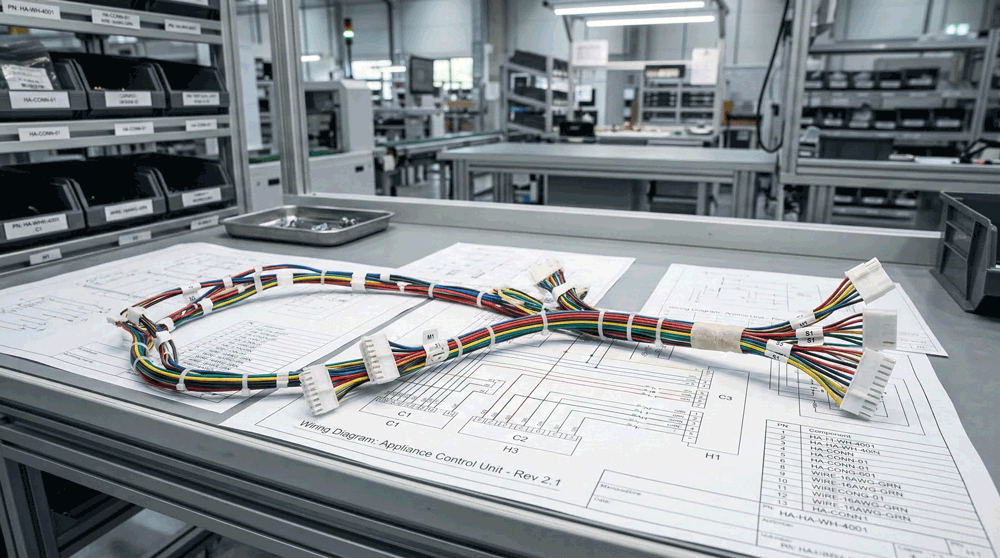
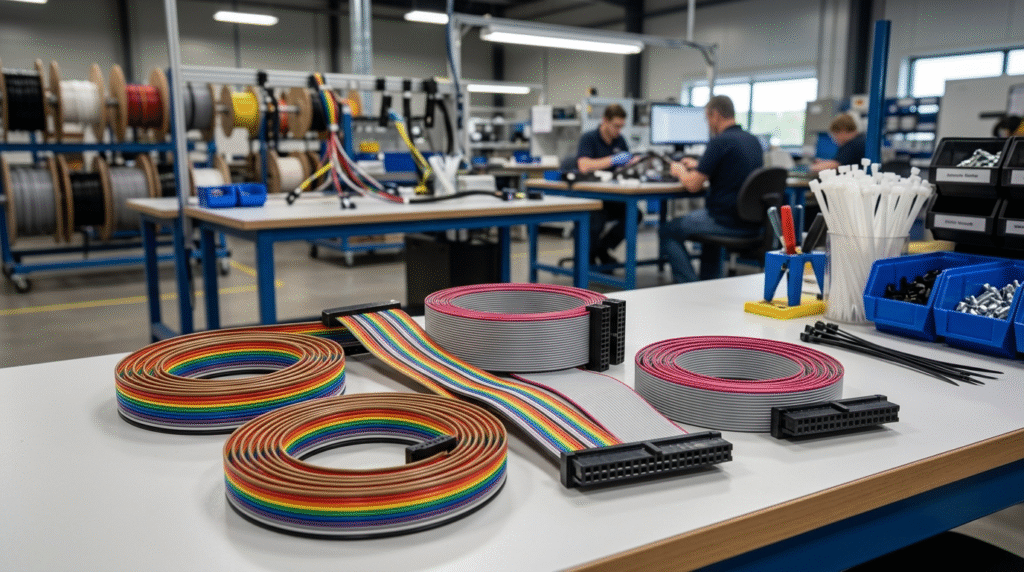
Flat ribbon cable assemblies are a natural fit for compact electronics because they solve a very specific packaging problem: how to move signals and power through tight internal spaces without creating the bulk and routing disorder of a round harness. Your own consumer-electronics page already positions them this way, describing flat ribbon cable assemblies as ideal for internal device wiring that is organized, compact, and easy to install. The same page also highlights ultra-thin, flexible wiring for space-constrained devices and miniaturized layouts for fast-moving consumer products.
That positioning is consistent with broader connector-industry guidance. Molex describes flat flexible interconnect solutions as helping designers maximize PCB space, reduce size and weight, and support reliable board-to-board and board-to-display connections. TE’s AMP-LATCH guide similarly frames ribbon cable interconnects as cable-to-board devices used heavily inside equipment to connect one board or subsystem to another. In other words, these assemblies are not simply “flat cables.” They are packaging tools for dense electronics.
Table of Contents
ToggleWhy Compact Devices Use Them
Compact electronics create two linked constraints at the same time: limited physical volume and rising interconnect density. Your site addresses this directly by emphasizing compact wiring for tight spaces, miniaturized layouts, and flat ribbon assemblies for internal device wiring in consumer products.
External supplier guidance points the same way. Molex says compact FFC and flexible interconnect solutions reduce size requirements, support miniaturized applications, and offer customization such as folding to improve routing in cramped spaces. That is useful for OEM buyers because it explains why flat formats continue to appear inside displays, handheld electronics, compact controllers, and tightly packaged subassemblies: the form factor itself supports system miniaturization.
Space Savings First
The biggest advantage of flat ribbon assemblies in compact electronics is usually not electrical novelty. It is controlled use of space. Your consumer-electronics page describes ultra-thin, flexible wiring tailored for tight housings and compact internal routing, and it identifies flat ribbon cable assemblies as a fit for organized internal device wiring.
Molex makes a similar case from the component side, stating that compact flexible interconnect solutions help maximize PCB space and reduce assembly size requirements. For OEM buyers, that means flat ribbon assemblies should be evaluated first as geometry solutions. If the product needs low-profile routing between boards, displays, modules, or compact subassemblies, a flat format often becomes attractive before any discussion of cable aesthetics or convention.
Routing Gets Cleaner
Compact devices rarely fail because they have no space at all. More often, they fail because internal routing becomes messy, inconsistent, or hard to assemble. That is exactly where flat ribbon formats add value. Your site emphasizes organized internal device wiring and simplified integration, while Molex notes customization options such as folding and routing support in cramped spaces.
For OEM buyers, the practical lesson is straightforward: routing should be part of the specification, not something left for factory improvisation. If the assembly must pass through a narrow gap, sit flat against a surface, fold at a defined location, or align with a display, camera, or board stack, those conditions should be included in the RFQ. In compact electronics, routing clarity is often one of the main reasons to choose a flat cable assembly in the first place.
Pitch Matters More
Compact electronics often push buyers toward smaller pitches and denser interconnect systems, but smaller pitch also raises the cost of ambiguity. Molex’s compact interconnect portfolio shows just how much miniaturization depends on pitch options, with fine-pitch flexible solutions used to increase circuit count in smaller footprints. Your existing flat-cable content also treats pitch as a central design variable rather than a minor detail.
For OEM projects, that means pitch should be defined explicitly and early. The buyer should not assume the supplier will infer the correct pitch from a mating part photo or a rough sample. In compact devices, the wrong pitch is not just a connector mismatch problem. It can force a different routing envelope, a different stack-up, and a different assembly process.
Orientation Cannot Drift
In compact electronics, orientation errors are more painful because the internal packaging is less forgiving. A ribbon assembly installed backward or flipped at one end may not merely fail electrically. It may also be difficult to seat, impossible to route cleanly, or hard to notice until later in assembly. TE’s IDC ribbon guidance emphasizes controlled connector-to-cable transitions, and your site already highlights polarity and keying as key design decisions in flat ribbon work.
That is why compact-electronics builds should define pin-1 logic, cable exit direction, and any anti-error orientation features up front. In a roomy enclosure, a wiring mistake may be easier to see and correct. In a tightly packaged device, the same mistake can turn into hidden rework, delayed assembly, or repeated operator confusion.
Assembly Speed Counts
One reason flat ribbon assemblies work well in consumer-style and compact products is that they can simplify repetitive assembly work. Your site explicitly calls out color-coded and labeled assemblies as a way to reduce human error and improve efficiency on the production line. It also emphasizes consistency across production runs and faster integration into evolving product builds.
This matters because many compact-electronics programs live under schedule pressure. A cable that is electrically correct but awkward to identify, orient, or install can slow the line more than buyers expect. Flat ribbon assemblies can create value by reducing visual clutter and making routing more repeatable, especially when labeling, conductor identification, and connector orientation are all defined clearly. That is an inference directly supported by your site’s focus on organized wiring and integration efficiency.
Durability Still Matters
Compact does not mean low-risk. Consumer and portable devices often include hinges, rotation points, opening covers, or repeated service access. Your consumer-electronics page explicitly highlights high-cycle durability for flexible harnesses used in hinges, rotating screens, and foldable devices. Molex also describes high-vibration retention options, shielding variants, and high-performance flat interconnect solutions for demanding miniature environments.
For OEM buyers, the takeaway is that a flat ribbon assembly should not be specified only by size. If the cable will flex, sit near moving parts, or face repeated handling, the project should also define retention, routing strain, and durability needs. In compact electronics, reliability failures often come from movement and packaging stress, not just from basic connectivity mistakes.
Signal Quality Can Matter Too
Not every compact-electronics ribbon assembly is electrically demanding, but some clearly are. Molex states that certain compact flexible interconnect solutions support high-speed signaling, EMI protection, first/last pin grounding, and impedance-matched options for protocols such as USB and HDMI. Your consumer-electronics page also emphasizes EMI shielding for signal integrity in dense electronic systems.
This is important because buyers sometimes think of flat ribbon assemblies as only low-speed internal wiring. In practice, compact devices can combine size pressure with signal-integrity pressure. That means the RFQ may need to define not only pitch and orientation, but also shielding, grounding, interface type, and any reliability expectations for data transmission in noisy or dense environments.
What Buyers Should Define
A useful compact-electronics RFQ should describe the device type, installation space, routing path, pitch, conductor count, connector family, orientation logic, and whether the build needs labeling, folding, shielding, or strain relief. Your site’s broader RFQ and flat-cable positioning already support this structured approach, and supplier documentation reinforces that flat and ribbon systems work best when the application is clearly defined before build selection.
In practical terms, the buyer should not send only a rough length and a connector photo. A better sourcing package includes the mating interface, routing space, required profile, anti-error needs, and any handling or flex requirements. In compact electronics, those details usually matter more than they do in roomier equipment because there is much less tolerance for “close enough” assembly decisions.
Final View
Flat ribbon cable assemblies are a strong fit for compact electronics because they solve packaging, routing, and assembly-order problems at the same time. Your own site positions them as organized, space-saving internal wiring for consumer devices, while major connector suppliers describe compact flexible interconnects as tools for miniaturization, routing control, and reliable board-level connectivity.
For OEM buyers, the most useful rule is simple: specify the assembly around the device geometry, not just around the connector. When routing path, pitch, orientation, profile, and handling requirements are written clearly, flat ribbon cable assemblies become much easier to source and much less likely to create hidden integration problems in compact electronics.
FAQ
Why are flat ribbon cable assemblies common in compact electronics
Because they help save space, keep internal wiring organized, and support low-profile routing between boards, displays, and modules inside tightly packaged devices.
Are flat ribbon assemblies only for low-speed internal wiring
No. Some flat interconnect solutions are designed for higher-speed signals, EMI control, and compact data applications, depending on the cable and connector system chosen.
What should buyers define first for compact-electronics ribbon assemblies
Start with the physical use case: routing space, pitch, conductor count, connector family, and orientation requirements. In compact products, geometry mistakes become expensive quickly.
Does routing really need to be written into the RFQ
Yes. In compact electronics, routing is often one of the main reasons for choosing a flat ribbon format, so it should be treated as part of the specification rather than a factory-side guess.
Should labeling and orientation control be part of the design
Often yes. In dense products, clear identification and defined orientation reduce assembly errors and improve production efficiency.
If your device depends on low-profile internal wiring, do not treat flat ribbon cable assemblies as generic commodity parts. Define the routing space, pitch, orientation, and installation logic clearly before quotation so the assembly supports the product from the first build.
Related articles
- How to Specify Flat Ribbon Cable Assemblies for OEM Projects
- IDC Ribbon Cable Assemblies: Pitch, Orientation, and Assembly Risks
- Flat Ribbon Cable Assemblies for Control Panels and Low-Profile Modules
- Flat Ribbon Cable Assembly Test Plan for OEM Buyers
- Common Flat Ribbon Cable Assembly Mistakes That Cause Misalignment and Rework