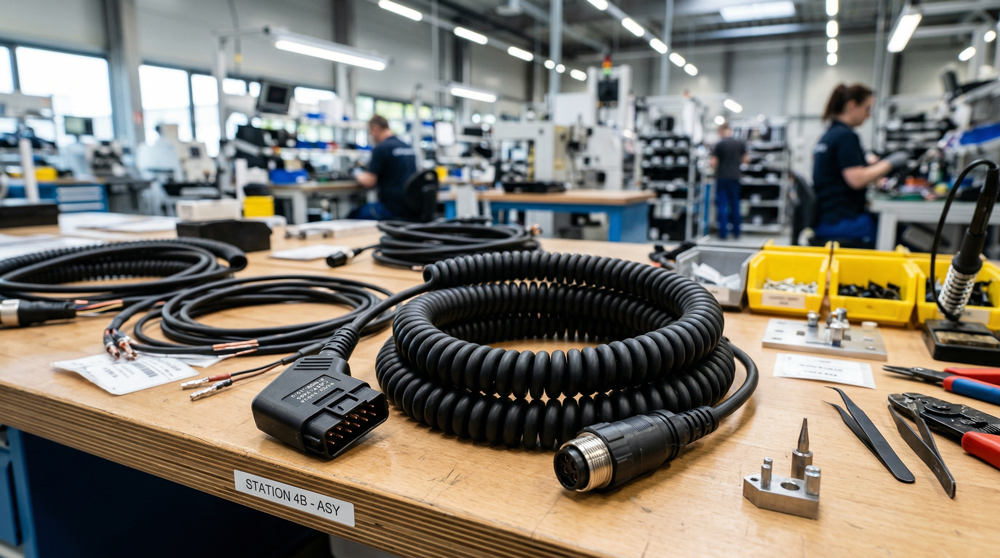
Custom coil cords are easy to underestimate. At first glance, they look like a simple way to save space and keep a cable tidy. For OEM buyers, though, the real value is not visual neatness. It is controlled extension, predictable retraction, better handling in moving equipment, and lower risk around cable drag, snagging, and transition-zone fatigue. Suppliers serving this segment consistently position coil cords around repeated movement, compact routing, and user-facing equipment where a straight cable would create clutter or wear problems. Your own coil cord page already frames them this way for medical devices, industrial controls, and mobile electronics.
That is why this topic deserves a dedicated OEM guide. Coil cords sit at the intersection of mechanics, cable design, usability, and sourcing. A buyer can choose the right conductor count and still get the wrong product if retracted length, extension ratio, tangent direction, coil outer diameter, jacket material, or recovery behavior are not defined correctly. Northwire, Galaxy, and Meridian all emphasize that coiled-cable design starts with application movement, geometry, and testing rather than with a generic stock part mindset.
Table of Contents
ToggleWhat custom coil cords are
A coil cord, also called a coiled cord, curly cord, or retractile cord, is a cable designed to extend during use and return toward its contracted shape afterward. Galaxy describes a coil cord as having two tangents, which are the straight lead sections at each end, and a coiled body in between. That sounds simple, but it is actually the reason coil cords require more application review than many standard cable assemblies. The buyer is not only specifying electrical performance. The buyer is also specifying motion behavior.
For OEM projects, that motion behavior is the whole point. Coil cords are commonly used where operators move tools, handheld devices, carts, pendant controls, scanners, mobile electronics, telescopic mechanisms, or robotic subsystems and need cable length only when the equipment is in use. Northwire highlights handheld tools, telescopic applications, tight spaces, and situations requiring continuous adjustment. Conwire points to medical devices such as defibrillators, scanning equipment, and hospital carts. Your own service page places coil cords in medical devices, industrial controls, and mobile electronics.
Why OEMs choose coil cords
The first reason is space control. A straight cable long enough for full reach often creates extra slack when the system is idle. That slack can tangle, snag, drag across surfaces, or make the product look less controlled. Coil cords solve that by providing working length only when needed and reducing loose cable when not in use. This is one reason they are so common in user-handled and motion-variable equipment.
The second reason is motion management. Coil cords are not just “short cables that stretch.” They are chosen because the application has a repeated extension-and-recovery pattern. In the wrong application, that behavior adds unnecessary complexity. In the right application, it improves ergonomics, keeps work areas cleaner, and reduces cable damage caused by dragging or uncontrolled loops. Conwire’s medical examples make this especially clear: retractile cords are valued not only for compactness, but also for mobility, cleanliness, and reducing clutter around critical equipment.
The third reason is application fit. Coil-cord geometry can be tailored around the product instead of forcing the product to adapt to a stock cable. Your own page calls out customization of wire gauge, coil diameter, straight lead lengths, and overall coil geometry. That matters because a coil cord used on a handheld scanner is not specified the same way as one used on a hospital cart, pendant controller, or moving machine interface.
Design should start with movement, not with the coil shape
One of the most useful lessons from existing manufacturer guidance is that coiled-cable design starts with how the cable will move in service. Northwire’s four-factor framework focuses on environment, retracted versus extension lengths, tangent direction and length, and coil outer diameter. Galaxy similarly says that understanding the dimensions in use, extended, and retracted is key. That is exactly the right order of thinking for OEM buyers.
Retracted length vs working extension
This is the first design question because it affects almost everything else. Northwire cites a 5:1 design ratio example, meaning a cable retracted to 5 feet could extend to 25 feet. Galaxy describes typical extended length as roughly 3 to 5 times the retracted length. That does not mean every project should use those exact ratios, but it does show the range many suppliers use as a design reference. The practical lesson for buyers is simple: define both the parked condition and the full-use condition. If you specify only one, the supplier may optimize the wrong behavior.
Tangent direction and lead length
The straight sections at each end of the coil body are not minor details. Northwire explicitly distinguishes between parallel tangential exits and drop axial exits. Galaxy also defines tangents as part of the coil-cord structure itself. In real OEM equipment, tangent direction can determine whether the cable routes cleanly or creates a twist, rub point, or awkward service loop near the connector. Lead length matters just as much. If it is too short, installation becomes difficult. If it is too long, the assembly can lose the very space-control benefit that justified the coil cord in the first place.
Coil outer diameter and installed space
Northwire specifically calls out overall coil diameter as a core design factor because it affects manufacturing and finished geometry. For buyers, the bigger point is application packaging. A coil that performs well electrically but interferes with enclosure space, operator grip, or nearby components is not a successful design. This is why sample review should include actual use position, retracted position, and maximum reach rather than only a bench-top continuity check.
Materials matter more than many buyers expect
A coiled cable is a mechanical product as much as an electrical one, so jacket and conductor construction strongly influence field behavior. Galaxy lists common jacket materials such as PVC, polyurethane, thermoplastic elastomer, neoprene, polyethylene, and Hytrel, and notes that higher strand counts improve flexibility. Igus, from a broader cable-material perspective, notes that jacket materials are responsible for protecting against mechanical stress, extreme temperatures, and chemical exposure. Together, those points support a practical buyer rule: do not specify the coil shape first and ask about materials later. Material choice directly influences flex behavior, abrasion resistance, chemical tolerance, and service life.
For many OEM projects, polyurethane and TPE-family materials come up repeatedly because buyers often want a mix of flexibility, durability, and environmental resistance. That said, there is no universal “best” jacket. Medical, industrial, consumer, and outdoor applications do not impose the same stresses. Northwire starts its design framework with environment for exactly that reason, asking whether the cable will see extreme temperatures or fluid exposure.
Shielding and conductor count also need to be specified as application-driven decisions. Galaxy notes that custom coil cords can include different shielding constructions and conductor counts, while Conwire’s medical examples include shielded retractile cords. So if the application includes sensitive signals, noisy electrical environments, or mixed power-and-signal routing, that should be defined early rather than treated as an afterthought.
Where custom coil cords create the most value
The strongest fit is in equipment that changes position during normal use. Industrial automation and robotics are obvious examples because moving interfaces, pendant controls, and service connections often need compact cable management. Your industrial and robotics page emphasizes high-flex cable assemblies for multi-axis robots, sliding actuators, and repetitive-motion environments, which is a natural adjacent use case for well-specified coil cords in the right motion profile.
Medical equipment is another strong fit because mobility, cleanliness, and user handling often matter as much as raw electrical performance. Conwire’s examples include defibrillators, scanners, pulse oximeters, and hospital carts, and it stresses the importance of lightweight, durable cords that resist twisting and knotting while conserving space. That logic also applies to many mobile diagnostic and operator-handled devices outside healthcare.
Handheld and mobile electronics are also logical applications when the product needs controlled reach without storing loose cable. Your own service page positions coil cords in mobile electronics for exactly this reason. The important distinction is that a coil cord should be selected because the user interaction requires controlled extension and recovery, not simply because the coil looks more premium.
Prototype and test before volume release
This is where many projects go wrong. Coil cords are often judged by appearance first, but the real risk usually appears in repeated use. Meridian’s testing guidance is useful here because it treats the process as staged: simulated design work, prototyping, automated electrical testing, and advanced life testing. Meridian specifically describes continuity testing, insulation breakdown testing, and environmental exposure such as chemicals, water, and temperature extremes as part of the test framework for coil-cord designs.
For OEM buyers, that means sample approval should cover more than “it stretches.” A proper validation plan should check retracted length, full extension, extension force if operator feel matters, recovery consistency, tangent orientation, connector retention, continuity, insulation performance where relevant, and environmental exposure that reflects the real use case. If the coil cord will see repeated handling, the test plan should simulate that handling. If it will be used around cleaners, oil, or UV, that should be in the validation plan as well.
Common mistakes OEM buyers should avoid
The first mistake is treating a coil cord like a standard straight cable with a different cosmetic finish. It is a motion product. If motion conditions are not defined, the final assembly may have the wrong extension ratio, recovery force, or routing behavior. Manufacturer guidance consistently shows that extended length, retracted length, tangent geometry, and coil diameter need to be reviewed together.
The second mistake is underdefining the environment. Northwire begins with environmental exposure, and Meridian’s life-testing discussion shows why that matters. A coiled cable for an indoor handheld device and one for an oily industrial zone should not share the same assumptions.
The third mistake is skipping prototype comparison. Meridian notes that some projects require multiple design iterations and prototypes before the right material and logistics combination is found. That is not inefficiency. It is risk reduction. Coil behavior is too application-specific to assume the first build is always production-ready.
What to send in an RFQ
A good RFQ for custom coil cords should include the retracted length, required working extension, tangent direction, tangent length, conductor count, wire gauge, shielding requirement if any, connector types, target environment, expected flex or use profile, and any installation-space limitations around the coil body. If operator feel matters, state that too, because the acceptable extension and recovery behavior may be part of the product experience. These parameters align closely with the design factors suppliers themselves ask for: geometry, environment, conductor construction, and end use.
This is also where your internal content structure can help the reader move toward inquiry. In the published version, this article should naturally connect to your Coil Cord Assemblies page, your Industrial & Robotics page, and your Cable Assembly RFQ Checklist article, because those pages align directly with application fit and sourcing readiness.
Conclusion
Custom coil cords are not just a neat cable format. For OEM equipment, they are a motion-management solution. When specified correctly, they can improve cable control, user handling, space efficiency, and durability in applications where straight cables would create clutter or fatigue risk. When specified poorly, they can create the opposite problem: inconsistent recovery, awkward routing, or premature failure.
The best buying approach is to define movement first, then geometry, then materials, then validation. That sequence follows the way experienced coil-cord manufacturers themselves describe the product. It also gives engineering, sourcing, and quality teams a better path from prototype to stable production.
FAQ
What is the difference between a coil cord and a standard cable assembly
A coil cord is designed to extend during use and return toward a contracted form afterward, while a standard cable assembly usually maintains a fixed straight geometry. Coil cords also include defined tangent sections and a coiled body that must be specified around the application’s movement profile.
How much can a custom coil cord extend
Many manufacturers describe typical design ranges in the 3:1 to 5:1 area, though the correct ratio depends on the application, material system, and geometry. Buyers should specify both retracted length and required working extension rather than relying on a generic assumption.
What industries commonly use custom coil cords
Industrial equipment, robotics, medical devices, handheld tools, mobile electronics, communications, and test equipment are all common use cases cited by manufacturers.
What should OEM buyers test before approving production
Beyond continuity, buyers should verify retracted and extended dimensions, recovery behavior, tangent orientation, connector retention, insulation performance where required, and environmental resistance that reflects actual service conditions.
Are custom coil cords always better than straight cables
No. They are better when the application benefits from controlled extension, compact storage, and repeated movement. In a static or protected installation, a standard cable assembly may be simpler and more economical. This is an inference from how suppliers position coil cords around movement, space constraints, and repeated adjustment.
If your OEM project involves movement, limited space, pendant-style handling, or handheld operation, start the discussion with the motion profile rather than with the connector alone. A qualified supplier should be able to review retracted length, working extension, tangent layout, jacket material, shielding need, and test plan before prototype release. Your published version can route that discussion toward the Coil Cord Assemblies page and the Cable Assembly RFQ Checklist article so buyers can move from concept to sourcing with fewer blind spots.
Related articles
When to Use Molded Cable Assemblies