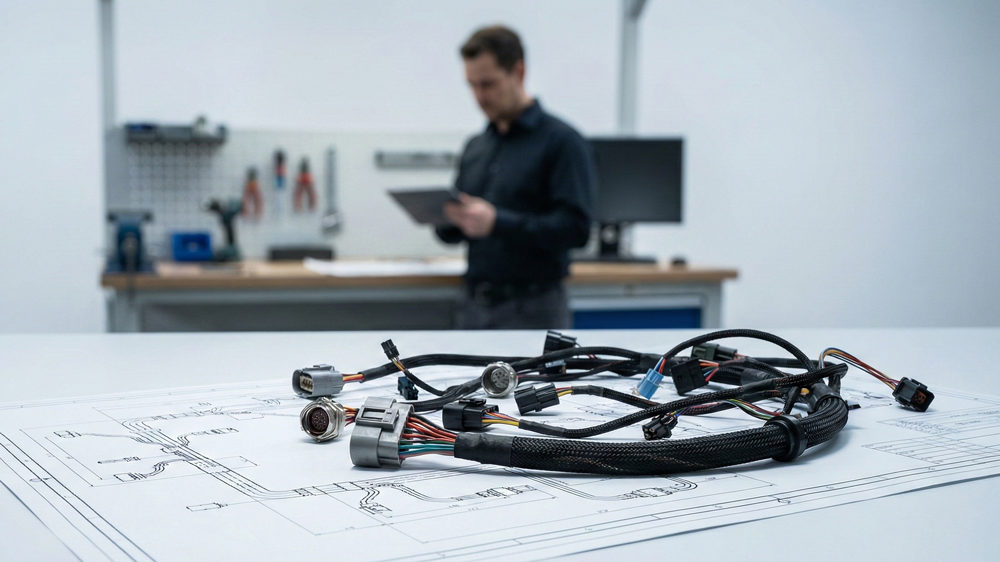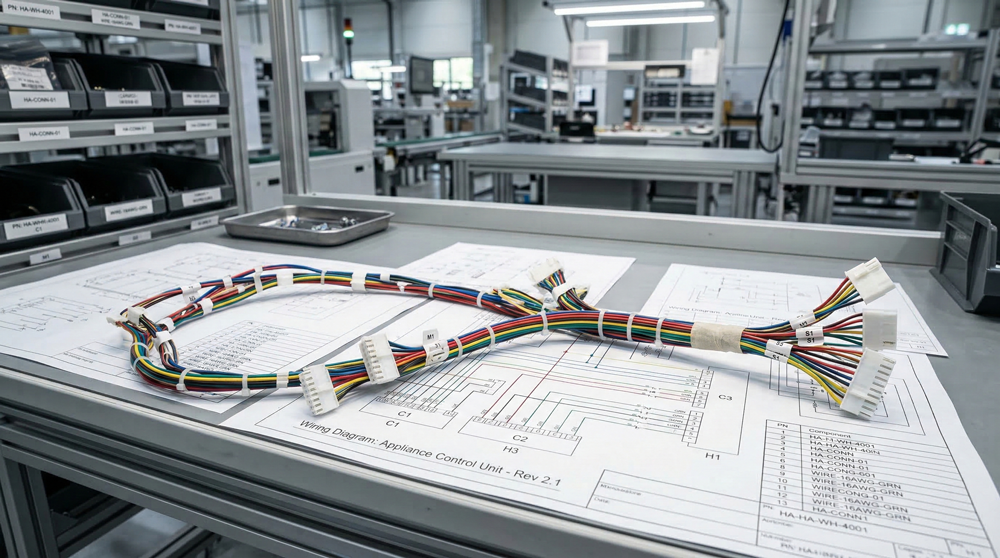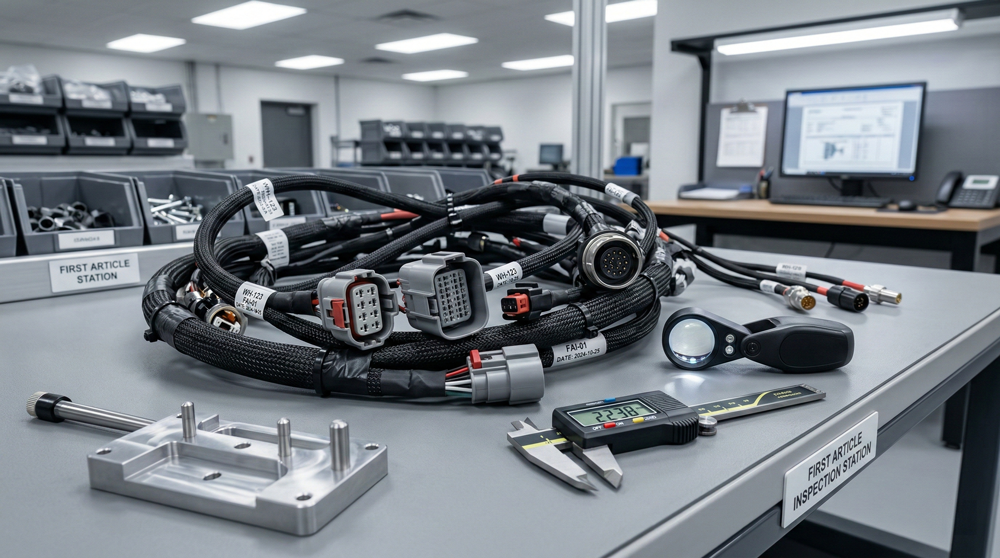
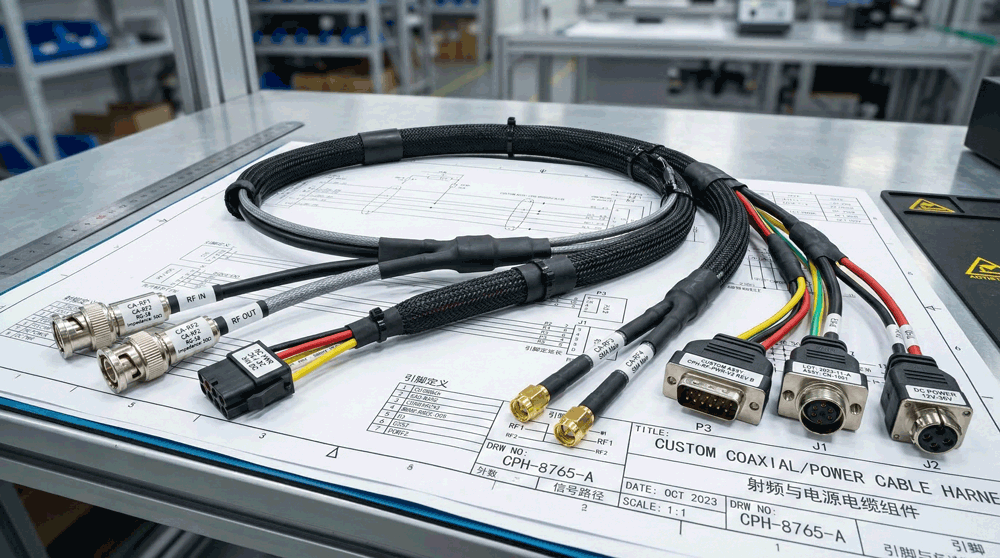
In RF systems, a cable assembly is not just a passive link between two points. It is part of the signal path, which means it can either preserve system performance or quietly degrade it. Your own RF & SMA Cable page already frames this correctly: in high-frequency systems, even small signal loss or impedance mismatch can lead to weak transmission, data corruption, and failed certifications. It also positions your RF offer around signal integrity, mechanical stability, connector precision, low MOQ, and full electrical testing.
That is why OEM buyers should treat RF cable assemblies differently from general-purpose cable builds. In a standard low-speed harness, getting the pinout and continuity right may be enough to move the project forward. In RF work, continuity is only the floor. Return loss, insertion loss, VSWR, impedance control, shielding continuity, connector fit, and routing behavior all become part of whether the finished product actually works in the field. Rohde & Schwarz specifically describes VSWR and return loss as core RF measurements, and Anritsu notes that cable insertion loss must be considered when evaluating system return-loss behavior.
Table of Contents
ToggleWhy RF cable assemblies matter more than many buyers expect
Many OEM teams underestimate RF cable assemblies because they look physically simple. A coax cable with two connectors does not appear as complex as a PCB, a radio module, or an antenna. But electrically, the cable assembly sits directly inside the performance chain. If the impedance is not controlled, if the connector transition is poor, or if the cable choice does not match the frequency and routing environment, the assembly can become a source of reflections, added loss, instability, or measurement noise. Your own RF service page already leans into this by emphasizing low VSWR, minimal return loss and insertion loss, and careful connector matching for real device specs.
This is also why RF cable assemblies tend to matter earlier in development than many buyers assume. They are not just a sourcing decision for later production. They often affect prototype debugging, certification readiness, antenna performance, enclosure layout, and even whether a team correctly diagnoses where signal degradation is really coming from. That is a practical inference from the service-page claims on your site combined with the way RF measurement companies position return loss, insertion loss, and VSWR as system-relevant rather than connector-only metrics.
What OEM buyers are really buying
When an OEM buys a custom RF cable assembly, the purchase is not only for cable and connectors. The buyer is also buying a controlled transition between interfaces, a defined impedance system, a specific shielding approach, and a manufacturing process capable of holding those choices consistently. Your RF page makes this visible by offering multiple cable families such as RG174, RG316, RG178, RG58, RG402, and low-loss coax, as well as connector combinations like SMA, MCX, TNC, BNC, Fakra, N-Type, and custom transitions. That product mix alone shows that RF cable assemblies are application-defined, not commodity-defined.
For OEM buyers, that means the first question should not be “Can you make SMA cables?” The better question is “Can you build the right RF path for this device, this frequency range, this enclosure, and this mechanical environment?” A supplier that only quotes from connector names is not doing enough. A capable RF supplier should be able to discuss cable family, connector family, shielding, bend limits, routing constraints, test method, and expected performance tradeoffs together. This is an inference drawn from the breadth of configurable elements on your RF page and from the connector-specific performance positioning published by Amphenol RF.
The main performance issues that separate RF from ordinary cable assemblies
The first is insertion loss. Every RF path loses some signal energy, and cable choice, length, connector transitions, and frequency all influence how much. Anritsu explicitly notes that cable insertion loss has to be taken into account when making system return-loss measurements, and also notes elsewhere that every connection adds to total insertion loss. For OEM buyers, this means cable assemblies should be evaluated as part of the actual signal chain, not as isolated parts.
The second is return loss and VSWR. Rohde & Schwarz highlights VSWR and return loss as foundational RF measurements, and Amphenol’s glossary notes that what is commonly measured as VSWR in the RF world is referred to as return loss in dB in CATV language. In practical terms, these metrics tell you how much of the signal is being reflected because the path is not behaving as a clean impedance match. For OEM buyers, this is why “connector installed correctly” is not enough. The transition still has to perform electrically.
The third is impedance control. Your RF page explicitly says you maintain tight impedance control and use quality coaxial cables to keep return loss and insertion loss low. That matters because impedance errors are one of the most common hidden sources of RF instability, especially when a design mixes cable types, connectors, board launches, or cramped routing. The dielectric inside the coax also matters here; Amphenol’s glossary notes that the dielectric significantly influences electrical characteristics such as impedance and capacitance.
The fourth is shielding and grounding continuity. Your RF page calls out full-braid, foil, or hybrid shielding with proper drain-wire and grounding methods, designed to block EMI and maintain stability in noisy environments. This links RF cable assemblies directly to the broader shielded-cable logic already present on your site, where EMI is framed as a system threat rather than just a cable feature. For many OEM programs, especially in industrial, telecom, automotive, and medical environments, shielding execution is not optional detail work. It is part of the RF performance baseline.
Connector choice is a system decision
A useful RF cable assembly article for OEM buyers should not pretend all connector choices are interchangeable. Different connector families solve different mechanical and electrical problems.
SMA remains one of the most practical connector families for many OEM RF builds because it combines a compact form factor with a threaded coupling that resists loosening under vibration. Amphenol RF lists SMA with 50-ohm impedance, frequency range to 18 GHz and extended-range designs to 34 GHz, and emphasizes its threaded coupling, durability, and fit for test, antenna, radar, and OEM RF interconnects. That makes SMA a strong default when buyers need a secure threaded RF interface with broad industry familiarity.
MCX is more relevant when the product needs smaller, faster, snap-on RF interfaces in tighter spaces. Amphenol positions MCX as a compact snap-on connector family with broadband performance up to 12 GHz, 50- and 75-ohm options, and a small form factor suitable for dense layouts, handheld electronics, and space-constrained builds. That makes MCX more attractive when packaging density matters more than threaded retention.
FAKRA belongs in a different conversation: automotive and other keyed, vibration-prone applications. Amphenol describes FAKRA with color-coded and keyed housings that reduce assembly errors, secure latch coupling, and vehicle-grade design suited to vibration and temperature extremes, with RF performance beyond 6 GHz and some options to 12 GHz. For OEM buyers in ADAS, GPS, telematics, and vehicle electronics, that combination matters more than generic connector familiarity.
This is why connector choice should come after application definition, not before it. The right connector is the one that fits the frequency target, impedance system, mechanical retention need, serviceability requirement, packaging limit, and mating environment together. That conclusion is a practical synthesis of the connector-specific performance information above.
Where OEM projects go wrong
One common mistake is assuming that any coax with the right connector names will be “close enough.” Your RF page already argues against this by positioning cable-family choice, connector precision, shielding strategy, and test data as real differentiators. In practice, an RF cable assembly can be wrong even when the interfaces look correct on a drawing. The hidden problems often come from wrong cable family, poor transition quality, routing stress, or test criteria that were never defined clearly enough.
Another mistake is treating RF cable assemblies like ordinary custom cable assemblies with an extra technical label. That usually leads buyers to under-specify test requirements. Your site says you can provide VSWR, insertion loss, return loss, and continuity data, and your Tests & Inspections page emphasizes continuity, insulation resistance, current-carrying capacity, dimensional inspection, durability, and environmental testing as part of broader quality control. For RF programs, buyers should turn those capabilities into explicit acceptance criteria rather than leaving the quote at “100 percent test.”
A third mistake is separating electrical performance from mechanical environment. In RF systems, those two are connected. A cable that performs acceptably on the bench may not stay stable if the connector retention is weak, the bend profile is too aggressive, or the routing changes under vibration. Amphenol’s SMA and FAKRA materials both tie connector choice to vibration resistance and real operating conditions, which is a reminder that electrical specs alone do not finish the job.
What OEM buyers should define before asking for a quote
A useful RF cable RFQ should start with the actual use case: frequency range, signal path role, device type, routing space, and whether the product is fixed, portable, automotive, outdoor, or test-oriented. Then it should define connector families and orientations, cable family or performance target, length reference, shielding expectation, and the performance metrics the supplier needs to hit. Your existing Cable Assembly RFQ Checklist already explains why missing upstream inputs lead to different products, not just different prices. In RF work, that point becomes even more important because the build path affects both signal performance and mechanical integration.
It is also worth defining what evidence the supplier should provide. In RF assemblies, the useful discussion is not just “Can you test?” but “Which measurements, at what stage, and against what target?” Your RF page says VSWR, insertion loss, return loss, and continuity data can be measured per order or per cable. That is exactly the kind of statement buyers should convert into sample approval and production-release requirements.
Final view
RF cable assemblies deserve their own sourcing logic because they influence both electrical performance and program risk. They are not just cables with expensive connectors. They are controlled RF paths whose connector family, cable family, shielding approach, impedance behavior, and test method all affect whether the product works cleanly outside the lab. Your RF service page already contains the right core positioning for this: measurable signal integrity, connector precision, cable-family flexibility, custom transitions, shielding control, and test support.
For OEM buyers, the practical takeaway is simple. Start with the signal path, not the connector name. Define the application, the mechanical environment, the performance targets, and the proof you expect from the supplier. When those inputs are clear, a custom RF cable assembly becomes much easier to quote correctly, validate early, and release with confidence.
FAQ
What makes RF cable assemblies different from standard cable assemblies
RF cable assemblies must preserve signal performance, not just electrical continuity. That means insertion loss, return loss, VSWR, impedance control, shielding, and connector transitions matter much more than they do in many ordinary cable builds.
Why do OEM buyers often choose SMA cable assemblies
SMA offers a compact 50-ohm interface with threaded coupling, strong vibration resistance, broad industry familiarity, and frequency capability from DC to 18 GHz, with extended-range options higher than that.
When is MCX a better choice than SMA
MCX becomes attractive when space is tighter and fast snap-on mating is more useful than threaded retention. It is positioned as a compact broadband connector family for dense layouts and small RF interconnects.
When should OEM buyers use FAKRA
FAKRA is especially relevant in automotive and similar keyed, vibration-prone applications where color coding, keyed interfaces, secure latch retention, and vehicle-grade robustness matter.
What test data should buyers ask for on RF cable assemblies
At minimum, buyers should consider continuity plus RF-relevant measurements such as VSWR, insertion loss, and return loss, then match those checks to the prototype, validation, and production stages of the program.
If your project depends on stable RF transmission, do not start with connector names alone. Start with the signal path, routing space, mechanical environment, and acceptance targets, then work backward into the right custom build. You can naturally connect this article to RF & SMA Cable, Shielded Cable Assemblies, Tests & Inspections, and Cable Assembly RFQ Checklist for Faster Sourcing.
Related articles
How to Specify SMA Cable Assemblies for OEM Projects
VSWR, Insertion Loss, and Return Loss in RF Cable Assemblies
How to Choose RF Connectors for Custom Cable Assemblies