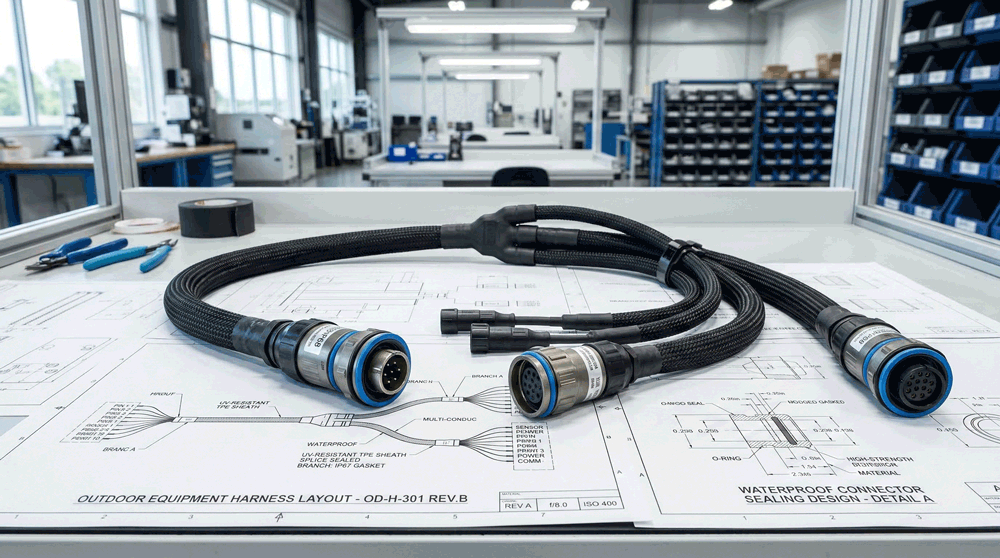
How to Quote a Wire Harness from Samples, Photos, or an Old Harness
Many OEM buyers need to quote a wire harness from sample parts, photos, or an old harness because the original drawing is missing, incomplete, outdated, or controlled by a previous supplier. This is a very common situation in custom wire harness and custom cable assembly projects. A buyer may have a working sample, a damaged harness removed from equipment, a few photos from the assembly line, or an old part that needs to be rebuilt for aftermarket service. However, they may not have a complete drawing, BOM, pinout table, or formal engineering package.
This does not mean the project cannot move forward. A professional wire harness manufacturer can usually start the quotation process from a sample, photos, sketches, or an old cable harness assembly. The key is to understand what information can be identified from the sample and what information still needs to be confirmed before quotation, prototype, or production.
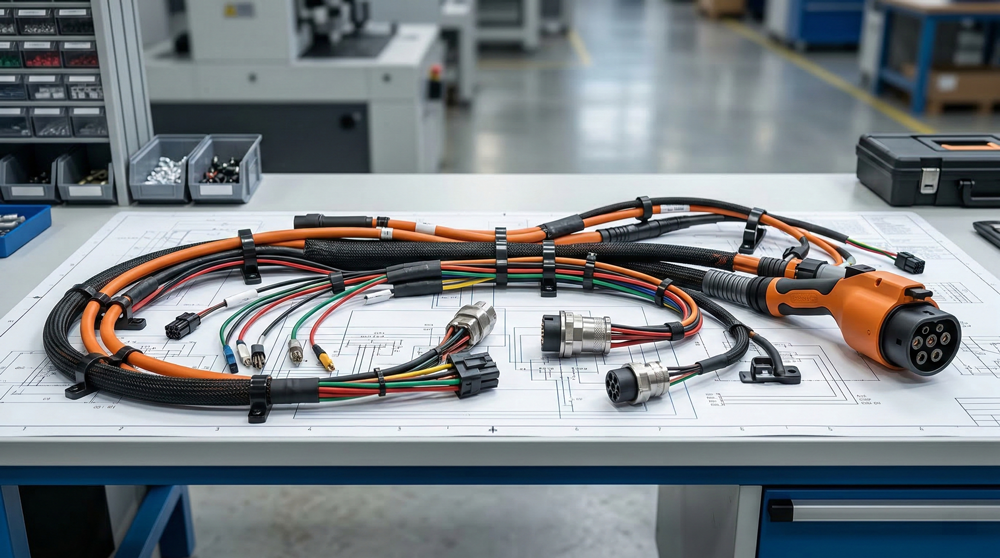
A physical sample can show connector shape, wire routing, branch layout, wire colors, protective materials, labels, sleeves, heat shrink, and general workmanship. Clear photos can also help a supplier understand the basic structure before a sample is shipped. But some of the most important details are not visible from the outside. Pinout, current, voltage, signal type, shielding requirements, environmental conditions, and test standards should never be guessed only from appearance.
This article explains how to prepare an RFQ when you only have a sample, photos, or an old harness. It also explains how a supplier reviews sample-based projects, what information affects quotation accuracy, and how OEM buyers can reduce risk before moving into prototype or production.
Table of Contents
ToggleWhy Many Custom Wire Harness Projects Start Without Complete Drawings
In an ideal project, an OEM buyer would send a complete technical package to the supplier before requesting a quotation. That package would include a 2D harness drawing, BOM, connector and terminal part numbers, wire specifications, pinout table, label requirements, testing standards, target quantity, packaging requirements, and revision history. With this information, a supplier can quote more accurately and build samples with fewer rounds of clarification.
In real projects, the starting point is often less complete. Many wiring harness projects begin with only a sample or an old part. A machine may have been designed years ago, and the original documentation may no longer be available. A previous supplier may have built the harness but never provided the production drawing. A product may have started from a hand-built prototype, and the cable assembly was never converted into a formal engineering file. In other cases, a service team may need replacement wire harnesses for older OEM equipment, but the only reference is a used harness removed from the field.
This is especially common when a customer is switching suppliers, repairing discontinued equipment, preparing spare parts, developing a new version of an existing product, or trying to reduce dependence on a single source. In these situations, the buyer may not be looking for a theoretical design guide. They need a practical quotation path.
A good custom wiring harness manufacturer should be able to work with imperfect information. The supplier should not simply reject the project because the drawing is missing. At the same time, the supplier should not make unsafe assumptions just to issue a fast price. The right process is to use the sample as a starting reference, identify what is clear, list what is still unknown, and help the customer move toward a production-ready package.
What a Physical Wire Harness Sample Can Tell the Supplier
A physical sample is usually the best starting point when drawings are missing. Compared with photos, a real sample allows the supplier to inspect details more accurately. The manufacturer can measure the total length, check branch dimensions, review connector orientation, inspect wire colors, look for printed markings, and study how the harness is protected.
A sample also helps the supplier understand workmanship. For example, a harness may use braided sleeve, corrugated tube, PVC tubing, spiral wrap, heat shrink, cable ties, adhesive labels, overmolded strain relief, or special routing protection. These details affect material cost, labor time, assembly process, inspection method, and final quotation. They are difficult to understand fully from a short written description.
Connector identification is another reason a physical sample is valuable. Many connectors look similar in photos, but small differences can make them incompatible. The pitch, locking tab, keying direction, seal structure, terminal series, and mating interface all matter. If the original connector part number is not available, the supplier may need to compare the sample with known connector series or check the mating side of the equipment.
However, a sample should not be treated as a perfect engineering document. A used harness may be bent, stretched, repaired, modified, contaminated, or damaged. An old harness may not represent the latest revision. A prototype harness may work in one unit but still lack repeatable production documentation. Therefore, the supplier can use the sample to build a preliminary understanding, but the final quotation and sample build should still be based on confirmed information.
What Photos Should Show Before You Send a Sample
Photos can be useful when the buyer wants a preliminary review before sending a physical sample. They can help the supplier judge whether the project is simple or complex, whether the connectors are identifiable, and what information is still needed. But for photos to be useful, they should be taken for engineering review, not just for general appearance.
The first photo should show the full harness from end to end. The harness should be placed on a clean surface, with branches naturally arranged and not hidden under each other. A ruler or measuring tape beside the harness is helpful because it gives the supplier a sense of scale. This overview photo helps the manufacturer understand the overall structure and number of branches.
Connector photos are even more important. Each connector should be photographed from the mating face, side view, rear view, and wire exit direction. The mating face helps identify cavity count, pin arrangement, keying, and connector family. The rear view helps show seals, strain relief, wire entry, and terminal layout. If the mating connector, PCB header, sensor interface, or device socket is available, photos of that side are also helpful.
Wire markings should also be photographed clearly. Printed marks on the cable jacket may show wire gauge, insulation type, temperature rating, voltage rating, UL style, manufacturer code, or material information. If the harness has labels, tags, serial numbers, part numbers, revision markings, or color codes, these details should be shown clearly because they may be part of the OEM assembly or service process.
Branch points should not be ignored. If the harness splits into several directions, the supplier needs to see where each branch starts, how it is protected, and whether heat shrink, tape, sleeve, or conduit is used. In custom cable assemblies, breakout geometry often affects installation. A branch that is only 20 mm too short may create assembly stress, while an unclear breakout position may lead to inconsistent production.
Photos can support early communication and may be enough for a rough estimate on simple cable assemblies. For complex harnesses, replacement parts, supplier transition projects, or production orders, a physical sample is still usually the safer reference.
What Cannot Be Safely Guessed from a Sample or Photo
The biggest risk in sample-based wire harness quotation is assuming that visible details are enough. They are not. A wiring harness is not only a physical bundle of wires and connectors. It is part of an electrical and mechanical system. Many important requirements are invisible from the outside.
Pinout is the first major risk. A supplier may be able to trace wires from one connector to another, but the customer should still confirm the correct circuit relationship. Wire color alone is not a reliable pinout standard. Two harnesses may use similar colors but different electrical functions. A wrong pinout can cause equipment failure, communication errors, sensor problems, short circuits, or damage to electronic components.
Electrical load is another detail that cannot be guessed safely. The same-looking wire may carry low-current signal, DC power, motor current, communication data, sensor output, or mixed circuits. Current, voltage, duty cycle, and signal type affect wire gauge, insulation, shielding, twisting, routing, and test requirements. A supplier can inspect the wire used in the old harness, but that does not always prove it is correct for the new project.
Material requirements also need confirmation. A sample may show the general insulation or jacket type, but it may not fully confirm temperature rating, oil resistance, flame rating, UV resistance, flexibility, abrasion resistance, or compliance requirements. A cable assembly used inside a clean indoor device has different material requirements from one installed in outdoor machinery, agricultural equipment, industrial automation, medical equipment, or battery systems.
Testing standards should also be clarified before final quotation. A simple cable harness may only need continuity and short-circuit testing. A high-reliability harness may require HiPot testing, insulation resistance testing, shielding continuity, pull force verification, functional testing, or customer-specific inspection. If the buyer does not define the required tests, different suppliers may quote very different prices because they are not quoting the same quality level.
How to Prepare an RFQ Without a Complete Drawing
When you do not have a complete drawing, the goal is not to make the RFQ perfect before contacting a supplier. The goal is to provide enough useful information for the supplier to review the project and identify the missing items clearly.
Start with the application. Explain where the harness is used and what type of equipment it belongs to. A short description such as “This wiring harness is used inside an industrial control cabinet,” “This cable assembly connects sensors on outdoor machinery,” or “This harness is a replacement part for existing OEM equipment” gives the supplier important context. Application information helps the supplier think about material, protection, routing, labeling, and inspection requirements.
Next, explain the status of the sample. A supplier needs to know whether the sample is a new approved part, an old harness removed from equipment, a damaged part, a prototype, or a previous supplier’s production sample. These situations are not the same. An approved sample may be copied more directly, while a damaged or old sample may require more verification.
Quantity is also important. A 5-piece prototype order, a 100-piece pilot run, and a 10,000-piece annual production project require different quotation logic. For very small quantities, the supplier may focus on flexible production and low setup cost. For higher quantities, the supplier may need to consider tooling, fixtures, formboards, test jigs, material planning, and production efficiency.
Even if there is no formal drawing, a simple sketch is useful. It can show total length, branch length, connector position, label position, and installation direction. A hand-drawn sketch is better than no drawing. The supplier can later convert the information into a clearer drawing, but the sketch reduces misunderstanding at the quotation stage.
Pinout information should be provided whenever possible. If the customer does not have a pinout table, the supplier may trace the sample, but the traced result should be approved by the customer. In many sample-based projects, pinout confirmation is the difference between a useful quotation and a risky guess.
How a Supplier Reviews a Sample-Based Wiring Harness Project
A professional supplier normally reviews a sample-based RFQ in several layers. The first layer is structural review. The supplier studies the harness layout, connector quantity, branch points, total length, wire count, protection materials, labels, and assembly complexity. This helps estimate the labor and material structure of the quotation.
The second layer is component identification. The supplier checks connectors, terminals, wires, sleeves, tubes, heat shrink, seals, and other materials. If exact part numbers are available, the quotation can be more accurate. If the part numbers are unknown or the components are obsolete, the supplier may need to search for equivalent parts or ask the customer to approve alternatives.
The third layer is electrical and application review. The supplier should consider whether the visible design matches the intended use. For example, if a harness is used in outdoor machinery, the supplier may ask about waterproofing, UV exposure, abrasion, vibration, and field repair. If it is used in medical diagnostic equipment, the supplier may ask about cleanliness, signal stability, labeling, and documentation. If it is used in industrial automation, the supplier may review shielding, grounding, and connector locking.
The fourth layer is risk clarification. A good supplier should explain which items are confirmed and which items are assumed. For example, the supplier may state that the quotation is based on standard continuity testing, a certain wire gauge, a specific connector series, or a certain order quantity. This avoids misunderstanding and helps the buyer compare quotations correctly.
A fast price is not always a good price. If the quotation is based on too many assumptions, the project may later face price changes, sample failures, lead time delays, or production risks. A structured review may take more effort at the beginning, but it usually saves time later.
When Reverse Engineering Is Needed
Reverse engineering is often needed when the buyer has an old harness but no drawing, BOM, or pinout file. In this process, the supplier studies the sample and creates a new technical reference. This may include measuring the harness, identifying connectors, tracing wires, recording wire colors, checking labels, reviewing sleeves or protection materials, and preparing a preliminary drawing and BOM.
Wire harness reverse engineering can be very useful for replacement parts, supplier transition projects, and older equipment. It allows the buyer to rebuild documentation that may have been lost or never created. It can also help convert a hand-made prototype into a more repeatable production design.
However, reverse engineering should be handled carefully. An old harness may not be the latest version. It may have been repaired in the field. It may include substitute parts. It may be damaged or deformed. If the old harness failed because of poor strain relief, weak protection, or incorrect routing, copying it exactly may repeat the same problem.
For this reason, reverse engineering should not jump directly from old sample to mass production. The better process is sample review, preliminary drawing, BOM preparation, prototype build, customer approval, and then production. This creates a controlled path from incomplete information to repeatable manufacturing.
Why an Old Harness Should Not Always Be Copied Exactly
Many buyers ask for an old wire harness replacement quote and expect the supplier to copy the existing part exactly. In some projects, exact copying is necessary. If the harness is a replacement part for installed equipment, the new harness must fit the same connectors, routing space, mounting points, and electrical interfaces. Compatibility is the priority.
In other projects, exact copying may not be the best choice. The old harness may have design weaknesses that were accepted years ago but should not be repeated. A branch may be too short for easy installation. A connector may be obsolete or have a long lead time. A wire exit may lack strain relief. A sleeve may not provide enough abrasion protection. A label may be unclear for service technicians. A certain material may no longer meet the customer’s current compliance requirements.
A supplier should not change the design without approval. However, the supplier should point out visible risks when reviewing the sample. This is one of the values of working with an experienced custom cable assembly manufacturer. The project may begin as a simple replacement request, but it may become an opportunity to improve reliability, installation efficiency, sourcing stability, or future serviceability.
The right decision depends on the project purpose. If the goal is direct replacement, the new harness should match the old part as closely as required. If the goal is new production, supplier transition, or product improvement, the buyer may benefit from reviewing the old design before freezing it again.
Sample Approval Before Production
Sample approval is especially important when the quotation starts from photos, sketches, or an old cable harness. The first sample is not only a visual reference. It should be used to confirm fit, function, pinout, installation, material, labeling, and testing.
A sample should be installed in the actual equipment whenever possible. This is the best way to check whether the total length is correct, whether the branches reach the right locations, whether the connectors mate properly, and whether the harness can be routed without stress. A harness that looks correct on a table may still be difficult to install inside a compact product or machine.
Electrical confirmation is equally important. Continuity and pinout testing should verify that every circuit is connected correctly. If the harness carries higher voltage or requires insulation protection, the agreed test method should be applied. If shielding is required, the customer and supplier should confirm how shield continuity and grounding are handled.
Any sample changes should be documented clearly. Verbal changes or scattered email comments can easily create confusion later. The approved drawing, BOM, pinout, sample, and quotation should all match before production begins. This is especially important when the buyer plans repeat orders or supplier transition.
Practical RFQ Checklist for Sample-Based Projects
Although most of this article is written in paragraph form, a short checklist is useful for buyers preparing a sample-based RFQ. Before asking a supplier to quote, try to prepare the following information:
- Physical sample or clear photos from multiple angles
- Application and installation environment
- Estimated quantity for prototype, pilot run, and production
- Total length and branch length, even if approximate
- Connector photos, part numbers, or mating interface information
- Pinout table or approval for the supplier to trace the sample
- Current, voltage, and signal type
- Wire gauge, wire color, and material preference, if known
- Shielding, sleeve, conduit, heat shrink, or strain relief requirements
- Testing requirements such as continuity, HiPot, insulation resistance, or functional test
- Labeling, kitting, and packaging requirements
- Required lead time and shipping destination
You do not need to have every item ready before contacting a supplier. However, each confirmed detail reduces uncertainty. The more complete the RFQ is, the more accurate the quotation will be.
How Infinite Possibilities Supports Sample-Based Wire Harness Projects
Infinite Possibilities supports OEM customers who need custom wire harnesses and custom cable assemblies from samples, photos, sketches, old harnesses, or incomplete drawings. Many real projects do not begin with perfect documentation. Our role is to help customers organize the available information, identify what is missing, and move toward a practical quotation and prototype plan.
For sample-based projects, we can review harness structure, identify connectors, measure key dimensions, prepare preliminary drawings, create BOMs, build prototype samples, and support low MOQ production. We can also help customers improve documentation when they are replacing an old supplier, rebuilding replacement parts, or preparing for repeat orders.
Our production support includes custom wiring harness manufacturing, cable assembly development, old harness replacement, supplier transition support, low-volume production, prototype builds, and 100% continuity and pinout testing. If your project starts only with photos or an old sample, we can still begin the review. The important point is to separate confirmed information from assumptions and resolve the key risks before production.
Final View
It is possible to quote a wire harness from a sample, photos, or an old harness, but the process should be handled carefully. A sample can show many useful physical details, including connector shape, wire routing, branch layout, protective materials, labels, and workmanship. Photos can support early communication and help a supplier understand the basic structure.
However, the most important quotation risks are often invisible. Pinout, current, voltage, signal type, material grade, environmental exposure, and testing standards must be confirmed before production. A professional supplier should help identify these missing details instead of guessing them.
For OEM buyers, the best approach is to provide the available sample or photos, explain the application, confirm the quantity, share any pinout or electrical information, and work with the supplier to create a clear drawing and BOM before production. This process helps reduce quotation errors, sample revisions, production delays, and quality risks.
A good wire harness quote is not only a price. It is a structured review of the product, application, materials, risks, and production requirements behind the harness.
FAQ
1. Can a supplier quote a wire harness from photos only?
Yes, a supplier can often provide an initial estimate from clear photos, especially if the harness is simple. However, photos are usually not enough for final production. The supplier will still need dimensions, connector details, pinout, electrical requirements, quantity, and testing standards.
2. Can I get a custom wire harness quote without a drawing?
Yes. A custom wire harness project can start from a physical sample, old harness, sketch, or photos. The supplier can help create a preliminary drawing and BOM, but the final version should be approved before production.
3. What is the most important missing information in sample-based RFQs?
Pinout is usually the most important missing information. Connector details, current, voltage, signal type, wire gauge, environmental conditions, and testing requirements are also critical for accurate quotation and safe production.
4. Can an old wire harness be reverse engineered?
Yes. A manufacturer can measure the harness, identify connectors, trace wires, record labels, and prepare a new drawing and BOM. However, the customer should approve the final drawing, pinout, and sample before production begins.
5. Should an old harness always be copied exactly?
Not always. If the harness is a direct replacement part, exact compatibility may be required. If the project is moving into new production, the supplier may recommend improvements for strain relief, material availability, labeling, protection, or assembly efficiency.
CTA
Need to quote a custom wire harness from a sample, photos, or an old harness?
Send us your sample photos, application details, estimated quantity, pinout information, and any available sketches or drawings. Our team will review the project and help you move from sample evaluation to quotation, prototype, and production.
Contact Infinite Possibilities for a Custom Wire Harness Quote
Related Articles
- Supplier Transition Guide for Custom Wire Harness Projects
- Wire Harness Replacement Parts for OEM Aftermarket and Service Teams
- How to Reduce Wire Harness Lead Time Without Increasing Quality Risk
- Connector Availability and Approved Alternates in Custom Harness Projects
Series
Wire Harness RFQ and Supplier Transition Guide
This is the pillar article of the series. The following supporting articles will expand on supplier transition, OEM replacement parts, lead time reduction, and connector availability management.