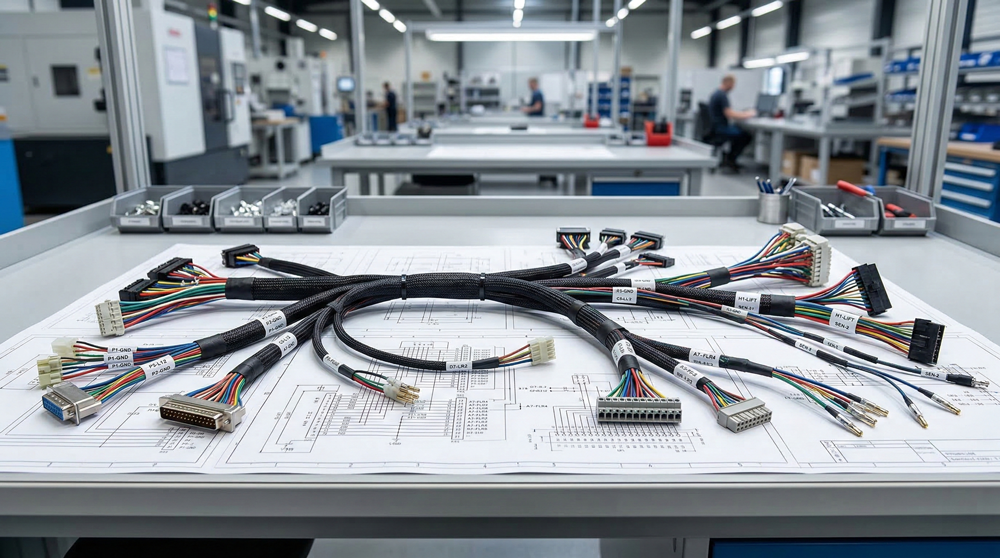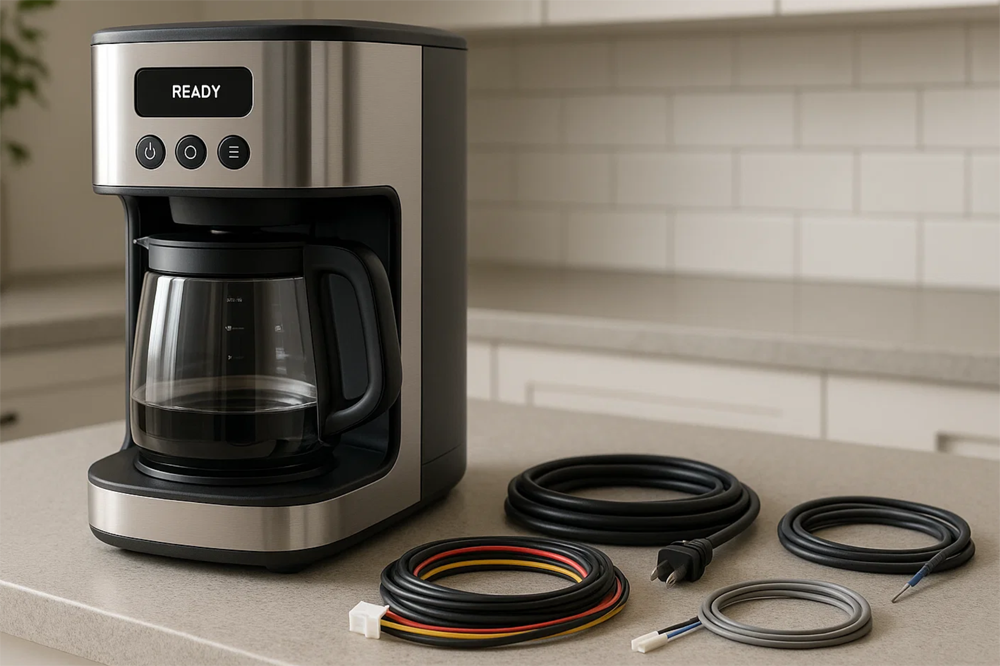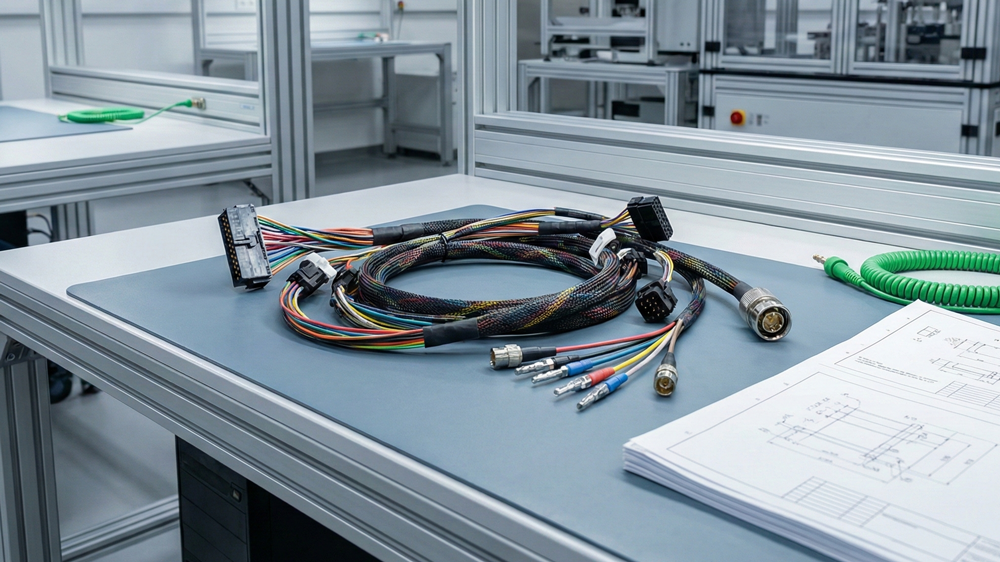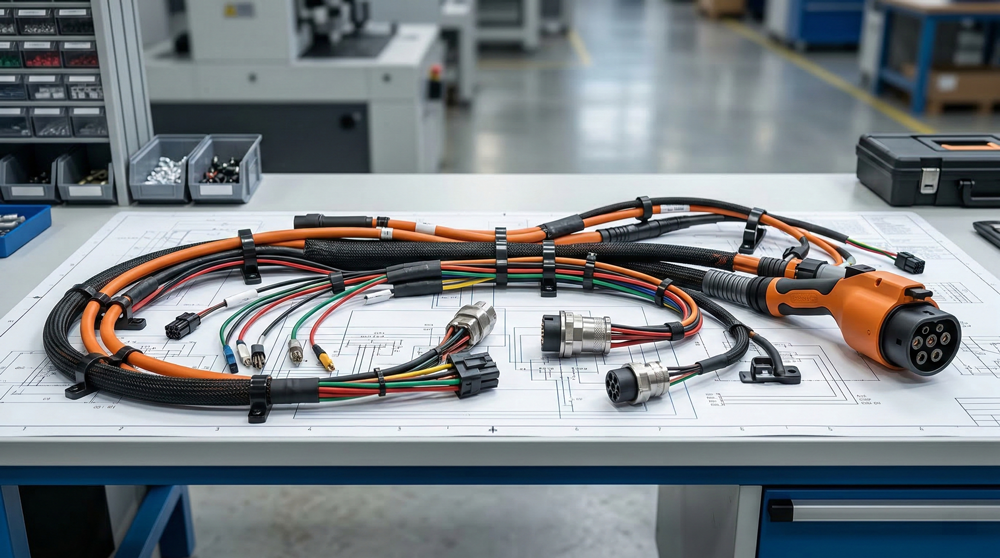
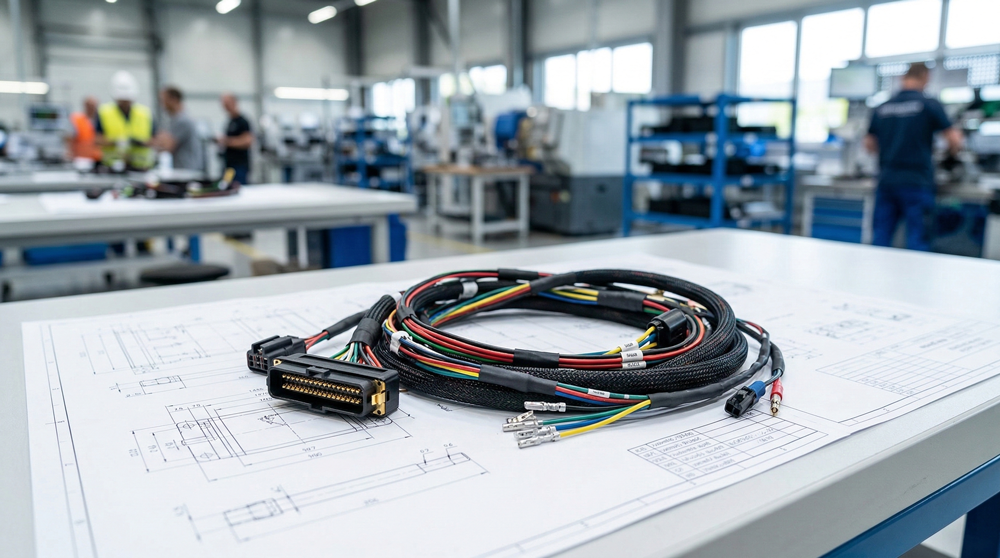
Industrial power cords are not ordinary supply cables. In machine equipment, they are part of the working power path that must carry current safely, tolerate the environment, fit the machine layout, and remain reliable through installation, operation, and service. Your Custom Power Cord page already positions this category around low- and high-voltage power harnesses, heat-resistant insulation, secure crimping, and full electrical testing for industrial machines, electric vehicles, energy storage systems, and heavy-duty electronics.
That positioning matters because industrial machines create different risks from office electronics or simple appliances. A power cord may be exposed to cabinet heat, motor vibration, oil mist, abrasion, repeated service access, tight routing, or high startup current. Your Industrial & Robotics page also frames industrial wiring around clean power distribution, signal communication, panel-to-device connections, conveyors, automation, AGVs, and high-uptime environments, which is exactly where power-cord decisions become engineering decisions rather than catalog choices.
Table of Contents
ToggleWhy They Matter
In industrial machines, downtime is expensive. A weak power cord can create more than a replacement cost. It can delay commissioning, stop a machine, damage customer confidence, or force a rushed redesign after the equipment has already entered pilot or production. Your site’s industrial equipment content makes this point clearly for cable assemblies in general: a cable assembly that works on the bench but fails under vibration, bending, oil mist, repeated mating, or cabinet heat is not a low-cost choice; it is a future downtime event.
Industrial power cords therefore need to be specified around the machine, not around the cord appearance. The buyer should define the equipment load, target market, routing path, operating temperature, environment, strain relief, termination method, and release tests. If those inputs are vague, the supplier may still quote quickly, but the first sample may not represent the real machine requirement.
Know the Machine
The first useful question is: what kind of machine is this power cord supporting? A cord for a control cabinet is not the same as a cord for a motor-driven unit, heating system, conveyor, compressor, inverter, battery cabinet, or outdoor industrial device. Your Electric Wire Harness page identifies industrial electrical control, heavy-duty motors, control panels, PLC-based equipment, energy storage, inverter cabling, and high-voltage distribution lines as demanding power-distribution environments.
For OEM buyers, this means the application should appear at the beginning of the RFQ. The supplier needs to understand whether the power cord is feeding the entire machine, connecting a module, linking a power supply, serving a motor, entering a cabinet, or supporting field-service replacement. That application context changes the cable, connector, jacket, routing, testing, and documentation strategy.
Load Comes First
Industrial power cord selection should begin with voltage, current, and duty cycle. Interpower’s guidance states that amperage and voltage requirements are crucial when selecting a power cord or cord set, and that different amperage levels can change plug patterns and cable size.
The key point is that a power cord should not be specified only as “2 meters, black jacket, with plug.” The supplier needs to know what current the cord will carry, whether the load is continuous or intermittent, whether the machine has startup current, and whether the cord is used in a confined cabinet or open installation. A cord that is acceptable during a short bench test may behave differently under long operating cycles or high ambient temperature.
Ratings Must Align
A power cord assembly is only as strong as its lowest-rated component. Interpower explains that the rating of a cord set is limited by the lowest-rated component, whether that component is the plug, cable, or connector.
This is one of the most important sourcing lessons for industrial buyers. A higher-rated cable does not make the whole assembly safe if the connector is underrated. A robust plug cannot compensate for an undersized conductor. A secure-looking terminal may still be wrong if its current rating, contact area, or crimp quality does not match the machine requirement. The RFQ should define the required rating for the complete assembly and ask the supplier to confirm that every component in the path supports it.
Gauge Is a Tradeoff
Wire gauge is often discussed as a cost issue, but in industrial machines it is really a current, heat, flexibility, and layout issue. Interpower notes that amperage affects cable size, and different destination markets may also affect voltage and amperage requirements.
If the gauge is too small, the cord may create voltage drop or heat rise. If it is too large, it may become stiff, hard to route, and more expensive than needed. The right gauge depends on current, cable length, installation method, ambient temperature, conductor count, and whether the cable is bundled or exposed. For OEM buyers, the better approach is to provide the actual load and routing conditions, then confirm the wire gauge with the supplier instead of choosing from habit.
Heat Is Central
Heat is one of the most common industrial power-cord risks because it may not appear in a quick sample check. A cord can pass continuity, fit the connector, and still run too warm when the machine operates for long cycles. Heat can come from current, conductor size, contact resistance, ambient temperature, bundling, cabinet enclosure, nearby motors, heaters, power supplies, inverters, or battery systems.
LAPP’s cable guide includes current-rating reference tables and notes that cable current ratings depend on technical regulations and application conditions. For buyers, the lesson is clear: do not let the supplier design the cord without temperature and installation context. A power cord used inside a hot machine cabinet needs a different risk review from one used in open air. If the cord is close to a motor housing, heater, inverter, compressor, or battery cabinet, the RFQ should say so.
Material Must Match
Industrial environments can be harsh on cable jackets. LAPP’s cable guide shows that material choices can relate to abrasion resistance, cut resistance, rubber flexibility, oil resistance, and halogen-free requirements. LAPP Tannehill also notes that oil-resistant wire, cable, and connectivity solutions should be considered in industrial settings to help reduce maintenance costs and machine downtime.
For industrial machines, this means jacket selection should start with the working environment. Will the cord face lubricating oil, cutting fluid, coolant, dust, abrasion, cleaning agents, hot water, UV, or repeated handling? Will it be dragged, tied, clamped, moved, or exposed near rotating equipment? “PVC jacket” or “black cable” is not enough information. The buyer should explain the environment so the supplier can recommend the right material system.
Terminations Matter
Many industrial power-cord problems begin at the termination. A cord may use a molded plug, ring terminal, spade terminal, quick-disconnect terminal, IEC connector, appliance connector, panel connector, custom plug, or internal harness interface. Your Custom Power Cord page emphasizes secure crimping and full electrical testing, which is the right focus because termination quality directly affects reliability.
The RFQ should define the termination style, mating connector, polarity, grounding, crimp requirement, terminal material if known, overmold or boot requirement, and strain-relief method. It should also define whether the cord is factory-installed, field-connected, detachable, or serviceable. A terminal that is acceptable for a one-time internal connection may not be suitable for repeated service access or harsh handling.
Routing Is Design
Routing is not a factory detail. In industrial machines, routing affects heat, abrasion, bend radius, strain relief, installation time, and serviceability. Your Custom Cable Assemblies page notes that cables can be cut, stripped, and routed to exact dimensions for plug-and-play assembly, and that wire gauge can be tailored to current, signal, and space requirements.
For power cords, the buyer should define entry and exit points, length reference, bend path, clamp locations, panel openings, grommets, nearby heat sources, moving parts, and whether the cord is bundled with other cables. This is especially important for industrial machines because internal space may look generous on a drawing but become crowded after motors, drives, fans, panels, guards, cable trays, and service doors are added.
Oil and Abrasion
Many industrial machines work near oil, coolant, cutting fluid, grease, dust, or rough surfaces. LAPP describes oil-resistant products as suited for exposure to lubricating, cutting, and cooling oils, chemical cleaners, and hot water. This is relevant because the wrong jacket material can age, swell, crack, stiffen, or lose mechanical protection faster than expected.
For OEM buyers, oil and abrasion should not be discovered after the first field complaint. If the cord will be installed near machine tools, hydraulic units, compressors, conveyors, or food-processing equipment, the RFQ should mention the likely exposure. The supplier can then discuss jacket choice, protective sleeves, routing changes, molded strain relief, or conduit protection. LAPP notes that protective conduit systems can add dimensional stability, abrasion resistance, impact resistance, strain relief, flexibility, and sealing.
Panels and Motors
Industrial machines often combine power cords with control panels, motors, PLC-related equipment, drives, and sensor systems. Your Industrial & Robotics page describes harness kits for clean power distribution, signal communication, and panel-to-device connections, and your Electric Wire Harness page specifically references heavy-duty motors, control panels, PLC-based equipment, and high-voltage distribution in demanding energy systems.
That matters because power cords rarely operate alone. They may run near signal cables, control cables, shielded cables, or data lines. In some machines, the buyer may need to coordinate power routing with signal integrity and grounding strategy. Your Control Cable Assemblies page describes control cable assemblies as important for automation and intelligent equipment where delay or interference can lead to system instability. For industrial equipment, power and control wiring should therefore be planned together when routing space or interference risk matters.
Testing by Risk
Industrial power cords should be tested according to risk. At minimum, buyers should define continuity, polarity, visual inspection, dimensional checks, and termination inspection. Depending on the application, they may also need insulation resistance, dielectric testing, pull-force testing, crimp inspection, heat-related review, or strain-relief checks. Your Tests & Inspections page supports this broader approach by listing practical inspection items such as pull-force testing, continuity and short testing, and crimp inspection for cable assembly quality control.
The biggest mistake is writing only “100% tested.” That phrase is not specific enough. Buyers should state which checks apply to prototypes, which apply to pilot builds, and which apply to production release. A prototype should prove the design. A pilot build should prove repeatability. Production testing should screen the real failure modes that matter for the released machine.
Plan Service
Industrial machines often have a longer service life than consumer devices. A power cord may be touched again during maintenance, replacement, machine relocation, upgrades, or field repair. That means serviceability should be part of the design. If technicians need to disconnect the cord, replace a module, or access a panel, the connector style, labeling, strain relief, and routing path all matter.
Your industrial content emphasizes high uptime environments and panel-to-device connections, which implies that maintenance clarity is part of the product value. A cord that is cheap but hard to identify, hard to remove, or easy to reinstall incorrectly can increase service time and create repeat faults. OEM buyers should define labels, color coding, terminal identification, and connector keying when service access is expected.
Supplier Inputs
A useful industrial power-cord RFQ should include the machine type, target market, voltage, current, duty cycle, wire gauge if known, jacket requirements, plug or termination details, grounding, routing path, heat exposure, oil or abrasion exposure, strain relief, test requirements, and volume expectations. The homepage of Infinite Harness positions the company around custom wire harness and cable assembly support for OEMs, equipment manufacturers, and industrial buyers needing prototypes, low-volume orders, and ongoing production.
This is valuable because industrial power cord sourcing often begins before every detail is finalized. A capable supplier should be able to review the application, ask the right technical questions, and help convert machine requirements into a buildable specification. That does not mean the supplier should guess. It means the buyer and supplier should use the RFQ stage to remove hidden assumptions.
RFQ Checklist
A practical RFQ for industrial power cords should cover the following items.
| RFQ item | What to define |
|---|---|
| Machine type | Motor, panel, inverter, heater, cabinet, module |
| Electrical load | Voltage, current, power, duty cycle |
| Market | Country, region, plug or compliance path |
| Cable | Gauge, conductor count, grounding |
| Material | Heat, oil, abrasion, coolant, UV, chemicals |
| Termination | Plug, terminal, connector, polarity, crimp |
| Routing | Length, entry point, bend path, enclosure |
| Protection | Strain relief, grommet, boot, sleeve, conduit |
| Testing | Continuity, polarity, crimp, pull, insulation |
| Production | Prototype, pilot, volume, records, packaging |
This table should not replace engineering review, but it prevents the most common sourcing problem: asking the supplier to quote a cord without enough context to design one correctly.
Final View
Industrial power cords should be specified as machine power assemblies, not as generic cables. They must support the load, match the rating path, survive heat, tolerate the environment, fit the routing space, hold the termination securely, and pass a test plan that reflects the machine’s real risks.
For OEM buyers, the practical lesson is simple: define the machine condition before defining the cord. When voltage, current, duty cycle, temperature, routing, materials, terminations, and testing are clear, the supplier can build a safer and more reliable power path. When those details are left vague, the project may save time during quotation but lose far more time during sampling, commissioning, or field support.
FAQ
What makes industrial power cords different from ordinary power cords?
Industrial power cords often face higher loads, cabinet heat, oil, abrasion, vibration, service access, and harsher routing conditions than ordinary cords. They should be specified around machine requirements, not only plug type and length.
What should buyers define first?
Start with voltage, current, duty cycle, machine type, and target market. These inputs affect cable size, rating, plug or connector choice, material, and testing.
Why does wire gauge matter?
Wire gauge affects current capacity, heat rise, voltage drop, flexibility, routing, and cost. Amperage requirements affect cable size, so gauge should be tied to the equipment load.
What material risks matter most?
Common industrial risks include heat, oil, abrasion, coolant, cleaning chemicals, UV, and repeated handling. Jacket materials should be chosen around the actual machine environment.
What should be tested?
At minimum, buyers should define continuity, polarity, visual inspection, dimensional checks, and termination inspection. Higher-risk applications may also need insulation, dielectric, pull-force, or crimp checks.
CTA
If your industrial machine needs a custom power cord, do not start with length and connector photos alone. Define the machine load, heat conditions, material exposure, routing path, termination method, and test plan first. For related capabilities, see Custom Power Cord, Electric Wire Harness, Custom Cable Assemblies, Tests & Inspections, and Quality Guarantee.