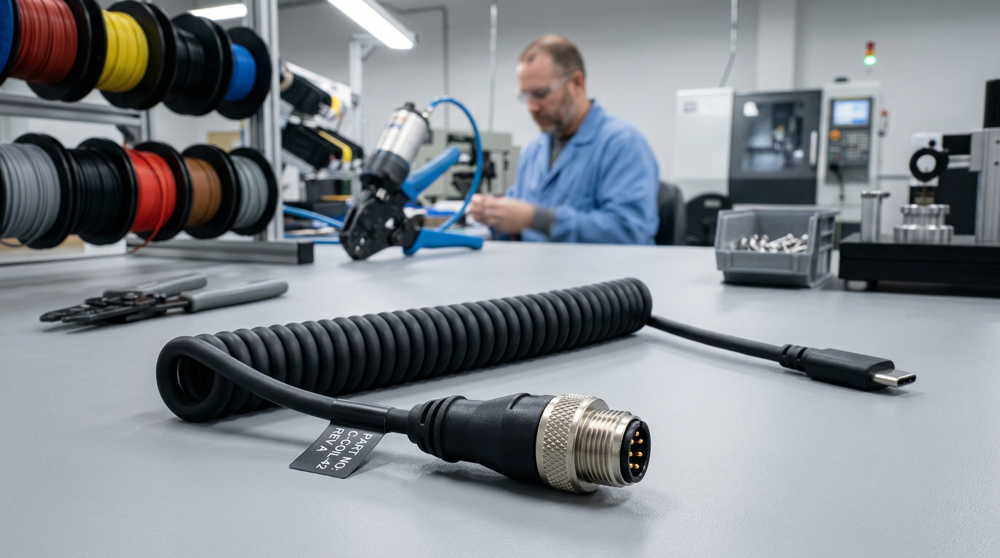
A coil cord is not proven by looking good on the bench. It is proven when it can extend, recover, route cleanly, maintain electrical performance, and survive the real conditions of use over time. That is why coil cord testing should never be treated as a small add-on after the geometry is approved. Manufacturers that specialize in retractile cords consistently describe testing as part of the design process itself, not as a final checkbox after sampling. Meridian, for example, frames proper coil cord development around simulated design work, prototyping, automated electrical testing, and advanced life testing.
For OEM buyers, this matters because coil cords are hybrid products. They are electrical assemblies, but they are also motion products. A coil cord can pass a quick continuity check and still fail in real use because recovery is poor, tangent routing is wrong, the jacket degrades in cleaners, or the cable fatigues after repeated extension and flexing. Your own site already positions coil cord assemblies around repeated flexing, long service life, and tailored geometry, while your tests-and-inspections page emphasizes continuity, insulation resistance, and current-carrying verification as part of broader harness quality control. Those two ideas belong together in one OEM testing framework.
Table of Contents
ToggleWhy coil cord testing needs its own approach
Testing a straight cable assembly is not exactly the same as testing a coil cord. The reason is simple: geometry and motion behavior are part of the product requirement. In a retractile design, buyers are not only approving conductor continuity and connector correctness. They are also approving parked length, working extension, recovery behavior, tangent orientation, and fatigue life in repeated use. Meridian’s coil-cord material describes this clearly by separating dimensional design, prototype validation, electrical testing, and life testing, while Northwire positions retractile cords specifically for high-flex applications, telescopic use, handheld tools, and continuous adjustment.
That means the test plan should reflect the way the product is actually handled. A cord used once a month for occasional service access does not need the same validation emphasis as one used all day on a pendant controller or hospital cart. New England Wire’s medical-device design guidance is helpful here because it ties flex-life performance to specific test cycles, bend radius, and failure definition such as loss of conductor continuity. In other words, motion testing only becomes meaningful when the use case is defined clearly.
The five testing layers OEM buyers should review
The most practical way to structure coil cord validation is to divide it into five layers: dimensional checks, electrical checks, motion and flex-life checks, environmental checks, and production-release checks. This layered approach fits well with what specialized suppliers already describe. Amphenol CIT explicitly lists point-to-point continuity testing, dimensional confirmation, and flex-life testing on its coil-cord capability page, while Meridian expands the picture with insulation breakdown and environmental exposure.
1. Dimensional confirmation
Dimensional testing is the first layer because a coil cord that does not fit the product cannot be rescued by good electrical results. For coil cords, dimensional confirmation should include at least retracted length, normal working extension, maximum allowable extension if specified, tangent length at both ends, tangent direction, and coil outer diameter. Amphenol CIT specifically calls out 100 percent dimensional confirmations per customer specifications for coil cords, and your own Coil Cord Assemblies page highlights coil diameter, coil pitch, and straight lead lengths as tailored variables.
For OEM teams, the key lesson is that dimensions should be checked in the right states. A single “overall length” number is usually not enough. The parked state and working state are both part of product behavior.
2. Electrical performance checks
At minimum, a coil cord should go through point-to-point continuity verification so the correct circuits are present without opens, shorts, or miswires. Amphenol CIT explicitly lists full point-to-point continuity testing for coil cords, and your tests-and-inspections page similarly positions continuity as a baseline quality control method for harnesses and cable assemblies.
Depending on the application, the electrical layer may also include insulation resistance and dielectric or insulation-breakdown testing. Meridian specifically describes continuity testing and insulation breakdown testing as part of the coil cord test framework. More general cable-testing guidance from TPC Wire explains why insulation-resistance testing matters: it verifies the effectiveness of insulation materials in preventing electrical leakage and faults.
For OEM buyers, the point is not to add every possible electrical test by default. The point is to match electrical validation to risk. A low-voltage signal cord and a power-carrying retractile cord may not need the same acceptance plan.
3. Motion and flex-life testing
This is the layer that most clearly separates coil cord validation from standard cable checks. Meridian describes advanced life testing and also shows custom testing equipment that continuously extends and retracts the cable while monitoring electrical performance. Meridian’s older advanced-life-testing write-up adds a useful detail: flex radius, cycle speed, and rotation angle can be customized, and failure can be monitored through conductor continuity.
That is the right logic for OEM programs. Flex-life testing should not be generic. It should reflect the real motion profile as closely as practical. New England Wire’s guidance reinforces this by describing flex life in terms of specific cycle count, bend radius, and defined failure condition.
For a buyer, that means a meaningful coil cord life test should define:
the motion path,
the extension-and-retraction pattern,
the cycle count target,
the bend or flex radius if relevant,
the failure definition,
and whether the straight tangents, the coiled section, or both are under stress.
Without those details, “passed flex test” is not very informative.
4. Environmental exposure checks
A coil cord that works well in a clean lab may behave very differently around oils, medical cleaners, water, UV exposure, or temperature extremes. Meridian explicitly includes environmental exposure such as chemicals, water, and temperature extremes in its coil-cord test framework. Northwire also starts its retractile-cord design discussion with environment, asking whether the cable will face extreme temperatures or fluid exposure.
This part of the validation plan should be application-specific. Industrial automation, handheld field equipment, and medical devices do not impose the same environmental demands. The OEM team should define the actual exposure rather than requesting a vague “durability test.”
5. Production-release and ongoing quality checks
Even a strong prototype test program does not guarantee stable mass production. Coil cord validation should therefore include a release-stage plan: what gets checked at sample stage, what gets repeated at pilot stage, and what becomes part of routine production inspection. Amphenol CIT’s published capabilities are useful here because they combine dimensional confirmation, continuity testing, and flex-life capability, which is close to the practical structure many OEMs need across prototype and production phases.
Your own quality-related pages also support this layered thinking. The Tests & Inspections page emphasizes electrical verification, and the broader quality pages stress full testing and inspection discipline. For a coil cord program, that means the buyer should define not only the engineering test plan, but also which checks remain in regular production control.
What a practical coil cord acceptance plan should include
A useful acceptance plan should be simple enough to execute and specific enough to prevent ambiguity. In most OEM projects, it should cover form and fit, electrical correctness, motion behavior, and the key environmental risks. Meridian’s staged testing approach provides a good model because it separates design simulation, prototype work, electrical checks, and advanced life testing instead of treating the whole process as one generic pass/fail event.
In practical terms, a sample acceptance plan often needs answers to these questions:
Does the cord sit correctly in the parked condition?
Does it reach the required working distance without over-tension?
Do the tangents route cleanly without creating connector-side strain?
Does continuity remain stable during extension and retraction?
Does insulation performance meet requirement?
Does the cord recover consistently after repeated cycles?
Does it hold up under the chemicals, moisture, or temperatures the product will actually see?
These are not abstract engineering questions. They decide whether the cord will feel controlled or frustrating in real use.
Common testing mistakes OEM buyers should avoid
The first mistake is approving a sample based on static inspection alone. A coil cord can look correct in a bag or on a table and still behave badly once installed. Meridian’s testing content exists precisely because movement has to be validated, not assumed.
The second mistake is using a generic flex-life claim with no test definition behind it. New England Wire’s guidance is valuable because it makes flex life measurable through cycle count, bend radius, and failure condition. Without that structure, the number itself has limited meaning.
The third mistake is separating dimensional approval from performance approval. Amphenol CIT’s coil-cord page is useful because it places dimensional confirmation next to continuity and flex-life capability, which reflects real-world practice: geometry, electrical behavior, and durability should be validated together.
The fourth mistake is skipping environmental exposure because the sample “already works.” Materials and recovery behavior can change meaningfully after real environmental stress. Meridian specifically includes water, chemical, and temperature exposure for this reason.
How OEM buyers should define flex-life expectations
Flex-life is one of the most misunderstood parts of coil cord sourcing because buyers often ask for a high cycle number without defining the motion or the failure criteria. New England Wire’s guidance is the clearest practical reference here: flex life should be measured in terms of a defined cycle count, bend radius, and failure condition such as loss of conductor continuity. Meridian’s advanced-life-testing description adds the complementary process variables of cycle speed and rotation angle.
A better OEM request is not “need long life.” A better request is something like:
the cord will be extended and retracted multiple times per shift,
the cable sees repeated operator handling,
the minimum bend radius in service is approximately X,
the test should monitor conductor continuity during cycling,
and the sample should still recover and route acceptably after the target cycle count.
That kind of language gives the supplier a much clearer validation target.
What to include in an RFQ for coil cord testing
If you want accurate samples and fewer iterations, include the test intent in the RFQ instead of waiting until after quotation. A strong RFQ for a coil cord program should define the product’s parked condition, working extension, motion profile, electrical requirements, environment, and which checks are mandatory at sample approval. Your own Cable Assembly RFQ Checklist for Faster Sourcing already makes the broader point that missing upstream information leads to different products, not just different prices. For coil cords, that applies directly to testing as well.
In many OEM programs, the RFQ should also indicate whether the buyer expects:
prototype-only validation,
pilot confirmation,
100 percent continuity in production,
dimensional spot checks or 100 percent dimensional checks on key geometry,
and whether flex-life or environmental testing is needed before release.
That does not make the RFQ more complicated for the sake of it. It makes the validation path visible earlier.
Final view
A coil cord testing plan should prove more than electrical correctness. It should prove that the cord behaves correctly in the product, survives the intended use pattern, and remains stable enough to release into repeat production. The strongest programs combine dimensional confirmation, continuity and insulation checks where needed, motion and flex-life validation, environmental review, and a clear production-release plan. That structure aligns closely with the way specialized coil-cord manufacturers describe proper development and testing.
For OEM buyers, the practical rule is simple: test the way the cord will actually be used. When that happens, sampling becomes more meaningful, release risk goes down, and the final assembly is much less likely to surprise the product team or the end user.
FAQ
What is the most important test for a coil cord
There is rarely only one. Continuity testing is essential, but a true coil cord validation plan also needs dimensional confirmation and motion or flex-life validation because geometry and recovery behavior are part of the product requirement.
Should flex-life testing monitor continuity during cycling
Yes. Both Meridian’s advanced-life-testing materials and New England Wire’s flex-life guidance tie cable-life evaluation to continuity or conductor-failure criteria during defined cycling.
Does every coil cord need insulation resistance testing
Not necessarily every project, but insulation-resistance or insulation-breakdown testing becomes important when the application risk justifies it. Meridian includes insulation-breakdown testing in its coil-cord framework, and general cable-testing guidance explains its role in verifying insulation integrity.
Should dimensional checks be part of production inspection
For many OEM coil cord programs, yes. Published coil-cord capabilities from Amphenol CIT include dimensional confirmation per customer specification alongside electrical testing, which reflects real production practice for geometry-sensitive products.
What is the biggest validation mistake in coil cord projects
One of the biggest mistakes is approving the cord in a static condition without checking real movement, recovery, and repeated-use behavior in the installed product. Specialized coil-cord testing guidance consistently treats motion validation as essential.
CTA
If your team is developing a new retractile cable program, do not wait until after the first sample arrives to decide how it will be tested. Start with the motion profile, the electrical risk, the environment, and the release stage that each test should support. You can begin with our Coil Cord Assemblies page for the main design variables, and use the Cable Assembly RFQ Checklist for Faster Sourcing to organize the test inputs before quotation.