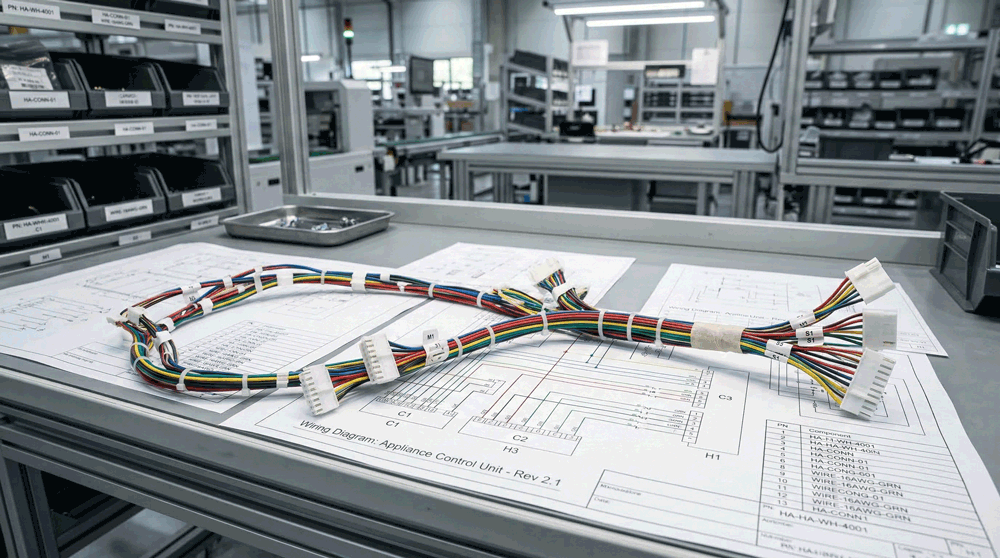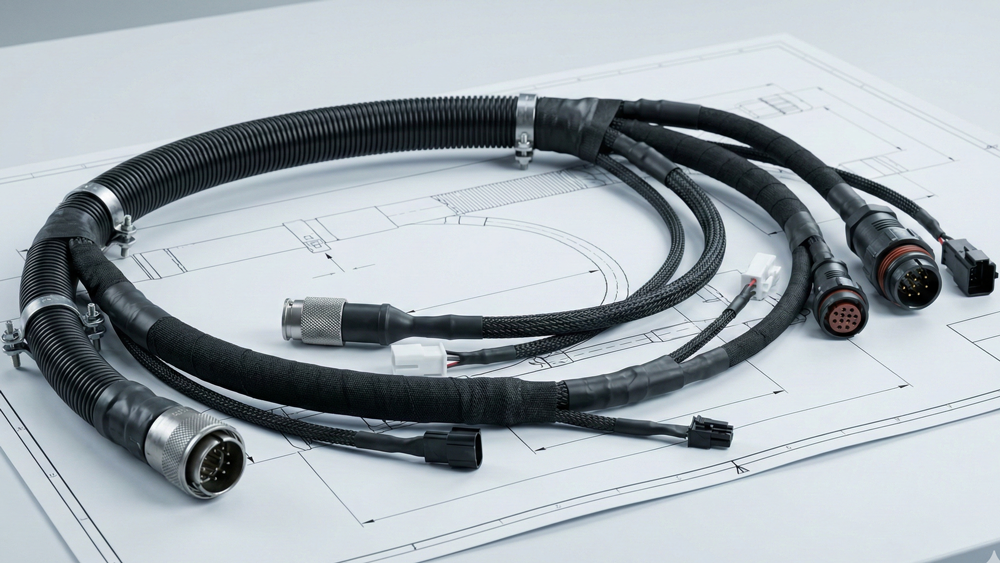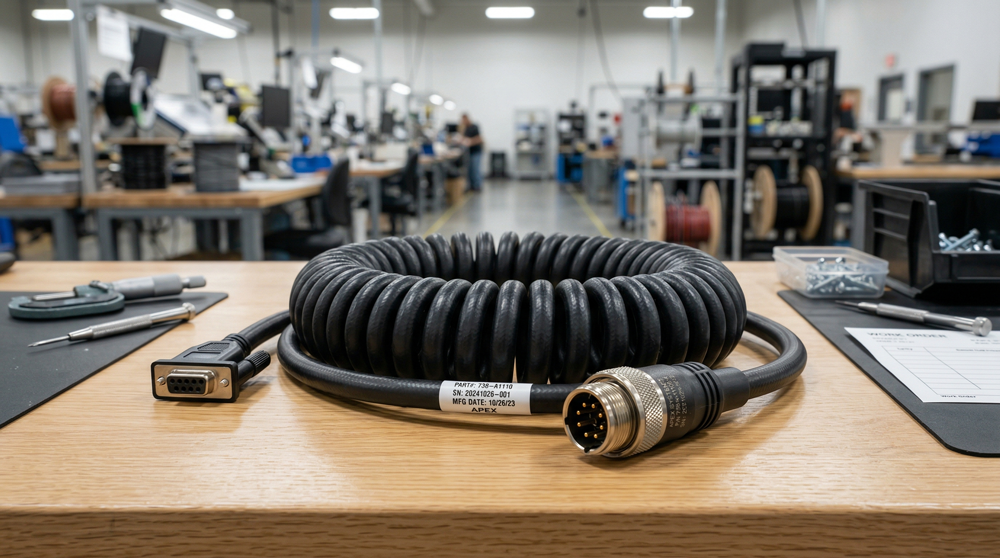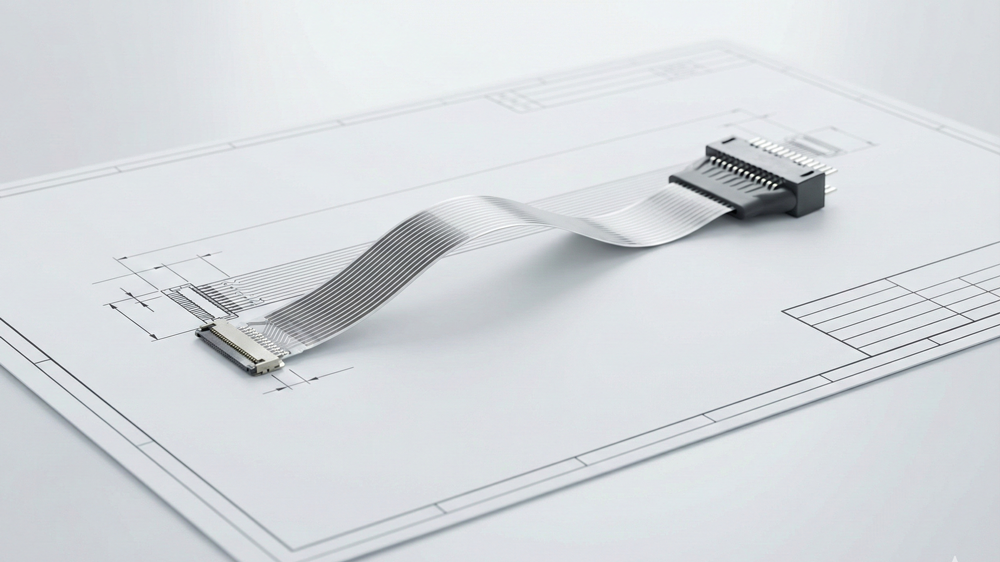
SMA cable assemblies are often treated as simple RF jumpers, but in OEM projects they are usually much more than that. They sit inside the actual RF path, so a wrong choice in cable type, connector orientation, impedance control, or routing behavior can quietly degrade performance long before anyone suspects the cable. Your own RF & SMA Cable page already positions SMA assemblies the right way: not just as connectorized coax, but as part of a controlled signal path where low insertion loss, low return loss, stable shielding, and correct connector transitions matter to overall device performance. (infiniteharness.com)
That is why “need SMA cable” is not a sufficient specification. A quote-ready OEM definition should explain what frequency range the assembly must support, what impedance system it belongs to, what cable family fits the routing and loss target, what connector style fits the enclosure, how the cable will bend in service, and what RF measurements will be used for approval. Times Microwave makes the point bluntly: RF and microwave cable assemblies are inherent parts of the system, and choosing them correctly requires specifying the appropriate requirements up front.
Table of Contents
ToggleStart with the RF path, not the connector name
Many buyers begin by choosing SMA because it is familiar, compact, and widely available. That is reasonable, but it is still only the starting point. Amphenol RF lists SMA as a 50-ohm connector family with a DC to 18 GHz frequency range in standard designs, extended-range options up to 34 GHz, and a precision threaded coupling intended for robust vibration resistance. Those features explain why SMA is common across antennas, test systems, radar, telecom, and OEM radio products. But they do not eliminate the need to define the full cable assembly around the actual application.
For OEM projects, the more useful first question is this: what role does the assembly play in the system? Is it a short board-to-panel RF jumper, an antenna feed, a test lead, a radio-to-filter link, or a cable routed through a moving enclosure? The answer determines what matters most. In some projects, compactness and routing space dominate. In others, low loss or better phase stability dominate. Mini-Circuits’ RF coaxial cable guidance emphasizes exactly this point: the right cable assembly is selected by prioritizing application requirements, not by assuming all coaxial assemblies with the same interface behave equivalently.
Define the frequency range early
Frequency range is one of the first parameters that should appear in the RFQ because it affects cable family, connector suitability, expected loss, and test method. Amphenol’s SMA specifications show standard SMA performance to 18 GHz and extended-range variants to 34 GHz, but those figures are connector-family capabilities, not automatic guarantees for every finished cable assembly. The actual assembly still depends on cable choice, length, transition quality, and build consistency.
This matters because cable loss rises with both cable length and signal frequency. Rohde & Schwarz states that coaxial cable loss, also called insertion loss, increases linearly with length and becomes greater at higher frequencies, with connectorization, bends, and wear also adding reflected energy and measured loss. So if the buyer does not define the intended operating band at the start, the supplier may quote a cable that fits mechanically but underperforms electrically once the actual frequency is applied.
Confirm the impedance system
SMA is commonly associated with 50-ohm RF systems, and Amphenol’s SMA connector data explicitly states 50 ohms. In practical OEM work, that means the assembly should be specified as part of a 50-ohm path unless the design intentionally uses something else. This sounds basic, but impedance assumptions are exactly the kind of “obvious” detail that gets omitted from quick RFQs and then reappears later as reflection problems, poor return loss, or unstable measurement behavior.
Your RF page already supports this logic by emphasizing tight impedance control and low return loss. That is the right framing. Buyers should not assume a cable assembly is acceptable simply because it has SMA interfaces on both ends. The entire cable, connector transition, and mating environment still need to behave like the intended impedance system. (infiniteharness.com)
Choose the cable family based on loss, flexibility, and routing
The cable portion of the assembly is often where the most important tradeoffs sit. Your RF page offers a useful practical range: RG174, RG316, RG178, RG58, RG402, low-loss coax, and other custom options. That already signals the real engineering question. Different cable families exist because different projects need different balances of size, flexibility, shielding, ruggedness, and attenuation. (infiniteharness.com)
Mini-Circuits’ cable-selection guidance supports the same idea. It notes that RF coaxial cables vary by construction and attributes, and that selecting the right one requires prioritizing parameters for the application rather than trying to compare everything as a simple commodity spreadsheet. For example, semi-rigid constructions can offer excellent shielding and controlled geometry but sacrifice flexibility, while more flexible constructions are easier to route but can be more sensitive to bending-related performance changes.
For OEM buyers, this means the RFQ should not simply state “SMA to SMA, 500 mm.” It should also say whether the project prioritizes lower loss, smaller diameter, tighter routing, hand-formable shape, or more bend tolerance during installation and use.
Specify connector style, gender, and orientation clearly
One of the easiest ways to create sample confusion is to assume the supplier will infer the correct connector configuration from a device photo or a brief note. In SMA assemblies, that is risky. Buyers should define connector gender, plug versus jack, straight versus right-angle, bulkhead versus free-hanging, and whether there are panel-mount or enclosure constraints. Your RF page already highlights connector diversity and custom transitions, which is a reminder that interface naming alone does not fully define the build. (infiniteharness.com)
This is also where enclosure design matters. A straight SMA may be electrically fine but mechanically awkward in a tight housing. A right-angle configuration may reduce routing stress or improve serviceability. Rohde & Schwarz’s connector-handling guidance stresses that coaxial connectors are key RF components whose selection and handling affect repeatable measurements and long-term performance. That is an important reminder that connector style is not just a drafting detail.
Define the reference length correctly
In RF cable assemblies, length should never be treated as an innocent number. Buyers should define what the length reference actually means: tip-to-tip, connector interface to connector interface, overall assembled length, or cable cut length before termination. If that reference is not explicit, two suppliers can quote and build physically different products from the same nominal number. This is already a familiar problem from your general Cable Assembly RFQ Checklist, but it becomes more important in RF because electrical length directly affects insertion loss and can affect phase behavior as well. (infiniteharness.com)
Mini-Circuits’ phase-stability article reinforces why this matters. It notes that phase is affected by the physical length of the cable assembly, the cable bend radius, and the cable assembly technique. In other words, even when the project is not explicitly a “phase-stable cable” application, the buyer should still understand that physical definition influences electrical behavior.
State bend limits and routing conditions
Routing conditions belong in the RFQ because bends and handling can affect cable loss, reflections, and phase behavior. Rohde & Schwarz states that discontinuities caused by connectors, bends, or damage can reflect energy back to the source and increase measured loss. Mini-Circuits also explains that bending changes the physical length at the point of bend and can change dielectric and shielding relationships enough to alter phase performance.
This means OEM buyers should tell the supplier whether the cable will be installed once and left alone, hand-routed through a tight enclosure, repeatedly flexed during service, or bent near the connector exit. In many projects, the most useful RFQ detail is not a formal bend-radius number but a photo or sketch showing the real routing environment. That often prevents more trouble than a long generic specification list.
Include the mechanical environment, not just the RF environment
SMA is often chosen partly because of its threaded coupling. Amphenol lists precision 1/4-36 threaded coupling and robust vibration resistance as key SMA features, and also provides coupling-torque guidance of 3 to 5 in·lbf for brass and 7 to 10 in·lbf for stainless steel options. Those details matter because RF performance is not independent from mechanical integrity. A connector that is nominally correct but inconsistently tightened or poorly supported in vibration can still become a source of unstable behavior.
So the RFQ should mention whether the assembly will operate in portable equipment, outdoor equipment, vibration-prone equipment, field-service equipment, or a protected indoor enclosure. It should also note whether repeated mating is expected. Amphenol lists SMA durability up to 500 mating cycles, which is useful context when the assembly will be used beyond one-time installation.
Put the test plan into the specification
One of the biggest RF sourcing mistakes is leaving measurement expectations until after the first sample arrives. Your RF service page already offers a strong starting point by explicitly naming continuity, VSWR, insertion loss, and return loss as available checks. That is exactly the kind of language buyers should convert into sample-approval criteria. (infiniteharness.com)
Rohde & Schwarz states that a VNA is the preferred tool for measuring cable loss, and explains one-port and two-port methods for cable-loss measurement. That supports a simple but important OEM rule: do not ask only whether the supplier “can test.” Ask which RF measurements will be performed, across what frequency band, with what setup, and what pass criteria apply. If the project is sensitive enough that connectorization, bends, or wear could matter, that should influence the validation plan as well.
What a good SMA cable assembly RFQ should include
A useful RFQ for an SMA cable assembly should include the device application, operating frequency range, impedance system, cable family or performance target, connector configuration on each end, length reference, routing or bend constraints, environment, and test requirements. Times Microwave’s article on RF and microwave assemblies is especially relevant here because it concludes that specifying the appropriate requirements is essential when choosing an RF or microwave coaxial cable assembly.
In practical terms, that means your RFQ should answer the following without forcing the supplier to guess:
what frequencies the assembly must support,
what cable family or loss target is needed,
what connector geometry fits the enclosure,
how the length is defined,
how the cable will bend or route in service,
and what RF measurements must be passed before approval.
That is the level of clarity that reduces sample churn and makes RF cable sourcing more predictable.
Final view
To specify SMA cable assemblies well, OEM buyers need to define more than interface names. They need to define the RF path, the performance band, the cable family, the connector geometry, the length reference, the mechanical environment, and the approval method. SMA itself is a strong and widely useful RF interface, but it does not remove the need for good specification discipline. Amphenol’s SMA data, Rohde & Schwarz’s RF measurement guidance, Mini-Circuits’ cable-selection and phase-stability explanations, and your own RF service-page positioning all point to the same conclusion: correct RF cable assemblies are designed around the application, not guessed from the connector alone.
For OEM buyers, the most practical takeaway is simple. Treat the SMA cable assembly as part of the system design, not as a late purchasing accessory. When the specification is clear enough before quotation, the supplier can build the right path faster, validate it earlier, and reduce the risk that the project loses time chasing avoidable RF problems. (infiniteharness.com)
FAQ
What should OEM buyers define first for an SMA cable assembly
Start with the actual RF application: operating frequency range, system impedance, signal-path role, and routing environment. Those parameters determine whether the rest of the assembly definition will make sense.
Is SMA always a 50-ohm connector
For the standard SMA family discussed here, yes. Amphenol RF lists SMA as a 50-ohm connector family.
Why is cable length definition important in RF assemblies
Because insertion loss rises with length, and physical length also affects phase behavior. A nominal length without a clear reference can lead to both mechanical and electrical mismatch.
Should bend conditions be included in the RFQ
Yes. Bends can increase reflections and affect phase stability, so the supplier should know whether the cable will be tightly routed, repeatedly flexed, or installed near critical bends.
What test data should be requested for SMA cable assemblies
At minimum, buyers should decide whether continuity alone is enough or whether VSWR, insertion loss, and return loss should be part of sample approval and production release. Your RF page already positions those as relevant RF checks. (infiniteharness.com)
CTA
If your project depends on stable RF transmission, do not send an RFQ with only “SMA to SMA” and a nominal length. Start by defining the frequency band, cable target, connector layout, routing conditions, and required RF measurements, then let the supplier build around the real use case. This article can naturally connect to your RF & SMA Cable service page as the commercial landing point for the series.