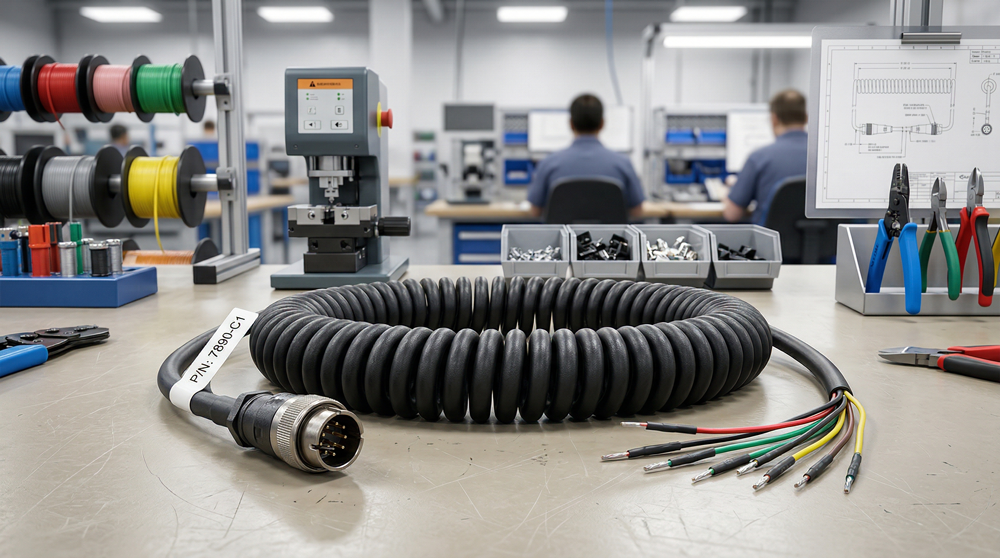
A coil cord can look simple on a drawing and still behave badly in the real product. That is why geometry matters so much. In OEM projects, most coil cord problems do not start with conductivity. They start when the cable retracts too aggressively, does not recover cleanly, twists near the connector, hangs awkwardly in the parked position, or takes up more space than the product team expected. Manufacturers that specialize in retractile cords consistently frame design around movement, dimensions, tangent layout, and recovery behavior rather than around a generic stock part mindset.
For OEM buyers, that means coil cord geometry should be treated as a functional specification, not a cosmetic preference. Your own Coil Cord Assemblies page already highlights tailored coil geometry, coil diameter, coil pitch, lead-out lengths, and long flex life as core design variables. The missing step is turning those ideas into a clear RFQ language that engineering, sourcing, and the supplier can all use the same way.
Table of Contents
ToggleStart with the use condition, not the drawing view
The first mistake in coil cord sourcing is to begin with what the cable should look like on paper instead of how it should behave in service. Northwire’s guidance starts with environment, retracted length versus extension length, tangent direction and tangent length, and overall coil diameter. Galaxy makes the same point from another angle: understanding the dimensions in use, extended, and retracted is key to the design of the coil cord. That sequencing is useful because it forces the buyer to define real motion before choosing physical geometry.
A good OEM review should answer a few practical questions first. Where is the parked position? What is the farthest normal working position? Is the movement mostly straight pull, angled pull, or repeated side motion? Does the operator hold the connected device in hand, or is the cable only moving with a door, arm, cart, or pendant? Once those conditions are clear, the geometry discussion becomes much more accurate.
The core geometry parameters buyers should define
Most custom coil cords can be defined around five geometry decisions: retracted length, extended working length, tangent layout, coil diameter, and coil pitch. Meridian simplifies the shape discussion into three main sections—coil diameter, retracted and extended lengths, and tangents—while your service page adds coil pitch and lead-out lengths as tailored variables. That is a strong practical framework for OEM RFQs.
1. Retracted length
Retracted length is the cable in its normal resting state, not under working pull. This dimension matters because it determines how compact the assembly remains when the product is idle. If the retracted length is too short, the cord may be under constant tension even in the parked position. If it is too long, the product loses the space-saving benefit that justified a coil cord in the first place. GlobalSpec identifies retracted length as one of the key sourcing parameters for coiled cords and cables.
For OEM buyers, the most useful habit is to define the parked state explicitly. Do not just give the supplier a maximum length and assume they will infer the rest. The parked state is part of the product behavior.
2. Extended working length
Extended length should reflect the real working reach, not the farthest emergency stretch someone achieved in a quick sample test. Northwire gives a 5:1 design-ratio example, and both GlobalSpec and Galaxy describe typical extended lengths in the rough 3:1 to 5:1 range relative to retracted length. That does not mean every design should target those exact numbers, but it does show that extension ratio is a deliberate design variable, not a fixed universal rule.
Buyers should therefore specify two things separately: the normal working extension and the maximum allowable reach. If those are not separated, the supplier may optimize for one while compromising the other.
3. Tangents and lead-out lengths
Tangents are the straight, uncoiled sections at both ends of the coil body. They are much more important than they first appear. Galaxy defines them as part of the fundamental structure of a coil cord, and Northwire distinguishes between different tangent directions such as parallel tangential exits and drop axial exits. Meridian also treats tangents as one of the main sections used to specify cord shape.
In OEM equipment, tangent length and direction affect routing, connector stress, serviceability, and the visual neatness of the installed product. A tangent that is too short can create assembly difficulty or force a tight bend near the connector. A tangent that is too long can create unwanted loops and reduce the value of the retractile design. This is exactly the kind of issue that should be clarified before quotation, not discovered after first articles.
4. Coil outer diameter
The outer diameter of the coil influences both extension behavior and packaging fit. Meridian notes that a larger outer diameter generally allows a coil cable to stretch farther than a smaller one. Northwire also identifies overall coil diameter as a core design factor. For a buyer, that means diameter is not just a visual preference. It affects how the product fits into space, how far it can extend, and how the cable feels in use.
This matters especially in handheld devices, pendant controls, medical carts, and compact industrial equipment where the cable sits in the operator’s field of view and competes for space with other components.
5. Coil pitch
Your own coil cord page explicitly lists coil pitch as a customization variable, which is important because pitch influences how compactly the coil sits and how it behaves during extension and recovery. Even when manufacturers do not always turn pitch into a marketing headline, it is part of the physical geometry that determines how the coil body behaves in practice. For OEM buyers, pitch should be reviewed together with diameter and extension target rather than treated as an isolated spec.
Geometry is tied to material behavior
A coil cord’s shape cannot be specified independently from its cable construction. Galaxy lists common jacket materials such as PVC, polyurethane, thermoplastic elastomer, neoprene, polyethylene, and Hytrel, and notes that higher strand counts improve flexibility. Connectorsupplier also notes that performance limits for coiled cables are influenced by coil width as well as the elasticity and thickness of the outer jacket material. In other words, geometry and material system are linked.
This is why a buyer should not ask for a geometry copied from another project unless the cable construction is also similar. A coil that behaves well in one jacket system may recover differently or fatigue differently in another. If the application involves chemicals, cold temperatures, oils, medical cleaning agents, or repeated high-cycle use, material review needs to happen at the same time as geometry review. Northwire explicitly starts its design discussion with environment for that reason.
The geometry mistakes that cause the most trouble
The most common error is defining only one length. A buyer might send a note saying “need 2 meters” without clarifying whether that means parked length, full extension, installed route, or shipping condition. Your own Cable Assembly RFQ Checklist for Faster Sourcing makes the broader point that ambiguous inputs create different products, not just different quotes. Coil cords amplify that problem because geometry is behavior.
Another common mistake is ignoring tangent direction. A coil that exits in the wrong direction may still pass bench checks while creating twist, rub, or connector-side strain in the actual product. Northwire’s distinction between tangent configurations is useful precisely because it reminds buyers that routing behavior starts at the exit, not in the middle of the coil.
A third mistake is approving geometry on appearance alone. Meridian’s testing guidance for coil cords includes simulated design work, prototyping, electrical testing, and advanced life testing. That is important because a coil cord can look correct at first glance and still recover poorly, fight the operator, or age badly in repeated use.
How OEM buyers should validate coil cord geometry
Geometry approval should happen in the product, not only on the bench. At minimum, sample review should check the parked position, normal working reach, maximum reach, tangent routing, connector strain at both ends, and recovery after repeated use. Meridian specifically discusses continuity testing, insulation breakdown testing, and environmental exposure such as chemicals, water, and temperature extremes as part of proper coil-cord validation.
For many OEM programs, the best practical validation sequence is simple. First, confirm form and fit in the installed product. Second, confirm motion behavior through repeated extension and recovery. Third, confirm the electrical and environmental requirements that match the application. This mirrors the general logic already used across your own blog content: define the use condition, remove ambiguity in the RFQ, and validate what the assembly will actually experience in service.
What to include in an RFQ for coil cord geometry
A procurement-ready RFQ for a custom coil cord should define the resting position, required working extension, maximum allowable extension, tangent length at each end, tangent direction, coil outer diameter target or space envelope, coil pitch requirement if known, conductor count, wire gauge, shielding requirement if any, connector types, environment, and expected motion profile. Those inputs align closely with the way your service page and manufacturer guidance describe custom retractile cord design.
If your team already has route photos, assembly drawings, or packaging limits, include them. Coil cords are much easier to quote and build correctly when the supplier sees the installed context instead of guessing from a single nominal length.
Final view
For OEM buyers, coil cord geometry is not a minor drafting detail. It is the control system for how the cable behaves in the product. The strongest designs start with real movement, then define retracted length, working extension, tangents, diameter, pitch, material system, and validation method in that order. That approach is consistent with both specialized coil-cord manufacturers and the logic already visible in your own coil cord service positioning.
If the geometry is defined well, the supplier can quote more accurately, prototypes need fewer revisions, and the finished product feels more controlled in daily use. If geometry is left vague, even a technically sound cable may become an awkward assembly.
FAQ
What is the most important geometry spec for a coil cord
There is rarely only one. The most important starting point is the combination of retracted length and required working extension, because those define the motion envelope the supplier must design around.
Do tangents really matter that much
Yes. Tangents affect routing, connector strain, and service behavior. A well-designed coil body can still perform poorly if the straight lead sections are the wrong length or exit in the wrong direction.
Does a larger coil diameter always mean better extension
Not always, but manufacturers do note that larger outer diameters generally allow more extension than smaller ones. The right diameter still depends on space limits, cable construction, and target behavior in use.
Should coil pitch be listed in the RFQ
Yes, when it is known or when installed behavior is sensitive to compactness and recovery. Your own service page treats coil pitch as a tailored geometry variable, so it is worth defining when the application depends on it.
Can I copy geometry from another coil cord project
Only with caution. Geometry depends on material system, jacket behavior, strand construction, and environment, so the same shape may not behave the same way across different cable constructions.
CTA
If your team is sourcing a new retractile cable, start by defining how the cord should behave in the real product instead of only listing a nominal length. Our Coil Cord Assemblies page outlines the main customization points, and our Cable Assembly RFQ Checklist for Faster Sourcing can help you prepare cleaner quote inputs before sampling.