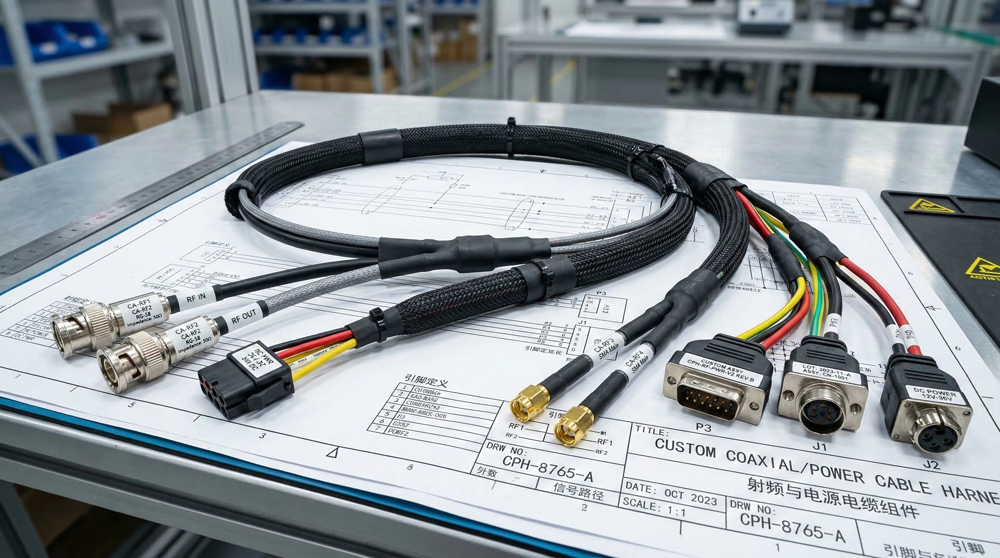
Validating cost-down changes in cable assemblies is the step that decides whether a savings idea becomes a safe improvement or a future problem. Validating cost-down changes in cable assemblies means checking that a lower-cost connector, wire, label, package, or process change still protects the real product requirement before the new version moves into pilot, release, and repeat supply.
For OEM buyers, this is where good cost-down work separates itself from false economy. A change may look minor on the BOM and still affect route fit, lock strength, label clarity, incoming handling, service replacement, or early-lot stability. That is why cost-down validation should never be treated as a formality. It is a release-control step.
Table of Contents
ToggleWhy Validation Matters
Many cost-down changes fail for one simple reason: the team assumes that if the product still looks similar, the risk must also be small. In custom cable assemblies and wiring harness programs, that assumption is dangerous. A slightly cheaper connector can change retention feel. A different cable can change route stiffness. A revised label can confuse receiving. A simpler package can slow warehouse handling or allow tangling. None of those issues always shows up in a quick desk review.
That is why validation matters. It turns a savings proposal into a controlled decision. It helps procurement confirm the commercial gain, engineering confirm product fit, quality confirm control, and the supplier confirm that the new version is actually repeatable. Without this step, the cost-down may still go live, but the real test is pushed downstream into pilot, incoming inspection, or field use—where mistakes are much more expensive.
Start with the Change
The first step in validation is to define exactly what changed. This sounds simple, but many OEM teams discuss cost-down too broadly. They say the connector is cheaper, or the packaging was simplified, or the cable was optimized, without clearly separating what was changed from what stayed the same.
A better validation path begins with a precise description. Did the connector family change? Did only the label stock change? Did the wire gauge change, or only the cable jacket? Did the packaging count per carton change, or the whole inner pack method? Was the assembly process simplified, or was the physical product also altered? The clearer the change definition is, the easier it becomes to validate the right things.
This is especially important when several savings ideas are being discussed at once. If the team bundles too many changes together, it becomes much harder to know which change caused a later problem. Strong validation starts by isolating what the project is actually trying to prove.
Classify the Risk
Not every cost-down change carries the same risk. A better validation plan starts by classifying the change according to what it can affect.
Some changes are mainly commercial or logistical. For example, a carton-size standardization or a simpler outer label may not affect electrical function, but can still affect handling, receiving, and version control. Some changes are mechanical, such as connector swaps, cable jacket changes, or strain-relief adjustments. Some are electrical, such as shield reduction or wire changes. Some are process-driven, such as a different label placement or reduced manual assembly steps. Each type of change needs its own validation depth.
A practical risk split often looks like this:
| Change type | Main risk | Typical validation need |
|---|---|---|
| Connector change | Lock, route, service, fit | Sample, pilot, FAI |
| Cable or wire change | Route, flex, shielding, durability | Sample, pilot, incoming focus |
| Label change | Receiving, traceability, service | Controlled sample or first lot review |
| Packaging change | Protection, handling, stock flow | Packaging review, first lot check |
| Process change | Repeatability, labor variation | Pilot review, early-lot monitoring |
This kind of classification helps the team avoid both under-validating and over-validating.
Confirm the Baseline
A cost-down change can only be validated against a stable baseline. If the current product definition is already drifting, then the team is not really validating a cost-down. It is validating a moving target.
Before any review begins, the buyer should confirm the active drawing, BOM, label logic, packaging method, and any related release notes that define the current version. This matters because many cost-down discussions happen while other ECNs, pilot learnings, or supplier clarifications are still in flight. If those are not separated clearly, the project can confuse a cost-down effect with a broader revision effect.
This is where earlier process discipline matters. Good cost-down validation depends on the same kind of control discussed in Cable Assembly Change Control and Production Readiness and How OEM Buyers Manage Cable Assembly ECN and Revision Changes. If the current baseline is unclear, the validation result will be weak no matter how carefully the test is run.
Validate the Application Fit
A cost-down change should always be checked against the real application, not only against the drawing. This is one of the most important principles in B2B cable assembly work.
If the product is static and protected, some savings may be very safe. If the same product is exposed to vibration, motion, UV, service handling, or signal sensitivity, the same change may be risky. That is why validation should ask practical product questions. Does the revised assembly still fit the route? Does the cable still behave correctly? Does the connector still feel appropriate? Does the label still work in receiving and service? Does the packaging still protect the part and support the warehouse flow?
The key is that validation must be tied to where the harness or cable assembly actually lives. A change that looks harmless on the table may still be wrong in the product.
Validate the Connector Change
If the cost-down affects the connector, the validation should focus on what connectors actually do in the product: mate, lock, hold, route, and support service access.
The team should review whether the new connector still supports the real cable exit, still locks clearly enough, still fits the route, and still works for production and service handling. In many OEM cable assemblies, connector problems are not dramatic electrical failures. They are small mechanical frustrations that grow into real cost later. A lock that feels weaker, a release feature that is harder to reach, or an exit direction that increases bend stress can all turn a price saving into a lifecycle problem.
That is why connector cost-down validation usually needs more than a spreadsheet review. It often needs at least a physical sample and, depending on the application, a pilot or first article step as well.
Validate the Cable Change
If the cost-down affects wire or cable, the validation should focus on route, handling, flex, shielding, and connector fit. Cable changes are especially easy to underestimate because the revised cable may look almost identical to the old one while behaving very differently in use.
The team should review whether the new cable still supports the route naturally, whether it changes stiffness at the connector transition, whether it still suits the environment, and whether any shielding or handling differences matter in the real application. This is especially important in wiring harnesses used in motion, compact packaging, outdoor environments, or service-handled products.
For OEM buyers, this step protects against one of the most common false savings: reducing cable cost while quietly increasing assembly difficulty or durability risk.
Validate the Label Change
Label changes often look small and therefore get under-controlled. In reality, they are one of the most common ways for cost-down work to create warehouse, incoming, and service problems.
Validation should confirm that the revised label still supports the required identification logic. That means checking content, readability, placement, format consistency, and how the label works in receiving and later service use. If the cost-down reduced material grade, the team should also confirm that the new label still survives the real environment and handling path of the product.
This kind of review is usually lighter than connector or cable validation, but it still matters. A cheaper label that slows receiving or confuses spare-part identification is not a true savings.
Validate the Packaging Change
Packaging changes should be validated against protection, handling, and stock logic. A new package may look efficient from the supplier side and still create trouble once it reaches the buyer’s receiving and warehouse flow.
The review should check whether the package still protects the cable assemblies correctly, whether labels remain visible, whether the new pack count still works operationally, and whether the assemblies remain easy to count, store, and issue. If the packaging simplification reduces labor and material without hurting these functions, it is a strong cost-down. If it introduces tangling, connector stress, hidden labels, or slower receiving, the commercial gain becomes weaker.
This is why packaging should be treated as part of the product flow, not just part of shipping.
Use the Right Validation Stage
Different changes should be validated at the right stage. Trying to prove everything in the same way usually creates either too much work or not enough control.
Some cost-down changes can be reviewed through a controlled sample. Others need a pilot run because the real question is repeatability, not only single-part fit. Some should flow through first article inspection because the buyer needs to confirm that the new version matches the released baseline in production-representative form. Some require stronger incoming inspection on the first lots because the operational risk sits in packaging, labels, or version mix-up rather than in the part itself.
A practical decision path often looks like this:
- Sample when the team needs to check physical fit, connector behavior, cable route, or basic handling.
- Pilot when the team needs to check repeatability, labeling, packaging, and supplier process behavior.
- FAI when the revised version must be checked as a production-representative release state.
- Incoming focus when the main risk is lot identity, labels, packaging, or first-lot execution.
Using the right stage makes the validation stronger without making it unnecessarily heavy.
Check the Supplier Process
Cost-down validation is not only about the revised part. It is also about whether the supplier can control the revised version repeatably.
A supplier may build one good sample and still have weak release discipline, unclear label flow, or unstable material handling when the new version enters production. That is why the buyer should review how the supplier is implementing the change. Is the updated BOM clear? Are old and new versions separated correctly? Are first revised lots identified clearly? Does the supplier communicate the revision basis cleanly? If not, the cost-down may be technically sound and operationally weak.
This is particularly important in OEM cable assemblies where many cost-down moves affect not only physical parts but also labels, packaging, and minor process steps. The supplier’s control path matters as much as the new material itself.
Use Early-Lot Control
Once a cost-down change is released, the first production lots deserve more attention than mature supply. This is where early-lot control adds value.
The buyer should decide which first lots need tighter incoming inspection, clearer lot marking, or closer label and packaging review. If the revised version is entering production after an ECN, the project should also confirm that old and new stock are not mixed and that receiving teams know exactly what to expect. This is especially important for cost-down changes because they often look small enough to slip through under casual handling.
Early-lot control does not have to be complicated. It just needs to be intentional. The purpose is to make sure the savings idea remains aligned in real supply, not just in engineering discussion.
Avoid Common Mistakes
A common mistake is validating a cost-down only at desk level because the revised assembly “looks similar enough.” Another is bundling several savings changes together and then losing visibility into which one caused a problem later. A third is validating the product but not validating the supplier’s version-control path, which can lead to mix-up between old and new lots.
Another frequent mistake is treating label and packaging changes as too small to need controlled validation. In reality, those are often the changes most likely to create receiving and stock-control problems. A final mistake is skipping early-lot monitoring because the pilot or first sample already looked fine. In OEM supply, the first real production lots often reveal what the sample could not.
Use a Practical Validation Framework
A simple framework keeps cost-down validation focused.
| Validation area | Key question |
|---|---|
| Change scope | What exactly changed |
| Risk type | Is the risk mechanical, electrical, packaging, label, or process-related |
| Baseline | Is the old version fully defined and stable |
| Application fit | Does the new version still suit the real use case |
| Supplier control | Can the factory implement the new version cleanly |
| Validation stage | Sample, pilot, FAI, or incoming focus |
| Early lots | How will first revised shipments be checked |
| Release decision | What must be true before the new version becomes standard |
This kind of structure helps the team validate the savings efficiently without weakening release control.
Conclusion
Validating cost-down changes in cable assemblies is the step that turns a lower-cost idea into a controlled OEM improvement. The strongest validation process starts with clear change definition, correct risk classification, a stable baseline, real application review, supplier process control, the right validation stage, and tighter early-lot checks where needed.
When buyers do this well, they protect both sides of the decision: the savings and the product. In OEM cable assemblies and wiring harness programs, that is how cost-down becomes a business improvement instead of a future quality problem.
FAQ
Do all cost-down changes need the same level of validation?
No. The validation depth should match the risk. Connector and cable changes often need more proof than simple label or carton changes, though even small changes still need control.
Is a sample enough to validate a cost-down?
Sometimes, but not always. A sample can confirm basic fit and handling. Pilot, first article, or stronger incoming checks may still be needed for repeatability or early-lot control.
Why should label and packaging changes be validated?
Because they affect receiving, stock control, service identification, and version management. Even when the cable itself is unchanged, operational risk can still increase.
What is the biggest validation mistake in cable assembly cost-down?
One of the biggest mistakes is assuming that because the revised assembly looks similar, the change must be low-risk and does not need structured release control.
How do OEM buyers know if a cost-down is safe?
They know by checking the new version against the real product use case, the supplier’s control path, and the first-lot behavior before treating the change as standard.
CTA
If you are planning cost-down changes in an OEM cable assembly or wiring harness program, the best first step is to define exactly what changed and what proof is needed before that change becomes the new released standard.
You can send your drawings, BOM, old and new parts, supplier comments, and release timing through Contact. Our team can help review the validation path and support a more practical OEM release decision before the savings go live.