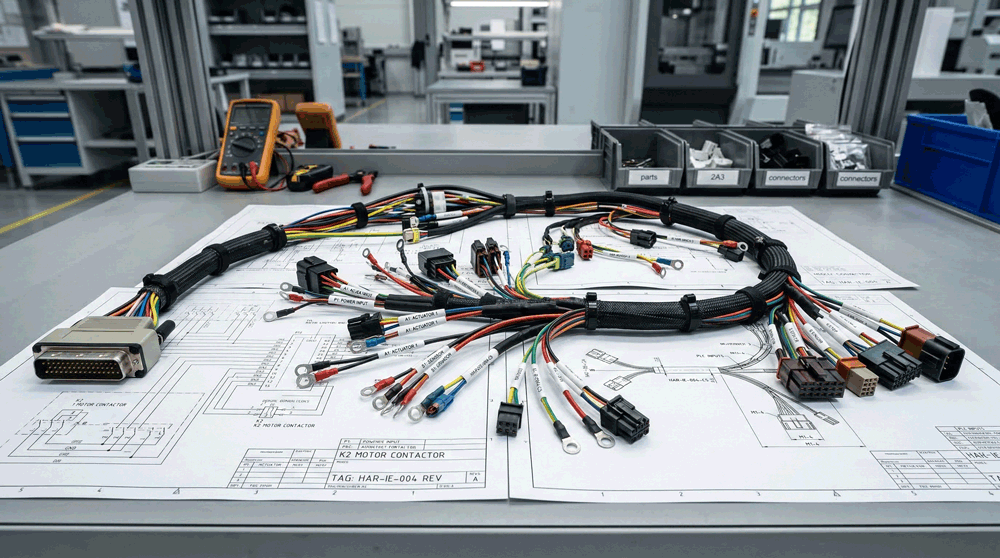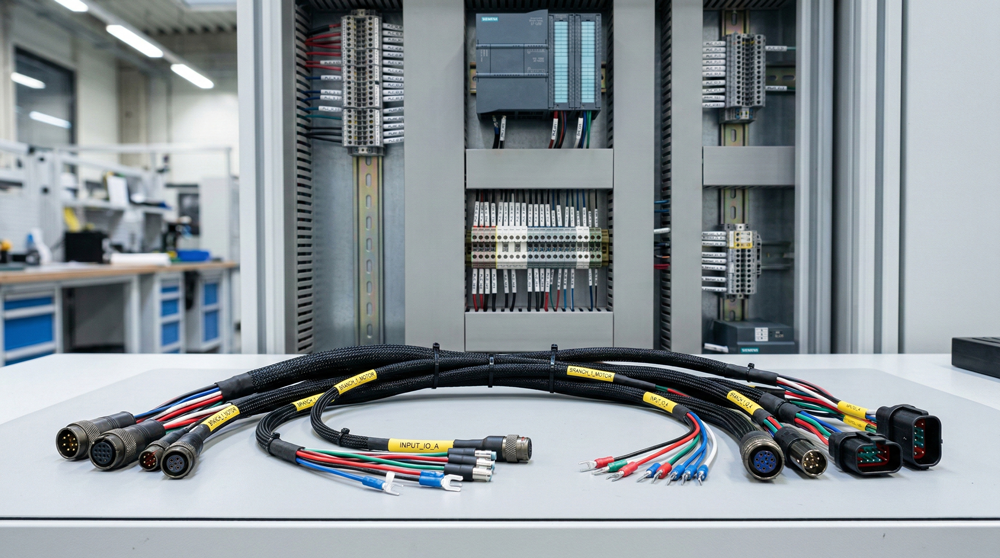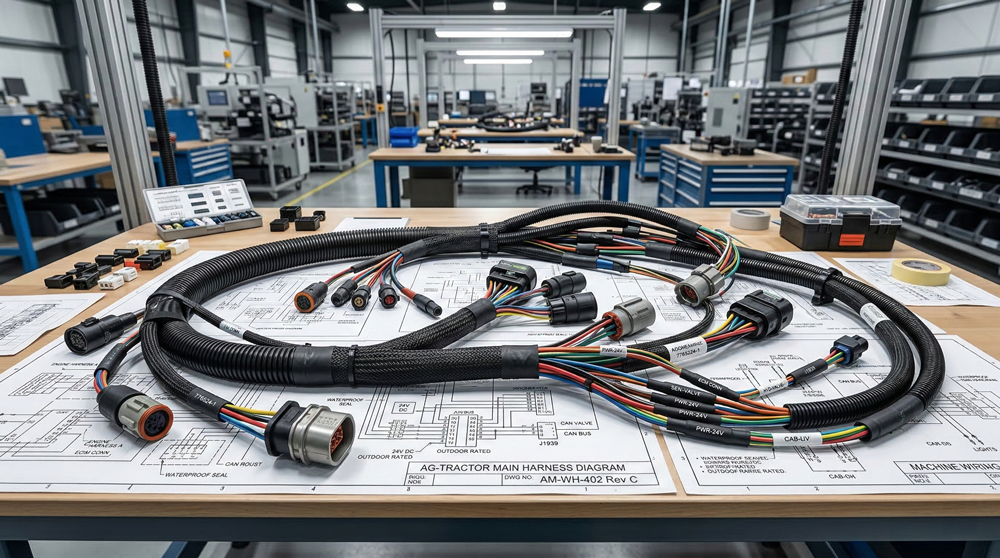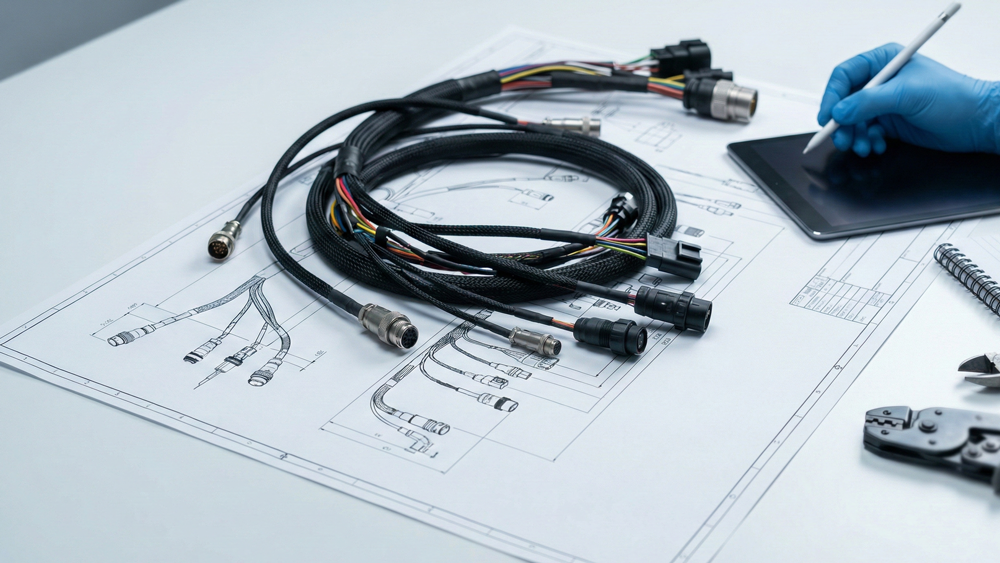
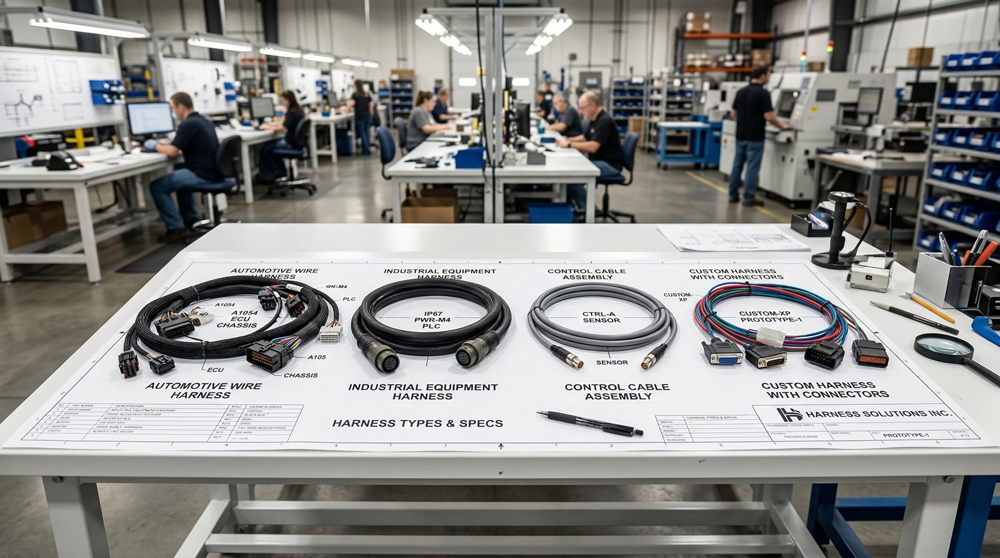
Cable assemblies for automotive auxiliary systems need to balance reliability, packaging efficiency, cost control, and long-term supply stability in a very practical way. Even when the assembly is not part of the core powertrain or primary vehicle control architecture, it still operates in a demanding environment shaped by vibration, temperature change, routing constraints, electrical noise, installation speed, and service expectations. A cable that looks acceptable on the bench can become a recurring problem once it is installed in a vehicle, special-purpose platform, or mobility system and exposed to real operating conditions.
For OEM buyers, that means these assemblies should not be treated as generic low-risk parts simply because they belong to an auxiliary function. In many programs, auxiliary systems still affect vehicle usability, field reliability, assembly efficiency, and warranty cost. The right cable assembly supports clean integration and stable performance. The wrong one creates intermittent faults, loose connections, routing complaints, delayed assembly, and repeated service issues that cost more than the original price difference.
Define the System
Automotive auxiliary systems cover a wide range of functions, and that is exactly why cable assembly requirements should not be generalized too quickly. A harness or cable assembly used in a camera module, lighting subsystem, HVAC accessory, seat feature, telematics unit, display interface, door module, charging accessory, warning system, or specialty vehicle add-on may all fall under the same broad category, yet the operating conditions can be very different.
Some auxiliary assemblies live inside relatively protected cabin areas but still face repeated movement, vibration, and service access constraints. Others are routed closer to engine compartments, underbody zones, exterior lighting positions, roof modules, or commercial vehicle bodies where temperature, moisture, splash, and abrasion become more important. Some carry low-level signals. Others combine power, control, and communication lines in a compact package. Some are installed once at production and left untouched. Others are serviced later in the field.
That is why OEM engineering and procurement teams should start with the real subsystem definition. Where does the assembly live? What function does it support? Is it fixed or moving? Is it inside the cabin, in a door, in a seat, in an exterior module, in a utility body, or in a specialty attachment? Does it face operator handling, vehicle vibration, water splash, or repeated mating during service? Once those questions are clear, the sourcing decision becomes much more precise.
Know the Environment
Auxiliary systems may not always face the same severity as main vehicle harnesses, but they still operate in a demanding automotive context. Vibration is often continuous. Temperature can swing between seasonal extremes or rise locally near electronics, lighting, or enclosed spaces. Moisture, condensation, dust, road splash, and chemical exposure may also matter depending on where the assembly is installed. In commercial vehicles and special-purpose platforms, the operating environment can be even less forgiving.
This matters because many cable assembly issues in automotive auxiliary applications do not appear immediately. The first samples may fit correctly and pass electrical checks, yet the real-life environment slowly exposes weaknesses. A connector may loosen under vibration. A cable route may chafe near a bracket. A jacket may harden or wear faster than expected. A strain-relief point may fatigue after repeated door or seat movement. A signal line may become unstable when routed near other electrical systems. These are not unusual failure modes. They are common results of underestimating the actual operating environment.
OEM buyers should therefore define the environmental picture early. A few useful questions usually help. Will the assembly see moisture or only cabin humidity? Will it move with the subsystem? Is it exposed to vibration from road conditions or rotating machinery? Does it sit near heat sources, sharp edges, or high-current lines? Will it be disconnected during service? A supplier can only recommend the right materials and construction if those conditions are visible during review.
Match the Duty
One of the most common sourcing mistakes is using the same design logic across very different auxiliary applications. A cable assembly for a static interior display module should not automatically follow the same design logic as one used in a powered seat mechanism, exterior lighting cluster, roof accessory, or utility-vehicle warning unit. The electrical connection may be simple in both cases, but the mechanical and environmental duty is not.
A useful way to frame this is by duty profile. Some auxiliary systems are mainly static and signal-oriented. Some are static but exposed to more temperature and vibration. Some move repeatedly, such as seats, doors, lift mechanisms, foldable modules, or articulated vehicle accessories. Some sit in semi-exposed zones where sealing and retention become more important. Others are mounted in commercial or specialty equipment where vibration and field handling create extra stress.
The table below shows how auxiliary applications often shift cable assembly priorities.
| Auxiliary application | Main stress factors | Typical priorities |
|---|---|---|
| Interior electronics | Tight routing, service access, moderate vibration | Compact design, label clarity, stable connectors, clean routing |
| Door and seat systems | Repeated movement, flexing, vibration | Flex tolerance, strain relief, retention, routing stability |
| Exterior lighting and body modules | Moisture, splash, vibration, temperature cycling | Sealing, retention, corrosion resistance, durable materials |
| Telematics and camera systems | Signal stability, compact packaging, EMI | Shielding, connector security, consistent grounding, routing control |
| Commercial vehicle accessories | Harsh vibration, service handling, outdoor exposure | Rugged support, wear protection, identification, field durability |
| Specialty equipment add-ons | Mixed duty, custom routing, low-to-medium volume | Custom geometry, practical serviceability, documentation control |
This kind of breakdown helps both the OEM and the supplier move away from vague category language and toward a real application discussion.
Choose the Cable
Cable selection in automotive auxiliary systems should reflect the real duty rather than only nominal conductor count and voltage level. On a bill of materials, two cable options may look similar, but their behavior in vibration, heat, flexing, abrasion, and packaging can be quite different.
For more static auxiliary applications, the priorities may be compact routing, stable handling during assembly, and good long-term insulation behavior. In moving systems, flex life and mechanical durability become more important. In semi-exposed or exterior zones, jacket toughness, moisture resistance, and temperature stability carry more weight. In signal-sensitive systems, shielding design and cable construction quality influence performance just as much as the connector does.
This is why OEM teams should resist the temptation to choose cable only from what is easiest to source at the moment. A cable that is convenient for purchasing may still be the wrong choice for the subsystem if it is too stiff for the route, too weak for the motion profile, or insufficiently stable for the electrical environment. In B2B OEM programs, cable construction is part of system reliability, not just a sourcing detail.
A capable cable assemblies manufacturer should therefore review the actual use case with the buyer. They should be able to discuss where the cable will sit, how it will move if at all, and what environmental conditions matter. That early conversation often prevents much larger problems later.
Select the Connector
Connector decisions in automotive auxiliary systems often look simple at first because the interfaces may appear smaller or less complex than main vehicle interconnects. But in practice, connector choice still affects retention, serviceability, assembly speed, routing geometry, and long-term stability.
The right connector depends on how the subsystem is used. A fixed interior electronics connection may prioritize compact size and packaging efficiency. A door, seat, or movable module may need stronger retention and better cable-exit support. An exterior subsystem may need better sealing logic. A serviceable accessory may need more accessible release features and clearer keying. A telematics or camera assembly may place more emphasis on signal integrity and connector stability.
In many OEM projects, the connector also affects the final assembly path. Exit direction, latch accessibility, packaging envelope, and mating force all influence how easily the product can be built on the line. A connector that is technically correct but awkward to install can slow assembly or create quality variation. This is why connector choice should be reviewed not only for fit, but also for manufacturing and service behavior.
Control Routing
Routing is a major factor in whether an auxiliary cable assembly remains reliable in the vehicle. A design can be electrically sound and still become a field problem if the installed route creates avoidable wear, pinch points, over-bending, noise exposure, or service difficulty.
This is especially true in subsystems such as seats, doors, body modules, tailgate systems, dashboard areas, or accessory installations where available space is limited and mechanical movement may be present. A cable route that looks fine in CAD or in an early prototype may still create long-term stress if it crosses sharp features, rubs against structure, lacks support near the connector, or moves too much during normal vehicle use.
OEM engineering teams should therefore review routing with real installation conditions in mind. Where are the fixed points? Where does the assembly flex? Does the route protect the cable from repeated abrasion? Does it keep the assembly away from sharp edges, heat concentration, or noisy electrical zones? Can the assembly be installed consistently by operators? Can service technicians replace it later without disassembling too much surrounding hardware?
Good routing supports both production and field life. Poor routing turns even a decent cable assembly into a reliability risk.
Protect Stress Points
Most auxiliary cable failures do not start in the middle of the cable. They begin at stress points. In automotive systems, these points are often near connector exits, clamp locations, moving interfaces, brackets, pass-through areas, or tight changes in direction. That is where mechanical load accumulates.
This is why stress-point protection should be treated as a design control, not a minor build detail. Depending on the application, the solution may involve better strain relief, local protection, improved clamp position, more suitable bend management, or a revised routing path. In some cases, adding more protective material helps. In others, the better solution is reducing the stress concentration itself.
Repeated vibration and movement make this especially important. In a seat system, door module, or commercial vehicle accessory, even a small unsupported movement near the connector can eventually create fatigue. In an exterior or semi-exposed module, local abrasion or ingress risk may make the same transition point the weak spot. These are the places where a good supplier’s practical experience often adds real value, because they can recognize likely failure points before the first volume release.
Manage Signal Quality
Many automotive auxiliary systems now involve more than simple power delivery. Cameras, telematics, displays, sensing modules, control units, infotainment accessories, and communication-connected subsystems all place more attention on stable signal performance. That means cable assemblies in these applications should be reviewed with more care than a generic low-voltage jumper.
Signal issues often do not present as complete failures. They may appear as intermittent behavior, unstable data, weak image signals, communication faults, or difficult-to-diagnose system noise. In many cases, the cable assembly contributes to these problems through weak shielding, poor grounding continuity, routing too close to noisy systems, or insufficient connector stability.
This is why OEM teams should review signal assemblies more holistically. The right questions are not only whether the cable is shielded, but how the shield is constructed, how it is terminated, how the route behaves in the vehicle, and how stable the connector interface remains under vibration. In auxiliary automotive systems, signal quality is increasingly part of product quality.
Design for Service
Auxiliary systems often need to be serviced more often than buyers initially assume. Even when the subsystem itself is not a frequent maintenance item, field replacement, diagnostics, repair, or accessory upgrades may require the cable assembly to be disconnected and reinstalled. If the design is difficult to identify or access, service cost rises quickly.
Service-friendly design begins with clarity. Can the cable assembly be identified easily? Are labels readable after installation? Is the connector accessible? Is the routing understandable without relying on tribal knowledge? Can a technician remove the assembly without damaging nearby components? In many vehicle-related products, these questions matter because field conditions are not ideal and service time is expensive.
There is also a spare-parts dimension. If the same assembly will later be provided as a service part, then part-number control, packaging clarity, and revision discipline become more important. A cable assembly that is easy to build but difficult to service is not fully optimized for OEM lifecycle cost.
Build a Better RFQ
A better RFQ usually leads to a better automotive auxiliary cable solution. Too many RFQs provide only nominal connector and length information, leaving the supplier to guess the real installation and duty conditions. That makes pricing less meaningful and increases the chance of redesign or clarification later.
A stronger RFQ should include subsystem description, installation position, movement conditions if any, environmental exposure, routing constraints, signal or power role, service expectations, annual volume, and any known issues from previous builds. Photos or installation views are especially useful because many routing and access problems are easier to see than to describe. If the assembly is part of a commercial vehicle, specialty vehicle, or add-on module, that context should also be visible.
Procurement should also define what kind of support is expected. Is the supplier building strictly to print, or are they expected to provide design feedback, routing suggestions, packaging support, and documentation stability for repeat production? The clearer this is, the more useful the supplier’s technical and commercial response becomes.
Qualify for Repeatability
A one-time successful sample does not prove that an auxiliary automotive cable assembly is ready for production. It only proves that one version was built successfully under controlled conditions. The more important question is whether the design can be built repeatedly, installed consistently, and perform reliably across normal production and field conditions.
Qualification should therefore go beyond simple continuity and visual review. Depending on the application, OEM teams may want to pay closer attention to connector retention, routing repeatability, strain-relief quality, labeling, local protection, and any critical signal or power behavior. In moving or exposed auxiliary systems, early production lots often reveal weaknesses that prototypes hide.
Pilot builds are especially useful because they show whether the supplier can maintain geometry, support details, workmanship level, and documentation consistency once the assembly is no longer a one-off engineering sample. In B2B OEM programs, repeatability is often what separates a workable supplier from a genuinely scalable one.
Control Documentation
Documentation may not be the first thing people think about when discussing auxiliary cable assemblies, but it becomes very important over the life of the program. Drawings, revisions, labels, BOM control, packaging references, and approved build states all affect whether the product can be manufactured, serviced, and updated cleanly.
This matters even more when auxiliary systems evolve over time. A small connector update, route change, accessory revision, or packaging adjustment can create confusion if document control is weak. The supplier’s ability to maintain revision discipline therefore matters almost as much as their build quality. A cable assembly with poor documentation control becomes harder to source, harder to service, and harder to transfer later if another supplier is needed.
For OEM buyers, this is a reminder that the supplier relationship is not only about today’s shipment. It is about how well the program stays controlled over time.
Evaluate Total Cost
Automotive auxiliary cable assemblies are often pressured on price because they may appear less critical than main vehicle systems. But total cost thinking is still important. A lower quoted price may lose its advantage quickly if the assembly creates production inefficiency, service difficulty, signal instability, or repeated warranty issues.
A more useful cost discussion looks at the full program effect. Does the assembly install cleanly? Does it reduce operator variation? Is it easy to service? Is the route stable? Are the materials appropriate for the environment? Does the supplier support revisions clearly? In many cases, better design clarity and smarter manufacturability improvement create more sustainable savings than pushing the BOM into a weaker design.
That is why the best commercial question is often not “How do we make this cheaper?” but “Where can this auxiliary cable assembly be optimized without increasing vehicle risk?” Strong suppliers usually respond better to that question because it invites real engineering judgment.
Choose the Supplier
Choosing the right supplier for automotive auxiliary cable assemblies is about more than capacity and unit price. The supplier should understand vehicle-related vibration, packaging constraints, routing realities, service expectations, and the discipline required for repeat OEM supply. They should also be able to distinguish between a simple build-to-print request and a project where practical engineering feedback can reduce future risk.
A strong supplier often shows this early. They ask about installation position, movement, environment, routing access, signal sensitivity, and service use. They do not assume all auxiliary systems are low-risk just because they are not part of the main vehicle harness. They understand that a small assembly can still create a large field problem if the design or support details are weak.
For OEM buyers, this kind of supplier behavior matters because it usually translates into better stability later. In automotive-related programs, consistency, documentation, responsiveness, and practical engineering support are part of supplier quality.
Conclusion
Cable assemblies for automotive auxiliary systems should be selected with the real subsystem environment, motion, packaging, service pattern, and long-term supply needs in mind. Even when the assembly is not part of the core vehicle harness, it still operates inside an automotive context where vibration, routing limits, temperature change, signal quality, and service access all matter.
The strongest approach is to define the actual system clearly, match cable and connector choices to the real duty, control routing and stress points, review signal needs carefully, support serviceability, prepare a stronger RFQ, qualify for repeatability, and work with a manufacturer that understands practical OEM supply. When that happens, the assembly becomes a stable part of the vehicle subsystem rather than a recurring source of warranty and service noise.
FAQ
What counts as an automotive auxiliary system for cable assemblies?
Typical examples include lighting modules, telematics, cameras, displays, HVAC accessories, seat functions, door modules, warning systems, specialty vehicle add-ons, and other non-core vehicle subsystems.
Are auxiliary cable assemblies lower risk than main vehicle harnesses?
Not necessarily. They may be smaller or simpler, but they still face vibration, routing constraints, service access issues, and environmental exposure that can create real field problems if the design is weak.
What should OEM buyers include in an RFQ for these assemblies?
In addition to connector and circuit information, the RFQ should describe installation position, movement conditions, environmental exposure, routing constraints, service expectations, and target volume.
Do automotive auxiliary systems need signal review too?
Yes, especially for cameras, telematics, displays, sensing modules, and communication-related functions where shielding, grounding, and connector stability affect performance.
How can buyers reduce cost without increasing warranty risk?
The safest path usually comes from design simplification, better routing, smarter support details, and clearer manufacturability rather than weakening critical materials or connector choices.
CTA
If you are sourcing cable assemblies for an automotive auxiliary system, the best place to start is a review of the actual subsystem environment, routing path, service needs, and signal requirements before comparing quotes only by BOM and piece price.
You can send your drawings, BOM, installation photos, annual demand, and project details through Contact. Our team can help review the application and support a more practical OEM sourcing discussion for your next automotive auxiliary project.