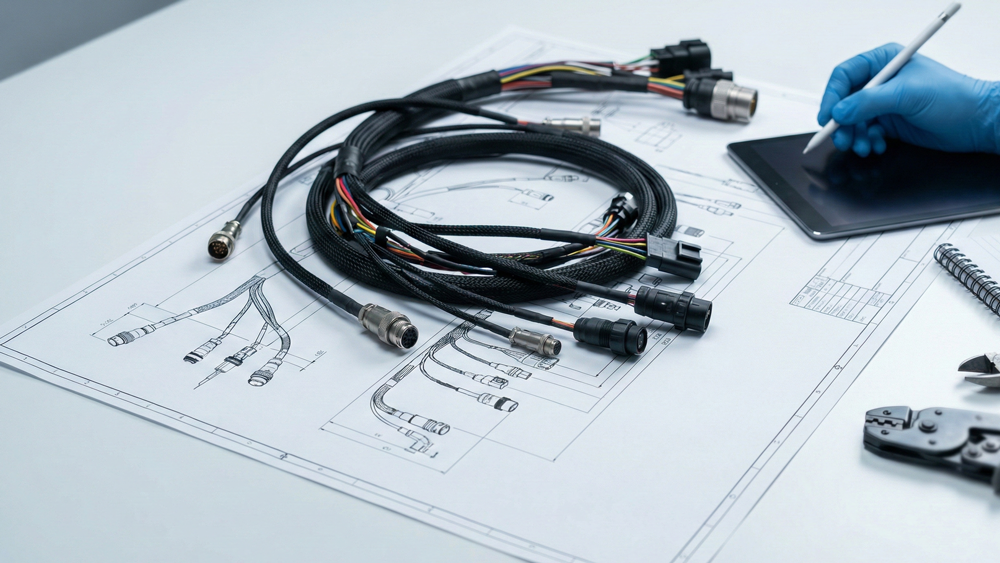
Many OEM teams ask for waterproof cable assemblies and then treat testing as a final checkpoint right before approval. That approach often creates delays, repeated sample cycles, and unclear supplier arguments, because sealing failures are discovered too late and test results are hard to interpret. In practice, waterproof cable assembly testing works best when it is planned early and linked to the real environment, sealing design, and release decisions.
This waterproof cable assembly testing guide for OEM buyers is written for engineering, sourcing, and quality teams that need a practical testing framework. The goal is not only to “pass a waterproof test,” but to build a validation process that helps teams compare designs, identify failure causes, and judge whether the design can be released with confidence.
This article closes the P8 environmental protection series and works with Environmental Protection Design Guide for Cable Assemblies, IP Rating Guide for Cable Assemblies, Cable Assembly Sealing Design at Connector and Overmold, and Sealing Materials for Cable Assemblies in Harsh Environments.
Table of Contents
ToggleCable Assembly Testing and Real Exposure
Waterproof cable assembly testing should start with the real exposure profile, not with a test label alone. A cable assembly used in rain, splash, temporary immersion, washdown, dusty outdoor installation, or coolant splash may all be called “waterproof,” but the sealing risks are different. If the test plan does not match the actual exposure, the project may pass testing and still fail in field use.
For OEM buyers, the key testing question is not only “Which test do we run?” but “Which failure mode are we trying to reveal?” Once that question is clear, test planning becomes much more useful.
Waterproof Testing and Exposure Profile
A practical exposure profile should describe the main water or moisture condition, duration, frequency, and whether other stresses are present, such as thermal cycling, vibration, fluid contamination, or repeated mating. Even a short exposure note can improve test relevance and supplier alignment.
Without this context, “waterproof testing” easily becomes a generic exercise that produces pass/fail results with low decision value.
Waterproof Testing and Service Life
Service life expectations also matter in test planning. A short-life application and a long-life outdoor product may use similar waterproof labels, but they should not rely on the same validation confidence. Long-life projects usually need stronger assumptions around aging, interface stability, and repeatability.
This is why OEM release decisions should consider both immediate test results and long-term risk assumptions.
Cable Assembly Sealing Validation Plan
Cable assembly sealing validation should be planned as a sequence, not as one test event. In most OEM projects, early tests are used to screen sealing concepts, while later tests support sample approval and production release. If teams mix these stages, results are often over-interpreted and sample failures create unnecessary conflict.
A better approach is to define a sealing validation plan with clear stages, objectives, and decision points. This allows the team to learn from early failures and avoid treating every prototype test as a final qualification result.
Sealing Validation and Screening Tests
Screening tests are used to compare design directions, identify obvious weak points, and improve the sealing path before formal qualification. At this stage, the goal is learning speed, not final proof. Teams should expect changes in geometry, materials, or process settings and should record them clearly.
This makes screening data far more valuable during later qualification review.
Sealing Validation and Qualification Tests
Qualification tests should be run on a defined design revision with controlled sample information and agreed acceptance logic. By this stage, the project should know what is being validated and what assumptions are still open. Qualification without this clarity often leads to repeated tests and inconsistent conclusions.
For OEM buyers, the quality of the validation plan is often more important than the number of tests listed.
Cable Assembly Ingress Testing Basics
Cable assembly ingress testing is commonly used to check whether sealing performance meets a target condition, but ingress testing should be interpreted carefully. A passing result confirms performance under the tested condition. It does not automatically prove long-term durability under all field conditions.
This is especially important for connector exits, overmold transitions, and interface zones, where degradation may develop over time rather than appear in the first test cycle. In many field failures, the design once passed ingress testing but later failed because the real stress profile was different.
Ingress Testing and Sealing Path
Ingress testing is most useful when teams already understand the likely sealing path and high-risk transition zones. If the project only tracks pass/fail at the assembly level, it may miss where the leakage path started and what design feature needs adjustment.
This is why ingress testing should be paired with transition-zone review and failure-location recording.
Ingress Testing and Test Assumptions
Every ingress test includes assumptions about sample condition, assembly state, and exposure condition. If those assumptions are not documented, test results become difficult to compare across versions, suppliers, or retests. A result may look better or worse only because the sample condition changed.
OEM teams should make these assumptions explicit before testing begins.
Waterproof Testing and Sample Condition
Sample condition is one of the most underestimated variables in waterproof cable assembly testing. A fresh sample, a sample after thermal cycling, a sample after repeated mating, and a sample after mechanical handling may not behave the same way in sealing tests. If the application includes any of these exposures, testing only fresh samples may give false confidence.
For OEM buyers, this does not mean every project needs a complex test matrix. It means the project should define which sample conditions matter and why.
Sample Condition and Thermal Cycling
Thermal cycling can change interface stress, material stiffness, and sealing compression, especially in connector rear-entry and overmold transition zones. A sample that seals well when new may develop risk after thermal expansion and contraction cycles.
If the application faces temperature change, sample condition should reflect that risk before final release decisions.
Sample Condition and Repeated Mating
Repeated mating can affect connector sealing surfaces and alignment, especially in applications with maintenance or frequent field connection cycles. If the cable assembly will be unplugged and reconnected in service, fresh-sample-only testing may not represent actual use.
Including repeated-mating sample condition in validation can prevent late surprises.
Sample Condition and Mechanical Handling
Handling, routing, and installation can disturb cable exit sealing and transition interfaces even before the product enters service. In some applications, the first real stress event is installation, not operation. Testing only untouched lab samples may hide this risk.
This is another reason to define sample condition based on real use, not convenience.
Waterproof Testing and Failure Analysis
Waterproof cable assembly testing creates real value only when failures are analyzed correctly. If a sample fails and the team immediately retests without documenting failure location and conditions, the project loses the chance to learn. Repeated tests without structured failure evidence often turn validation into argument rather than engineering progress.
A strong failure-analysis approach does not need to be complicated. It needs discipline: record what failed, where it failed, under what condition, and on which sample version.
Failure Analysis and Leakage Location
Leakage location is often the most useful clue in waterproof cable assembly testing. A failure at a connector rear-entry zone suggests a different design issue than a failure at an overmold boundary or a branch transition. Without location data, teams may change the wrong feature and waste sample cycles.
This is why failure evidence should include location notes and photos whenever possible.
Failure Analysis and Version Control
Failure analysis is much more effective when sample revision, process condition, and material system version are tracked clearly. Many OEM projects lose time because multiple variables change between retests and no one can identify the real cause of improvement or regression.
Version control turns testing into a learning loop instead of a pass/fail debate.
Waterproof Testing and Production Repeatability
A prototype passing waterproof testing does not guarantee production stability. Sealing performance can be sensitive to cable OD variation, molding parameters, assembly torque, cure conditions, and dimensional consistency. If repeatability is not considered, a project may approve a design that works in prototypes but becomes unstable in production.
For OEM buyers, production release should therefore consider both design suitability and process repeatability. This is where quality and sourcing teams need to align closely with engineering.
Repeatability and Process Control
Repeatability depends on process control as much as design intent. Even a good sealing design can become unreliable if process windows are narrow or uncontrolled. OEM teams should ask how the supplier controls the process factors that influence sealing performance.
This supports more realistic supplier comparison and release decisions.
Repeatability and Release Decisions
Release decisions are stronger when they are based on repeatable results rather than one successful sample. A project that defines repeatability expectations early usually reaches production approval faster because the validation logic is clear for both buyer and supplier.
This aligns with Tests & Inspections and Quality Guarantee in OEM supply projects.
OEM Validation Plan for Waterproof Cable Assemblies
An OEM validation plan for waterproof cable assemblies should connect exposure profile, sealing design, sample condition, test stages, failure analysis, and repeatability into one decision framework. Many validation problems happen because these elements are handled separately by different teams and only compared late in the project.
A practical validation plan does not need to be long. It needs to be clear enough that engineering, sourcing, quality, and the supplier all understand what is being tested, why it is being tested, and what result is needed for the next decision.
OEM Validation Plan and RFQ Clarity
Validation quality starts at RFQ quality. If the RFQ only says “waterproof cable assembly” with no exposure detail or use condition, the test plan will likely be weak from the beginning. A stronger RFQ improves both design proposals and testing relevance.
This is why testing strategy should be discussed before sample build, not after the first failure.
OEM Validation Plan and Supplier Alignment
Supplier alignment improves when the validation plan is shared as a decision tool instead of only as a pass/fail requirement. Suppliers can provide better recommendations when they understand which risks matter most and which assumptions are fixed or flexible.
That usually reduces rework and shortens sampling cycles.
Common Waterproof Testing Mistakes
Common mistakes in waterproof cable assembly testing usually come from poor timing or poor definition. One mistake is waiting until final approval stage to test sealing seriously. Another is treating one ingress test result as proof of long-term field reliability. A third is ignoring sample condition and failing to record failure location and version data.
These mistakes often produce the same outcome: repeated samples, unclear debates, and late project delays. Teams that avoid them usually define exposure early, stage the validation plan, document sample condition, and treat failure analysis as part of testing rather than as an afterthought.
Conclusion for Waterproof Cable Assembly Testing
The best waterproof cable assembly testing guide for OEM buyers is not a list of test names. It is a practical validation method that connects real exposure, sealing-path risk, sample condition, failure analysis, and repeatability to release decisions. When testing is structured this way, pass/fail results become much more useful because they support design learning and supplier alignment.
When OEM engineering, sourcing, and quality teams use waterproof testing as a decision framework instead of a late checkpoint, field reliability becomes more predictable and production release becomes much more confident.
FAQ
Is one waterproof test enough for cable assembly approval
Usually not. One test result can confirm performance under a specific condition, but OEM approval often needs staged validation, clear sample condition, and repeatability confidence.
Why is sample condition important in waterproof cable assembly testing
Because fresh samples may perform differently from thermally cycled, repeatedly mated, or mechanically handled samples. Sample condition can change sealing behavior.
What should be recorded when a waterproof test fails
At minimum, record failure location, exposure condition, sample version, process condition, and any relevant photos before retesting.
Does a prototype waterproof pass guarantee production performance
No. Production performance also depends on process repeatability, dimensional variation, and process control for sealing-sensitive features.
How should OEM buyers plan waterproof cable assembly validation
Define the real exposure, stage the test plan, specify sample condition, document failure evidence, and include repeatability expectations before release.
CTA
Need Help Building a Waterproof Cable Assembly Validation Plan
If your OEM project involves waterproof cable assemblies, outdoor exposure, washdown conditions, or sealing risk at connector and overmold transitions, we can help you build a more practical waterproof cable assembly testing plan before sample approval and production release.
We can support exposure-risk mapping, sealing validation planning, sample-condition definition, failure-analysis workflow, and repeatability review so your testing supports real release decisions instead of only pass/fail reporting.
If you already have drawings, connector part numbers, cable specs, routing photos, environment notes, or test reports, contact us through our Contact page. You can also review our Environmental Protection Design Guide for Cable Assemblies, Tests & Inspections, Quality Guarantee, and Assembly Capabilities pages before starting the discussion.