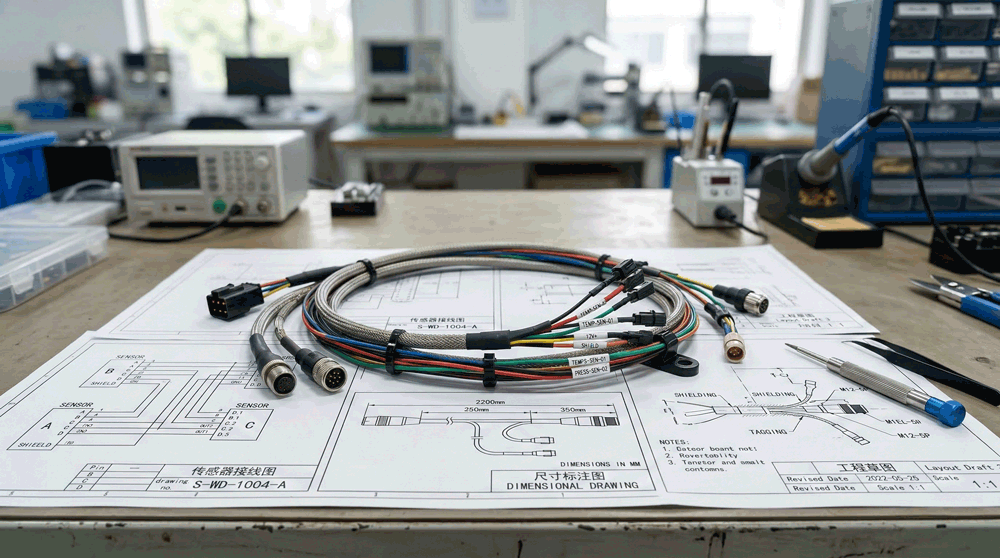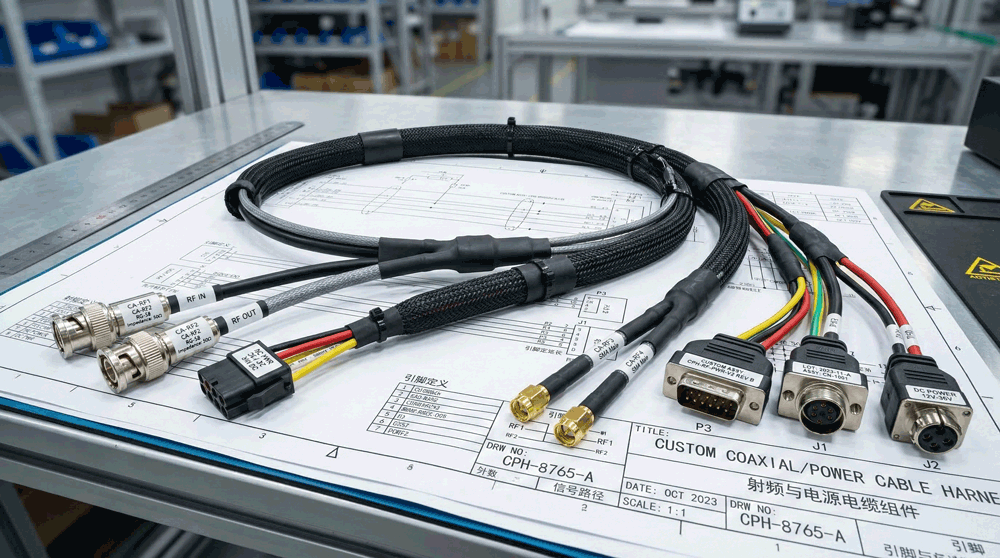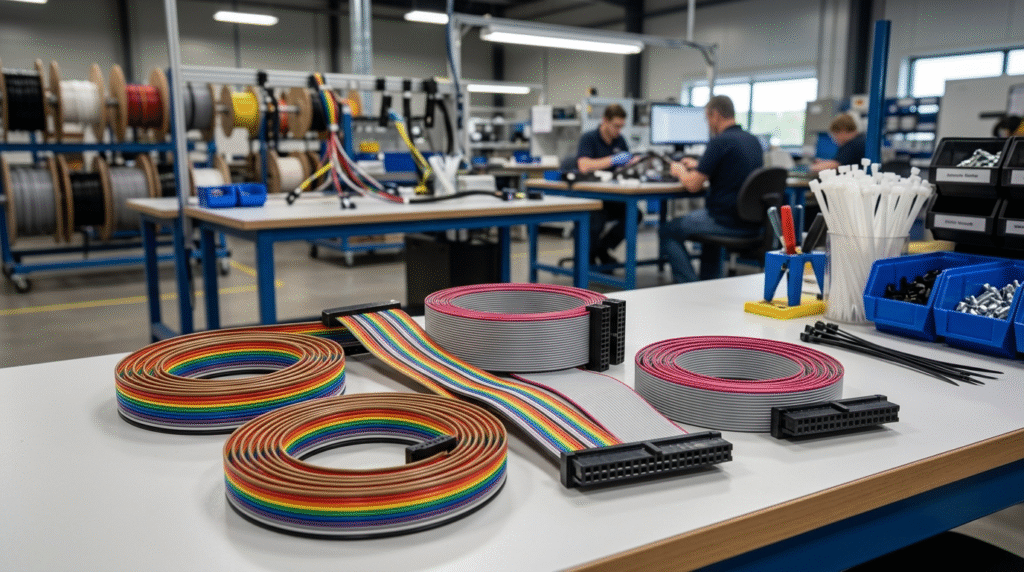
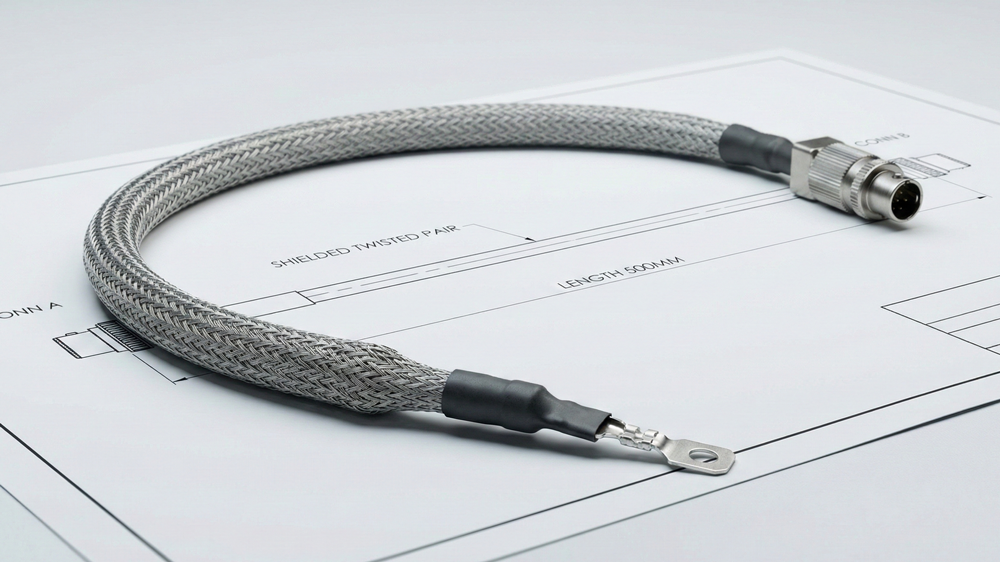
Drag chain cable selection for cable assemblies is one of the most important reliability decisions in moving industrial systems. Many OEM teams focus on connector interface, signal requirements, and cable core count first, then assume any “industrial cable” can survive the motion path. In real machines, that assumption often fails. A cable assembly may pass bench testing and early startup, but repeated drag chain motion later creates intermittent signals, broken conductors, jacket wear, shielding instability, or premature failure near the fixed or moving ends.
This happens because drag chain reliability is not only about choosing a “flexible cable.” It depends on the full cable assembly system: motion profile, chain layout, routing conditions, bend radius control, strain relief design, termination quality, and validation method.
This article explains how OEM buyers can approach drag chain cable selection for cable assemblies from a system design and sourcing perspective. It is intended for engineering, sourcing, and quality teams that need to reduce failure risk before sample approval and production release.
For the broader dynamic-use framework, pair this article with our High Flex Cable Assemblies Design Guide for OEM Buyers. For custom project alignment, your Custom Cable Assemblies and Strong Technical Support pages are useful starting points.
Table of Contents
ToggleWhy Drag Chain Cable Selection Often Fails
A common mistake is treating drag chain cable selection as a material-only decision. Teams ask for a drag chain rated cable, confirm the connector part numbers, and move forward without defining the actual chain conditions. The result is predictable: the selected cable may be technically “drag chain capable” in one setup, but not suitable for the real machine path, cycle profile, loading, or installation constraints.
In many OEM projects, the field failure is blamed on cable quality when the root cause is a mismatch between design assumptions and actual use. The chain may be overfilled. The cable may be forced into torsion. The clamp may be placed too close to the moving bend zone. The chain radius may be acceptable for the cable alone but too tight once the assembly transition and connector exit geometry are considered.
For OEM buyers, the key lesson is simple: drag chain cable selection must be defined as an application-specific cable assembly decision. Without the machine motion context, supplier quotes are difficult to compare and validation results are often misleading.
Define Drag Chain Motion Profile First
Before selecting a cable assembly for a drag chain, define the motion profile. This is the most valuable input you can give a supplier.
At a minimum, OEM teams should clarify:
- travel length or stroke
- motion frequency or cycle rate
- speed and acceleration range
- duty cycle
- expected service life or cycle target
- whether motion is continuous, intermittent, or indexed
- whether the cable also experiences twist or side loading
Even when exact values are not available, a realistic range is much better than no data. Suppliers can make better recommendations when they understand whether the system is a slow-moving inspection station, a medium-speed gantry, or a high-cycle automation axis.
This also improves internal decisions. A cable assembly that survives limited startup motion may fail quickly in continuous production because the actual duty cycle is much higher than the sample review assumed.
If the machine is part of a broader automation platform, it helps to align requirements with your Industrial & Robotics application framing before final RFQ release.
Drag Chain Motion Is More Than Repeated Bending
Drag chain motion is often described as repeated bending, but in real equipment it includes more than that. The cable assembly experiences a controlled moving bend inside the chain, but it may also see acceleration loads, cable-to-cable contact, chain sidewall interaction, installation handling stress, and transition stress near the fixed and moving ends.
This matters because a cable selected only for bend durability may still fail if the assembly is sensitive to abrasion, compression, or repeated stress at the terminations. In some systems, the highest risk zone is not inside the chain body but at the cable exit area where routing becomes less controlled.
OEM buyers should therefore evaluate drag chain cable assemblies as motion systems, not as isolated cable samples. If the cable assembly includes sensitive signals, shielding, or mixed power and communication lines, the motion effects can show up as signal instability long before a hard electrical open occurs.
Drag Chain Chain Size and Fill Conditions
Cable selection cannot be separated from drag chain size and fill condition. A good cable assembly can fail early if the chain is overloaded or poorly organized.
When reviewing a drag chain application, OEM teams should confirm:
- chain internal dimensions
- number of cables and hoses sharing the chain
- approximate fill level
- separation strategy between different media lines
- whether the cable assembly can move freely within the intended lane
If the chain is crowded, cables can rub, cross over, or develop unstable movement patterns. This increases wear and changes how loads are distributed over time. A supplier may recommend a suitable cable, but the installed chain condition can still invalidate the expected flex life.
For OEM buyers, this is why sample approval based only on cable datasheets is risky. The chain layout is part of the cable assembly requirement, and it should be documented in the project review.
Drag Chain Bend Radius and Cable Assembly Geometry
Bend radius is one of the most cited requirements in drag chain projects, but it is also one of the most misunderstood. A cable may have a published minimum bend radius, yet the actual cable assembly can still operate below that radius once connector exits, strain relief features, and routing transitions are included.
OEM teams should evaluate bend radius in the installed assembly geometry, not only the raw cable specification. In practice, the effective radius can be reduced by:
- stiff overmold transitions
- rigid backshells
- immediate bends after clamps
- cable stacking inside the chain
- exit routing constraints outside the chain
This is why drag chain cable selection must include assembly geometry review. A cable that is acceptable in a free bend test may be unsuitable once the full assembly is installed in the machine.
For deeper design alignment on bend life, see Bend Radius and Flex Life for Cable Assemblies.
Avoid Torsion in Drag Chain Cable Assemblies
Many drag chain cable failures are caused or accelerated by unintended torsion. Drag chains are typically designed to manage controlled bending, not continuous twisting. When a cable assembly is installed with twist, or when machine motion introduces torsional loading, the cable may fail much earlier than expected.
Common torsion sources include:
- installation twist during routing
- misaligned clamp points
- uneven cable lane constraints
- chain path geometry that introduces side pull
- moving-end routing that rotates the cable
For OEM buyers, torsion risk should be reviewed during installation planning, not after failures appear. A cable assembly can be correctly selected for drag chain bending and still perform poorly if the installed path forces twist. This is one reason field failures often appear inconsistent across machines: the cable is the same, but installation practices vary.
Fixed End and Moving End Stress Zones
In many drag chain systems, the highest stress is not in the center of the chain. The most failure-prone zones are often near the fixed end and moving end where the cable exits the chain and transitions into freer routing.
These transition zones are sensitive because the cable assembly shifts from controlled chain motion to local bend, clamp, and connector constraints. If clamps are too close, unsupported length is too short, or routing direction changes abruptly, stress concentrates near the termination area.
OEM teams should explicitly review:
- clamp position relative to bend zone
- free length outside the chain
- routing direction after chain exit
- connector orientation and rear exit geometry
- whether the cable is forced to bend immediately after termination
This is where strain relief design becomes critical. A strong cable inside the chain can still fail early if end transitions are poorly managed. For detailed design principles, see Strain Relief Design for High Flex Cable Assemblies.
Cable Routing in Drag Chain Systems
Routing quality has a major effect on drag chain cable life. Even a well-selected cable assembly can fail if routing is uncontrolled during machine build or service.
OEM buyers should define routing rules for production and field replacement, especially when the project is expected to scale. Useful routing controls include:
- no twist installation rule
- bend radius protection near exits
- clamp location standard
- separation from sharp edges
- separation from heat sources
- separation between power and sensitive signal cables when needed
Without routing controls, sample test performance may not translate into field reliability. Two machines can use the same cable assembly but have very different outcomes because technicians route the cable differently.
This is also a supplier communication issue. If the supplier validates a sample in an ideal routing setup and the OEM installs it in a constrained path, the project may appear to have a cable problem when the real issue is routing mismatch.
Power, Signal, and Shielding in Drag Chain Cable Selection
Drag chain cable selection becomes more complex when the assembly carries mixed circuits such as power, control, feedback, and communication. In these cases, mechanical survival alone is not enough. Signal stability and shielding performance must remain stable under motion.
Repeated flexing can stress shielding terminations and change noise performance over time, especially in equipment with drives, motors, or switching loads. Some cable assemblies continue to show continuity but develop intermittent communication errors or sensor noise because the shielding or grounding path becomes unstable in motion.
OEM buyers should therefore define functional acceptance in addition to mechanical durability. If the application includes sensitive circuits, supplier discussions should cover:
- shielding structure suitability for motion
- shielding termination method under flexing
- separation strategy in the chain
- post-cycle functional checks
- signal performance monitoring during motion when needed
For production and validation alignment, tie these requirements to your Tests & Inspections process and Quality Guarantee expectations.
Connector and Termination Fit for Drag Chain Use
A cable may be suitable for drag chain motion while the finished cable assembly is not, because connector and termination design introduce stress concentration. OEM buyers should review connector and termination choices in the context of the drag chain path.
Important factors include:
- connector rear exit stiffness
- cable retention method
- available backshell or boot options
- overmold geometry
- minimum free length before first bend
- installation space near moving components
In many failures, the cable itself is not the first weak point. The termination transition fails first because the assembly is forced into a tight bend or repeated vibration near the connector. This is why drag chain cable selection must include assembly-end geometry review, not only cable spec comparison.
Supplier process quality also matters. Small variation in termination support, overmold shape, or strain relief positioning can change life significantly in high-cycle systems. Review supplier Assembly Capabilities before approving a final design.
Environmental Conditions in Drag Chain Applications
Drag chain systems often operate in industrial environments with oil mist, coolant splash, dust, vibration, temperature changes, and mechanical abrasion. These conditions can reduce cable life even when the motion profile is well defined.
OEM buyers should evaluate environmental compatibility for:
- cable jacket material
- insulation system
- overmold or boot materials
- sealing materials if used
- external wear protection features
Material substitutions after sample approval can create major risk. A jacket that looks similar and passes static checks may behave very differently under drag chain motion and chemical exposure. This is especially important when cost-down changes are proposed after engineering validation.
For supplier alignment, include environmental assumptions and change-control expectations in the RFQ, not only in late-stage quality discussions.
Drag Chain Cable Testing and Validation for OEM Buyers
A drag chain cable assembly should be validated under a test setup that reflects the real machine as closely as practical. A generic “flex test” may provide some screening value, but it is not enough for many OEM decisions if it ignores travel length, bend radius, end transitions, or functional monitoring.
A practical validation approach should define:
- motion profile used in testing
- chain geometry or representative simulation setup
- cable routing and clamp conditions
- sample quantity
- cycle target or staged checkpoints
- pass/fail criteria for electrical function and physical condition
- post-test inspection requirements
- retest or redesign rules if failures occur
For many applications, functional monitoring during motion is as important as end-of-test checks. Intermittent faults often appear before permanent opens, and these are frequently the failures that create difficult field diagnostics.
This topic will be expanded in High Flex Cable Testing Guide for OEM Buyers.
OEM RFQ Checklist for Drag Chain Cable Assemblies
A strong RFQ reduces ambiguity and improves quote quality. For drag chain cable assemblies, OEM teams should define more than connector type and cable core count.
A practical RFQ should include:
- machine application and axis function
- stroke length and motion frequency
- speed and acceleration range if available
- duty cycle and production usage pattern
- expected service life or cycle target
- drag chain dimensions and shared contents
- bend radius constraints in the installed condition
- fixed-end and moving-end routing constraints
- connector type and space limits
- signal sensitivity and shielding requirements
- environmental exposure conditions
- validation test expectations
- sample quantity and repeatability expectations
- change-control requirements for cable and assembly materials
If possible, include routing sketches, photos, or a short motion video. In drag chain projects, installation geometry often matters more than a long generic specification.
For custom projects, route the discussion through Custom Cable Assemblies and Strong Technical Support so engineering assumptions are aligned early.
Common Drag Chain Cable Assembly Mistakes
Several mistakes repeatedly cause drag chain cable failures.
One common mistake is selecting a drag chain cable based only on catalog claims without defining the actual chain setup. Another is ignoring end-transition stress and focusing only on the cable section inside the chain.
A third mistake is allowing installation twist. Many cable assemblies fail early because the cable was routed with torsion, even though the cable itself was appropriate for bending.
Another common mistake is underestimating routing variation across builds. Sample performance may look good, but field failures appear later because assembly technicians or service teams route the cable differently.
Finally, some teams approve a design after one sample passes limited testing and then accept material or geometry changes without revalidation. In drag chain systems, small changes can significantly alter life.
How OEM Buyers Compare Suppliers for Drag Chain Projects
Supplier comparison for drag chain cable assemblies should focus on application understanding and repeatable execution, not only unit price.
Useful comparison points include:
- how well the supplier interprets motion profile and chain conditions
- ability to review routing and end-transition risks
- strain relief and termination design capability
- validation method quality and test setup relevance
- process repeatability in production
- documentation discipline and engineering communication
- response quality when failures occur and redesign is needed
- change-control discipline for cable and assembly materials
A supplier that asks detailed questions about stroke, routing, clamps, and chain layout usually provides better long-term value than one that simply confirms “drag chain cable available.”
Conclusion
Drag chain cable selection for cable assemblies is a system-level decision, not a simple cable upgrade. For OEM buyers, reliable results come from defining the motion profile, reviewing chain fill and routing conditions, controlling bend radius in the installed assembly, protecting end transitions, and validating the design under representative motion.
The best outcomes come from early alignment between engineering, sourcing, and quality teams. When machine motion and routing constraints are defined clearly before sample release, supplier recommendations improve, validation becomes more meaningful, and field reliability is far more predictable.
FAQ
Is a drag chain rated cable enough for a drag chain cable assembly
Not always. The cable may be suitable, but the finished assembly can still fail due to routing, torsion, bend radius violations, or poor end-transition strain relief.
Why do drag chain cable assemblies often fail near the ends
Because fixed-end and moving-end transitions often create the highest stress. Clamp position, free length, connector geometry, and immediate bends can cause early failure.
Can installation twist really reduce drag chain cable life
Yes. Drag chains are mainly for controlled bending. Unintended torsion can significantly reduce cable life and cause inconsistent failures across machines.
What should OEM buyers include in a drag chain cable RFQ
Include motion profile, chain dimensions, fill condition, routing constraints, bend radius limits, connector geometry, environment conditions, and validation expectations.
Should drag chain validation include functional monitoring during motion
In many applications, yes. Intermittent faults often appear before permanent failure, and motion-time monitoring helps detect real-world problems earlier.
CTA
Need Help Choosing a Drag Chain Cable Assembly for an OEM Project
If your team is selecting a cable assembly for a drag chain axis, we can help review the motion profile, chain layout, end-transition risks, and validation assumptions before sample approval.
We can support:
- drag chain motion profile review
- chain fill and routing risk assessment
- bend radius and end-transition design review
- shielding and functional stability review for mixed circuits
- OEM validation planning and supplier comparison
If you already have drawings, chain dimensions, routing photos, or machine motion details, contact us through our Contact page. You can also review our High Flex Cable Assemblies Design Guide for OEM Buyers, Assembly Capabilities, and Tests & Inspections pages before starting the discussion.