When engineers or sourcing teams search for cable assembly manufacturers, they’re rarely doing “supplier shopping” in a casual sense. They’re trying to reduce program risk—risk of intermittent failures, EMI noise issues, cracked jackets, connector pull-out, production delays, and “it worked in the lab but fails in the field” surprises. In other words, selecting a cable assembly manufacturer is not only a purchasing decision. It’s a reliability decision.
That’s why capability matters more than marketing. Two suppliers can both claim they “make custom cable assemblies,” but one may truly understand overmolding design-for-manufacture, coax termination best practices, or flat ribbon strain relief—while the other is essentially a connector crimp shop with limited process control. If your product depends on stable performance, predictable lead time, and repeatable builds across prototype-to-production, you need a structured way to qualify capability.
This guide gives you exactly that: a practical capabilities checklist organized around four high-impact build types—overmolded cable assemblies, RF/coax cable assemblies, flat ribbon cable assemblies, and control cable assemblies. Along the way, you’ll see what “good” looks like in engineering support, process control, testing, documentation, and scalability. If you already have drawings and want a fast quote, start with Custom Cable Assemblies. If you’re still clarifying scope, begin with Cable Assemblies and then use this article to decide what you must specify.
Table of Contents
ToggleWhy “capabilities” is the real filter for cable assembly manufacturers
The easiest way to waste time in sourcing is to filter suppliers by geography, price, or “years in business” before you filter by capability. Cable assemblies fail for predictable reasons: incorrect strip lengths, improper shield termination, wrong crimp geometry, inconsistent strain relief, uncontrolled adhesives, mislabeled variants, or incomplete testing definitions. Most of those failure modes are not solved by negotiating price. They’re solved by systems: controlled processes, correct tooling, defined inspection points, and test programs that match the application.
A manufacturer’s capabilities show up in how they answer simple questions. When you ask, “How do you prevent intermittent failures?” a mature supplier will talk about process control and test definitions rather than “strict QC.” When you ask, “Can you do overmolding?” a mature supplier will ask about sealing, flex, material compatibility, and tooling strategy rather than only “yes, we can.”
This is why capability pages are useful as proof points. If you want a quick view of what mature scope typically includes, review Assembly Capabilities and Tests & Inspections. These two pages are especially important for E-E-A-T style credibility because they reflect real operational discipline rather than vague claims.
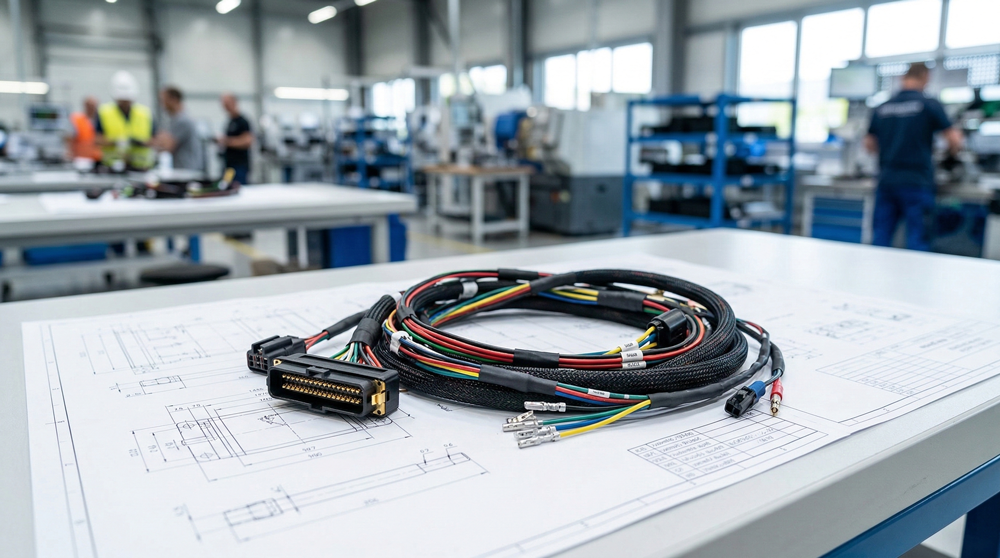
Cable assembly vs wire harness: get the category right before you quote
Many sourcing delays happen because the product is mislabeled. A routed multi-branch system inside a machine is usually better treated as a harness. A performance-critical interconnect based on coax, shielded cable, or molded ends is often better treated as a cable assembly. Hybrids exist, and that’s where confusion becomes expensive.
A practical rule works well: when the dominant complexity is routing/branching/physical fit, treat it as harness-led; when the dominant complexity is electrical performance, shielding, overmolding, or termination method, treat it as cable-led. If you want a deeper clarification framework, your buyers can reference Cable Assemblies alongside Wiring Harness so both engineering and procurement speak the same language.
Once category is aligned, quoting becomes faster because suppliers stop guessing scope.
The capability pillars that separate “real manufacturers” from “simple assemblers”
Before we get into the four build types, it helps to know what capability looks like in a general sense. A high-performing cable assembly manufacturer typically has four pillars:
The first pillar is engineering support. That means they can review a drawing pack, highlight ambiguity, suggest DFM improvements, and document assumptions clearly. If a supplier cannot ask good questions, they will build the wrong thing fast.
The second pillar is controlled processes. Cable assembly is not only “cut, strip, crimp.” It’s controlled stripping, correct shield handling, controlled torque or insertion procedures, reliable strain relief, and defined workmanship standards. This often shows up as consistent work instructions and process checkpoints.
The third pillar is testing discipline. “100% test” is not a complete requirement; the manufacturer must define what test is run, using which fixture or program, with what acceptance criteria. For shielded assemblies, you may need additional checks beyond continuity. For higher voltages, you may need insulation resistance or hipot. The point is that testing must be specified and controlled, and the manufacturer must be able to execute repeatably. This is where Tests & Inspections becomes a practical reference.
The fourth pillar is scalability and supply chain execution. Prototype builds have different economics than production. Mature suppliers can handle both by using documented revisions, controlled incoming inspection, and consistent procurement practices. If you require speed, check how they define quick-turn scope via Quick Turn Available.
With those pillars in mind, we can now evaluate the four build types that most commonly decide whether a supplier is a good fit.
Capability 1: Overmolded cable assemblies (design + DFM + tooling reality)
Overmolding is one of the most misunderstood capabilities in cable assembly sourcing. Buyers often treat it as a cosmetic upgrade, but in many programs it is a functional requirement: strain relief, sealing, abrasion protection, improved durability, and sometimes environmental protection against moisture or chemicals. Overmolding changes your manufacturing model because it can introduce tooling, material selection decisions, and DFM constraints that must be agreed early.
If a manufacturer truly understands overmolding, they will not simply quote “overmolded cable assembly” based on a photo. They will ask what the overmold must accomplish. If the goal is strain relief, the key variables are bend radius, cable flex rating, and how the material bonds to the jacket. If the goal is sealing, then interface geometry, adhesion, and any ingress pathways matter. If the goal is abrasion protection, then material hardness and thickness become key.
A mature supplier will also talk about the difference between “molding” and “overmolding.” Overmolding is typically integrating a molded feature around an existing cable/connector interface. That means the cable jacket and connector body become part of the mold interface and the design must account for shrink, adhesion, and mechanical retention features. This is why overmolding is best scoped explicitly using Overmolding Services, and why many overmolded builds overlap with Molded Cable Assemblies.
When you qualify an overmolding-capable manufacturer, capability shows up in the questions they ask and the constraints they communicate. If they can’t discuss material compatibility, how they prevent cable pull-out, how they manage gating/flow, and how they control dimensional consistency, you are likely looking at a supplier who outsources molding or treats it as “we’ll figure it out.”
Overmolding capability also intersects with quality. Overmold defects are often not caught by continuity testing. You need workmanship and inspection standards: surface defects, voids, flash, incomplete fill, adhesion, and functional geometry at the interface. If your project is quality-sensitive, you want to see not only a statement but a system—quality policy, inspection standards, and documented checks. Supporting proof pages include Quality Policy, Quality Guarantee, and Certificates.
Capability 2: RF cable assemblies and coax assemblies (SMA, coax, shielding, and performance control)
RF and coax assemblies are a common “capability trap” because they look simple—cable plus connectors—but their performance depends heavily on termination method, geometry control, and shielding continuity. A supplier who can build basic power cables may still struggle with RF if they don’t treat coax termination as a controlled process.
When sourcing RF cable assemblies, the first capability check is whether the manufacturer understands what performance matters for your application. For many programs, the central requirement is not only continuity; it’s stable signal behavior. That typically means correct impedance assumptions (often 50 ohm in common RF contexts), consistent connector installation, and proper shielding termination. A supplier should be able to explain their termination method, how they prevent braid damage, and how they avoid inconsistent geometry that can create performance variability.
The second capability check is whether they can handle the connector families and cable types you use. “SMA” is often mentioned, but that is only one part of the story. Programs may use multiple connector types and multiple coax cable families depending on routing constraints and frequency requirements. A capable supplier can translate your part numbers into a repeatable work instruction that maintains performance and reduces scrap.
The third capability check is testing definition. Some programs require only continuity and visual inspection because the system-level RF testing is done elsewhere. Other programs need stronger confirmation and will ask for additional test evidence. What matters is not that every supplier has a lab-grade setup; what matters is that the test plan is aligned with your acceptance criteria and that the supplier can execute it consistently. This is why a general testing framework page like Tests & Inspections is useful: it anchors testing as a controlled deliverable instead of an undefined promise.
If your RF build is part of a broader data or telecom product, you may also find it useful to position the application context through Telecom & Data—not to “sell,” but to help buyers self-identify that higher expectations around performance and documentation may apply.
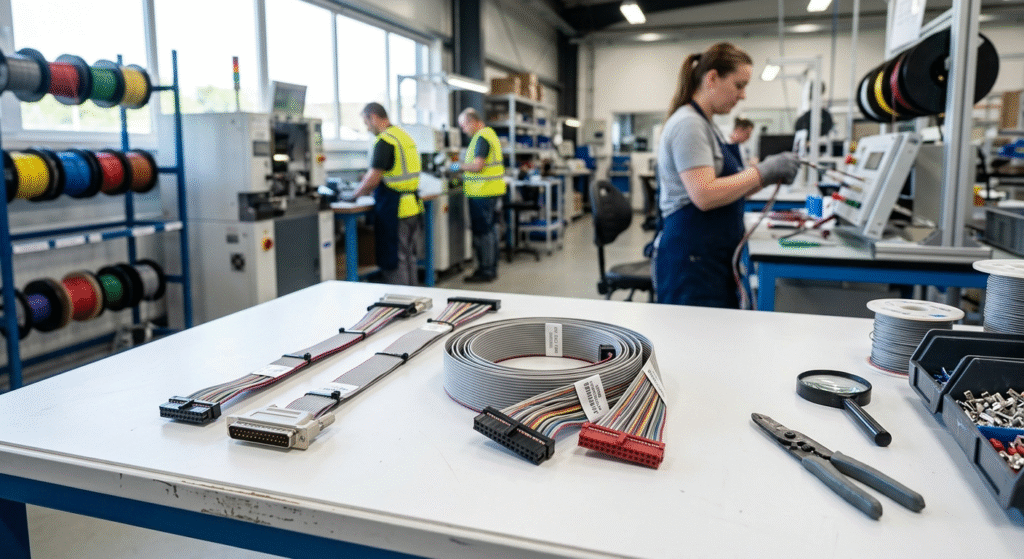
Capability 3: Flat ribbon cable assemblies (IDC, pitch, orientation control, strain relief)
Flat ribbon cable assemblies can look commodity—especially if you think of them as “IDC connectors and ribbon cable.” In practice, they are often a reliability and assembly-control challenge because ribbon cable is sensitive to orientation, pitch, strain relief, and installation handling. A small mistake in orientation can create systematic miswires that are hard to detect visually, especially in dense multi-pin contexts.
When you qualify flat ribbon capability, the first check is whether the manufacturer can control pitch and alignment consistently and whether they have standardized methods for cutting, terminating, and strain-relieving the ribbon. IDC terminations are sensitive to uniform pressure, correct alignment, and correct connector selection. A good supplier will ask you to confirm pitch, conductor count, orientation, and whether keying or polarization is required.
The second check is strain relief strategy. Ribbon cables often fail mechanically due to repeated flexing at the connector transition. Manufacturers who treat ribbon as “just another cable” may not address strain relief adequately. A manufacturer who has built ribbon assemblies for industrial or device contexts will ask about movement, bend radius, and whether additional strain relief or protective booting is required.
The third check is testing strategy. Ribbon assemblies can pass continuity tests even when mechanical robustness is poor. If your application includes movement or repeated maintenance cycles, you should define acceptance criteria beyond “it works once.” You may need defined strain relief placement and workmanship standards. If you need stronger process assurance, that again ties into a visible testing and inspection system, which is why internal references like Tests & Inspections and Quality Guarantee are valuable.
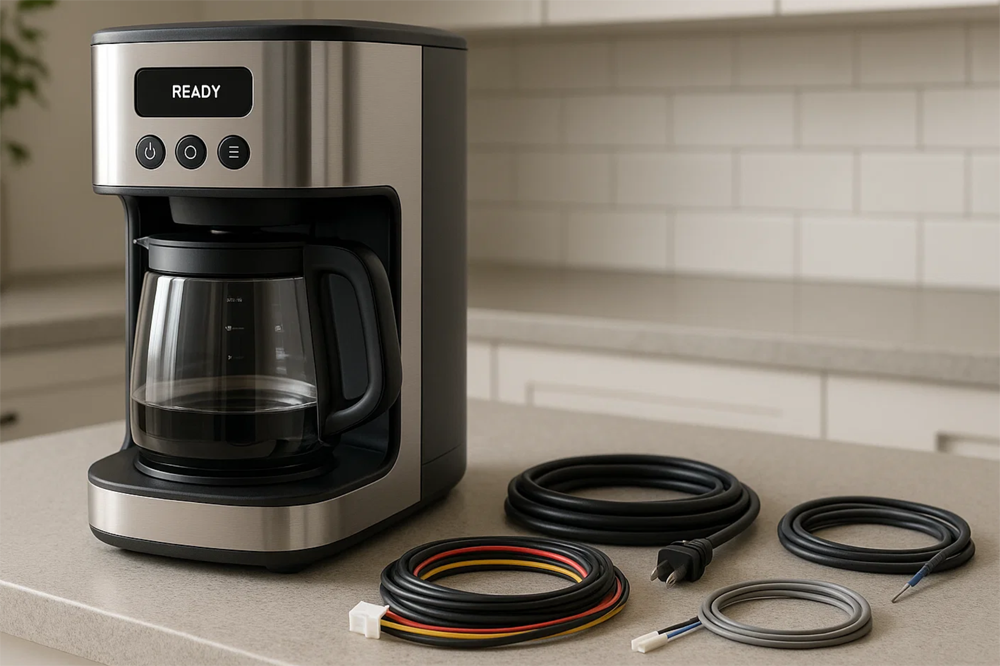
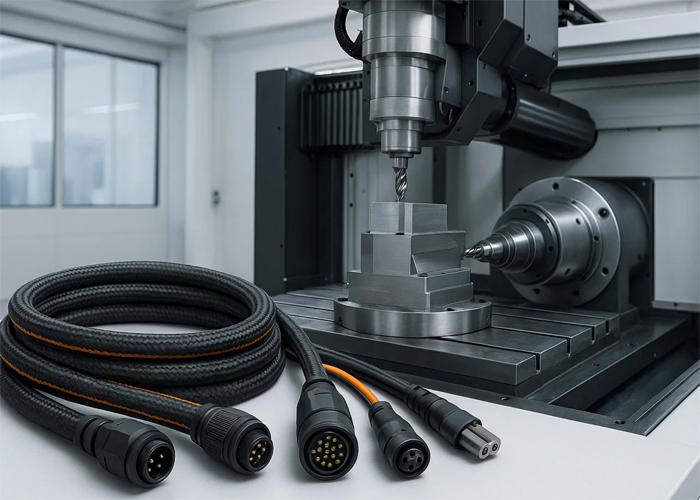
Capability 4: Control cable assemblies (industrial automation, 24V sensors, motion, and reliability under real conditions)
Control cable assemblies for industrial automation often live in harsh reality: vibration, oil exposure, cable carriers, repeated flexing, and field maintenance. Many are 24V sensor and actuator interconnects, but the term “control cable” can include a broad set of applications—encoders, feedback lines, machine I/O, and integration between controllers and subsystems.
Capability here is less about “can you crimp a connector” and more about whether the supplier can build for durability and maintainability. A mature control-cable supplier will ask about flex cycles, environment (oil, abrasion, temperature), shielding needs (noise immunity), and installation constraints. They will also recognize that labeling and variant control can matter more in automation because maintenance teams rely on identification and repeatability.
If your control assembly lives in robotics or industrial equipment, it’s useful to anchor the application context via Industrial Robotics. Again, this is not marketing fluff; it’s a cue to buyers that your manufacturing approach is based on real application environments rather than generic cable talk.
Testing and documentation matter here, too. Many control assemblies are not high-frequency RF, but they are still sensitive to intermittent failures caused by vibration and flex. A supplier should be able to define how they prevent such defects through process control and verification, and you should be able to align test coverage through Tests & Inspections.
The “capabilities checklist” you can actually use in supplier qualification
At this point, the question becomes practical: what do you ask a cable assembly manufacturer to quickly separate real capability from generic claims?
Start with engineering intake. Ask how they handle incomplete documentation. Do they generate a question log? Do they confirm assumptions in writing? Can they recommend DFM improvements when they see a failure risk? Strong engineering support is a capability, not a courtesy, and the supplier should be comfortable explaining it. A proof page that signals this mindset is Strong Technical Support.
Then evaluate process control. Ask whether they can describe their build steps clearly for your build type. Overmolding, coax termination, ribbon IDC, and control cables each have different critical variables. If the supplier can’t explain those variables, you may still get a quote—but you will likely pay for ambiguity later.
Next evaluate testing definition. Ask what “tested” means for your build. Can they execute continuity and short testing as standard? Can they align on additional tests if needed? Can they produce evidence if your customer requires it? This is where Tests & Inspections should be treated as part of the qualification conversation, not only an afterthought after a failure.
Finally evaluate scalability. Ask how they handle prototypes vs production. Do they have a quick-turn pathway? Do they maintain revision control? Can they support stable lead times once you ramp? If your timeline is aggressive, review Quick Turn Available and confirm whether the supplier can truly execute that scope.
A useful meta-check is to look at whether the supplier can provide credible proof pages: Factory at a Glance, Certificates, and Quality Policy. In B2B, these are not sufficient on their own, but they are often necessary for stakeholder confidence—especially when you’re qualifying a new supplier.
What to include in your RFQ to get fast, stable quotes
If you want fast quoting, don’t make suppliers guess. Most quote instability comes from missing definition: incomplete BOMs, unclear connector part numbers, undefined strip lengths, ambiguous drawings, and undefined test requirements.
A practical RFQ pack for cable assemblies typically includes the cable spec, connector part numbers, end-prep requirements (strip length and shield termination method if applicable), any overmolding requirements, and the test definition. If you have drawings, include them. If you have photos of a legacy build, include them as supplemental references but do not treat them as the primary build definition.
If you want a structured intake path designed for this exact purpose, use Custom Cable Assemblies. If you’re not sure whether the build is cable-led or harness-led, start by browsing Cable Assemblies and then route the RFQ accordingly.
CTA: qualify the manufacturer, then request the quote
If your cable assembly includes any of these complexity markers—overmolding, coax/RF terminations, ribbon/IDC assemblies, or control cables for automation—you’ll get better outcomes by qualifying capability first, then quoting. Capability is what prevents the failure modes that cost schedule and reputation later.
When you’re ready, submit your RFQ through Custom Cable Assemblies. If you want to discuss scope before sending drawings, use Contact. If your internal stakeholders need proof signals before approving a new supplier, share Assembly Capabilities, Tests & Inspections, and Certificates.