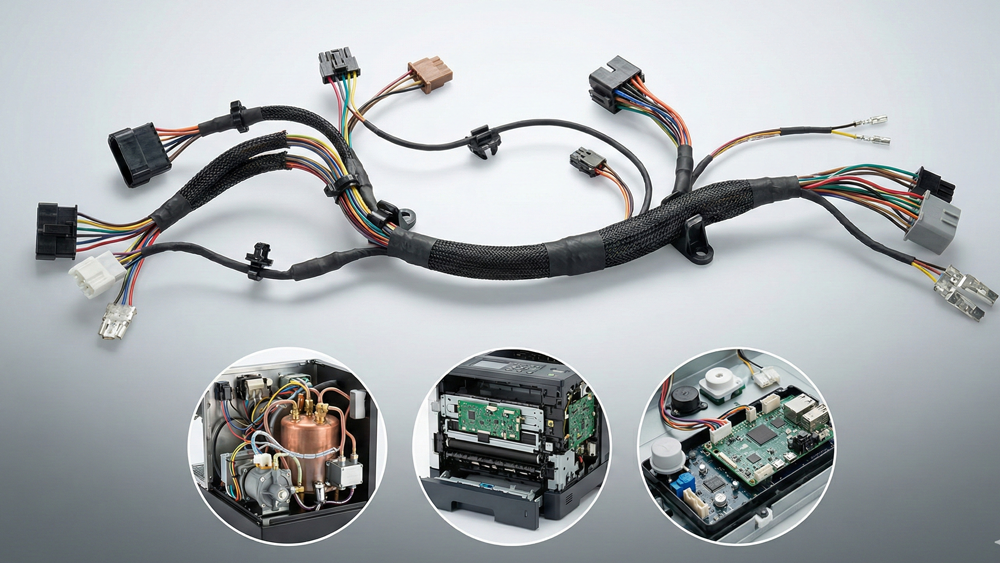
Wire harness material cost reduction is often the first place OEM buyers look when a program needs cost-down. That is understandable. Material cost is visible, measurable, and usually appears to offer the fastest path to savings. Connectors, terminals, wires, seals, tapes, tubing, labels, and protective accessories all carry direct purchase value, so it seems logical to ask whether the material side of the harness can be optimized before touching design, process, or packaging.
But in B2B wire harness supply, material cost reduction is also where many cost-down projects begin to go wrong. The problem is not that buyers review materials. The problem is that material review is often approached too narrowly. A supplier is asked to reduce cost, and the discussion quickly turns into finding cheaper parts. If that happens without disciplined control of function, sourcing path, validation scope, and change approval, then the business may reduce the visible purchase price while quietly increasing quality risk, lead-time instability, documentation gaps, or field-failure exposure.
That is why wire harness material cost reduction should never be treated as a simple substitution exercise. It should be treated as a controlled review of whether the current material stack still matches the real needs of the OEM program. In some cases, the answer will be yes. The current materials may already be well aligned to the application, and aggressive cost-down would only create risk. In other cases, the answer will be no. The harness may contain legacy material choices, over-specified accessories, outdated sourcing assumptions, or missed alternate-approval opportunities that are increasing cost without delivering equivalent value.
For procurement, engineering, and quality teams, the right question is not simply whether the harness can use cheaper materials. The right question is whether the harness can use more appropriate materials, better sourced materials, or more commercially efficient material paths without losing the approved performance and control logic the project depends on. That distinction is critical. It shifts the discussion from “cheapen the product” to “remove unnecessary material cost while protecting the baseline.”
This matters especially in OEM and custom harness programs because materials do not operate independently. A wire choice affects seal fit, routing behavior, and current-carrying margin. A connector choice affects not just unit price, but crimp tooling, mating reliability, approval status, and supply continuity. A protection material affects abrasion resistance, appearance, labor content, and packaging volume. Even labels and secondary consumables can affect receiving, traceability, and service support. In other words, material cost is real, but so is material interaction.
That is why a strong material cost-reduction project usually begins not with a lower quotation request, but with a baseline review. The buyer and supplier need to understand what materials are frozen by customer requirement, what materials are function-driven, what materials are legacy-driven, what materials are commercially inefficient, and what materials may be reviewed through a controlled Design for Manufacturability (DFM) and sourcing lens. Pages like Wire Harness BOM and Part Control, Wire Harness Drawing Review, and Wire Harness ECO and Revision Control are directly relevant here because material cost reduction only works cleanly when the product baseline is already visible and controlled.
This article explains how OEM buyers should approach wire harness material cost reduction from a B2B decision-making perspective. The goal is not to promote indiscriminate downgrading. The goal is to show how materials can be reviewed systematically so that cost reduction remains real, defensible, and sustainable after approval.
Table of Contents
ToggleWhy Material Cost Matters
In many harness programs, material is the largest visible share of direct cost. That makes it tempting to treat material reduction as the main answer whenever the buyer is under price pressure. But material cost matters for a deeper reason than budget alone. It matters because materials define much of the harness’s functional and commercial profile.
A harness is not only an electrical connection system. It is a combination of interfaces, conductors, protections, identifiers, and installation-support features. The material stack determines what the harness can tolerate mechanically, electrically, environmentally, and operationally. It also determines how easy the harness is to source, build, inspect, pack, and support across its lifecycle. When buyers understand this, material cost reduction becomes more strategic. It becomes an effort to separate materials that genuinely protect performance from materials that simply reflect old assumptions or inefficient supply structure.
This is why buyers should resist the instinct to look first for the cheapest line-item equivalent. A cheaper terminal or a lower-cost tube may reduce the BOM on paper, but if it creates more crimp variability, weaker fit retention, longer procurement risk, or customer reapproval burden, the material decision was not really a saving. It was a transfer of cost into another part of the program.
Strong material cost reduction therefore begins with a simple principle: every material line should justify both its function and its sourcing logic. If it cannot, it deserves review.
Start with BOM Control
The safest material cost-down work usually starts with the Bill of Materials. Without BOM discipline, material discussions become vague and risky. Teams begin talking about “cheaper connectors” or “different wire” without first confirming what the current approved material state actually is.
That is why Wire Harness BOM and Part Control should be considered the starting point of any material cost review. A proper BOM review does more than list part numbers. It shows which manufacturer references are mandatory, which are approved alternates, which are customer-designated, which are legacy carryovers, and which are commercially open for review. When that structure is weak, cost reduction tends to drift toward assumption instead of control.
A clean BOM review also reveals where apparent material cost is actually being driven by non-material issues. A connector may seem expensive, but the real issue may be that volume is fragmented across multiple similar variants. A wire may appear high cost, but the actual driver may be a low-volume procurement pattern or a declaration path that was never updated. A tape or sleeve may look routine, but the project may be using a premium grade because the original application assumptions were conservative and never revisited.
The important point is that the BOM should tell the team not only what the harness uses, but why each material path exists. Once that logic is visible, the discussion becomes much more useful. Instead of asking for generic price reduction, the team can ask whether the material is technically necessary, commercially necessary, or simply inherited.
Review Connector Cost
Connector systems are often one of the first places buyers want to review because they can represent a meaningful share of harness material cost. But connector cost reduction is rarely as simple as replacing one housing with a lower-priced housing. In most OEM programs, a connector decision affects mating reliability, sealing performance, tooling compatibility, lead time, regulatory traceability, and customer approval status.
That is why connector cost review should begin with usage logic. Is the current connector family required by the mating interface? Is it customer-nominated? Is the sealing level actually necessary for the real environment? Are accessories being specified beyond need? Are there family-level variants that were selected during prototype or launch but are now commercially suboptimal for stable serial production?
Sometimes the best connector cost reduction does not come from replacing the core interface at all. It comes from reviewing accessory structure, approved cross-reference paths, or unnecessary variation between closely related harnesses. In other cases, the connector family may genuinely be over-specified for the installation environment, but if that is true, the review still needs engineering and change-control discipline. A connector is never just a price number. It is a system decision.
This is also where Wire Harness Drawing Review becomes relevant. A connector may look expensive because the drawing structure is carrying legacy complexity around keying, branch orientation, or service logic. If those broader design factors are not understood, connector cost review will stay shallow.
Review Wire Cost
Wire is another major cost area, especially in programs with heavier conductor content, multiple lengths, or special insulation requirements. But wire cost reduction should not begin with conductor size reduction unless the engineering basis is extremely clear. In B2B harness programs, wire selection carries electrical margin, installation behavior, seal fit, flex behavior, declaration requirements, and routing stability.
A more disciplined review starts by asking whether the current wire construction and sourcing path still match the application. Is the insulation type aligned to real environmental need, or was it specified conservatively during launch? Is the outer diameter driving unnecessary seal or protection cost? Is color complexity increasing procurement fragmentation without enough downstream value? Are there low-volume color or gauge combinations that could be rationalized? Are there approved equivalent wire sources that would lower cost and reduce supply risk at the same time?
Sometimes wire cost reduction comes from simplifying the family logic rather than reducing the wire itself. If the buyer can reduce unnecessary variation across similar harnesses, the supplier may gain more efficient procurement and cut-list planning without changing the approved electrical intent. In other cases, a carefully reviewed insulation or source alternative may offer cleaner savings. But again, these choices should be made through controlled review, not through casual commercial pressure.
This is where the connection between material cost and process cost becomes obvious. A wire that is slightly cheaper but harder to strip, crimp, seal, or route consistently may not be a true saving. That is why material review should always consider build impact as well as purchase price.
Review Protection Materials
Protection materials such as tape, tubing, braided sleeve, corrugated conduit, boots, and wraps often receive less attention than connectors and wires, but they can be a meaningful source of cost, especially in larger or appearance-sensitive harnesses. They are also a common place where legacy assumptions remain untouched long after launch.
A strong review asks why each protection material exists. Is it providing abrasion resistance, routing retention, thermal protection, bundling control, cosmetic finish, noise suppression, or packaging support? Once the function is clear, the team can ask whether the current material is the most appropriate way to achieve that function.
In some cases, the existing protection choice may still be correct. In others, the harness may be carrying multiple overlapping protective layers because the original project was conservative. A wrap may continue into an area where it adds labor and material cost without real benefit. A high-grade sleeve may remain in use even though the surrounding environment no longer justifies it. A premium tape may be applied because it was convenient during early builds, not because it is truly required in steady production.
Protection material cost reduction is often effective because it can lower both material spend and labor time together. But it must still be reviewed carefully. If a simplified protection strategy changes handling, appearance, abrasion behavior, or branch stability, that impact needs to be visible before approval.
Review Labels and Secondary Materials
Labels, markers, seals, clips, ties, small accessories, and other secondary materials are easy to overlook because each line looks small. But in many recurring harness programs, these items accumulate cost quietly. They also create hidden labor and documentation burden.
A label may be technically correct but commercially inefficient if it includes information that no downstream user actually needs. A tie or clip may be carried because the original packaging or assembly assumption has changed. A secondary identification tag may exist only because the supplier and buyer never rationalized receiving logic after launch. These items are not dramatic, but they can be worth reviewing precisely because they are often legacy-driven rather than function-driven.
This is where procurement and operations should talk together. A buyer may assume a label is essential because it has “always been there,” while receiving or assembly may no longer use that information at all. Conversely, a supplier may suggest label simplification that appears harmless, but the buyer may know it supports containment or service identification. The point is not to remove small materials aggressively. The point is to verify whether they still earn their cost.
In some cases, the savings from these reviews are modest per piece but meaningful over annual volume. More importantly, they often reduce labor complexity at the same time.
Use Approved Alternates
One of the most practical ways to reduce material cost without degrading quality is to improve approved alternate strategy. Many harness programs become expensive not because the primary material is technically wrong, but because the sourcing logic is too narrow.
A supplier may be locked into a single source where controlled alternates would be acceptable. A connector accessory may be specified at manufacturer level when multiple approved commercial paths could support the same requirement. A protection material may have functionally equivalent options, but no formal alternate approval has ever been developed. In these cases, the cost issue is not only the material itself. It is the lack of sourcing flexibility.
But approved alternates must be handled with discipline. An alternate is not simply “something similar.” It is a controlled material option that has been reviewed for fit, function, approval status, and documentation impact. When alternates are developed properly, they can reduce both cost and supply risk. When they are introduced informally, they become one of the fastest ways to create baseline drift.
That is why Wire Harness ECO and Revision Control matters directly in material cost reduction. If alternates are accepted, the program should know how they are documented, when they can be used, and what evidence is required. Cost-down through alternates can be very effective, but only if the approved state remains explicit.
Match Material to Volume
Material cost is heavily influenced by volume and release behavior. A material choice that looks expensive at low volume may become much more competitive at stable volume. Conversely, a material that seems commercially efficient in a narrow procurement window may create hidden cost if the buyer’s order pattern is erratic.
That is why material cost reduction should be reviewed together with volume logic. Pages like MOQ and Forecast Strategy Guide are useful here because they show that buyer-side forecast quality and order consolidation can change material economics significantly. A supplier who can buy more predictably often has better pricing access, lower fragmentation, and less premium exposure on constrained materials.
This means some material cost-down projects do not require changing the approved material at all. They require changing how the material is purchased, forecast, or allocated across part families. If the buyer can stabilize releases or align MOQs more intelligently, the supplier may be able to reduce cost while keeping the technical material path unchanged.
These are often the best savings because they preserve the validated baseline. They also strengthen supplier predictability, which usually benefits quality and delivery as well.
Validate Material Changes
A material-saving idea is only useful if the team can verify that it does not create hidden downstream cost. That is why validation is central to material cost reduction.
The validation burden should fit the change. A major connector-family change clearly requires deeper review than a packaging-neutral marker rationalization. But every approved material change should answer the same basic questions. What changed? Why is it acceptable? What risks were considered? What records or checks confirm the change is controlled? How will the new state be recognized in future production, audits, or supplier transitions?
This is where Wiring Harness Quality Evidence Pack Guide and Wire Harness Test Reports and Quality Documents become valuable. They remind the team that validation is not just a technical formality. It is what makes savings durable. If the change is later questioned by quality, a customer, or a second supplier, the business needs more than memory. It needs evidence.
A project that cannot explain how a cheaper material remained safe has not really completed cost-down. It has only changed cost temporarily.
Control Material Changes with ECO
Many material cost-down problems begin after the technical discussion is over. The supplier and buyer agree on a saving, but the formal baseline is not updated clearly enough. Production then starts using the revised material path while drawings, BOMs, approval notes, or evidence expectations remain partly old and partly new.
That is why material cost reduction must connect to change control. If the approved material state changes, the project should decide whether that change belongs in an Engineering Change Order, a controlled BOM update, a formal alternate-approval path, or another documented release mechanism. The exact route depends on the program, but silence is not a safe option.
Strong ECO discipline protects future sourcing as much as current production. It ensures that later RFQs, second-source reviews, audits, and internal cost discussions inherit the true approved material logic rather than a patchwork of email history and supplier habit.
In other words, ECO control is not bureaucracy added onto cost-down. It is the reason the saving survives in a controlled way.
A Practical Material Cost Review
A simple framework can help buyers review materials without slipping into random substitution thinking.
| Material area | Main cost question | Strong control outcome |
|---|---|---|
| Connectors | Is the current interface or accessory stack commercially heavier than needed | Function is protected and unnecessary complexity is removed |
| Wires | Is wire construction, color mix, or source path over-specified | Electrical and environmental needs remain protected |
| Protection | Are wraps, tubes, or sleeves exceeding real application need | Material and labor cost both improve without reliability loss |
| Secondary items | Do labels, ties, clips, or markers still justify their cost | Legacy items are rationalized without losing traceability |
| Alternates | Can controlled sourcing flexibility reduce cost and risk together | Approved alternates are explicit and documented |
| Volume logic | Is material cost inflated by fragmented releases or poor MOQ alignment | Forecast discipline supports better procurement economics |
| Validation | Can the project prove the saving is safe | Records and checks match the change level |
| ECO control | Is the new material state visible in the approved baseline | Future supply inherits the correct material logic |
This type of review is useful because it forces the team to connect every saving idea to both mechanism and control. That is exactly what prevents “material cost reduction” from turning into “material uncertainty.”
What Strong Suppliers Do
A strong supplier does not respond to material cost pressure by quietly shopping for lower-grade substitutes. A strong supplier helps the buyer understand where the material stack is genuinely overbuilt, where sourcing flexibility exists, where volume behavior is inflating cost, and where a proposed saving would likely create more trouble than benefit.
They explain material function, not just price. They distinguish between customer-frozen and reviewable materials. They connect alternates to validation. They show where protection strategy, label content, or sourcing structure may be rationalized cleanly. And they are honest when a material line should not be touched because the hidden risk would outweigh the visible savings.
That behavior matters in B2B harness supply because cost reduction is never just about purchasing. It is about trust in engineering judgment, document control, and long-term supply discipline.
Conclusion
Wire harness material cost reduction can be one of the most effective parts of a broader cost-down strategy, but only when it is managed as a controlled review of function, sourcing logic, volume behavior, and change approval. The strongest savings usually do not come from blindly finding the cheapest part. They come from clarifying the BOM, reviewing connector and wire logic carefully, rationalizing protection and secondary materials, building approved alternate paths, improving forecast alignment, validating proportionately, and controlling the new material state through proper release discipline.
For OEM buyers, the most important principle is simple: material cost should be reduced by removing unnecessary material burden, not by weakening the harness invisibly. When that principle drives the review, the savings are much more likely to remain real in production.
FAQ
What is the safest way to reduce wire harness material cost?
The safest approach is to start with BOM control and review whether current materials are function-driven, customer-frozen, legacy-driven, or commercially inefficient. Savings should come from rationalization and approved alternates, not informal substitution.
Can connector cost be reduced without changing performance?
Sometimes yes, but only after reviewing interface requirements, accessory structure, approval status, and sourcing path. In many cases, accessory simplification or approved alternate strategy is safer than changing the core connector family.
Is wire cost reduction mainly about using smaller wire?
No. Wire cost reduction is often more about construction choice, source path, color rationalization, and volume logic than conductor downsizing. Smaller wire should never be pursued casually.
Do small items like labels and ties really matter?
Yes. Individually they may look minor, but across annual volume they can add meaningful cost and labor burden, especially if they are legacy items with limited downstream value.
Does every material change need formal change control?
Any material change that affects the approved baseline should be handled through clear control rules, whether by ECO, BOM update, or formal alternate approval. Hidden material changes are where many cost-down projects create later problems.
CTA
If you are reviewing a harness program for material cost reduction, the most useful first step is usually not asking for a lower quote across the board. It is reviewing your BOM, material stack, approved alternates, and forecast pattern to identify where cost is truly structural and where it is simply inherited.
You can send your drawing set, BOM, annual volume, target price pressure, and current material concerns through Contact. Our team can help review practical material-saving paths using references such as Wire Harness BOM and Part Control, Wire Harness Drawing Review, Wire Harness ECO and Revision Control, MOQ and Forecast Strategy Guide, and Wiring Harness Quality Evidence Pack Guide.