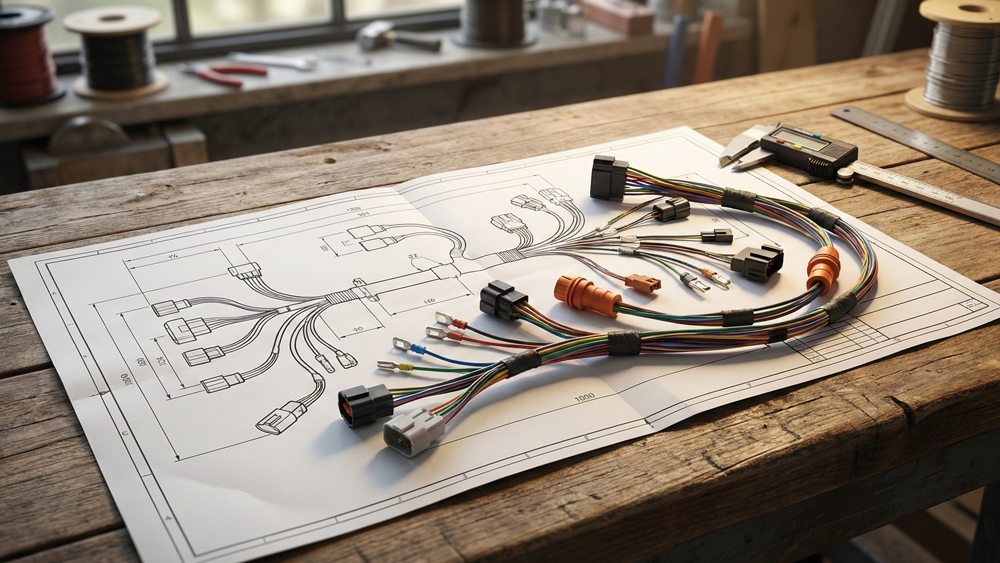
A wire harness drawing and BOM transfer guide is one of the most important control tools in any supplier transition or second-source qualification project. Most wire harness transfer problems do not begin with obvious manufacturing failure. They begin much earlier, when the receiving supplier is given a drawing package and a Bill of Materials (BOM) that appear complete enough to quote, but are not yet controlled enough to transfer without interpretation gaps. Those gaps often remain invisible during early conversations. The quotation looks fine, the sample may even appear acceptable, and the project starts moving. Only later do the real problems emerge. A connector sub-variant is interpreted differently. A terminal family is assumed rather than controlled. A wire specification is close, but not fully aligned. A label rule was clear to the old supplier but never formalized for the new one. An alternate part was historically accepted, but that approval lived only in email history rather than in the released package.
That is why a wire harness drawing and BOM transfer guide should not be treated as a document handoff checklist alone. It should be treated as a baseline transfer method. Its purpose is not merely to move files from one supplier to another. Its purpose is to move the design intent, part-definition logic, and approval boundaries in a way that the receiving supplier can actually execute under production conditions without creating drift.
For OEM buyers, this matters because the supplier is not only receiving a print and a parts list. The supplier is receiving the operational definition of the harness. That definition influences quotation accuracy, sample interpretation, pilot readiness, change-control stability, and later field traceability. If the drawing and BOM are weak, every downstream step becomes more expensive. Engineering must answer repeated clarifications. Procurement compares quotes that are not based on the same scope. Quality struggles to decide what is correct. Operations discovers that the approved sample and the production-ready package were never fully aligned.
A disciplined drawing and BOM transfer therefore creates commercial value, not just engineering clarity. It reduces the cost of transition, shortens the time spent resolving avoidable questions, and gives the new supplier a more stable basis for delivering acceptable product. It also protects the buyer from a common and dangerous situation: believing the supplier made a mistake when the real problem was that the transfer package itself was incomplete or internally inconsistent.
This article explains how OEM buyers should handle wire harness drawing and BOM transfer during supplier transition. The goal is to help teams transfer the product definition in a form that is buildable, reviewable, traceable, and suitable for controlled qualification.
Table of Contents
ToggleWhy drawing and BOM transfer is more than document sharing
In many supplier change projects, teams assume the transfer begins once the new supplier receives the current drawing, the latest BOM, and perhaps a sample. That assumption is understandable, but it is not enough. A transfer package is useful only when the receiving supplier can reach the same build understanding that the current program requires.
This sounds simple, but in practice a drawing and BOM often carry different types of information with different levels of discipline. The drawing may define geometry, branch logic, connectors, labels, and test notes. The BOM may define manufacturer part numbers, alternates, and material versions. The old supplier may also have practical build assumptions, legacy approvals, or process notes that never made it into the formal release structure. If those layers are not reconciled before transfer, the new supplier will receive a package that appears complete but is not truly authoritative.
That creates an especially risky situation during supplier transition. The new supplier may follow the formal documents honestly and still diverge from what the incumbent source has actually been shipping. At that point, the buyer may see “difference” and assume “error,” when the real issue is that the transfer package never represented the true approved baseline.
A strong transfer guide therefore starts from a more useful principle. The goal is not to send all available files. The goal is to identify which files define the current approved state, which files support interpretation, which files are obsolete, and which assumptions must be made explicit before the receiving supplier can quote or build responsibly.
This principle aligns closely with the logic already covered in Wire Harness Drawing Review and Wire Harness BOM and Part Control. A supplier transfer is safer when drawing clarity and BOM discipline already exist. When they do not, transfer becomes the event that exposes the weakness.
Start with the released baseline, not the inherited habit
The first step in drawing and BOM transfer is to define the baseline that the receiving supplier is expected to inherit. This may sound obvious, but it is often the most overlooked step.
Many existing harness programs have accumulated practical deviations over time. The incumbent supplier may have been allowed to use a substitute tape, a legacy label format, a slightly different protective covering, or a historical component cross-reference that solved a lead-time problem months earlier. The engineering team may know this informally. Procurement may know part of it. Quality may know another part through inspection history. But unless those approvals are reflected in the controlled transfer package, the new supplier has no reliable way to distinguish released requirements from inherited habits.
That is why the transfer should begin by asking a basic but powerful question: what exactly is the approved product state today? Not what the original drawing once intended. Not what the old supplier has gradually normalized. The question is what the business now considers correct and transferable.
Answering that question usually requires a disciplined review of three layers. The first is released documentation, including the current drawing revision, BOM revision, and linked specifications. The second is active exceptions, such as approved alternates, temporary deviations, pending Engineering Change Orders (ECOs), or packaging adjustments. The third is undocumented practice, which may include tacit build assumptions or recurring supplier-specific habits that were never converted into formal control.
A clean transfer is only possible once those three layers are separated clearly. Otherwise, the new supplier will inherit ambiguity instead of a baseline.
Make the drawing transferable, not just readable
A drawing can be technically readable and still be a poor transfer document. In supplier transition, a drawing must do more than look complete. It must support consistent interpretation by a new source that does not share the history of the old source.
That means buyers should review the drawing through a transfer lens. Are connector part numbers fully defined, including keying, gender, orientation, and mating assumptions? Are terminal families explicitly controlled, or only implied? Are wire gauges, colors, and constructions defined in a way that matches the BOM? Are branch lengths and measurement references clear enough that another supplier will measure the harness the same way? Are labels, identification marks, and packaging-visible features controlled? Are test notes specific enough to guide both build and outgoing verification?
A transfer-oriented drawing review also looks for hidden dependencies. Some harnesses depend on visual orientation notes, protection routing logic, dressing sequence, or interface assumptions that are obvious only to the current source. Those dependencies are dangerous in transition because they are often absent from the released drawing while still influencing sample acceptance.
This is exactly why a structured Wire Harness Drawing Review adds such strong value before supplier transition. A good drawing review is not about cosmetic drafting perfection. It is about making the drawing strong enough that a new supplier can quote, build, inspect, and revise from it without depending on unwritten history.
If the drawing cannot support that level of transfer, then it should not yet be treated as a stable handoff document.
Align the BOM to the real build state
The BOM is often where transfer problems become commercially expensive. While drawing errors are more visible, BOM weaknesses create material drift, quote mismatch, sourcing confusion, and approval risk that may remain hidden until pilot or production.
A transfer-ready BOM should answer more than “what parts are used.” It should help define how tightly each part is controlled and how the new supplier is expected to source it. For example, are specific manufacturer part numbers mandatory, or can equivalents be proposed? Are alternates already approved? Are there customer-designated components that cannot be changed without approval? Are obsolete or limited-distribution items still embedded in the BOM? Are labels, packaging materials, and secondary consumables included consistently, or left out because the incumbent source had already absorbed them as tribal knowledge?
A useful transfer review therefore compares the BOM against the actual approved build, not only against the drawing. This is especially important when the incumbent supplier has been supplying for a long time. Long-running programs often develop invisible BOM gaps. Part numbers remain technically valid but are no longer the actual source of supply. Historical substitutions get normalized. Internal shorthand replaces formal revision discipline. A new supplier does not understand those shortcuts unless the buyer rebuilds the BOM into a real transfer tool.
This is one reason Wire Harness BOM and Part Control matters so much in a transition context. BOM control is not just an engineering or ERP exercise. It is the method by which the buyer defines what the new source is and is not allowed to reinterpret.
Decide what is frozen and what is open
One of the most important decisions in drawing and BOM transfer is whether the buyer wants a pure transfer or a controlled optimization. Many transitions fail because the business unintentionally mixes those two goals.
In a pure transfer, the aim is to duplicate the current approved baseline as closely as possible at the new source. The benefit of this approach is that qualification is cleaner. The buyer can focus on whether the new supplier can reproduce the same approved product without adding the complexity of simultaneous design or material changes.
In a controlled optimization, the buyer intentionally invites the new supplier to suggest changes that improve manufacturability, cost, lead time, or supply resilience. That can be commercially valuable, but it makes the transfer more complex because the project is now both a supplier change and a product change.
Neither model is wrong. The risk appears when the project starts as a pure transfer but the new supplier is informally allowed to “improve” parts of the BOM, simplify labels, cross-reference components, or reinterpret notes during sample build. At that point, qualification becomes blurry. If the sample differs, is it a supplier issue, a design improvement, or an unapproved deviation? If the new source quotes lower cost, is that due to better execution or a changed material assumption?
A disciplined transfer guide avoids that confusion by defining what is frozen and what is open before quotation and before samples. Connectors, terminals, critical wires, labels, packaging rules, and evidence requirements should be placed into clear categories. Some items may be fully fixed. Others may be open for review. But the boundary must be explicit. That is how the buyer keeps supplier comparison fair and transition control stable.
Transfer revision logic with the documents
A major transition risk is assuming that a drawing and BOM can be transferred without equally transferring revision logic. In reality, revision control is part of the product definition. If the receiving supplier does not understand how changes have been managed historically and how future changes will be governed, then the transfer remains fragile even if the initial documents look complete.
The transfer guide should therefore include revision status, revision history where relevant, pending ECOs, open deviations, and the rule for which changes are in scope for the new supplier. If the incumbent source is building to a released revision plus a temporary exception, that needs to be visible. If a new revision is about to be issued, the buyer should decide whether the new supplier will quote and sample to the current released version, the pending version, or both under separate control.
This is where Wire Harness ECO and Revision Control becomes essential. Change-control logic cannot remain outside the transfer package. If it does, the new supplier may receive a technically current document set but still operate on outdated practical assumptions. That is one of the fastest ways to create parallel product states under one part number.
Transfer-ready revision control should answer several questions clearly. Which revision is the source of truth? Which linked files belong to that revision state? What exceptions are still valid? Who approves deviations? How will future ECOs be communicated to both suppliers if the project is temporarily dual-sourced? Once these answers exist, the receiving supplier is much less likely to guess.
Build a transfer matrix, not just a file folder
A common operational mistake is sending the new supplier a folder full of files and assuming the transfer is now under control. File volume is not the same as transfer clarity.
A much stronger approach is to create a transfer matrix. The purpose of the matrix is to show the receiving supplier, and the internal team, how each critical element of the harness is controlled. It does not have to be overly bureaucratic. But it should identify the relevant item, where it is defined, whether it is frozen or open, whether alternates are allowed, whether evidence is required, and whether any deviation or special note applies.
This kind of structure turns the transfer package into a working control tool. It also helps internal teams see where the package is weak. For example, the matrix may reveal that connector definition is split between drawing notes and the BOM, while label control lives only in an old work instruction. It may show that packaging is not revision-linked at all. It may show that one protective material is current in practice but absent from the released BOM. Those are exactly the kinds of issues that should surface before supplier sampling begins.
A practical matrix might cover categories such as connectors, terminals, wire types, coverings, labels, packaging, test criteria, shipping identifiers, and approved alternates. Even when the matrix is simple, it sharply improves transition communication because it reduces the chance that the receiving supplier interprets silence as permission.
Use sample and pilot to verify document transfer, not just part function
During supplier transition, buyers often evaluate samples mainly by fit, continuity, and general appearance. Those checks matter, but for drawing and BOM transfer they are not enough. The sample and pilot stages should also be used to verify whether the new supplier has actually inherited the product definition correctly.
A well-run sample review asks not only whether the harness works, but whether it matches the transfer baseline. Did the supplier use the right materials? Did they ask the right questions before building? Are the labels correct? Are the reported part numbers aligned to the transferred BOM? Did any assumptions appear during build that were not visible in the package? If a difference emerged, was it treated as an engineering question, a sourcing constraint, or an unapproved simplification?
Pilot is even more revealing. A supplier may rescue one careful sample build through skilled manual effort, but pilot shows whether the transferred drawing and BOM are strong enough to support repeatable production behavior. This is why Wire Harness Prototype Review and Pilot Build is so relevant in a transfer context. Pilot is not just a production rehearsal. It is a document-transfer stress test.
If the transferred package is strong, pilot questions become narrower and more manageable. If the package is weak, pilot typically exposes recurring gaps in labels, branch dimensions, material interpretation, outgoing checks, or traceability references. Those signals should be treated as transfer findings, not merely supplier mistakes.
Connect drawing and BOM transfer to evidence and traceability
A transfer guide is incomplete if it stops at engineering definition. In real OEM supply chains, the drawing and BOM must also support evidence, lot control, and later containment if something goes wrong.
That means the transfer should include how the supplier is expected to identify lots, reference revisions on records, tie material usage to shipment history, and provide outgoing verification evidence where required. If those expectations are not part of the transfer, the new source may build correct product but still create operational friction because the records are too weak for the buyer’s approval logic.
This is especially important when the buyer needs stronger shipment documentation, customer-facing quality evidence, or the ability to isolate affected stock quickly after a complaint. In that context, the transfer package should not only define the harness itself. It should define how the supplier proves that the shipped harness belongs to the right revision, the right material baseline, and the right control path.
That is why Wiring Harness Quality Evidence Pack Guide matters in supplier transition. Evidence discipline reduces the cost of uncertainty after transfer. It allows the buyer to compare lots across sources, investigate issues more efficiently, and maintain confidence that document transfer was not just technically complete but operationally usable.
Common mistakes in drawing and BOM transfer
One common mistake is treating the current supplier’s habits as equivalent to the released baseline. This often leads the new supplier to appear wrong when the real problem is that the old program was being sustained by informal knowledge rather than controlled documentation.
Another mistake is transferring a current drawing without reconciling the BOM to actual approved materials. This creates quote mismatches and hidden substitution risk later in the project.
A third mistake is failing to define what is frozen and what is open. When the receiving supplier is allowed to optimize without clear boundaries, the transfer becomes a blurred mix of replication and redesign.
A fourth mistake is leaving revision logic outside the transfer package. This is particularly dangerous in programs with active ECOs, temporary approvals, or overlapping supplier activity.
A fifth mistake is using sample approval as proof that the transfer documents are complete. A good-looking sample may only prove that a skilled team managed the ambiguity well once. It does not prove that the drawing and BOM are truly transferable.
These mistakes are not rare. But they are also not inevitable. Most of them can be prevented by treating the transfer package as a controlled baseline, not a collection of inherited files.
What strong suppliers do during document transfer
Strong suppliers do not simply accept the package and quote quietly. They actively test the package for transfer clarity. They identify where connector notes are incomplete, where terminal selection is implicit, where BOM items need better part control, where labels lack enough definition, or where historical changes are not reflected in the release state.
This behavior is valuable because it makes ambiguity visible before qualification becomes expensive. A strong supplier understands that a clean transfer protects both sides. It protects the buyer from hidden drift and protects the supplier from being blamed later for assumptions that were never actually controlled.
That is also why a supplier’s technical response during transfer can tell the buyer a great deal about long-term suitability. A supplier that asks disciplined questions about drawing logic, BOM structure, ECO scope, pilot expectations, and evidence requirements is often showing stronger project-control capability than a supplier that simply says yes quickly.
In B2B wire harness projects, that difference matters. The buyer is not only sourcing a factory. The buyer is sourcing a partner that can absorb a baseline without destabilizing it.
Conclusion
A wire harness drawing and BOM transfer guide is one of the most important foundations for supplier transition, second-source qualification, and controlled cutover. It ensures that the receiving supplier inherits not only the files, but the actual approved product definition, sourcing boundaries, change-control logic, and evidence expectations behind those files.
When buyers start from the released baseline, make the drawing truly transferable, align the BOM to the real build state, define what is frozen and what is open, transfer revision logic explicitly, use sample and pilot to verify document inheritance, and connect the package to evidence discipline, supplier change becomes far more manageable.
In custom wire harness supply, the transfer usually does not fail because no one knew how to build the harness. It fails because the baseline was never fully transferred. That is why document control is not an administrative detail. It is the core of transition control.
FAQ
What is the difference between a drawing review and a drawing transfer review?
A drawing review focuses on whether the drawing is clear and buildable. A drawing transfer review goes further by asking whether a new supplier can inherit the drawing without relying on informal knowledge from the old source.
Why is BOM transfer often more difficult than drawing transfer?
Because the BOM controls material reality. It must reflect actual approved parts, alternates policy, sourcing constraints, and hidden legacy substitutions. Those details are often less visible than drawing geometry but more commercially sensitive.
Should we allow the new supplier to propose alternates during transfer?
Only if the project defines that boundary clearly. If the transfer is intended to be a pure replication, alternates should not be introduced casually. If optimization is allowed, the approval path must be explicit.
How do we know whether our transfer package is weak?
A weak package usually creates repeated clarification questions, conflicting interpretations, quote spread caused by scope assumptions, or sample differences that expose undocumented practice.
Is a good sample enough to prove drawing and BOM transfer was successful?
No. A good sample may prove one successful build. Pilot and early production behavior are better indicators of whether the package was truly transferable and repeatable.
CTA
If you are planning to move a harness program to a new supplier or qualify a second source, the safest first step is to review whether your current drawing set and BOM actually represent the approved build state before you issue the transfer package.
You can send your drawing files, BOM, active revision notes, and current supplier pain points through Contact. Our team can help review transfer readiness, identify documentation gaps, and support a cleaner handoff using references such as Wire Harness Drawing Review, Wire Harness BOM and Part Control, Wire Harness ECO and Revision Control, Wire Harness Prototype Review and Pilot Build, and Wiring Harness Quality Evidence Pack Guide.