When buyers search for wire harness assembly, they’re usually not looking for a generic explanation of “how wires are bundled.” They’re trying to reduce risk. They want predictable lead time, predictable quality, and a supplier who can build the same harness the same way across prototypes, pilot runs, and production—without surprises after the first sample.
That predictability comes from process. Not from slogans, not from “we’ve been doing this for 20 years,” and not from a one-time inspection at the end. A reliable wire harness assembly line is built around repeatable work instructions, defined QC checkpoints, controlled materials, and a testing definition that matches what your product actually needs.
This article walks you through the full process flow—from cutting and stripping to final 100% electrical testing—while explaining what quality control looks like at each step, what common defects occur there, and what you should specify up front to prevent rework later. If you’re comparing suppliers and want the capability overview first, start with our Assembly Capabilities and Capabilities pages; if you already have a harness RFQ ready, the fastest path is to submit through Custom Wiring Harness.
Table of Contents
ToggleWhat “wire harness assembly” really includes (and why it’s easy to underestimate)
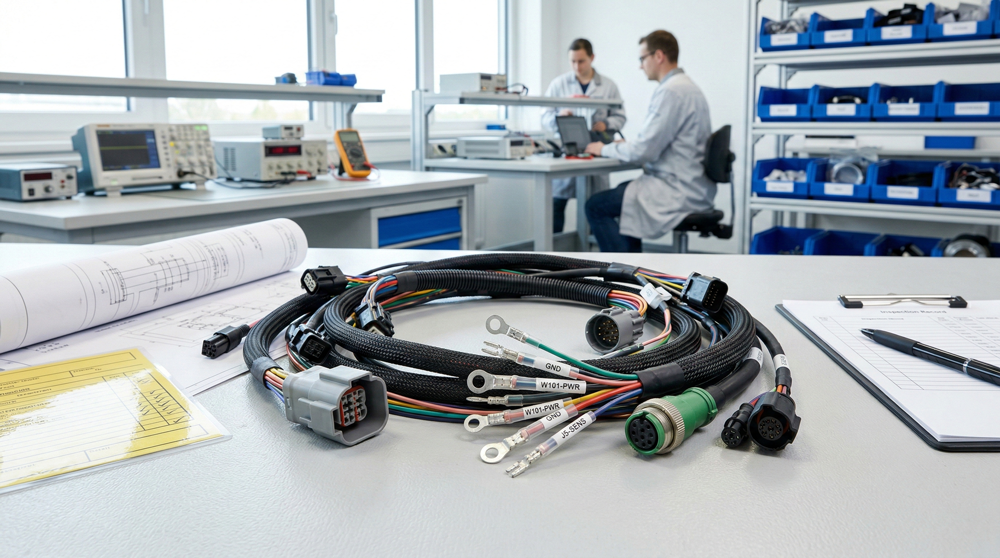
A wire harness is rarely “just wires.” Most real-world harnesses include branching, breakouts, protective coverings, strain relief, labels, clips, grommets, and sometimes seals or overmolding. The assembly work is therefore not just termination; it’s the controlled construction of a routed system that must fit physically, connect electrically, survive the environment, and remain serviceable.
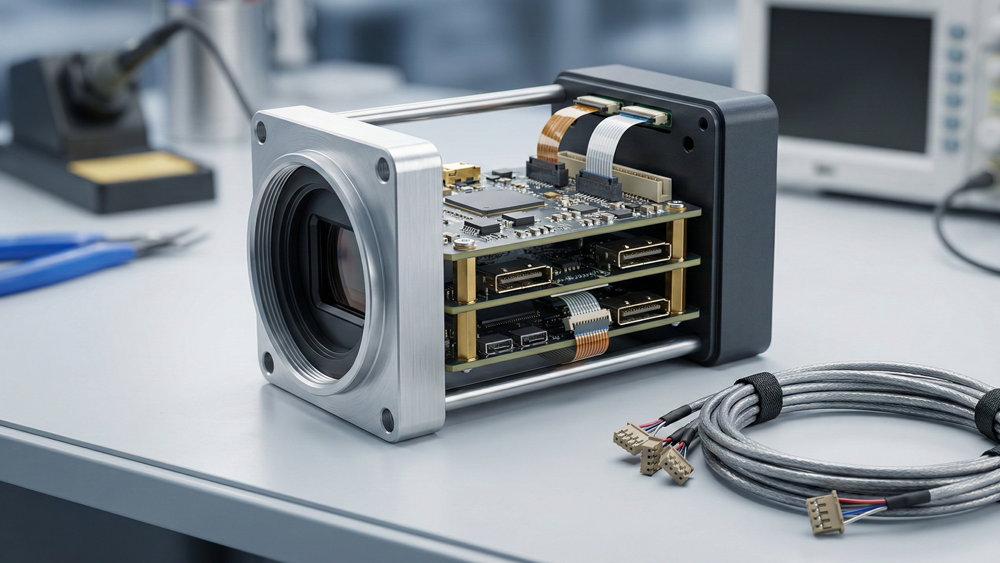
That’s also why some projects that buyers call “harnesses” are actually better treated as cable assemblies. If your build is mostly shielded cables with connectors, or includes molded ends, it’s often more accurate to scope it under Cable Assemblies or Custom Cable Assemblies, and only treat the routing and branching sections as “harness” elements. Getting the category right early prevents RFQ mismatch and helps you compare suppliers fairly.
A practical way to think about it is this: wire harness assembly is a sequence of controlled operations where each operation has a small set of “critical-to-quality” variables. The sooner those variables are defined—and the earlier they are checked—the less you rely on rework and final inspection to rescue the build.
The end-to-end process flow (from RFQ/DFM to shipment)
Most manufacturers will describe the process starting at “cut and strip,” but in practice the process starts earlier. The first quality decision is made before any wire is cut, because documentation and component control define whether the build is unambiguous and repeatable.
1) Engineering review and build definition (DFM and revision control)
Before production starts, a good manufacturer aligns on what exactly will be built. That alignment includes the drawing revision, the BOM revision, the pinout definition, any notes about length measurement, and the acceptance criteria for testing, labeling, and packaging. If those elements are scattered across email threads, the build will inherit ambiguity and the factory will be forced to “interpret.”
In well-run programs, the output of this stage is not a new design; it’s a build package: a controlled set of documents that tells production what to do and tells QC what to verify. If you’ve ever had a harness that “looked right but was wired wrong,” it almost always traces back to unclear build definition rather than a mysterious production mistake.
If you want a structured checklist of what to send so that this stage doesn’t drag on, you’ll want an RFQ pack format that includes drawing + BOM + pinout + test requirements + labeling/packaging + volumes. That’s the same logic we use on the intake side of Wiring Harness and Custom Wiring Harness, because it makes both quoting and production safer.
QC focus at this stage is mostly administrative but extremely impactful: correct revision, controlled assumptions, and explicit approvals for any alternates. It’s the cheapest place to prevent errors because a wrong decision here multiplies across every harness built later.
2) Incoming material control (IQC) and kitting
Once documentation is aligned, the factory needs to ensure that the materials being used match the BOM. This sounds obvious, but component variation is one of the most common causes of late-stage rework. A connector that looks similar but uses a different terminal, a seal that doesn’t match wire insulation diameter, or a wire insulation type that behaves differently under stripping can change your yield rate and reliability.
This is where disciplined BOM control matters. If your program allows alternates, define what “equivalent” means. If it doesn’t, the rule should be simple: no substitutions without approval. For buyers who want a deeper materials perspective—especially when cost-down discussions start—your reference hub on Cable Wiring Materials helps frame why certain substitutions are safe and others are not.
The practical production mechanism here is kitting. Rather than having operators “pull parts as they go,” a mature harness line kits the required wires, terminals, connectors, and protection materials for a work order. Kitting reduces mix-ups, improves throughput, and makes traceability easier.
QC focus at this stage is identity and suitability: confirming that the correct components are present, that plating and fit are correct, that seals match the wire size, and that critical materials are not damaged. This is where you prevent “we built it with the wrong parts” problems that cannot be fixed later without scrapping assemblies.
3) Cut and strip (where dimensional accuracy begins)
The cut-and-strip step seems simple, yet it produces a large fraction of downstream quality issues when not controlled. Wire length, strip length, and insulation damage are three variables that matter immediately. If wire length is short, the harness won’t route correctly and can fail installation. If strip length is wrong, crimps will be inconsistent. If insulation is nicked, the conductor can break later under vibration.
Manufacturers typically perform this step with controlled equipment and verify key dimensions at the beginning of a run and periodically thereafter. When a program is sensitive—tight routing, high vibration, or repeated flexing—this step deserves more attention than buyers usually give it.
QC focus at this stage is dimensional verification and insulation integrity. A small, consistent sampling plan can prevent a large rework event. It’s also the stage where you want to align on length measurement method (centerline, straight-line, harness-board reference) because two shops can measure differently and both believe they are correct.
4) Crimping and termination (the reliability hinge point)
If you had to pick one process step that separates “good harnesses” from “unpredictable harnesses,” it’s crimping. A poor crimp can pass a continuity test and still fail later due to vibration, thermal cycling, corrosion pathways, or insufficient mechanical retention. That is why mature harness assembly emphasizes controlled termination procedures rather than operator intuition.
What does control look like in real life? It means correct tooling, correct terminal-wire match, correct settings, and a routine verification method. Verification might include crimp height checks, visual inspection criteria, and periodic pull tests depending on your program’s requirements. The point is not to turn every program into a lab experiment; the point is that the factory can explain how they ensure repeatability.
It’s also why manufacturers with credible quality systems tend to emphasize tests and inspection frameworks on pages like Tests & Inspections and Quality Guarantee. Those pages are not only marketing. For B2B buyers, they function as evidence that the company thinks in controlled processes and measurable acceptance criteria.
QC focus at this stage is termination correctness (right terminal, right wire, right orientation) and termination quality (crimp geometry, mechanical retention, conductor placement). This is where many “intermittent” field failures originate, so this checkpoint deserves more than a final “looks okay” glance.
5) Splicing, joining, and branch creation (where routing mistakes are born)
Many harnesses require splices: a single feed branching into multiple outputs, grounds tied together, or signal circuits joined in a controlled way. Splicing can be done with crimp splices, ultrasonic welding, solder (less preferred in high-vibration unless properly supported), or other methods depending on application.
This step carries two categories of risk. The first is electrical correctness: the wrong wire group is spliced, or a circuit is omitted. The second is mechanical durability: splices that are not strain-relieved can fail under movement. Because splices are often covered by heat shrink or loom later, mistakes here can become invisible until final test—or worse, until field failure.
QC focus at this stage is circuit verification (splices match the circuit list) and mechanical support (strain relief, insulation protection, correct sealing/covering).
6) Assembly boards and harness layout (how complex harnesses become repeatable)
For multi-branch harnesses, the harness board (sometimes called a harness assembly board) is not just a convenience—it’s a process control tool. It defines routing paths, branch points, and relative lengths. It reduces variability between operators and shifts the build away from “craft” toward repeatability.
If your harness is complex, a manufacturer who builds it freehand without a consistent fixture is taking a risk that will show up as inconsistent branch lengths, twisted routing, or installation problems. The board does not need to be elaborate; it needs to be consistent.
This is also where “wire harness assembly line” maturity becomes visible. Mature lines don’t only have equipment; they have methods to prevent common errors: wrong branch, wrong breakout length, missing protective materials. The board is often paired with work instructions that include photos and checkpoints.
QC focus at this stage is routing correctness and dimensional stability. A harness that fails installation because a branch is 20 mm short is not a “minor defect”; it’s a schedule-killer. Controlled layout is how you avoid that.
7) Looming, protection, and strain relief (where durability is decided)
Looming and protection work includes braided sleeve, corrugated tube, tape wrapping, grommets, boots, clips, and other mechanical supports. These materials often look cosmetic, but they influence wear, abrasion resistance, vibration tolerance, and serviceability.
For buyers, this is one of the easiest areas to under-specify in the RFQ. A drawing might show “tube” without defining type, diameter, coverage, or how it should be secured. Two suppliers can interpret “wrap” very differently, leading to different cost and different field durability.
Programs with moisture exposure might require sealing practices; programs with harsh environments might need more protective coverage. If your harness includes molded features or boots, this is where the scope can shift toward Overmolding Services rather than purely tape-and-sleeve protection. Getting that scope right up front prevents a quote from being revised later.
QC focus at this stage is coverage consistency and protection correctness: correct diameter, correct start/stop points, secure termination of sleeves, and correct strain relief placement. These details don’t usually appear on a continuity test, but they appear later in field reliability.
8) Labeling and traceability (quality evidence, not decoration)
Labels are the bridge between manufacturing and the rest of your lifecycle. They enable receiving verification, installation, variant control, and field service. They are also the backbone of traceability: when something fails, labels allow you to isolate which lot or serial range was affected.
From an assembly standpoint, labeling is best implemented as part of process flow, not as an afterthought. Labels should have defined content, defined placement, and defined durability. Some applications require heat-shrink markers; others require wrap labels; some require barcode labels.
If you serve industries where traceability is naturally expected—such as Medical & Healthcare or EV & Battery—it’s usually worth being explicit about traceability level in your RFQ and validating that the manufacturer’s process supports it. Buyers in these categories tend to reward suppliers who can show a coherent traceability narrative.
QC focus at this stage is label accuracy (PN/Rev/serial) and placement consistency. When labels are wrong, the “defect” often becomes a logistics and service issue rather than a manufacturing one, but it still costs you time and credibility.
9) 100% electrical testing (what it can catch, and what it can’t)
Final electrical testing is the stage most buyers ask about, often using the phrase “100% test.” The phrase is understandable: it expresses a desire for certainty. But the value of 100% testing depends entirely on what the test includes.
A continuity + short test can reliably catch opens and shorts if the pinout definition is correct and the test fixture is correct. It cannot guarantee long-term mechanical durability. It cannot guarantee crimp robustness under vibration. It cannot detect insulation damage that hasn’t yet become a short. That’s why process checkpoints earlier in the flow still matter even when 100% testing exists.
For higher-voltage or safety-sensitive applications, additional tests such as hipot and insulation resistance may be necessary. For some systems, functional testing may be required. The practical sourcing point is that testing must be defined as part of acceptance criteria. Otherwise, two suppliers can both say “tested” while doing different things.
If you want a buyer-facing reference for how testing is executed and what evidence can be provided, the most natural supporting internal link is Tests & Inspections, because it anchors the concept in a visible quality process rather than a promise.
QC focus at this stage is the integrity of the test definition itself: correct test program, correct pin mapping, correct fixture, and clear pass/fail criteria. A wrong test program can produce 100% “pass” results on a 100% wrong harness, so test control is a real quality discipline, not a checkbox.
10) Final inspection, packaging, and shipment release
After electrical testing, final inspection confirms that mechanical features match the drawing and that packaging/labeling meets requirements. Packaging is frequently underestimated, especially for programs with multiple variants or kitting needs. Incorrect packaging can lead to incorrect installation and create “field failures” that are actually logistics failures.
A mature line releases shipments only after verifying the build package revision and the inspection/test completion. This is also where a manufacturer’s broader credibility signals help reassure new buyers. Trust pages like Factory at a Glance and Certificates are not substitutes for real QC, but they are useful proof points that support E-E-A-T when combined with process transparency and test evidence.
QC focus at this stage is conformance to the build package and shipment accuracy. It’s also the stage where traceability documentation should match what shipped.
What QC looks like in practice (the “critical checkpoints” narrative)
If you’re trying to evaluate a wire harness manufacturer, asking “do you have QC?” is too vague to be useful. A better approach is to ask where QC happens and what is checked at each point. Mature harness assembly doesn’t rely on a single final inspector to catch everything. It distributes checks across the flow so defects are caught close to where they are introduced.
In practice, the most valuable QC checkpoints tend to be: verifying cut/strip dimensions early, verifying crimp quality routinely, verifying splices against circuit lists, verifying branch lengths during harness-board layout, confirming protection materials and strain relief placement, and validating the electrical test program itself. These checkpoints reduce rework because they catch errors when they are still cheap to fix.
If you want to see how these principles translate into an end-to-end manufacturing posture, it’s useful to pair this article with your broader positioning pages such as Why Choose Us and the general Industries hub. The point is not to “sell” inside a technical article; it’s to provide credible continuity for buyers who want proof that process claims are supported by real scope and real experience.
Common defects in wire harness assembly (and how a good process prevents them)
Most harness defects are not exotic. They are variations of the same few patterns.
One category is dimensional: wires cut short, branch lengths inconsistent, routing too tight to install. These defects are prevented by clear measurement definitions, harness boards, and early dimension checks—not by final electrical tests.
A second category is termination quality: under-crimped or over-crimped connections, wrong terminals, incomplete insertion into connectors, incorrect seals. These are prevented by controlled tooling and verification, and by component discipline in incoming inspection.
A third category is electrical correctness: wrong pinouts, swapped circuits, missed splices, wrong wire color mapping. These are prevented by clear pinout definition, circuit lists, and correctly controlled test programs. Final continuity testing catches many of these, but only if the test program matches the correct pin mapping.
A fourth category is durability-related: insufficient strain relief, inadequate protection coverage, abrasion risks, label failures. These are prevented by defining protection requirements explicitly and by inspecting coverage consistency during assembly, not after shipment.
When you view defects through these categories, you can see why “100% test” is necessary but not sufficient. Durability is built into the process; it can’t be tested into existence at the end.
How to use this article in a real sourcing workflow
If you are sourcing a new manufacturer, you can use the process flow above as a conversation framework. Ask the supplier to describe their workflow in the same stages: incoming material control, cut/strip, termination, splicing, harness board layout, looming/protection, labeling, testing, final inspection, packaging. If they can describe the flow clearly and explain what is checked where, you’re talking to a supplier with process maturity.
If your priority is speed—fast prototype builds or pilot runs—align on what “fast” actually includes. Does quick turn include material sourcing, tooling, fixture prep, and test setup, or only assembly labor? Your Quick Turn Available page is a good place to set that expectation and prevent the classic mismatch where a buyer expects a 7-day build but the BOM contains long-lead components.
Finally, if a buyer wants to move from reading to action, the conversion path should be clean and specific. That is why the technical education in this article should lead to a simple next step: submit the RFQ through Custom Wiring Harness, or reach out via Contact if they want to ask a few questions before sharing drawings.
FAQ (short, practical answers for B2B buyers)
What is a wire harness assembly board and when do I need it?
A harness assembly board is a fixture that defines routing paths and branch points so the harness can be assembled consistently. If your harness has multiple branches, tight routing, or strict installation constraints, an assembly board is one of the easiest ways to reduce variation and dimensional defects.
Does 100% continuity testing guarantee my harness won’t fail in the field?
No. It can catch opens and shorts and many wiring mistakes, but it cannot guarantee crimp durability under vibration, long-term abrasion resistance, or mechanical strain relief quality. Those are built by process controls earlier in the flow.
Why do manufacturers ask for test requirements during quoting?
Because testing scope changes labor, equipment setup, and sometimes fixtures. If test requirements are undefined, quotes either assume too little (risk) or too much (cost). Defining test early makes quotes stable.
How should I specify wire lengths and tolerances?
Define measurement method (centerline vs straight-line vs harness-board reference) and specify a tolerance range. For complex harnesses, consistency matters more than extreme precision.
What documents should a good manufacturer be able to provide?
At minimum, they should be able to confirm build revision, provide a defined inspection and test approach, and provide traceability at least at the lot/batch level. If you require test records, confirm whether those are per-harness or batch-level.
When should I consider overmolding?
When you need robust strain relief, improved sealing, or enhanced durability at connector transitions. Overmolding changes tooling and process steps, so it should be scoped early; see Overmolding Services for how that affects manufacturing.
Is wire harness assembly the same as cable assembly?
Not always. Harnesses typically involve routing, branching, and bundling. Cable assemblies often involve shielded cables, molded ends, and different test considerations. If you’re not sure, compare the scope under Cable Assemblies and harness pages.
How do I know if a supplier’s QC claims are real?
Ask where QC happens in the process and what is checked at each point. A supplier who can explain checkpoints clearly—and point you to a quality framework like Tests & Inspections—is usually more credible than one who only says “we do strict QC.”
Next step (CTA)
If you want to reduce quote turnaround and improve first-sample success, send a complete RFQ pack that includes drawing, BOM, pinout/circuit list, test requirements, labeling/packaging needs, and prototype quantity plus forecast. You can submit it directly through Custom Wiring Harness. If you’re still evaluating scope and want to see how we approach manufacturing control before sharing drawings, review Assembly Capabilities and Quality Guarantee, then reach out via Contact.