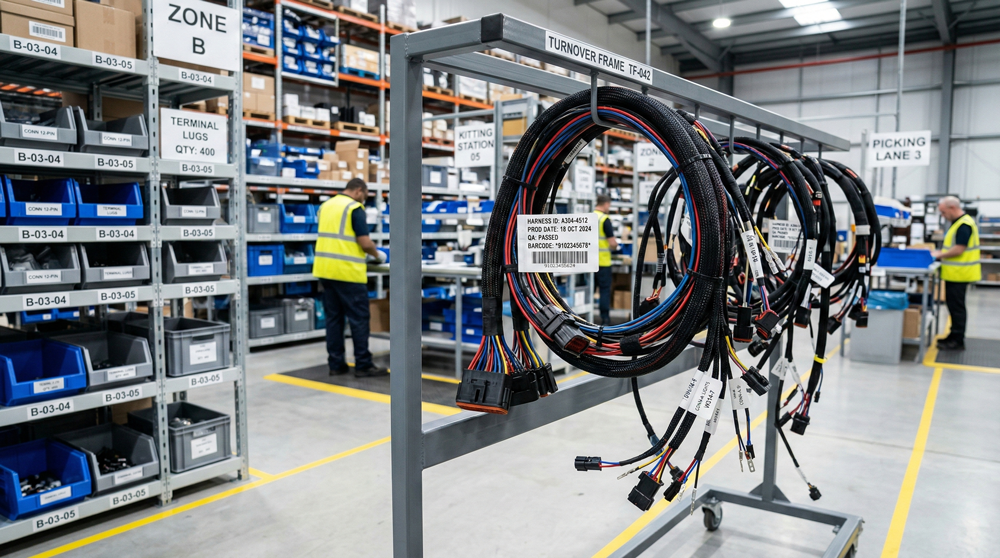
This warranty reduction guide for cable assemblies is for procurement, quality, and engineering teams who want to reduce the real cost of field failures: downtime, expedited replacements, customer dissatisfaction, and internal firefighting. In B2B wiring harness sourcing, warranty cost is rarely just the replacement part. It is the compound cost of detection, diagnosis, containment, rework, logistics, and lost trust.
The business goal is not “zero defects.” The business goal is fewer field failures, smaller containment scope when a failure occurs, and faster recovery with clear supplier accountability. This guide explains the warranty cost model, the prevention controls that matter most, and the validation and traceability system that turns reliability into a commercial advantage.
Table of Contents
ToggleCable assembly warranty cost model for B2B buyers
Warranty cost is often underestimated because buyers track only the cost of replacement assemblies. For cable assemblies, the bigger costs often come from response time and uncertainty.
A practical warranty cost model includes: replacement unit cost, premium freight, line downtime or service labor, troubleshooting time, engineering time, return processing, supplier dispute cycles, and the cost of containment (quarantine, sorting, and re-testing). If your program ships into OEM production, the largest cost can be the line stop itself.
This matters because it changes procurement decisions. If downtime cost is high, you should prioritize suppliers who deliver audit-ready evidence, stable validation, and fast containment—not only low unit price.
If you want to connect warranty economics to sourcing economics, the companion series P13 provides the TCO framework through Total Cost Guide for Custom Cable Assemblies.
Wiring harness field failure prevention starts with controlled requirements
Many warranty events are downstream of ambiguous inputs: unclear pinouts, inconsistent length measurement references, undefined labeling rules, or packaging that allows damage. When requirements are vague, suppliers fill gaps with assumptions, and assumptions become failures.
Field failure prevention begins with controlling requirements and revisions. Lock connector and terminal part numbers, cavity mapping, length reference points, labeling, packaging, and test requirements early. Then control changes through a structured workflow so revisions do not mix and alternates do not appear silently.
If you want a structured input discipline that reduces preventable warranty events, start with Cable Assembly RFQ Checklist and enforce change discipline using Cable Assembly Change Control and ECO Guide.
Cable assembly validation tests that reduce warranty cost
Not all tests reduce warranty cost. The most effective tests are those that expose early degradation mechanisms before product ships, especially under your real environmental and mechanical conditions.
A practical validation strategy typically includes: baseline electrical tests, termination mechanical integrity checks, sealing integrity checks where applicable, and stress-based tests that simulate field conditions such as temperature cycling, vibration, and bending.
The difference between a cost-adding test and a cost-reducing test is whether the test prevents a high-cost failure mode. For example, a quick continuity test prevents obvious opens but does not prevent resistance drift. A pull test can reveal weak terminations before they become intermittent failures under vibration. A contact resistance trend check can reveal marginal interfaces that would otherwise drift in the field.
If your program is termination sensitive, connect validation to existing methods:
Cable assembly environmental testing for warranty reduction
Many harness failures appear only after exposure: heat, humidity, condensation, salt, chemicals, or dust ingress. Environmental testing does not need to be complex, but it must match your exposure profile.
Environmental testing is where sealing, plating compatibility, and material selection become obvious warranty drivers. It also tends to reveal packaging and storage issues that buyers never anticipated.
This series will standardize that topic in the supporting article Environmental Testing Guide for Cable Assemblies. Buyers can use it to define qualification tests and periodic audit tests without turning validation into an endless lab project.
Wiring harness vibration and flex reliability controls
In many applications, wiring harness failures are mechanical before they are electrical. Micro-motion at terminations, weak strain relief, tight bend radius routing, and repeated flexing create fatigue failures that show up as intermittent opens, then become hard opens.
Vibration and flex reliability control is a warranty lever because it reduces the most frustrating failure type: intermittent faults that are hard to reproduce and expensive to diagnose.
The supporting article Vibration and Flex Reliability Guide for Cable Assemblies will define practical design and verification rules that reduce fatigue risk without inflating cost.
Cable assembly sealing and IP protection for reduced field returns
If your harness operates in wet, dusty, or corrosive environments, sealing is often the dominant warranty driver. Seal damage, wire OD mismatch, poor insertion method, and weak strain relief can turn a “sealed connector” into a corrosion engine.
Sealing and IP protection should be controlled through: correct wire OD selection, defined insertion methods, seal inspection checkpoints, and environmental validation aligned to application exposure.
The supporting article Sealing and IP Protection Guide for Cable Assemblies will provide buyer-ready criteria for specifying sealing requirements and verifying execution.
Traceability and containment reduce downtime cost
Even when failures occur, warranty cost is determined by containment speed. If you can identify affected lots quickly, you quarantine less inventory, ship replacements faster, and restore customer operations sooner.
Traceability is not just a compliance feature. It is the mechanism that shrinks containment scope. A supplier who can trace wire lots, terminal lots, and work orders to shipments can isolate risk quickly and avoid expensive “recall everything” reactions.
This series will cover containment systems in Traceability and Containment Guide for Cable Assemblies. It will define what traceability level to require, what labels must contain, and how evidence packs make containment operational.
Supplier failure analysis and CAPA discipline
Warranty reduction is not only prevention. It is also the ability to learn quickly from failures and prevent recurrence.
A mature supplier will run structured corrective actions that include: containment, root cause evidence, corrective action implementation, validation of the fix, and updates to process controls to prevent recurrence. Buyers should require this discipline because it turns a failure into a reliability improvement rather than a repeated cost.
The supporting article Failure Analysis and CAPA Guide for Cable Assemblies will standardize how buyers can request CAPA outputs that are useful, not ceremonial.
Warranty reduction as a commercial value proposition
Most suppliers sell “quality.” Buyers want outcomes: fewer failures, faster recovery, and less internal overhead. A warranty reduction narrative becomes a differentiator when it is backed by mechanisms: evidence packs, validation gates, traceability, and controlled change.
If you communicate “audit-ready verification and fast containment,” you are addressing a real procurement pain point: the cost of uncertainty. That is also why trust pages such as Why Choose Us and operational proof points like Tests & Inspections matter. They connect promises to systems.
A practical warranty reduction playbook for cable assemblies
If you want a practical program-level approach, combine these controls into a playbook:
Start with controlled RFQ inputs and revision ownership. Define validation gates that match exposure risk. Require evidence packs with method-defined test records. Control changes through ECO rules. Define traceability and containment expectations. Require CAPA outputs and verify recurrence prevention. Review the system periodically with supplier audits and trend data.
This playbook reduces failures, but more importantly it reduces the cost impact when failures happen.
Conclusion
Warranty reduction in cable assemblies is a system outcome. It comes from controlled requirements, risk-based validation, strong mechanical and environmental reliability controls, traceability-driven containment, and disciplined CAPA. When these elements are in place, you reduce field failures and you shrink recovery time, which is where most warranty cost lives.
If you want to win on reliability as a business advantage, design your sourcing process around proof: evidence, validation, and containment speed.
FAQ
What is the biggest driver of warranty cost for cable assemblies?
Downtime and uncertainty. The replacement part is often cheaper than the diagnosis, containment, and expedited recovery.
Which validation tests reduce warranty cost most effectively?
Tests that expose real degradation mechanisms: pull integrity, contact resistance stability, environmental exposure, and vibration/flex fatigue checks.
How does traceability reduce warranty cost?
It shrinks containment scope. When affected lots can be isolated quickly, you quarantine less inventory and recover faster.
Why do intermittent wiring harness failures cost so much?
They are hard to reproduce and diagnose. They often involve micro-motion, fatigue, or resistance drift that continuity tests do not catch.
What should buyers require from suppliers after a field failure?
Containment actions, root cause evidence, corrective action implementation, validation that the fix holds, and updates to controls to prevent recurrence.
CTA
If you want to reduce field failures and shorten recovery time for your harness program, share your connector families, environment exposure, volumes, and warranty pain points. We can propose a validation and containment plan that reduces downtime risk and supplier disputes.
- Discuss your program: Contact
- Verification scope reference: Tests & Inspections
- Why buyers select us: Why Choose Us
- Production scope: Cable Assemblies and Custom Cable Assemblies