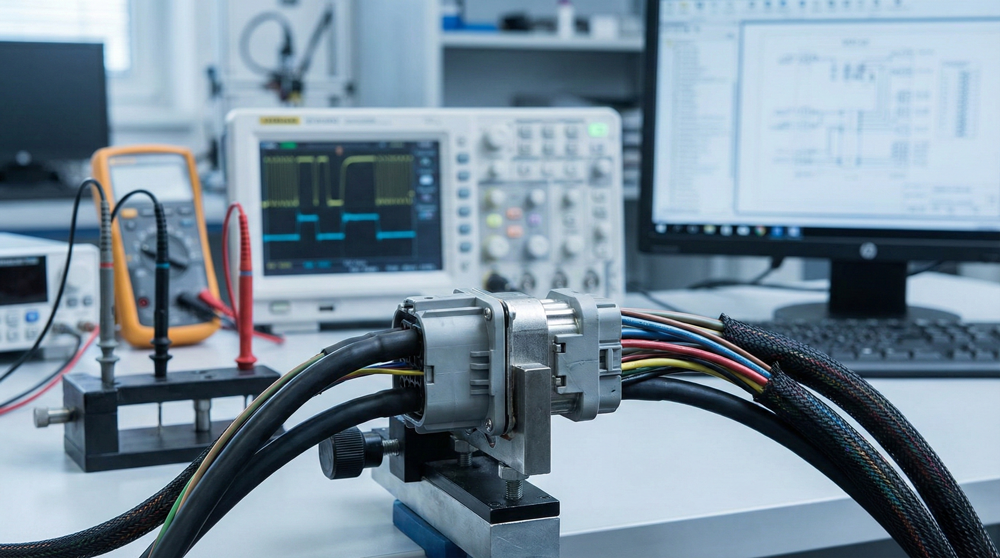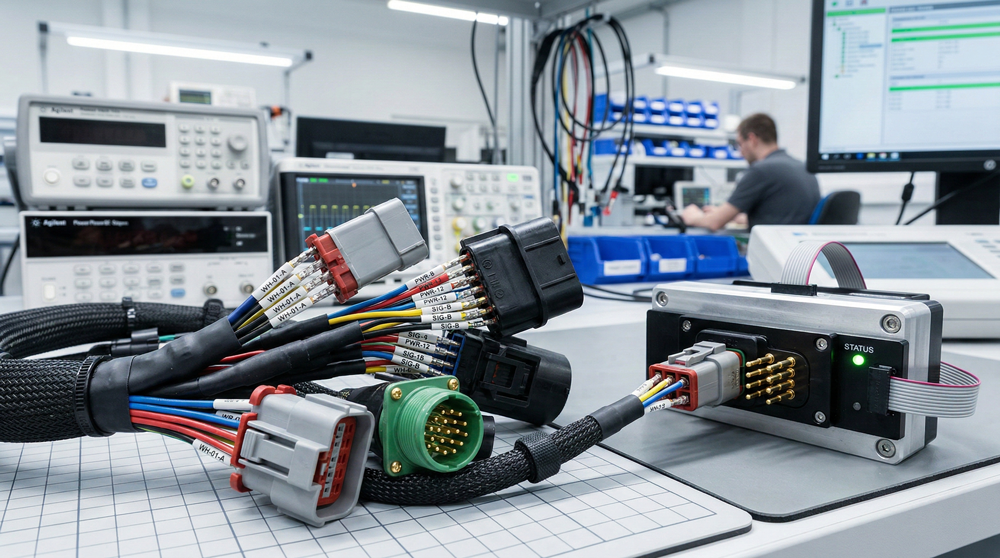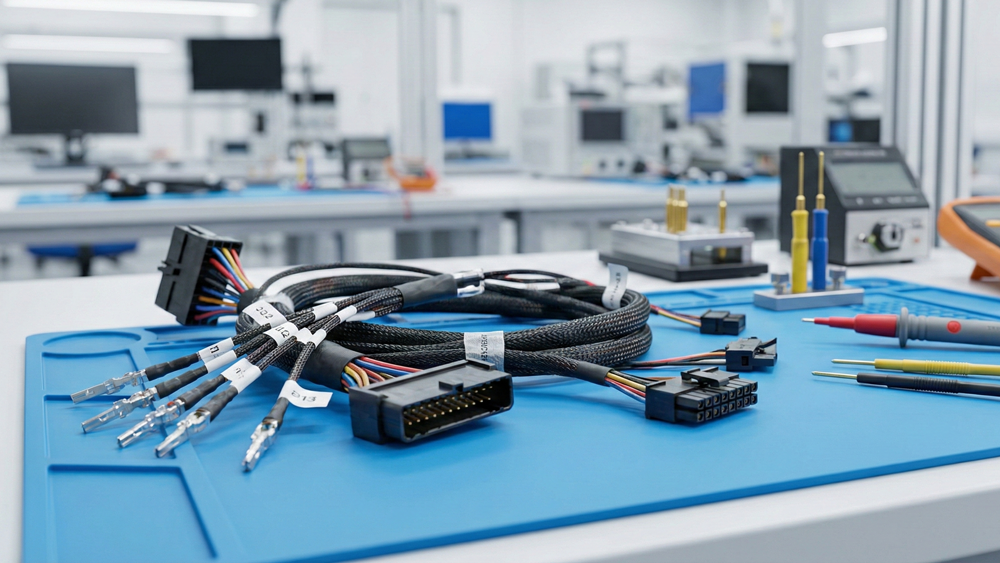
Testing is where many shielded cable assembly projects succeed or fail. A cable may look correct, use the right materials, and pass continuity checks, yet still create EMI problems after installation. For OEM buyers, the key question is not only whether the cable is assembled, but whether it is validated for the real application.
This shielded cable testing guide for OEM buyers explains how to build a practical validation approach for shielded cable assemblies. It focuses on checks that improve EMI confidence, reduce sampling rework, and support more stable production outcomes.
If you are working through the full shielding design sequence, review our Shielded Cable Assemblies EMI Control Design Guide, Braid vs Foil Shielding for Cable Assemblies, Shield Termination Methods for Shielded Cable Assemblies, and Shielded Cable Grounding Strategy for Industrial Systems before finalizing test criteria.
Table of Contents
ToggleWhy Shielded Cable Testing Matters for OEM Buyers
Many OEM teams treat cable testing as a basic electrical checklist. That is necessary, but it is not enough for shielded cable assemblies used in EMI-sensitive systems. A shielded cable can pass continuity and still underperform because the shield path, termination quality, grounding implementation, or connector bonding is weak.
Testing matters because shield performance depends on the full path, not just the cable core. The real outcome is influenced by shield prep, termination method, connector shell, backshell, chassis contact, and installation conditions. If your validation plan checks only conductor continuity, you may approve a cable that looks good in sampling but fails in system integration.
For sourcing teams, good testing criteria also improve quote quality and supplier consistency. When acceptance requirements are clear, suppliers are more likely to build and inspect the shielded cable assembly in the same way.
Shielded Cable Assembly Testing vs Basic Continuity Testing
Basic continuity testing confirms that conductors connect from end to end. It is an important first step, but it does not prove EMI performance. In shielded cable assembly projects, this is one of the most common misunderstandings.
A cable can pass conductor continuity while still having:
- Poor shield termination contact
- Incomplete connector shell bonding
- Excessive exposed shield length near the connector
- Inconsistent backshell assembly
- Weak chassis continuity in the final product
That is why OEM cable assembly validation should be layered. Start with baseline electrical checks, then add shield path verification, mechanical interface checks, and application-level testing relevant to the noise environment.
If your team is defining broader acceptance requirements, align the testing plan with your Tests & Inspections and Quality Guarantee expectations so supplier execution and buyer review use the same criteria.
Shield Continuity Test for Cable Assemblies
A shield continuity test is one of the most important checks for shielded cable assemblies, but it should be defined clearly. “Shield continuity” can mean different things unless the test path and acceptance method are specified.
For OEM projects, clarify what continuity should be verified:
- Shield-to-shield continuity across the cable run
- Shield termination continuity at each connector end
- Shield-to-connector shell continuity (if required)
- Shield-to-backshell continuity (if applicable)
- Shield path continuity into chassis hardware (system-level validation)
This matters because a cable may show continuity at one measurement point while the intended shielding path is still incomplete at the connector interface. In EMI-sensitive applications, continuity should be checked at the points that reflect the real current path.
When requesting supplier validation, ask how shield continuity is tested and documented during sampling and production, not just whether it is “checked.”
Insulation Resistance and Hi-Pot for Shielded Cable Assemblies
Insulation resistance and withstand voltage (Hi-Pot) tests are not EMI tests, but they are often essential parts of shielded cable assembly validation. They help confirm electrical isolation integrity and reduce the risk of hidden defects that can cause intermittent failures in service.
For OEM buyers, these tests are especially useful when the cable assembly includes mixed signal and power conductors, tight spacing, molded transitions, or demanding environmental conditions. A cable that passes shielding checks but fails isolation reliability is still a field risk.
Whether Hi-Pot is required depends on the application, voltage level, and product safety requirements. The key is to define test expectations in the RFQ or drawing instead of assuming the supplier uses the same standard as your internal team.
If your cable design includes molded strain relief or sealing structures, coordinate test criteria with Overmolding Services requirements so the electrical and mechanical validation plans stay aligned.
Connector Shell Bonding Test for EMI Control
In many shielded cable EMI failures, the problem is not the shield material itself but the connector shell bonding path. That is why connector shell bonding checks should be included in shielded cable testing when the design depends on shell or chassis grounding.
A connector shell bonding test may involve verifying continuity or low-resistance connection between the shield termination path and the conductive connector shell, backshell, or chassis interface—depending on the design intent. The exact method should match the real product architecture.
OEM teams should define whether the shield is expected to bond to:
- Connector shell
- Backshell
- Chassis or panel hardware
- Signal ground (in limited cases, if designed that way)
If this is not specified, suppliers may build different versions of the same part number, and EMI performance can vary even when all visible materials appear identical.
Shielded Cable Grounding Verification for OEM Validation
Grounding strategy and testing should be linked. If the design intent is single-end grounding, both-end grounding, or a specific chassis bond path, the validation plan should confirm that the built cable assembly supports that intended path.
Grounding verification for shielded cable assemblies may include checking:
- Which end(s) of the shield are bonded
- Whether the bond is to shell, backshell, or designated hardware
- Whether any end is intentionally isolated
- Continuity through the intended chassis path (if system-level test is available)
This is where many OEM projects lose time. Teams define a grounding strategy during design review but approve samples using only generic continuity checks, then discover mismatches during integration.
For industrial applications, this testing topic should be coordinated with your Shielded Cable Grounding Strategy for Industrial Systems guide so design intent and validation method stay consistent.
Pre-Compliance EMI Validation for Shielded Cable Assemblies
Formal compliance testing is expensive and slow. For many OEM programs, pre-compliance EMI validation is a better place to find cable-related risks early, especially when the product operates near motors, VFDs, switching power supplies, or dense control panels.
Pre-compliance testing does not need to be complex to be useful. The goal is to expose likely noise problems before production release by testing the cable assembly in a realistic operating setup. This may include running nearby noise sources, checking signal stability, and comparing behavior across cable builds or termination variants.
For OEM buyers and sourcing teams, pre-compliance validation is also a decision tool. It helps compare supplier builds based on functional behavior, not only on material declarations.
The most effective pre-compliance plan is usually built jointly by the OEM engineering team and the supplier, using real application conditions whenever possible.
Shielded Cable Inspection Checklist for OEM RFQ Acceptance
A strong RFQ and sample acceptance process should include a shielded cable inspection checklist that matches the project’s EMI risk and production goals. This checklist should cover both visible workmanship and functional verification points.
A practical OEM inspection checklist may include:
- Conductor continuity results
- Shield continuity results and test points
- Insulation resistance results
- Hi-Pot results (if required)
- Shield termination workmanship at both ends
- Exposed shield length near connector (limit check)
- Connector shell / backshell bonding verification
- Part identification and revision traceability
- Visual inspection of strain relief or molded transitions
- Functional test under application-relevant conditions (if available)
When possible, request photo records for critical shield termination areas during sampling. External cable appearance alone is not enough to evaluate EMI-related build quality.
If you are building a supplier qualification workflow, your Strong Technical Support and Assembly Capabilities pages can support the discussion around process control expectations.
Common Testing Mistakes for Shielded Cable Assemblies
Several testing mistakes repeat across OEM programs.
One common mistake is approving samples based only on conductor continuity and visual appearance. Another is performing shield continuity checks without defining the actual measurement points that reflect the intended EMI path.
Some teams also separate cable testing from system installation conditions. A cable may pass bench tests but fail in the machine because connector shell bonding, chassis contact, routing, or nearby noise sources are different.
Another costly mistake is documenting material specs but not documenting validation criteria. When the test method is undefined, two suppliers may claim the same performance while using different inspection scope and standards.
How OEM Buyers Build a Shielded Cable Validation Plan
The best validation plan is simple enough to execute consistently and specific enough to catch real risks. OEM buyers do not need to overcomplicate testing, but they do need to test what matters for the application.
A practical sequence is:
- Define the EMI risk and application environment
- Confirm shield type, termination method, and grounding intent
- Define baseline electrical tests (continuity, insulation, Hi-Pot if needed)
- Define shield path checks (continuity, bonding, isolation intent)
- Add application-level or pre-compliance EMI validation
- Document acceptance criteria in RFQ and sample approval records
This approach improves supplier alignment, reduces redesign risk, and makes future production quality reviews easier.
Conclusion
A shielded cable assembly is not fully validated when it only passes continuity. For OEM buyers, reliable EMI performance depends on a broader testing plan that verifies the shield path, connector bonding, grounding intent, and real application behavior.
The strongest results come when testing is defined as part of the design package—not added after noise problems appear. By linking shield selection, termination, grounding, and validation criteria, OEM teams can approve samples with more confidence and improve production stability.
FAQ
Is continuity testing enough for shielded cable assemblies
No. Continuity testing is necessary, but it does not confirm EMI performance. OEM buyers should also consider shield continuity, connector shell bonding, grounding verification, insulation resistance, Hi-Pot (if required), and application-level validation.
What is a shield continuity test for a cable assembly
A shield continuity test verifies that the intended shield path is electrically continuous. Depending on the design, this may include shield-to-shield continuity, shield-to-connector shell continuity, or shield-to-backshell/chassis continuity.
Do OEM buyers need Hi-Pot testing for shielded cable assemblies
It depends on the application, voltage level, and safety requirements. Hi-Pot is not an EMI test, but it is often important for validating insulation integrity and reducing field failure risk.
Why can two suppliers use the same cable but get different EMI results
Because EMI performance depends on more than cable material. Shield termination quality, connector shell bonding, backshell assembly, grounding implementation, and inspection methods can all change the final result.
What should be in a shielded cable sample acceptance checklist
At minimum: conductor continuity, shield continuity, insulation resistance, Hi-Pot (if required), shield termination workmanship, connector shell/backshell bonding verification, and any application-relevant functional validation.
CTA
Need Help Defining a Shielded Cable Test Plan for an OEM Project
If your team is preparing RFQ acceptance criteria or sample validation checks for shielded cable assemblies, we can help review the test plan before production release.
We can support:
- Shield continuity and bonding verification planning
- Grounding intent validation checks
- Connector shell / backshell interface review
- OEM inspection checklist definition
- Prototype and pre-compliance validation planning
If you already have drawings, specs, or sample approval records, contact us through our Contact page. You can also review our Tests & Inspections, Quality Guarantee, and Shielded Cable Assemblies pages before starting the discussion.