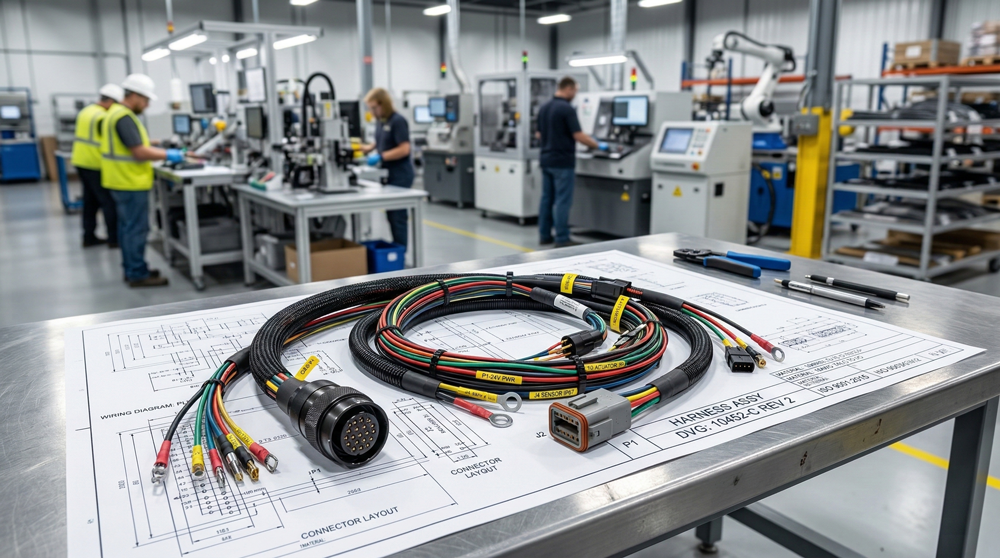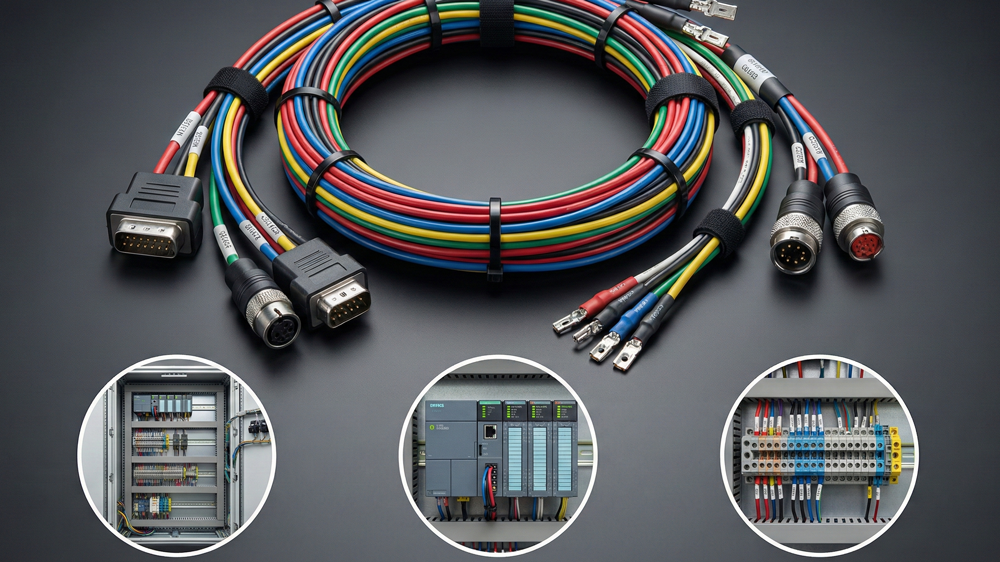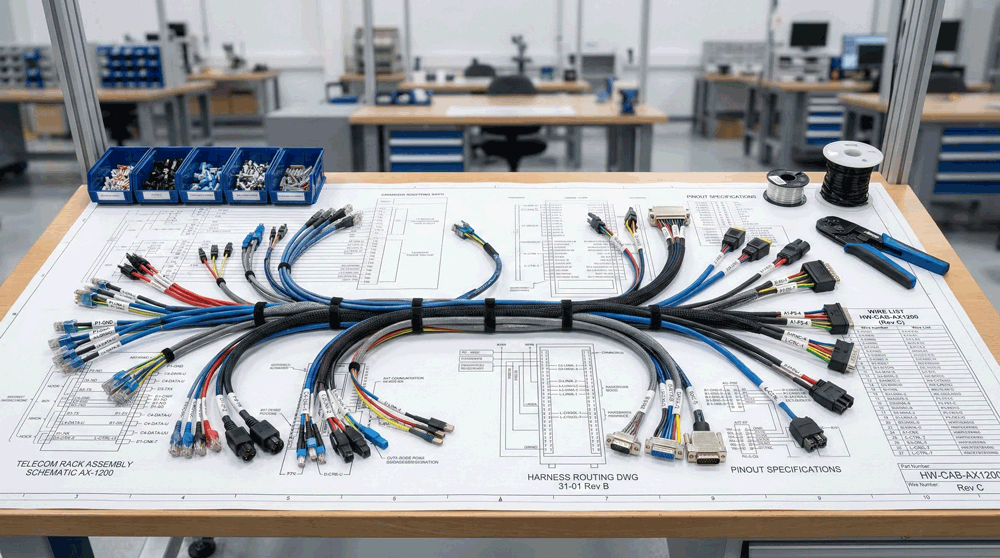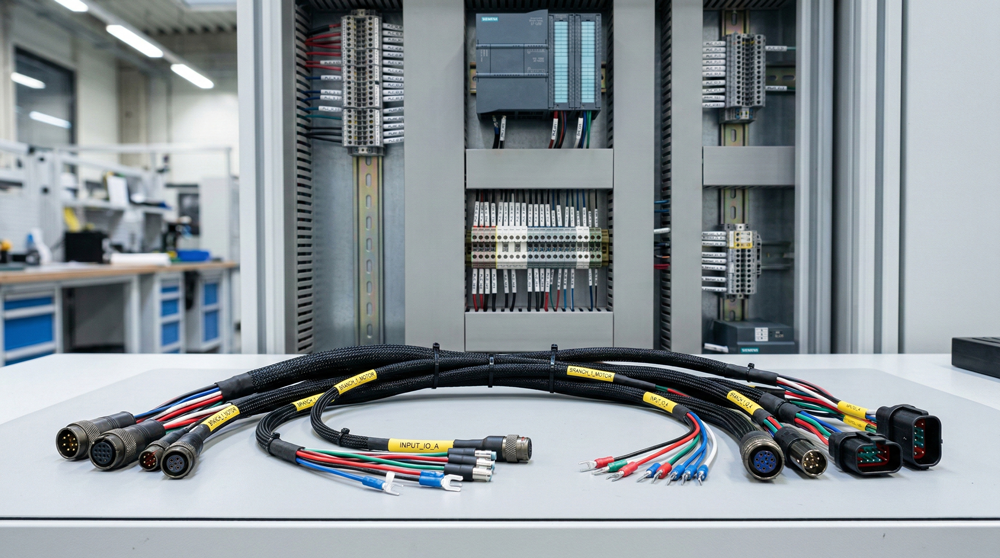
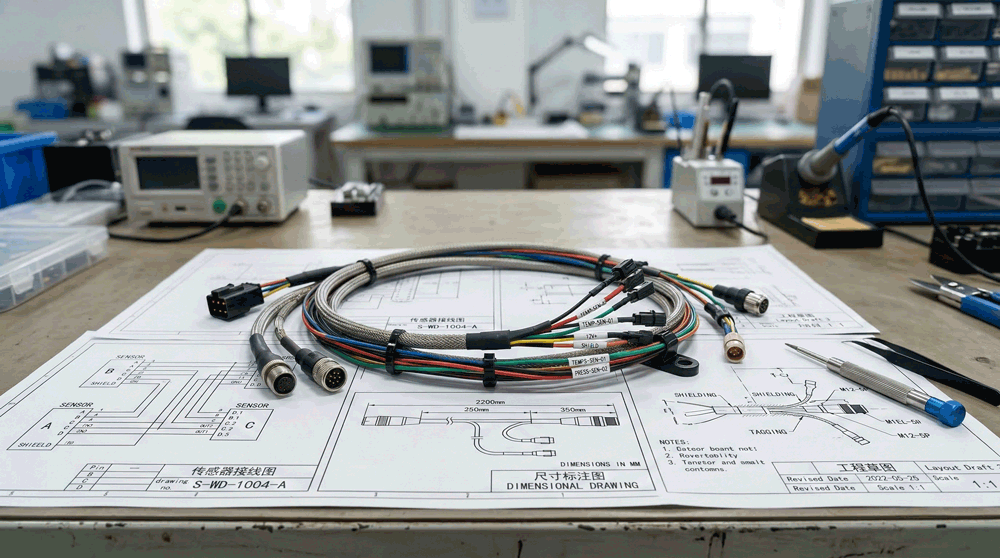
Outsourcing wire and cable harnesses is often discussed as a cost decision. That is true, but it is no longer the whole story. For OEMs, the bigger question is whether an external partner can help shorten development cycles, stabilize quality, reduce supply risk, and free internal teams to focus on the parts of the product that actually create competitive advantage.
That shift matters because outsourcing today is increasingly driven by access to skilled talent and agility, not only by labor arbitrage. In parallel, cable and wire harness assemblies remain highly workmanship-sensitive products, with industry acceptance commonly anchored to IPC/WHMA-A-620 and, in more demanding sectors, formal first-article verification practices.
Table of Contents
ToggleWhy this decision matters now
Many OEMs still build at least some harnesses internally because the process looks manageable. A harness is visible, tangible, and easier to understand than a PCB or an embedded controller. That can create the impression that keeping it in-house preserves control.
In practice, harness production becomes difficult when product mix expands, engineering changes accelerate, or demand becomes less predictable. The challenge is rarely just assembly labor. It is the combination of documentation control, crimp quality, traceability, test discipline, materials planning, operator training, tooling upkeep, and the ability to ramp without disrupting the rest of the factory. That is why the best outsourcing decisions are usually strategic operating-model decisions, not simple purchasing decisions. NAI’s article points in this direction, but mostly from a cost-and-capacity angle. A stronger OEM article should connect outsourcing to business execution and risk control.
The real business case
The strongest reason to outsource wire and cable harnesses is not that a supplier may quote a lower piece price. The stronger reason is that a capable supplier can often lower your total cost of ownership.
Total cost includes engineering iteration time, tooling utilization, operator learning curves, scrap, retest, incoming failures, field returns, excess inventory, production stoppages caused by shortages, and the hidden management burden of running a specialized process in a factory whose core competence may be somewhere else. When buyers evaluate only the quoted unit price, they often underprice the internal overhead they are already absorbing.
There is also a resource-allocation issue. Deloitte’s 2024 survey highlights that organizations increasingly use outsourcing to access skills and agility while keeping internal focus on core capabilities. For many OEMs, cable harness production is essential, but it is still not the highest-value use of scarce engineering and operations bandwidth.
Where outsourcing creates the most value
Outsourcing tends to create the most value in five situations.
1. When volume is unstable
If your volume profile moves from prototype to pilot to ramp, then back to mixed low-volume replenishment, internal teams often struggle to staff efficiently. An outside supplier that already runs harness lines every day can absorb that variability more smoothly than a factory trying to balance harness work against its main production priorities.
2. When product variety is growing
A single harness is simple. A family of harnesses with multiple connector options, regional variants, label requirements, and revision changes is not. Complexity multiplies through documentation, kitting, test routines, and revision discipline. Specialized suppliers usually handle that complexity better because their systems are designed around it.
3. When speed-to-production matters
A good supplier does more than assemble to print. They help review drawings, call out manufacturability risks, standardize components where appropriate, and lock down first-article expectations early. That can shorten the path from RFQ to approved production build, especially when your internal team is already overloaded.
4. When quality consistency matters more than local control
Cable and wire harnesses are highly dependent on workmanship. IPC states that IPC/WHMA-A-620 is the industry-consensus standard for requirements and acceptance of cable and wire harness assemblies, covering materials, methods, tests, and acceptance criteria. Buyers who outsource well are not giving up quality; they are moving quality into a better-defined and more specialized system.
5. When supply continuity is becoming a board-level issue
The NAI article rightly points out that outsourcing can help support demand spikes and improve resilience if the manufacturer has a broader footprint and stronger sourcing capability. That point is even more important today. The right supplier is not just an assembler. They are part of your continuity plan.
What good outsourcing looks like
The biggest mistake buyers make is thinking that outsourcing means sending a drawing, waiting for a quote, and comparing price. That is purchasing activity, not supplier strategy.
Good outsourcing has three layers.
The first layer is technical alignment. The supplier should understand connector families, crimp requirements, shielding, bend-radius constraints, strain relief, labeling, testing requirements, environmental conditions, and the downstream installation context.
The second layer is process control. You want documented work instructions, revision control, operator training, calibrated tooling, traceability where needed, electrical testing discipline, and clear nonconformance handling. In demanding sectors, first-article inspection is used specifically to verify that requirements are understood, documented, and met consistently across the supply chain. IAQG notes that this standardized approach is intended to improve quality, schedule, and cost performance.
The third layer is commercial governance. This includes lead-time assumptions, MOQ logic, liability boundaries, buffer-stock policy, component substitution rules, ECR/ECO handling, and a plan for volume changes. A supplier may build an excellent harness and still be the wrong partner if governance is weak.
In-house, outsourced, or hybrid
For most OEMs, the right answer is not ideological. It is situational.
| Model | Best fit | Main advantage | Main risk |
|---|---|---|---|
| In-house | Very low complexity, highly confidential builds, urgent one-off changes | Maximum immediate control | Hidden labor, training, tooling, and capacity burden |
| Outsourced | Repeatable production, variable demand, multi-SKU programs | Better specialization, scalability, and process discipline | Weak supplier selection can create dependency |
| Hybrid | Prototype in-house, production outsourced | Faster early iteration with scalable downstream supply | Handover failures if documentation is weak |
In practice, many successful OEMs use a hybrid path: early prototypes or validation builds close to engineering, then transfer stable revisions to a specialized supplier for repeatable production. That model usually gives the best balance of speed and scalability, especially when documentation is mature enough to support a clean transfer. This is a practical inference from the same themes emphasized by NAI, Deloitte, IPC, and standardized first-article practice.
When outsourcing is the wrong move
Outsourcing is not always the correct decision.
If your harness changes daily, exists only as a temporary engineering bridge, or depends on tacit knowledge that has not yet been documented, then externalization may slow you down. The same is true when the buyer is not ready to manage an external supplier with discipline. A weak RFQ package, vague acceptance criteria, and uncontrolled revisions will create problems whether production is internal or external.
Outsourcing also fails when buyers chase the lowest quote without understanding the supplier’s actual control system. A cheap harness that arrives late, fails electrical test, or varies from lot to lot is not a cost win. It is a disruption.
How OEM buyers should qualify a supplier
The best supplier-qualification process goes beyond “Are you a manufacturer?”
Start by asking how the supplier controls workmanship. If they reference IPC/WHMA-A-620 appropriately and can explain how they translate requirements into operator instructions, inspection points, and testing, that is a meaningful signal.
Then look at their new-product-introduction discipline. Do they support first articles, pilot builds, and deviation control in a structured way? Can they flag drawing problems before production? Standardized first-article methods exist for a reason: they reduce ambiguity before scale.
Next, evaluate sourcing strength. Ask which materials are customer-designated, which are supplier-managed, how alternates are approved, and what happens when connectors or terminals become constrained.
After that, review test capability. Continuity alone is not always enough. Depending on the application, you may need hipot, insulation resistance, pull-force validation, pinout verification, labeling checks, or application-specific functional tests.
Finally, check communication quality. Good suppliers ask better questions. They do not simply accept a drawing and push it to the floor.
What to send before RFQ
A serious RFQ package improves supplier performance before the first sample is ever built.
Provide the latest drawing revision, BOM, wire specifications, connector part numbers, assembly images if available, expected annual volume, pilot volume, application environment, test requirements, packaging requirements, labeling rules, and target incoterms. If there are critical-to-quality features, identify them explicitly.
Also define what counts as approval. Many delays happen because the buyer says “sample approved” informally, but production readiness was never clearly defined. A better model is to separate prototype approval, first article approval, pilot approval, and mass-production release.
The KPI question buyers often miss
Most buyers ask for price, lead time, and MOQ. Fewer ask how performance will be measured after award.
For outsourced wiring assemblies, the useful KPI set usually includes first-pass yield, on-time delivery, defect ppm where relevant, response time for engineering changes, corrective-action closure time, and first-article turnaround. Those metrics do more to protect your program than negotiating one more cent from the quote.
Final view
Outsourcing wire and cable harnesses should not be framed as a narrow labor-cost decision. The better frame is this: can a specialized partner help you build faster, scale more safely, control workmanship more consistently, and let your internal team stay focused on the parts of the product that truly differentiate your business?
When the answer is yes, outsourcing becomes more than purchasing. It becomes an operating advantage.
And that is the angle that usually resonates with serious OEM buyers. They are not looking for a cheap harness supplier. They are looking for a partner that can reduce friction between engineering, sourcing, quality, and production.
CTA
If you are evaluating outsourced wiring assemblies or need a more reliable OEM wire harness supplier, start with your drawing pack, target volumes, and test requirements. A strong supplier should be able to review manufacturability, propose the right build-and-test flow, and support first samples before mass production.
Related articles
How to choose a custom cable assembly manufacturer
Wire harness prototype to production transfer
Incoming inspection checklist for cable assemblies