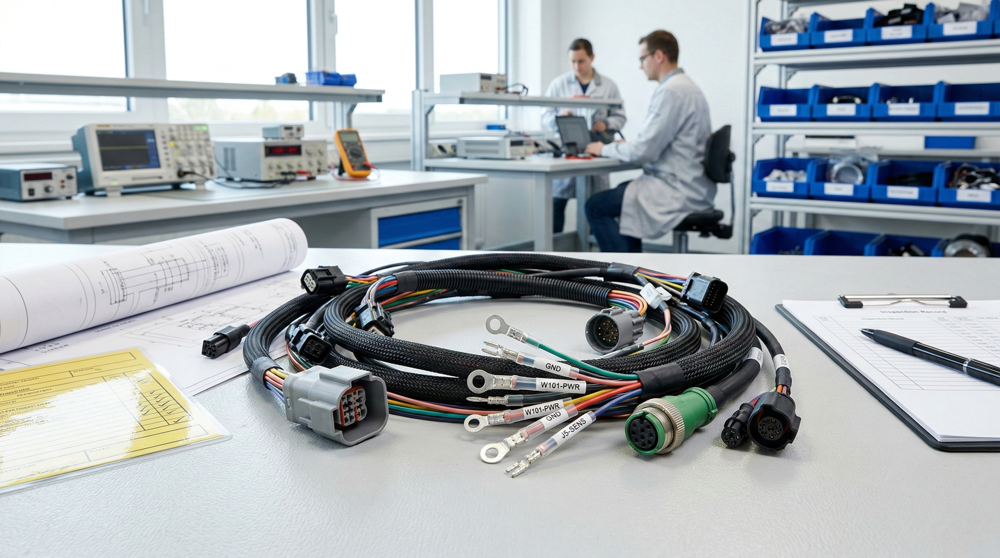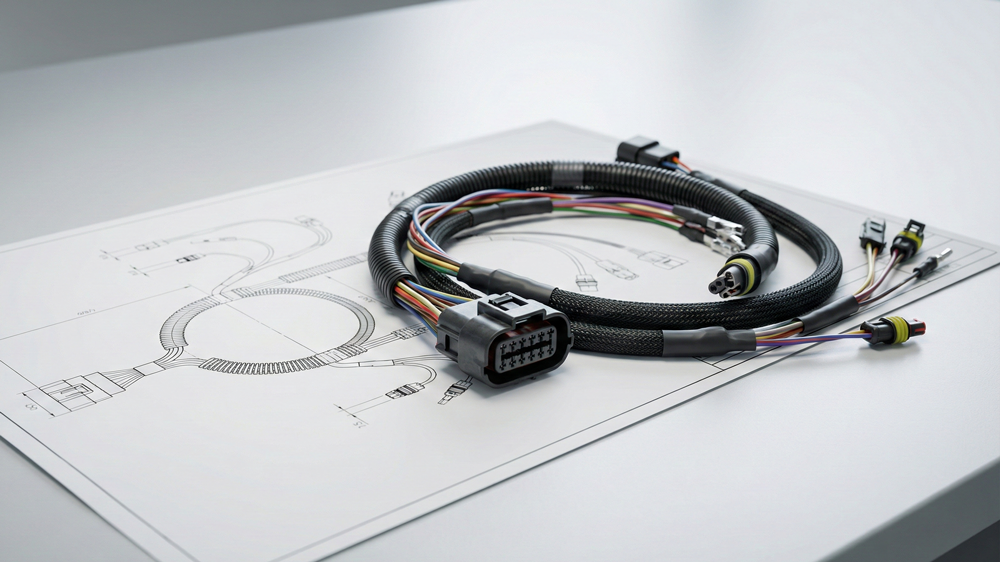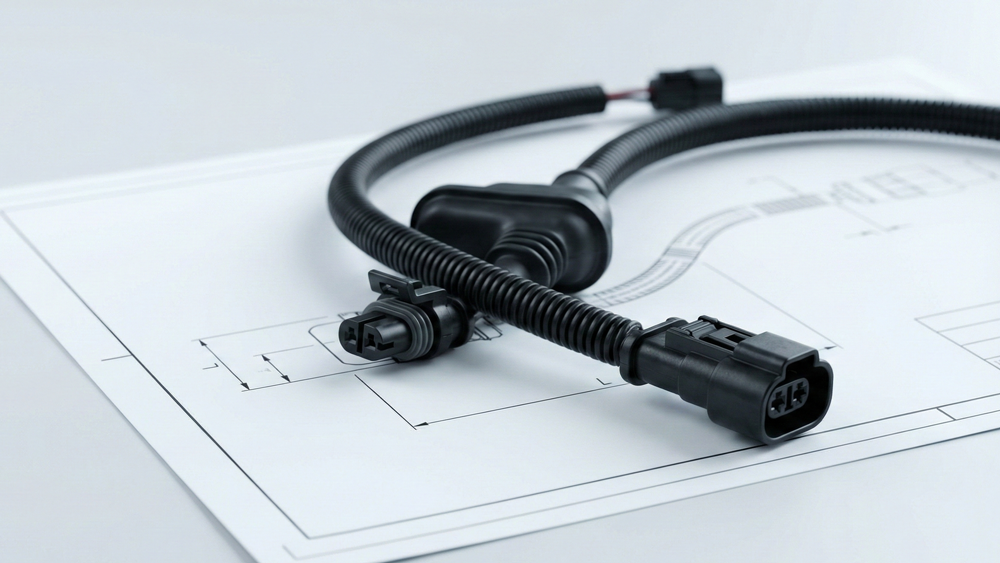
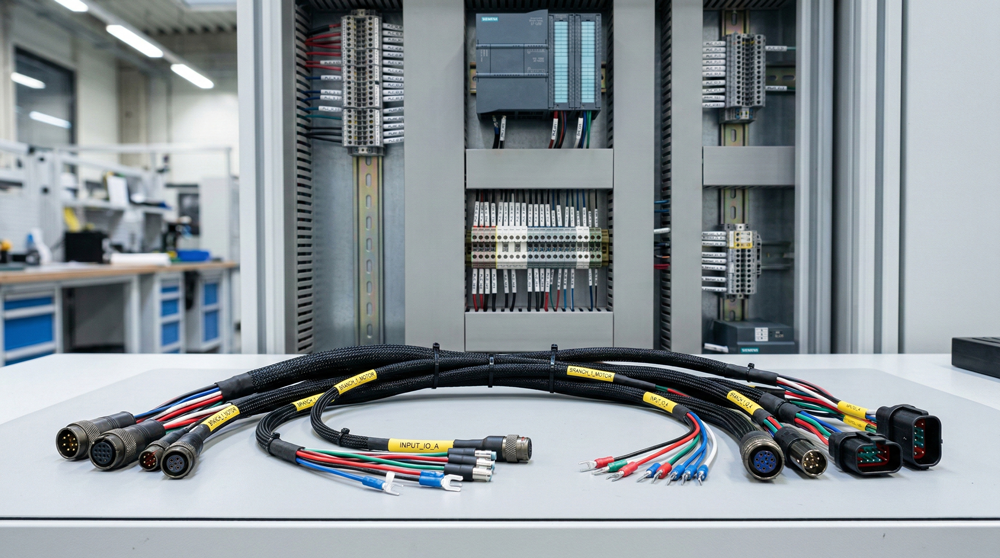
Outdoor equipment needs the right cable assemblies because the operating environment is much less forgiving than many indoor OEM applications. Sunlight, rain, humidity, mud, vibration, temperature swings, dust, washdown, and rough handling all place stress on the interconnect system. A cable assembly that performs well in a protected cabinet or light-duty indoor machine may age quickly, loosen, crack, wick moisture, or become a repeated service issue once it is exposed to real outdoor use.
Table of Contents
ToggleFor OEM buyers, this means the sourcing decision should not be based only on connector fit, nominal electrical performance, or initial unit price. In outdoor programs, the cable assembly affects uptime, field reliability, warranty cost, maintenance effort, and long-term brand confidence. The right design helps the equipment survive the environment. The wrong one creates hidden lifecycle cost that shows up later as intermittent faults, corrosion, replacement work, and customer complaints.
Outdoor Conditions
Outdoor equipment places a very different kind of demand on cable assemblies than indoor electronics or even many standard industrial systems. The challenge is not only that the environment is harsher. The challenge is that several stress conditions often act together.
A cable assembly on outdoor machinery may see UV exposure during the day, condensation at night, vibration during operation, dirt and water intrusion during work, and temperature cycling across seasons. On some equipment, it may also face fuel, oil, cleaning chemicals, salt spray, fertilizer residue, road splash, or repeated mechanical abuse during installation and service. Even if each of those conditions looks manageable by itself, the combined effect can shorten cable life quickly when the design is too light.
This is why outdoor cable assemblies should be evaluated as part of total application risk. A weak connector seal, an unsuitable jacket, poor strain relief, or incomplete labeling may not cause an immediate failure in early testing. But over months of field use, these details often become the difference between a stable product and a service burden. In B2B OEM supply, outdoor interconnect design is therefore much closer to a durability decision than a simple purchasing decision.
Define the Exposure
One of the most common mistakes in outdoor OEM projects is treating all “outdoor use” as the same condition. In reality, outdoor exposure varies widely depending on the equipment type, installation position, and service model. A cable on an agricultural machine, an outdoor lighting system, a portable power unit, a telecom enclosure, and a construction device may all be classified as outdoor, yet the real risks are very different.
Some assemblies are mounted externally and face direct sun, rain, and physical impact. Others are installed inside a partially protected housing but still experience moisture, temperature cycling, and dirt. Some are fixed in place for years. Others are moved, unplugged, or handled regularly during service. Some are routed near engines, hydraulic components, or moving structures. Others are used in lighter-duty signal applications but must still survive UV and seasonal weather.
That is why OEM teams should begin by defining the actual exposure pattern rather than using broad language. Is the assembly permanently exposed or partially shielded? Does it face direct water spray, only splash, or mostly humidity and condensation? Is it static or does it move with the equipment? Is it close to heat, abrasion, or chemicals? Will technicians unplug it in the field? Once these questions are answered clearly, the cable assembly design becomes much easier to control.
A simple application breakdown is often useful:
| Outdoor application | Main exposure | Typical cable priorities |
|---|---|---|
| External machine harness | UV, rain, dirt, vibration | Sealing, UV resistance, rugged retention, abrasion protection |
| Semi-protected enclosure cable | Humidity, condensation, temperature cycling | Stable materials, good strain relief, corrosion resistance |
| Portable outdoor equipment | Handling, bending, field service | Flexibility, connector durability, label clarity, easy replacement |
| Vehicle-mounted outdoor system | Vibration, splash, heat, road debris | Secure routing, sealing, abrasion resistance, strong retention |
| Agricultural or construction equipment | Mud, chemicals, washdown, mechanical abuse | Tough jacket, environmental sealing, robust support, corrosion control |
This kind of classification helps procurement compare suppliers more intelligently because each manufacturer is responding to a more realistic duty profile rather than a vague outdoor requirement.
Seal the Interface
For many outdoor cable assemblies, the most vulnerable point is not the middle of the cable. It is the interface. Moisture, dirt, and corrosion problems often begin where the cable meets the connector, where the connector mates to the device, or where a transition point leaves too much path for ingress.
This is why sealing should be treated as a system decision rather than a checkbox. The buyer should consider the connector sealing concept, the fit between wire insulation and seals, the strain-relief transition, and the actual mating environment. A connector may be marketed as sealed, but the real performance still depends on correct assembly, suitable wire diameter, undamaged seals, proper insertion, and the way the connector is mounted and used in the field.
Sealing risk becomes especially important when the equipment is washed, stored outdoors, transported through rain, or used in dirty environments. Water does not need a large opening to cause long-term trouble. Small ingress paths can lead to corrosion, unstable signals, higher resistance, or gradual failure over time. In cold environments, trapped moisture can also interact with freezing conditions and mechanical stress.
That is why OEM buyers should ask a more practical question than “Is this a sealed connector?” The stronger question is “How does this full cable-to-connector-to-device interface behave in the real outdoor application?” That framing usually leads to better design review and fewer false assumptions.
Choose Better Materials
Material selection is one of the biggest determinants of outdoor cable assembly life. A design that looks fine on paper can still age badly if the insulation, jacket, seals, labels, or protection materials are not matched to the real environment.
Cable jacket material is an obvious example. In outdoor equipment, the jacket may need to resist UV, moisture, abrasion, oils, chemicals, or low-temperature brittleness. The right material depends on the application, but the key point is that not all common cable constructions age the same way outside. A material that performs well in a controlled indoor machine may harden, discolor, crack, or wear prematurely outdoors.
Connector materials and plating also matter. Exposure to moisture and contamination can accelerate corrosion if the interface materials are marginal for the environment. Secondary materials matter as well. Sleeving, heat shrink, boots, tapes, labels, corrugated tubing, and clips are sometimes treated as minor items, but in outdoor equipment they often determine whether the assembly remains readable, protected, and mechanically stable after long service exposure.
Even labels deserve more attention than they sometimes receive. If a label fades, peels, or becomes unreadable after sun, dirt, and handling, field service becomes harder. In outdoor OEM applications, identification is part of usability, not just documentation. Good material selection supports both reliability and maintainability.
Control Routing
Many outdoor cable problems are created not by the wrong connector or the wrong cable alone, but by the wrong routing path. A cable assembly can be electrically correct and environmentally suitable on paper, yet still fail because the installed route exposes it to rubbing, unsupported movement, standing water, sharp edges, or repeated stress.
Routing should therefore be reviewed as part of the engineering decision. Where does the cable run relative to moving parts, frame edges, hot zones, and splash paths? Does it hang freely where vibration will make it whip or chafe? Does it sit in a low point where water or debris can collect? Are there clamps or supports in the right locations, or does the cable leave the connector and immediately enter a stress zone? These are practical questions, but they directly affect field life.
Outdoor routing also has a service dimension. A route that looks compact in design may be difficult to inspect or replace in the field. If technicians must cut multiple ties, move adjacent parts, or guess which branch goes where, maintenance cost increases. In many outdoor programs, smarter routing can reduce both failure risk and service time without adding major material cost.
This is one reason prototype appearance is not enough. A neat bench sample can still become a poor field assembly if the installed route creates stress or exposure that the sample never saw. OEM buyers should therefore review routing with real mounting conditions in mind, not only free-state appearance.
Protect Stress Points
Outdoor cable assemblies rarely fail uniformly across their full length. More often, the first problems appear at stress points. These are the locations where the assembly leaves the connector, passes through a bracket, enters a clamp, crosses a moving joint, changes direction sharply, or experiences repeated handling.
That is why stress-point protection should be intentional. Depending on the application, the design may benefit from boots, overmolds, grommets, sleeves, abrasion guards, clips, or better support geometry. In other cases, the best solution is not adding more material, but improving clamp location, bend control, or routing path so that load is not concentrated in the wrong place.
Vibration makes this especially important. On outdoor vehicles, portable equipment, utility devices, or ruggedized electronics, constant vibration can slowly damage an assembly that appears secure during static inspection. If the cable is allowed to move excessively near the connector or against a fixed structure, the damage may only become visible after months of use.
For procurement teams, this means that two suppliers quoting the same connector and cable may still be offering very different real-world durability if their support strategy and build discipline differ. The details around strain relief and local protection are often where outdoor reliability is won or lost.
Plan for Service
Outdoor equipment is not only built to operate. It is built to be maintained. A cable assembly that is difficult to identify, remove, or reinstall becomes a recurring service cost, especially when the equipment is used in remote, dirty, or weather-exposed environments.
Service-friendly design starts with access and identification. Can a technician see the label after installation? Is the connector easy to release with gloves or in awkward conditions? Is the route understandable without relying on tribal knowledge? Are similar-looking branches distinguishable during field work? In outdoor service conditions, these details matter because repairs are often made under time pressure and less-than-ideal conditions.
Replacement strategy matters too. If the assembly is expected to be stocked as a spare part, then part-number visibility, packaging clarity, revision control, and installation guidance become more important. An OEM that ignores these details may still ship a working machine, but later carry more support burden than necessary.
This is especially relevant when the same assembly is used across multiple equipment variants. In that case, clear identification and controlled documentation reduce the risk of wrong-part installation during field service. From a B2B perspective, that protects both the OEM and the end customer from avoidable downtime.
Build a Better RFQ
Many outdoor cable assembly quotations are based on too little application information. A supplier can still respond, but the quote often reflects internal assumptions rather than the true operating environment. That makes price comparison less meaningful and increases the chance of redesign later.
A stronger RFQ for outdoor equipment should include more than pinout and length. The supplier should understand the equipment type, mounting position, expected movement, exposure to water and dirt, UV conditions, temperature range, service expectations, target volume, and any known failure history from earlier versions. Photos of the installed environment are often extremely valuable, especially when routing space or exposure points are hard to capture in a flat drawing.
Procurement should also define what kind of support is expected. Is the supplier simply building to print, or are they expected to review the design, suggest material improvements, improve serviceability, or help standardize labels and packaging? These points matter because a stronger outdoor solution often comes from better early engineering discussion, not only from a longer BOM.
A better RFQ usually leads to better commercial decisions. Suppliers can quote the real application more accurately, and buyers can compare options based on actual risk instead of on incomplete assumptions.
Qualify for the Field
Qualification for outdoor cable assemblies should go beyond basic continuity and fit checks. A cable can pass electrical inspection and still be weak in the exact areas that determine field life. That is why OEM buyers should qualify the assembly in a way that reflects the outdoor use case.
The correct qualification depth depends on the program, but it often makes sense to review sealing integrity, connector retention, label durability, routing stability, abrasion protection, and consistency of assembly details across samples or pilot lots. If the application includes repeated handling or movement, that should be reflected in the review. If the equipment faces water, dirt, or chemicals, the validation logic should at least acknowledge those realities.
Pilot builds are especially important because they show whether the supplier can reproduce the intended design consistently. A hand-built prototype can hide assembly weaknesses that later appear in repeat production. Pilot output reveals whether the sealing, labeling, protection placement, and documentation remain stable when the build is no longer treated as a one-time engineering event.
For OEM teams, the goal is not to create unnecessary test burden. The goal is to make sure the assembly being approved is truly suitable for the environment it will face. Outdoor applications punish optimistic assumptions more quickly than protected indoor systems.
Manage Cost Wisely
Outdoor cable assemblies are often under cost pressure because they may be used in meaningful volumes and are easy to view as commodity items. But aggressive cost-down in this area can be misleading. A lower material cost today can create much higher cost later if the assembly ages badly in the field.
The most productive cost optimization usually comes from smarter design choices, better routing, controlled standardization, and clearer RFQ discipline rather than blunt material downgrading. A better clamp position, a cleaner branch layout, a more suitable label method, or a standardized connector family may improve both cost and reliability. By contrast, weakening sealing, lowering jacket quality, or reducing protection at a wear point may save money in quotation while creating warranty and service expense later.
This is why the stronger commercial question is not simply “How do we reduce price?” The better question is “Where can this outdoor assembly be optimized without increasing field risk?” Good suppliers usually respond more intelligently to that question because it invites engineering judgment rather than only cost cutting.
In B2B OEM programs, the lowest unit price is rarely the only economic measure that matters. Replacement cost, downtime exposure, service labor, and customer confidence should all be part of the sourcing decision.
Pick the Supplier
Selecting the right supplier for outdoor cable assemblies is about more than factory capacity. The supplier should understand how outdoor conditions affect cable life, how routing and protection change field performance, and how documentation and identification support service use. A supplier that only quotes from a connector list may still be usable for simple projects, but more demanding outdoor programs benefit from a manufacturer that can review the application more critically.
A strong supplier usually shows their value early. They ask about exposure, movement, ingress risk, stress points, service pattern, and expected environment instead of focusing only on the visible BOM. They help distinguish between what is fixed and what can be optimized. They also understand that outdoor reliability often depends on small details that are easy to overlook in early quoting.
Commercially, OEM buyers should also think about long-term support. Can the supplier maintain stable workmanship? Can they manage revisions and labeling clearly? Can they support pilot and repeat production without drifting in materials or build details? Those questions are especially important when the cable assembly will become a recurring spare part or a long-life product component.
Pages such as Choosing OEM Cable Assemblies for Different Applications and Why Choose Us only matter if the supplier’s real operating behavior matches them. In outdoor equipment, practical support is part of product quality.
Conclusion
Outdoor equipment needs the right cable assemblies because field exposure quickly reveals every weak assumption in the design. Sunlight, moisture, dirt, vibration, temperature swings, abrasion, and service handling all place demands on the interconnect system that many indoor designs never face.
For OEM buyers, the strongest path is to define the real exposure clearly, select materials with outdoor life in mind, control sealing and routing carefully, protect stress points, support field service, prepare a better RFQ, and qualify the assembly for the actual environment instead of only for bench success. When that happens, the cable assembly becomes a stable part of the product rather than a recurring field problem.
FAQ
What makes outdoor cable assemblies different from standard industrial cable assemblies?
Outdoor cable assemblies usually face combined exposure such as UV, moisture, dirt, temperature cycling, vibration, and handling. That means sealing, jacket choice, corrosion resistance, routing, and label durability often matter much more.
Is a sealed connector enough for outdoor use?
Not by itself. The full interface matters, including wire-to-seal fit, assembly quality, strain relief, mating conditions, and how the connector is mounted and used in the equipment.
What should OEM buyers provide in an RFQ for outdoor equipment?
Along with drawings and electrical definitions, suppliers should receive environment details, mounting position, movement description, exposure conditions, target volume, service expectations, and photos when possible.
Can outdoor cable assemblies be optimized for cost safely?
Yes, but the best savings usually come from smarter design, routing, standardization, and better manufacturability rather than reducing critical environmental protection or using weaker materials.
Why is labeling important in outdoor applications?
Because outdoor equipment is often serviced in difficult conditions. Clear, durable labeling helps technicians identify and replace the right assembly faster and reduces service errors.
CTA
If you are sourcing cable assemblies for outdoor equipment, the best starting point is a review of the real exposure, routing path, sealing needs, and service conditions before comparing quotations on price alone.
You can send your drawings, BOM, equipment photos, annual demand, and project requirements through Contact. Our team can help review the application and support a more practical OEM sourcing discussion for your next outdoor program.