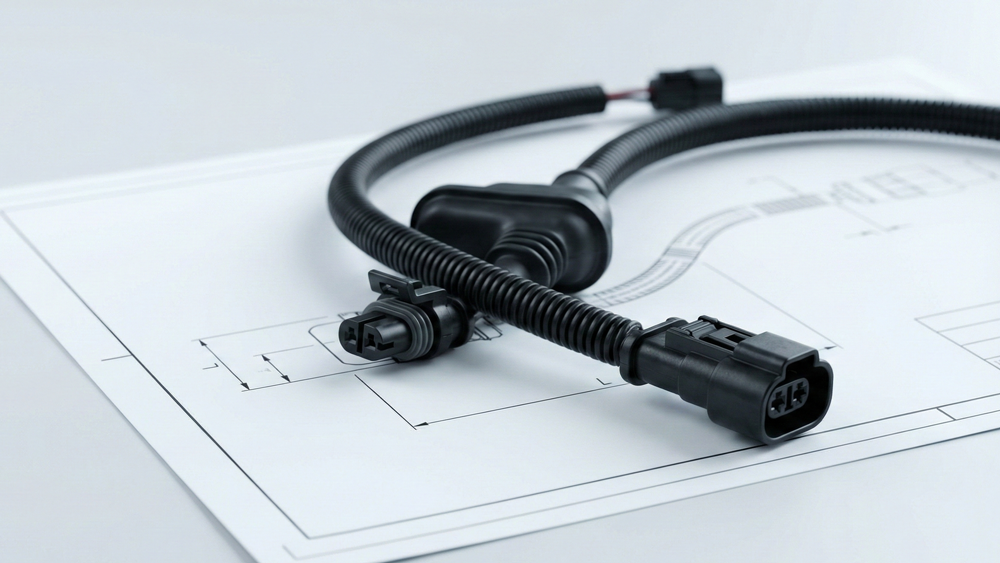
High flex cable testing is one of the most important steps in dynamic cable assembly development, but many OEM teams still use test methods that are too generic for real machine conditions. A cable assembly can pass bench checks, fit the connector correctly, and look good in a drawing review, yet still fail in the field after repeated movement. In most cases, the problem is not the existence of testing, but the relevance of testing.
This high flex cable testing guide for OEM buyers explains how to build a more practical validation approach for cable assemblies used in automation, robotics, drag chain systems, and other repeated-motion applications. The goal is not just to get a cycle number, but to reduce real reliability uncertainty before sample approval and production release.
For the full design context, this article should be read together with High Flex Cable Assemblies Design Guide for OEM Buyers, Drag Chain Cable Selection for Cable Assemblies, Bend Radius and Flex Life for Cable Assemblies, and Strain Relief Design for High Flex Cable Assemblies.
Table of Contents
ToggleWhy High Flex Cable Testing Must Match the OEM Motion Profile
A common mistake in cable assembly flex testing is treating any repeated-bend test as proof of application reliability. In practice, a generic flex test may tell you something about a cable sample, but it may tell you very little about performance in your machine. The difference usually comes from motion profile mismatch.
In OEM projects, cable assemblies are affected by bend direction, movement speed, acceleration, duty cycle, and routing constraints. A test that ignores these factors can produce a clean report and still miss the actual field failure mode. That is why OEM cable assembly validation should begin with the application motion profile, even if the first version is approximate rather than perfect.
Define Motion Profile for High Flex Cable Assembly Test Plan
Before setting up the test fixture, define how the cable assembly actually moves in service. The more clearly the motion profile is described, the more meaningful the test result becomes. This includes the type of movement, the dominant bend direction, whether torsion exists, and whether the cable operates continuously or intermittently.
Even a simplified motion description is better than a supplier-side assumption. In high flex cable testing, an approximate real profile usually creates better engineering decisions than a precise but irrelevant test setup.
High Flex Cable Testing Starts with Failure-Risk Mapping
How to validate high flex cable assemblies for OEM projects depends heavily on where the likely failure zone is located. Many teams focus on the cable body, but dynamic failures often begin at connector exits, clamp transitions, overmold edges, or drag chain end-routing sections.
When OEM buyers map these risk zones first, the test plan shifts from “bend the cable repeatedly” to “validate the actual stress path.” That change improves both test relevance and supplier communication.
High Flex Cable Assembly Test Setup and Pass Criteria Must Reflect Installed Geometry
One of the biggest reasons dynamic cable testing for cable assemblies fails to predict field behavior is that the test setup does not represent installed geometry. In real machines, the cable does not move in a free and ideal path. It moves through connector exits, clamp points, fixtures, and routing corners that define where stress accumulates.
A bench test can still be useful, but qualification testing should reproduce the installed bend zone and transition behavior as closely as possible. If full-machine testing is not practical, a representative fixture is usually the best solution.
High Flex Cable Assembly Test Setup Near Connector Transition Zones
Connector transition zones are often the first failure locations in repeated-motion applications. This is especially true when the cable exits a rigid connector body, passes through an overmold, and then bends within a short free length. If the test setup places the first bend farther away than the real installation, the validation may overestimate flex life.
A good high flex cable assembly test setup and pass criteria should therefore consider the real connector orientation, free length before the first bend, and nearby clamp geometry. These details often matter more than teams expect.
Drag Chain Cable Assembly Testing and Validation Guide for End Transitions
In drag chain systems, many failures do not happen in the center of the chain. They happen at chain entry and exit transitions, or in the cable path just outside the chain where motion constraints become less controlled. This is why a drag chain cable assembly testing and validation guide must include the end-transition geometry, not only the chain radius.
When OEM buyers evaluate drag chain assemblies, they should treat the chain, end clamps, and connector-side routing as one motion system. A cable-only test may miss the actual weak point.
Functional Monitoring During Cable Flex Testing Is More Important Than Final Continuity Only
Many cable assemblies do not fail as a clean permanent open circuit at the beginning of degradation. Instead, they develop intermittent faults, unstable shielding behavior, or signal problems during motion. If the test method only checks continuity after cycling stops, these early failure symptoms may be missed.
For OEM buyers, this is where testing becomes a quality and service-cost issue. Motion-induced intermittent faults are often the hardest field problems to diagnose, especially in automation and industrial systems.
Functional Monitoring During Cable Flex Testing for Signal and Mixed-Power Assemblies
Functional monitoring during cable flex testing is particularly important for encoder cables, sensor assemblies, communication lines, and mixed power-signal harnesses. A sample can survive mechanically while becoming electrically unstable under movement.
The right monitoring method depends on the application, but the principle is the same: validate performance during motion, not only after motion. This approach aligns much better with real use conditions and supports stronger OEM cable assembly validation decisions.
High Flex Cable Testing Guide for OEM Buyers and Stage Checkpoints
A strong high flex cable testing guide for OEM buyers should include staged checkpoints rather than a single final cycle result. When teams inspect only at the end, they lose information about when degradation started and how quickly it progressed.
By reviewing samples at defined intervals, engineering and quality teams can observe changes in bend-zone behavior, connector transition stress, or signal stability. This makes failure analysis more actionable and helps compare suppliers more fairly.
Bend Radius, Strain Relief, and Bend-Zone Migration in High Flex Cable Testing
High flex cable testing results can be misleading if teams assume the bend zone stays fixed during the entire test. In reality, the cable may begin bending in the intended location and then gradually shift toward a clamp edge, overmold boundary, or connector rear exit as cycles accumulate.
This bend-zone migration is one of the most important things to watch in repeated-motion validation because it often reveals a design weakness in the transition zone rather than a basic cable-material problem.
Bend Radius and Flex Life for Cable Assemblies in Test Validation
Bend radius and flex life for cable assemblies should be evaluated at the actual moving bend zone, not only in a drawing or free-cable test condition. A test setup may appear acceptable on paper but still create a tighter effective bend in the real stress area.
That is why OEM teams should link test observations back to design assumptions about bend radius, free length, and routing constraints. If those assumptions change during testing, the reported cycle result should be interpreted carefully.
Strain Relief Design for High Flex Cable Assemblies in Test Fixtures
Strain relief design for high flex cable assemblies directly affects how the cable bends in a validation fixture. A strain relief feature that looks robust may still force a sharp bend at the transition edge, especially if the fixture or clamp placement differs from field installation.
This is why test fixture design and strain relief evaluation should be reviewed together. If the fixture hides the real transition stress, the test may approve a design that later fails in service.
Sample Quantity, Repeatability, and Environmental Conditions in OEM Cable Assembly Validation
A single successful sample can be useful for learning, but it is weak evidence for production release. High flex performance is sensitive to assembly consistency, material variation, overmold placement, and installation differences. For OEM buyers, repeatability matters as much as peak result.
A better approach is to define sample quantity and repeatability expectations before testing starts. This does not mean every project needs a large test matrix, but it does mean qualification should say something about process consistency, not just one best-case sample.
OEM Cable Assembly Validation and Repeatability Expectations
OEM cable assembly validation becomes much more credible when repeatability is defined in advance. Teams should decide how many samples are needed for screening versus qualification, what variation is acceptable, and how an early failure in one sample will be handled.
This prevents ad hoc decisions and makes supplier comparison more objective. It also improves internal confidence when moving from sample approval to production release.
Environmental Conditions in High Flex Cable Testing for Cable Assemblies
Environmental conditions can change cable stiffness, jacket behavior, and long-term reliability. A cable assembly that performs well in a clean room-temperature lab may behave very differently in heat, oil mist, coolant exposure, dust, or vibration.
For higher-risk applications, OEM teams should explicitly decide whether to include environmental preconditioning or combined environment-plus-motion testing. The key point is not that every project must test everything, but that environmental assumptions should be defined rather than ignored.
OEM RFQ Checklist for High Flex Cable Testing Requirements and Supplier Alignment
If high flex reliability is important to the project, testing requirements should be written into the RFQ or technical agreement. Many projects define cable and connector part numbers clearly but leave validation expectations vague. That usually leads to mismatched assumptions between OEM and supplier.
A stronger RFQ describes the motion type, target life, critical bend zones, routing constraints, functional requirements during movement, pass/fail logic, repeatability expectations, and change-control rules for cable and strain-relief-related materials. In many cases, a short routing sketch or motion video can improve test relevance faster than a long text explanation.
Common Mistakes in High Flex Cable Assembly Validation
Common mistakes in high flex cable assembly validation include relying on a supplier’s standard cycle number without checking test relevance, validating only the cable body while ignoring connector transition zones, and approving post-test geometry or material changes without revalidation.
Another frequent mistake is using final continuity alone as the acceptance basis. In repeated-motion applications, intermittent faults during motion are often the more important risk.
How OEM Buyers Compare Suppliers on High Flex Cable Testing Capability
When comparing suppliers, OEM buyers should evaluate testing capability as a core quality indicator, not only part price and lead time. A supplier that can discuss motion profile, installed geometry, risk zones, and functional monitoring usually brings much stronger validation support than one that only offers a generic cycle test.
This matters even more after sample approval, because reporting discipline, failure analysis quality, and change control directly affect production stability and engineering response speed.
Conclusion: High Flex Cable Testing Guide for OEM Buyers Should Be Application-Driven
The best high flex cable testing guide for OEM buyers is not a generic cycle-count document. It is an application-driven validation method built around real motion profile, installed geometry, transition-zone behavior, and functional performance during movement.
When engineering, sourcing, and quality teams align early on test relevance, pass criteria, and repeatability expectations, OEM cable assembly validation becomes much more meaningful. That leads to better supplier decisions, more defensible sample approvals, and more predictable field reliability.
FAQ
Is a generic flex test enough to approve a high flex cable assembly
Usually not. A generic test can help early screening, but qualification testing should match the real motion profile, installed geometry, and functional requirements.
Why is functional monitoring during cable flex testing important
Because intermittent faults often appear during motion before permanent failure occurs. Final continuity checks alone may miss the real field risk.
Should connector transition zones be included in high flex cable testing
Yes. Many repeated-motion failures start near connector exits, overmold edges, and clamp transitions rather than in the cable body center.
How should OEM buyers handle sample quantity in high flex cable testing
Sample quantity should be defined based on project risk, and qualification should include repeatability expectations rather than relying on one sample only.
Do material or overmold changes require revalidation
In many cases, yes. Small changes in material stiffness or transition geometry can change bend behavior and flex life significantly.
CTA
Need Help Building a High Flex Cable Testing Plan for an OEM Project
If your team is validating a dynamic cable assembly for drag chain, automation, robotics, or repeated-bend use, we can help build a more relevant high flex cable assembly test plan before sample approval and production release.
We can support failure-risk mapping, installed-geometry test setup review, pass/fail criteria planning, motion-time functional monitoring strategy, and supplier comparison from a validation capability perspective.
If you already have drawings, routing photos, motion details, test reports, or sample failure records, contact us through our Contact page. You can also review our Tests & Inspections, High Flex Cable Assemblies Design Guide for OEM Buyers, and Assembly Capabilities pages before starting the discussion.
Related Articles in This High Flex Series
- High Flex Cable Assemblies Design Guide for OEM Buyers
- Drag Chain Cable Selection for Cable Assemblies
- Bend Radius and Flex Life for Cable Assemblies
- Strain Relief Design for High Flex Cable Assemblies
- High Flex Cable Testing Guide for OEM Buyers