
Table of Contents
ToggleIntroduction: why most wire harness quotes are slow
In B2B sourcing, a “slow quote” is usually not a supplier problem—it’s an information problem. Custom wiring harnesses look simple on the outside, but your quote accuracy depends on small details that are easy to miss: where a branch actually starts, what the pinout truly is, whether a connector series has seals, whether you need continuity only or hipot, and whether labeling is a nice-to-have or a contractual requirement.
When those details are missing, any manufacturer has two options. They can either ask questions and wait—slowing the quote but improving accuracy—or they can guess—speeding the quote but increasing the chance you receive a price and lead time that won’t survive production reality. If you’ve ever experienced a quote that later “changes after engineering review,” you’ve already seen the hidden cost of guessing.
This article fixes that by giving you a practical RFQ checklist you can reuse across suppliers. It’s written for buyers who want two outcomes at the same time: a fast response and a quote that doesn’t fall apart after sample build.
If you’re ready to submit your RFQ now, our intake page is Custom Wiring Harness. If you’d rather make sure your pack is complete first, keep reading—because the next 10 minutes can save you days of email back-and-forth.
What “a good RFQ” looks like for a custom wiring harness
A strong RFQ does not need to be fancy. It needs to be unambiguous. The goal is to let a manufacturer answer four questions without guessing:
First, what exactly are we building—physically and electrically?
Second, what components must be used, and what alternates are allowed?
Third, what acceptance criteria define “good” (test, labeling, packaging, documentation)?
Fourth, how should we plan capacity (prototype quantity, pilot quantity, production forecast)?
If your RFQ helps a supplier answer those four questions quickly, your quote will come back faster, your lead time will be more realistic, and your first samples will be closer to “right the first time.”
The RFQ Checklist
1) A harness drawing that clarifies routing and branch definitions
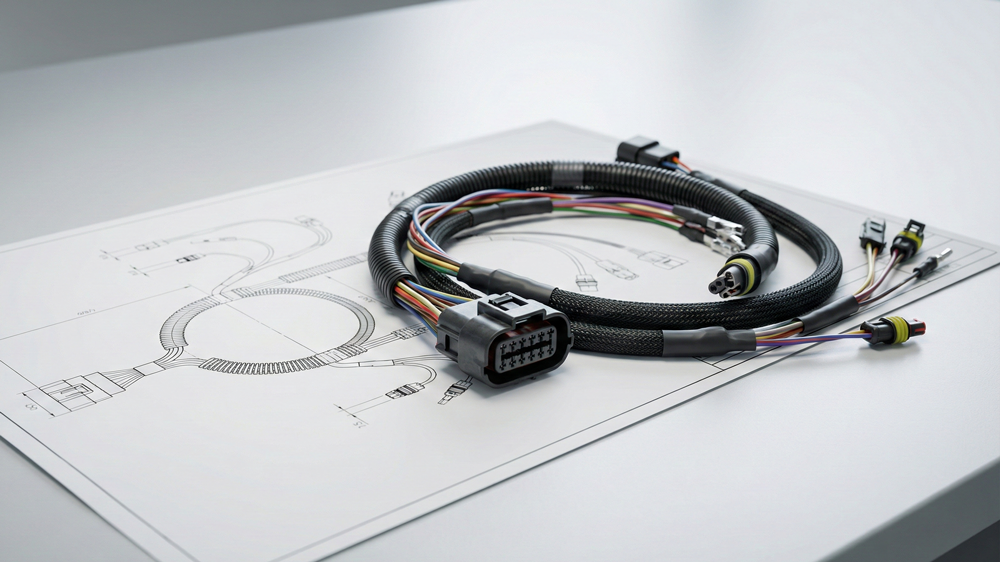
For a custom wiring harness, the drawing is less about artistic perfection and more about removing ambiguity. The most useful drawings clearly show overall harness length, branch lengths, connector callouts, and where branches split. A 2D harness layout is often enough, as long as it includes dimensions and references to connector part numbers and pinouts.
If you don’t have a formal harness drawing yet, you can still quote by providing a clear annotated sketch plus photos of an existing harness (if you’re doing a replacement) and a written list of required changes. What matters is that the manufacturer can identify every termination and every branch without interpretation.
What slows quoting is not the absence of CAD. It’s the absence of clarity. When a drawing doesn’t define the branch start point or doesn’t state measurement method (centerline vs straight line), suppliers will either ask multiple rounds of questions or quote with wide tolerances and safety margins.
A simple improvement that accelerates everything is to include a short “dimension notes” section, where you state how lengths should be measured and what tolerance is acceptable. Without that, two suppliers can interpret the same harness differently and legitimately deliver different builds.
2) A BOM (Bill of Materials) that controls components and prevents silent substitutions
A harness BOM is more than a shopping list. It is the control document that prevents the most painful sourcing surprise: a substitution you didn’t approve.
At minimum, your BOM should identify wire type (gauge, insulation, color), connectors (brand/series and part numbers), terminals, seals (if applicable), and protective materials such as heat shrink, braided sleeve, corrugated tube, tape wrap, or grommets. If your harness includes clips, strain reliefs, boots, or labeling materials, those should also be listed.
Many buyers are surprised that a manufacturer asks for brand/series preferences. The reason is simple: connectors and terminals are not generic. A “similar” terminal can crimp differently, mate differently, or fail to seal properly. If you allow alternates, state that explicitly and define what “equivalent” means for your application. If you do not allow alternates, state that explicitly too.
A practical way to speed quoting is to split your BOM into two tiers. Tier 1 is “no substitutes without approval” (connectors, terminals, seals). Tier 2 is “functional equivalents acceptable” (some sleeves, some tapes) if your program allows. That one decision can prevent both delays and quality surprises.
3) Electrical definition: pinout, circuit list, and what “correct” means
If your RFQ includes a drawing and BOM but doesn’t fully define the pinout, you’ve only described the harness mechanically. You haven’t described it electrically.
For simple harnesses, a pin-to-pin table may be enough. For more complex harnesses, a circuit list that maps connector pins to wire colors and destinations makes quoting and building significantly safer. This is especially important when multiple wires share the same color, when splices exist, or when the harness includes multiple branches that can be mixed up.
From a manufacturer’s perspective, pinout clarity directly reduces misbuild risk. From your perspective, it reduces the need for “engineering guessing,” which is where both delays and mistakes originate.
If you don’t have a formal pinout table, even a spreadsheet with columns like “Connector A Pin / Connector B Pin / Wire Color / Wire Gauge / Notes” can dramatically improve quote speed. It also makes later troubleshooting easier.
4) Test requirements: define what “100% test” means for your harness
Buyers often ask for “100% testing” because they want safety and reliability. That intent is correct, but the phrase is incomplete unless you define the test method.
For many harness programs, a continuity and short test is the baseline. For higher-voltage applications or safety-critical environments, you may need hipot and insulation resistance testing. If your harness is part of a functional subsystem, you may require fixture-based functional testing, which typically means you supply or co-develop a test fixture.
In your RFQ, the most useful approach is to state the minimum test coverage you need and whether you require a test record. Some buyers need a per-harness pass/fail record; others are fine with batch-level confirmation. The right choice depends on your risk profile and customer expectations.
Defining test requirements early does two things. It prevents hidden cost from appearing late, and it ensures the quote reflects the real work required to meet your acceptance criteria.
5) Labeling and traceability: the easiest thing to skip and the hardest thing to fix later
Labeling often gets overlooked until the first shipment arrives and your receiving team can’t tell variants apart—or until a field failure occurs and you can’t trace which batch had the issue.
If you need labels, define them in your RFQ: label content (PN, revision, serial, date code), label type (wrap label, heat shrink marker), and placement. If traceability matters, specify whether you need lot-level traceability or serial-level traceability.
Manufacturers can usually implement labeling easily, but only if you define it early. Adding labeling late can change labor and process steps, which affects both cost and lead time. More importantly, it affects your ability to isolate problems when they happen.
6) Packaging and kitting: how you want the harness delivered
B2B harness programs often require packaging discipline, especially when multiple harnesses ship together and must be installed in a sequence. If you need individual bagging, kit packing, or carton labels with barcodes, include that in your RFQ.
Packaging is not just “logistics.” It’s part of your installation workflow and part of your quality system. Wrong packaging leads to wrong installation, which creates “field failures” that are not electrical failures at all.
If you’re not sure what you need yet, the simplest safe default is individual bagging with clear part labels and a carton packing list. You can refine later, but start with something explicit.
7) Volumes and ramp plan: prototype, pilot, and production are different projects
A quote that ignores your volume profile is either incomplete or not very useful.
Prototype builds often prioritize speed and flexibility. Pilot builds prioritize process validation. Production builds prioritize repeatability and cost control. The same harness can have different unit economics depending on whether you’re ordering 5 pieces, 50 pieces, or 5,000 pieces.
In your RFQ, include at least three numbers: prototype quantity, expected pilot quantity, and a rough monthly or annual forecast. Even if you’re not sure, provide a range. This helps the manufacturer choose the right process assumptions and helps you avoid a quote that is only valid for one phase.
8) Commercial expectations: target lead time, destination, and Incoterms (if relevant)
Many quote delays happen because commercial terms are not defined early. If you care about shipping method, destination, or required delivery date, state it. If your company uses specific Incoterms or has packaging compliance requirements, include them.
You don’t need to lock everything down in the first email, but giving a target lead time and destination helps the supplier avoid quoting something that cannot be executed.
A “Fast Quote RFQ Pack” format you can reuse (simple and effective)
If you want a repeatable structure that works with most wire harness manufacturers, create one folder (or one email package) that includes:
A drawing (PDF), a BOM (Excel), a pinout table (Excel), and a one-page RFQ summary that states required tests, labeling/packaging needs, prototype quantity, forecast, and target timeline.
That’s it. Most quote cycles slow down because these elements are scattered across emails, or because “one missing detail” triggers multiple follow-ups. A single pack reduces cycle time dramatically.
The most common reasons RFQs stall (so you can avoid them)
In practice, RFQs stall for predictable reasons. The drawing doesn’t define branch points. The BOM doesn’t define connector series and terminals. The pinout is incomplete or inconsistent with the drawing. The test requirement is written as “100% test” without specifying what is tested. Labeling is requested but not defined. The volumes are missing, so the supplier cannot choose a process assumption. Or the program timeline is urgent but not communicated, so the supplier doesn’t prioritize it.
None of these require advanced engineering to fix. They require a structured pack.
If you want the manufacturer to quote faster, give them an easier job
Manufacturers prioritize RFQs that are clear because clear RFQs are lower risk. A clear RFQ is easier to estimate, easier to schedule, and less likely to become a dispute later.
This is also why a good supplier will ask questions. Good questions early are cheaper than rework later. So don’t treat clarifying questions as a nuisance—treat them as a maturity signal. The only time questions are a problem is when they are disorganized, repetitive, or undocumented. That’s not “thoroughness.” That’s a process gap.
Next step: submit your RFQ
If you want a fast and accurate quote for a custom wiring harness, send your RFQ pack with the drawing, BOM, pinout definition, test requirements, labeling/packaging needs, and your prototype quantity plus forecast.
You can submit it directly via Custom Wiring Harness. If your timeline is tight and you need prototypes quickly, you can also reference Quick Turn Available so we align on the fastest build path from the start.
If you’d like, I can also format this RFQ checklist into a downloadable “RFQ Pack Template” (Excel + 1-page PDF checklist) to use as a lead magnet and as a real operational tool for your buyers.