Custom molded cables are often presented as a rugged upgrade, but for original equipment manufacturer buyers, the real question is more practical: when does a molded design genuinely improve product reliability, installation efficiency, and long-term cost, and when is a standard cable assembly enough?
That distinction matters because search results for this topic often blur several related terms together. In the current market, “custom molded cables,” “molded cable assemblies,” and “overmolded cable assemblies” are frequently used interchangeably, while suppliers also position them around sealing, strain relief, connector protection, ruggedization, and branding. That overlap creates confusion for buyers who are trying to make a sound engineering and sourcing decision rather than just compare a few photos on supplier websites.
Table of Contents
ToggleWhat custom molded cables really mean
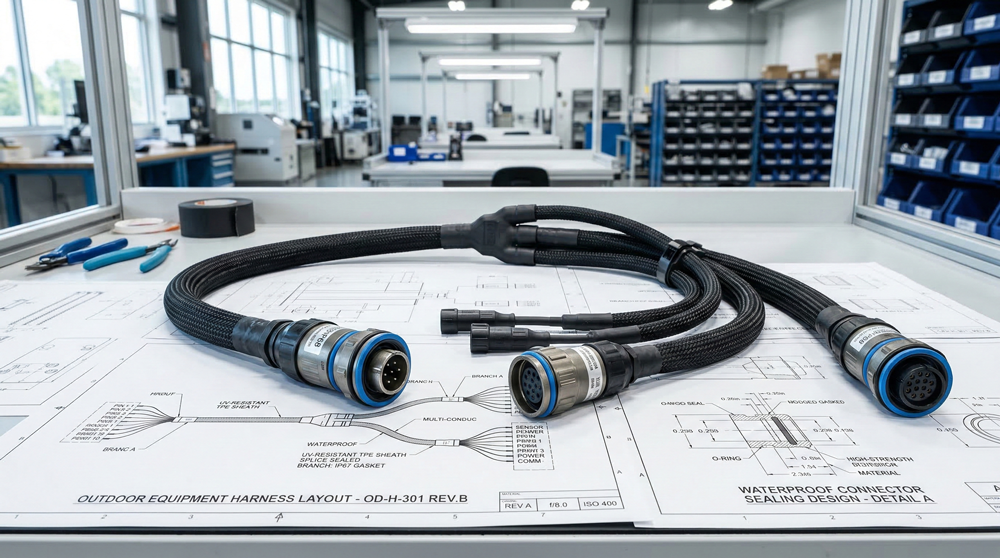
In practical B2B use, custom molded cables usually refer to cable assemblies in which a molded material is added around a termination area, junction, breakout, or connector interface to improve mechanical protection, environmental resistance, fit, and consistency. Many suppliers describe these products as molded, injection molded, or overmolded cable assemblies. Galaxy, for example, explicitly treats overmolded, molded, and injection-molded cable assemblies as closely related product forms, while MJM and other manufacturers position them as engineered solutions for demanding environments.
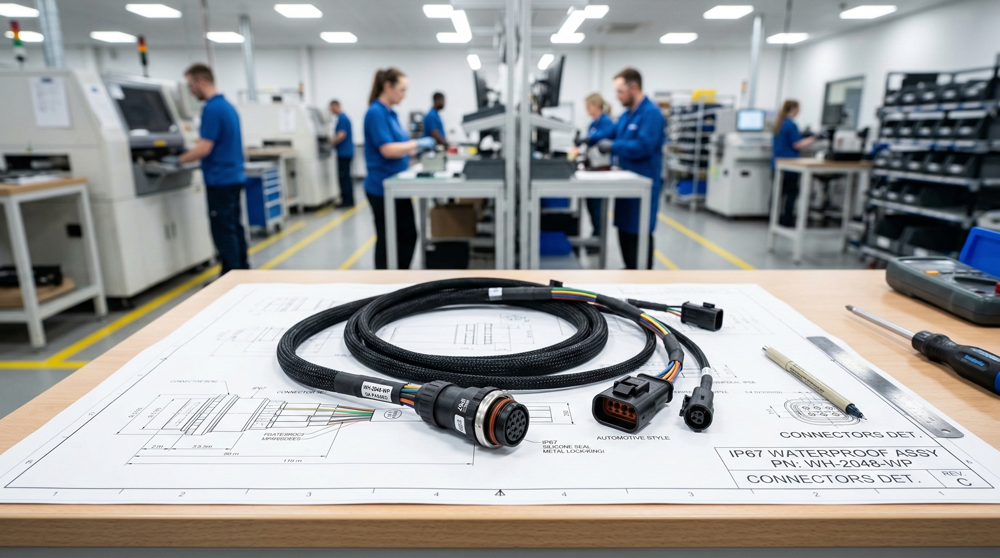
For OEM buyers, the most useful distinction is this: a standard cable assembly mainly depends on the connector, backshell, boot, and assembly workmanship, while a molded or overmolded design uses an added molding process to protect the termination zone, improve strain relief, and in some cases help support ingress protection targets such as IP67 or IP68 when the compound, cable, wire, and connector system are chosen correctly. That is why molded cables show up so often in industrial, medical, transportation, and other harsh-use applications.
When custom molded cables make sense
Custom molded cables make the most sense when the termination zone is the real risk point in the assembly. In many field failures, the problem is not the conductor itself. It is the repeated bending, pull force, vibration, fluid exposure, or connector-side handling that damages the cable near the transition point. Molded designs address that weak zone more effectively than a bare exit or a simple boot because they can distribute strain, reinforce the exit geometry, and create a more controlled interface between the cable and the connector body. Nortech highlights water resistance, abrasion protection, shock absorption, and strain relief as core advantages of molded cable assemblies, while Conwire and other suppliers also emphasize customization and service-life improvement.
This does not mean every custom cable should be molded. If the assembly lives in a benign indoor environment, sees limited handling, and does not need sealing or unusual strain relief, a standard custom cable assembly may be the better commercial choice. Buyers usually get the strongest return from molding when the application has one or more of these traits: repeated flexing, washdown or outdoor exposure, tight packaging constraints, visual branding requirements, frequent operator handling, or a high cost of field failure. That is the point where the added process becomes an engineering decision, not just a cosmetic one.
Molded vs overmolded vs standard assemblies
The terms are often mixed together in the market, but for sourcing decisions it helps to separate them.
| Type | Typical use case | Main advantage | Main limitation |
|---|---|---|---|
| Standard custom cable assembly | Indoor or lower-stress applications | Lowest upfront complexity and tooling burden | Less protection at the termination zone |
| Overmolded cable assembly | Connector rear area, strain relief, sealing, rugged exits | Better strain relief, cleaner geometry, stronger environmental protection | Added tooling, process setup, and validation work |
| Fully molded custom cable or molded junction | Complex breakouts, special shapes, integrated features, brand-specific form factor | Highest customization and product-specific fit | Highest development effort and higher non-recurring cost |
This framework reflects how current suppliers present the market: standard assemblies for simpler builds, overmolding for protected terminations and sealed exits, and more customized molded solutions for product-specific geometry, junctions, and ruggedized assemblies. Molex, MJM, and DC Electronics all position custom, overmolded, and sealed cable solutions as progressively engineered options rather than identical products.
Design factors that decide success
Cable jacket and mold compound compatibility
One of the most important design questions is whether the molding compound will properly adhere to the surface it is being applied to. Galaxy explicitly notes that this is the most important consideration in the molding process, because the wrong compound choice can undermine the structural integrity of the finished assembly. In plain terms, good molded cable design starts with materials compatibility, not with shape. A clean-looking overmold that does not bond well to the cable jacket will not deliver the reliability buyers expect.
For OEM teams, this means the cable material cannot be chosen in isolation from the mold material. If the program is still early, it is smarter to review the cable jacket, connector material, and molding compound together during design for manufacturability, instead of locking each part independently and hoping the supplier can “make it work” later.
Strain relief and bend behavior
Molding adds value when it improves the transition from rigid connector to flexible cable. The goal is not simply to make the rear of the connector thicker. The goal is to control bend radius, reduce stress concentration, and prevent repeated flex from migrating directly into the termination area. Nortech describes molded assemblies as reducing flex-induced stress on wires, connectors, and contacts, which is exactly why molded strain reliefs are often preferred in high-handling or high-vibration applications.
A good buyer review therefore asks how the cable will bend in actual use. Will the assembly hang under its own weight? Will operators pull on it at an angle? Will the cable exit straight, 45 degrees, or 90 degrees? Those decisions matter because the best mold geometry is driven by real use, not by what looks neat in a sample photo.
Sealing and environment
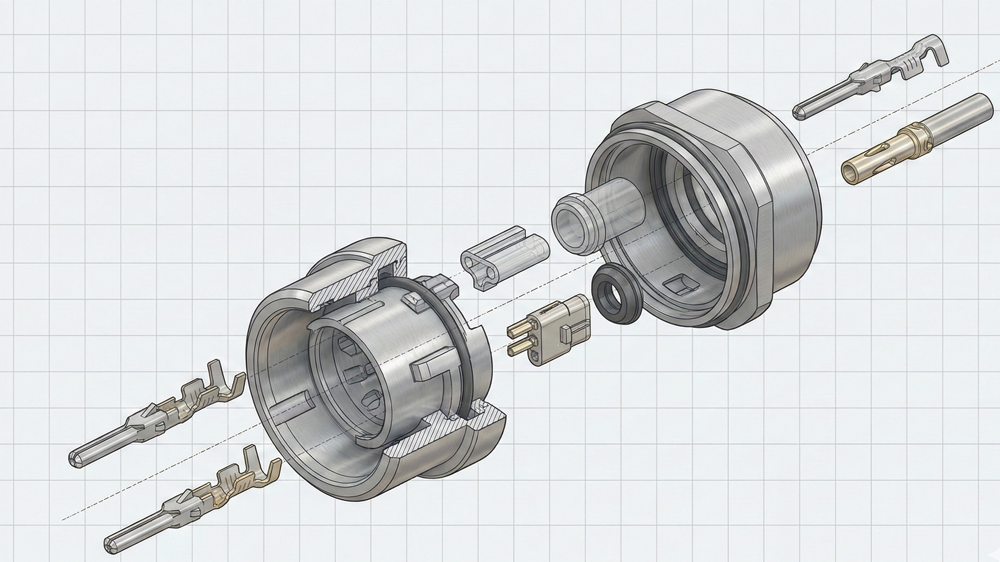
Many suppliers market molded cable assemblies for harsh or corrosive environments, and MJM specifically notes that customers seeking ingress protection such as IP67 or IP68 need the right combination of plastic compounds, cable, wire, and connectors. In other words, the molded shape alone does not create a sealed product. Sealing is a system outcome. The entire interface stack has to be designed for it.
For that reason, buyers should define the actual environment early. Outdoor rain exposure, chemical wipe-down, splash resistance, periodic washdown, oil contact, UV exposure, and true immersion risk are not interchangeable. A supplier can only recommend the right molded construction when the application language is specific.
Connector geometry and usability
A molded cable should also preserve the way the product is actually used. Large molded bodies can block latches, reduce finger access, interfere with panel clearance, or create cable routing problems in tight enclosures. This is one reason suppliers like Epec recommend form-and-fit checks, including 3D-printed model reviews before committing to hard tooling on more complex projects.
For B2B projects, this point is often underappreciated. A molded cable may pass electrical testing and still fail the application if it is awkward to install, difficult to unplug, or incompatible with surrounding hardware.
Material selection for custom molded cables
Material choice should be treated as a program decision, not a catalog checkbox. MJM lists a wide range of encapsulating and overmolding materials, including polyvinyl chloride, thermoplastic vulcanizate, thermoplastic rubber, thermoplastic elastomer, liquid crystal polymer, and Technomelt. The existence of so many options is the first signal that there is no single “best” molded cable material. The right compound depends on environment, flexibility, adhesion, appearance, and process needs.
From a buyer standpoint, material selection should start with use conditions. If the assembly needs a softer feel and flexible strain relief, that leads the conversation in one direction. If it needs stronger dimensional stability, different chemical resistance, or a more rigid feature set, that may lead in another. The important thing is to translate application language into material language. Instead of asking a supplier for “a strong overmold,” define the actual requirements: temperature range, handling pattern, exposure to oils or cleaners, color expectations, bend frequency, and whether the priority is flexibility, ruggedness, sealing, or cosmetics.
Tooling, NRE, and volume planning
This is the section many buyers underestimate.
Most custom molded cable projects involve non-recurring engineering, tooling, or both. Epec explains that hard tooling becomes costly to change once created, which is why they recommend form-and-fit checks such as 3D-printed models before committing to final tooling on appropriate projects. DC Electronics similarly positions in-house CNC mold creation and prototyping as a way to move from concept or drawing into prototype and then production.
For OEM buyers, the practical question is not whether tooling exists. It is whether the project economics justify custom tooling now, later, or not at all. If the program is early, volumes are uncertain, and the geometry is close to a common industry form, a supplier’s house tools may be enough to validate the concept with lower upfront cost. Epec specifically notes that dozens of existing house overmold tools can eliminate or reduce NRE in some cases, and their broader guidance also notes that house tools are often available for common connector types.
Once geometry becomes application-specific, however, custom tooling is often the right move. At that point buyers should confirm three things in writing: who owns the tool, what design revisions are included before rework charges apply, and whether the tool can be transferred if the program later moves to another manufacturer. Epec notes that tool ownership is often determined by the contract, and that paying NRE alone does not automatically guarantee customer ownership. That detail matters a great deal for long-life OEM programs.
Prototype and validation
A custom molded cable should not move from sample approval to mass production on appearance alone. The validation plan should reflect how the assembly will fail in the real world.
UL Solutions describes cable and connectivity evaluation in terms of electrical, mechanical, environmental, and interoperability requirements, while IPC and WHMA position IPC/WHMA-A-620 as the widely used industry-consensus standard for cable and wire harness requirements and acceptance. Together, those two points support a simple rule for buyers: molded cable validation should combine workmanship acceptance with application-specific performance testing.
In practice, that usually means reviewing the sample in three layers. First, verify form and fit. Second, verify workmanship, dimensions, labeling, and assembly quality. Third, verify application performance, which may include continuity, dielectric or insulation checks where required, pull or retention checks, environmental exposure, connector mating checks, and flex-life or handling simulation if the product will be repeatedly moved in use. A molded cable that looks excellent but has not been validated against actual handling and environment is still an incomplete approval.
Common failure modes buyers should prevent
The most common molded cable problems are usually preventable. They include poor adhesion between mold and cable jacket, inadequate strain relief geometry, oversized molding that interferes with installation, sealing assumptions that were never actually validated, and drawing packages that do not define critical dimensions around the molded area. These failure modes are consistent with the issues highlighted across supplier guidance: adhesion is a key technical risk, sealing depends on the full system rather than the mold alone, and fit checks should happen before final tooling is locked.
That is why strong buyers do not treat molded cables as “commodity plus rubber.” They treat them as a controlled electromechanical component with mechanical, material, and application interfaces that all need review.
How OEM buyers should choose a molded cable supplier
A good molded cable supplier does more than confirm that they have presses. Buyers should look for four capabilities.
First, they should be able to discuss design trade-offs clearly. If the supplier cannot explain why one exit angle, material family, or strain-relief profile is better than another, they are probably acting as a fabricator rather than an engineering partner.
Second, they should have a workable prototype path. DC Electronics emphasizes in-house engineering, custom mold creation, and prototype support, and Epec highlights form-and-fit modeling and house tools to lower risk before final tooling. Those are the kinds of capabilities that reduce redesign loops.
Third, they should show process discipline. IPC/WHMA-A-620 is widely used by OEMs and EMS companies as a foundation for cable and wire harness performance and acceptance, so buyers should understand how the supplier applies workmanship standards, inspection criteria, and test flow in real production rather than only in sales language.
Fourth, they should be commercially clear. Tool ownership, revision policy, minimum order quantity logic, lead-time assumptions, and ongoing support for engineering changes should all be visible before the program is awarded. In molded cable work, ambiguity in those areas often becomes more expensive than the quoted assembly price.
What to send in an RFQ
A strong request for quotation for custom molded cables should include the cable construction, connector part numbers, target molded area, cable exit direction, use environment, expected annual volume, initial build quantity, test requirements, labeling and packaging needs, and any specific fit constraints around panels, housings, or mating hardware. If you have 2D drawings, 3D files, or installation photos, include them early.
This is also where your internal links can help conversion on-site. In a live website article, it is natural to route readers from molded cable topics into related solution pages such as custom cable assemblies, OEM wire harness supplier, and cable assembly testing. That improves topic depth for readers and keeps the article aligned with transactional search intent.
Final view
Custom molded cables are not automatically the right answer, but they are often the right answer when reliability depends on the connector-to-cable transition, the environment is demanding, or the assembly needs a repeatable and application-specific form factor.
For B2B buyers, the strongest approach is simple: start with the real failure risk, not with the mold shape. Define the environment, the handling pattern, the fit constraints, the validation plan, and the expected program volume. Then choose a supplier that can connect material selection, tooling strategy, and production control into one coherent recommendation.
That is how custom molded cables stop being a “nice-looking option” and become a solid OEM engineering decision.
FAQ
What is the difference between custom molded cables and overmolded cable assemblies
In everyday B2B usage, the terms often overlap. Overmolded cable assemblies usually describe added molding around a connector or termination area, while “custom molded cables” can be used more broadly for product-specific molded features, junctions, or integrated cable forms.
When is custom tooling worth paying for
Tooling is usually worth it when the geometry is application-specific, expected volumes justify the upfront cost, and the molded design solves a real performance or installation problem. Earlier-stage or lower-volume programs may be able to start with house tools or prototype checks first.
Can custom molded cables support IP67 or IP68 goals
They can, but the result depends on the complete system design, including the compound, cable, wire, and connector combination. The mold alone does not guarantee sealing.
What should I validate before approving production
At minimum, confirm form and fit, workmanship quality, and application-specific electrical, mechanical, and environmental performance that reflects real use conditions.
What should I ask a supplier before placing an order
Ask about material compatibility, tooling approach, prototype method, inspection standards, test coverage, tool ownership, revision policy, and how engineering changes are handled after approval.
CTA
If your project involves custom molded cables, send your drawings, cable specifications, connector part numbers, application photos, and target quantities first. A qualified supplier should be able to review manufacturability, recommend the right molding strategy, and tell you whether house tooling, prototype molding, or full custom tooling makes the most sense before you commit to production.
Related articles
Custom cable assemblies for OEM projects
How to choose an OEM wire harness supplier
Cable assembly testing for production approval