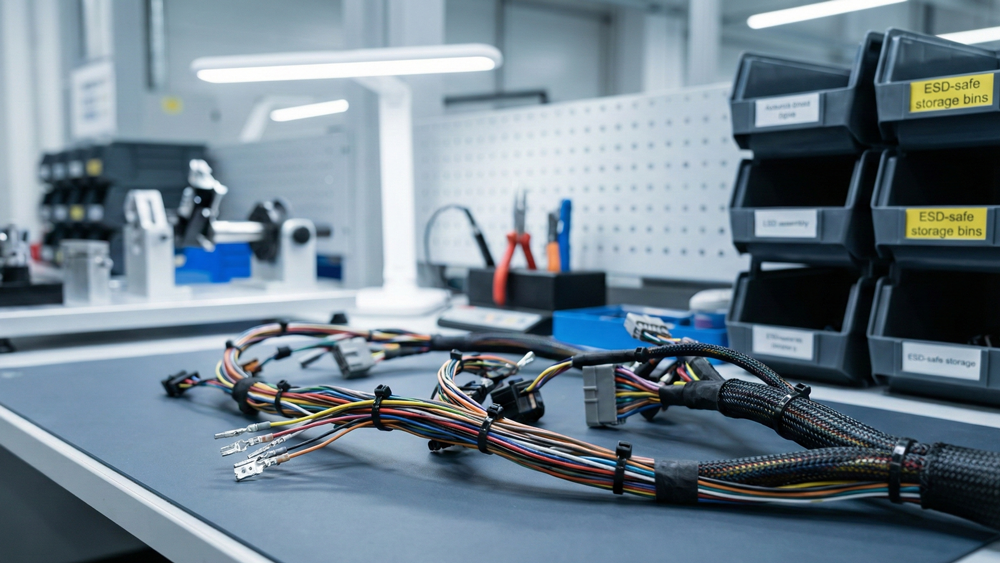
This crimp quality inspection guide is designed to help engineering and procurement teams define objective acceptance criteria, enforce consistent inspection discipline, and reduce “hidden” termination risk in outsourced cable assemblies. Crimp quality is not only about whether a termination passes today; it is about whether the connection remains stable after vibration, thermal cycling, humidity exposure, and repeated mating. Inspection is your fastest lever for reducing field failures because it catches variation before it becomes warranty cost.
If you have not standardized the upstream termination requirements yet, start with the cluster hub article, Crimping and Termination Guide for Cable Assemblies. This S1 guide focuses on inspection execution: what to check, how to document it, and how to make supplier evidence comparable across lots and programs.
Table of Contents
ToggleCrimp inspection goals
Most sourcing teams ask suppliers to “inspect crimps,” but the outcome varies widely because the request is too vague. A useful inspection system must accomplish three goals.
First, it must detect process drift quickly. A crimping process can produce visually acceptable results while gradually shifting out of its optimal compaction window due to tool wear, press shut-height changes, or wire variability. Inspection should surface that drift before it becomes an intermittent electrical fault.
Second, it must provide objective acceptance criteria that are transferable across operators and shifts. If inspection depends on one “expert” inspector, the process is not scalable and the risk is not controlled.
Third, it must generate evidence that is meaningful for B2B buyers. Procurement and supplier quality need more than “PASS” stamps. You need records, photos, and measurement logs that can be traced to lots and change events.
A mature supplier will align inspection with their broader verification discipline described under Tests & Inspections, then integrate it into a practical shop-floor flow.
Inspection layers in a cable assembly program
Crimp inspection is not a single gate at the end. It works best as layered verification at four points: incoming material checks, setup verification, in-process monitoring, and final acceptance.
Incoming material checks confirm that what you are about to crimp is actually within spec. If wire stranding, insulation hardness, or terminal plating is different from what the process was qualified on, inspection at the crimp station becomes reactive instead of preventive. Incoming checks do not need to be heavy, but they should be defined and repeatable.
Setup verification is where most defects are cheapest to fix. The first-off pieces after setup should be inspected using a higher intensity protocol, then approved and documented before production continues. This is also where you capture photo references that later help train inspectors and resolve disputes.
In-process monitoring is your drift detector. A stable process still drifts over time, especially on long runs. In-process checks should focus on the few metrics that predict reliability, such as crimp height, strip length, and seating verification. Monitoring frequency should be based on program risk and run length rather than an arbitrary “once per shift.”
Final acceptance provides lot-level evidence that the program shipped within the agreed inspection regime. For buyers, final acceptance is less about catching defects and more about documenting compliance and traceability.
If you are outsourcing assemblies, you can align these layers with your supplier’s production model for Cable Assemblies and Custom Cable Assemblies so scope and responsibilities are clear.
Defect prevention starts with clear workmanship standards
Many disputes come from unclear workmanship baselines. Engineering teams often reference IPC/WHMA-A-620, which stands for IPC/WHMA-A-620, a workmanship standard for cable and wire harness assemblies. Even when you use that standard, you still need to define what you will measure, how you will measure it, and what evidence is required.
A practical approach is to define a small set of Critical to Quality items, abbreviated as CTQ, and hold those CTQs to measurable acceptance limits. CTQs are the items most likely to drive reliability and field cost if they drift. Crimp height is often one CTQ, but it should not be the only one.
When the standard is used as a reference, your inspection guide should translate “acceptable workmanship” into program-specific criteria that the supplier can execute and document.
Crimp visual inspection criteria
Visual inspection is fast, inexpensive, and surprisingly effective when criteria are clear. The problem is that many suppliers perform visual inspection as a subjective “looks okay” decision. Your goal is to make visual inspection structured, repeatable, and tied to the geometry that actually correlates with reliability.
For conductor crimp geometry, inspectors should confirm that the conductor wings are formed symmetrically and that the crimp is centered on the conductor barrel. Off-center forming is a common root cause of inconsistent compaction, reduced pull strength, and premature fatigue.
Bellmouth formation should be present where expected. Bellmouth is the slight flare at the entry and exit of the crimp that helps avoid sharp edges cutting strands. Too little bellmouth can increase stress concentration and strand damage. Too much can indicate incorrect forming or wire positioning.
Conductor brush length should be within your defined range. Conductor brush refers to strands protruding slightly beyond the conductor crimp. A small brush can indicate correct strip length and proper strand capture. Excessive protrusion can cause shorts or interfere with insertion. No brush at all can also signal strip length or positioning problems, depending on terminal design.
Cut-off tabs must not present sharp edges that can cut insulation or interfere with seating. Cut-off tab issues are often a tooling condition problem and a good signal for maintenance needs.
For insulation support, inspectors should confirm that the insulation support crimp grips the insulation jacket as intended without cutting through it and without leaving the wire loose. The insulation support crimp does not carry electrical load, but it often determines whether the termination survives vibration and bending. A perfect conductor crimp can still fail if the insulation support does not provide mechanical stability.
If you produce sealed assemblies, visual inspection must also include seal condition and placement. Seal damage and improper compression can be hard to detect after full insertion, so inspection must be designed around the assembly flow, not added later as an afterthought.
If your assemblies include shielding, inspection criteria must define how shielding is handled and where it is terminated. The geometry and cleanliness around shield termination can affect both electrical performance and long-term corrosion behavior. Programs with higher noise sensitivity often align these details to product categories like Shielded Cable Assemblies.
Crimp height check method
Crimp height measurement is the most common dimensional check, but the value depends on measurement discipline. To make crimp height meaningful across suppliers and programs, define the method in your inspection guide.
Start by tying the target range to terminal manufacturer guidance or a validated internal spec. Then define where the measurement is taken. Different terminals and crimp profiles require the micrometer to contact specific surfaces. If inspectors measure at slightly different locations, the data becomes noise rather than insight.
Define tool control and calibration. A micrometer that is not calibrated or not used consistently can create false “process drift” signals or hide real drift. If you reference Measurement System Analysis, abbreviated as MSA, explain that MSA is a method to confirm that measurement tools and operators produce reliable, repeatable readings.
Define sampling frequency and reaction rules. A crimp height check that is performed occasionally without reaction thresholds does not control the process. A practical rule is to define a warning band and an action band. When measurements trend toward the edge of the range, you escalate to increased frequency, tooling inspection, or setup re-check. When measurements exceed the action limit, you contain product, stop production, and initiate corrective action.
Define what happens when the wire changes. Wire insulation hardness and strand construction can shift the relationship between crimp height and reliability. If you change wire supplier or wire construction, you should require re-validation rather than assuming the same crimp height target remains correct.
Strip length and strand damage inspection
Strip length is a deceptively important parameter because it influences conductor fill, conductor brush, and insulation support capture. Too long and you risk exposed conductor and shorting. Too short and you risk insufficient conductor capture and lower pull strength.
Your inspection guide should define strip length targets and tolerances and should also define how strip length is measured. A simple gauge or standardized scale can be sufficient when used consistently.
Strand damage is a major reliability killer. Nicks reduce tensile strength and create fatigue crack initiation sites, especially under bending and vibration. Strand damage often originates at stripping, not crimping, so inspection should include a focused look at strand condition in first-article inspection and periodically during production.
If a program is high risk, consider adding a destructive check where the crimp is cut open at intervals to observe strand condition. This can be complemented by cross-section analysis, but you do not need cross-section analysis for every job. You need a risk-based plan.
Terminal seating verification
Many intermittent electrical faults are not crimp defects; they are seating defects. If the terminal is not fully seated in the housing, or if the secondary lock is not engaged, the contact interface can micro-move, increasing contact resistance and causing intermittent opens under vibration.
Your inspection guide should define seating verification methods that are feasible in production. Depending on connector design, this may include a tactile check, a visual confirmation of a witness window, a pull-back check on individual wires, or a defined gauge method. What matters is that the method is explicit and repeatable.
Seating verification should also be linked to rework rules. If a terminal is not seated, define whether it can be reseated, whether the terminal must be replaced, and how the housing is inspected for damage.
For sealed connectors, seating verification must account for seal compression. A terminal can be seated electrically but still fail environmentally if seals are damaged or not properly positioned.
Crimp cross-section analysis
Cross-section analysis is the most informative destructive inspection method because it shows how strands are compacted and how the barrel wings are formed relative to the conductor. Cross-section is not always required, but it is extremely useful in three scenarios: qualification, major process change, and recurring field failures.
During qualification, cross-section validates that the process produces the intended compaction and that strands are not being cut, folded improperly, or left uncompressed. It also helps set realistic crimp height targets when terminal supplier data is incomplete or when the application risk is high.
During major process changes such as new wire construction, new terminal plating, or new applicator tooling, cross-section provides a direct view of whether the new configuration still produces a stable gas-tight interface.
During recurring field failures, cross-section helps separate contact-related failures from mechanical fatigue failures. When paired with contact resistance trending, it can narrow root cause quickly.
In your guide, define cross-section sampling rules and what evidence is captured. A few standardized photos with labels can dramatically improve supplier-buyer alignment. If your supplier claims they can perform this analysis routinely, it should be reflected in their inspection capabilities and the supporting evidence under Tests & Inspections.
Pull testing as an inspection companion
Pull testing is not a substitute for geometric inspection, but it is a powerful companion because it tests the mechanical integrity of the termination system. Pull strength can be influenced by strip length, strand damage, compaction, and insulation support. It can also expose seating problems when applied carefully.
Your inspection guide should clarify when pull testing is used and how results are interpreted. For example, a pull failure at the conductor suggests a different root cause than a pull failure at the insulation or a terminal pull-out from the housing. The failure mode matters as much as the force value.
If you want a standardized pull methodology for supplier audits and validation, use the companion cluster article Pull Force Test Guide for Cable Assemblies. Even if you do not run pull tests on every lot, defining the method upfront improves supplier accountability and reduces argument in corrective action cycles.
Contact resistance checks and drift detection
Continuity tests are necessary, but they do not tell you whether resistance will remain stable. Contact resistance, or the resistance at the contact interface, is sensitive to compaction quality, seating, contamination, and corrosion. Many field returns involve resistance drift rather than immediate opens.
In a B2B sourcing context, you often do not need to run contact resistance checks on every assembly. What you need is a plan that links contact resistance checks to risk triggers. You may run contact resistance checks during qualification, after major changes, or when in-process indicators suggest drift.
Your inspection guide should define how contact resistance is measured, at what current, with what fixtures, and with what acceptance logic. If you want a focused, practical approach, link to the companion article Contact Resistance Testing Guide.
Sampling plan and AQL discipline
A sampling plan turns inspection from “best effort” into an enforceable system. Many suppliers use AQL, which stands for Acceptable Quality Limit, a statistical sampling approach to determine how many units are inspected from a lot and what number of defects triggers rejection.
For high-risk terminations, sampling plans often blend attribute sampling with periodic variable measurements. Attribute sampling is pass-fail inspection for visible defects. Variable measurements include crimp height and strip length. Combining both can give better protection without excessive cost.
Your guide should define how lots are formed. If the lot definition is unclear, sampling becomes meaningless. A lot might be defined by a production shift, a wire lot, a terminal lot, or a work order. The best definition depends on where variation is most likely.
Your guide should also define defect categories. In many programs, you will classify defects as critical, major, or minor. A critical defect is one that can cause safety issues or immediate failure. A major defect affects function or reliability. A minor defect affects appearance but not performance. The classification drives sampling severity and escalation.
Below is a practical table you can adapt into supplier agreements. It is deliberately conservative for terminations because termination failures are often expensive.
| Defect category | Typical examples in crimping | Supplier action | Buyer impact |
|---|---|---|---|
| Critical | Exposed conductor short risk, missing seal in sealed system, terminal not seated and cannot lock | Stop ship, contain lot, 100% sort | Lot rejection likely |
| Major | Out-of-range crimp height, strand damage, insulation support missing, damaged seal | Contain, corrective action, increased sampling | Rework or rejection |
| Minor | Cosmetic marks, non-functional scuffs, minor cosmetic terminal marks | Monitor, trend | Accept with note |
Even with AQL, you should keep first-article inspection strict. AQL is not designed to compensate for a poor setup. It is designed to monitor stable production.
First-article inspection package
A consistent first-article inspection package reduces disputes and prevents “tribal knowledge” from becoming your quality system. A good first-article package for crimping should include: crimp height logs, strip length checks, visual geometry photos, seating verification method confirmation, and any special checks for seals or shielding.
For complex programs, include a reference photo set that defines acceptable and unacceptable conditions. The goal is to make inspection teachable. When the supplier trains a new inspector, they should be training to your shared reference, not to a personal preference.
If your program needs fast turnaround, the ability to run rigorous first-article inspection quickly becomes a competitive advantage. This is one reason buyers value suppliers that advertise structured process discipline such as Flexible Manufacturing and Quick Turn Available. Speed without inspection discipline is a risk multiplier.
In-process inspection frequency and reaction rules
The biggest mistake in crimp inspection is checking too infrequently and reacting too slowly. In-process inspection should be designed to detect drift before it becomes a lot-wide defect.
A practical approach is to define check frequency based on run length, tooling risk, and application risk. For example, high-current assemblies, safety-related circuits, or harsh environment assemblies may require more frequent checks. The key is that frequency is not arbitrary; it is tied to risk.
Reaction rules should be explicit. Define what triggers a process pause, what triggers increased sampling, what triggers applicator inspection, and what triggers re-validation. Define what evidence is captured during the reaction so that corrective action has data, not speculation.
If your supplier uses Statistical Process Control, abbreviated as SPC, explain that SPC is a method of tracking process measurements over time to detect trends and out-of-control conditions. Even basic SPC charts for crimp height can provide early warning and reduce scrap.
Documentation and traceability buyers should request
Inspection is only as valuable as the evidence it produces. In B2B sourcing, you are often managing multiple suppliers or multiple programs, and you need comparable evidence across them.
At minimum, request traceability for wire lot, terminal lot, applicator ID, press settings, and first-article sign-off. Then request inspection logs tied to those identifiers. When a defect occurs, you want to be able to answer quickly: which lots are affected and why.
Photographic evidence should be standardized. Define lighting, magnification, and labeling. A small investment in standard photos can cut weeks off failure investigations.
If your supplier offers “quality guarantees,” you want to see the operational practices behind the claim. Their published commitments under Quality Guarantee and Quality Policy should match what you see in inspection records and reaction discipline. When those align, procurement risk drops significantly.
Supplier corrective action and failure analysis loop
Even with good inspection, defects will occur. The difference between a mature supplier and an immature one is the corrective action loop.
If you require formal corrective action reports, define the format. Many programs use 8D, which stands for Eight Disciplines, a structured problem-solving approach. Others use CAPA, which stands for Corrective and Preventive Action. What matters is that the report identifies root cause, verifies containment, defines corrective action, and validates that the action works over time.
Your inspection guide should make failure analysis easier by requiring that defect data is captured in a consistent taxonomy. If defects are recorded inconsistently, root cause analysis becomes guesswork.
For recurring issues, connect inspection data back to process risk tools. PFMEA, which stands for Process Failure Mode and Effects Analysis, is a structured way to identify where failures can occur and what controls prevent them. When inspection data shows a recurring failure mode, PFMEA and the Control Plan should be updated, and the update should show up on the line.
If you are evaluating a partner for high-reliability programs, strong engineering support and transparent process thinking matter as much as production capacity. This is the type of capability many buyers look for under pages such as Strong Technical Support and Why Choose Us.
Practical inspection checklist for RFQs and audits
To help you translate this guide into sourcing action, here is a compact checklist you can embed into RFQs or supplier audits. Use it as a conversation structure, not as a bureaucratic form. The goal is to make the supplier show evidence and explain reaction rules.
| Audit question | What a strong answer looks like | Risk if missing |
|---|---|---|
| How do you verify setup before production? | First-article package with photos and measured logs | Lot-wide defects from bad setup |
| How do you control crimp height measurement? | Defined method, calibrated tools, reaction thresholds | Measurement noise hides drift |
| How do you detect strand damage? | Stripping audits, magnified checks, clear criteria | Fatigue failures and pull failures |
| How do you verify terminal seating? | Explicit method and 100% check definition | Intermittent contact failures |
| How do you handle sealed systems? | Seal handling standard, insertion verification, evidence | Corrosion and resistance drift |
| How do you form lots for sampling? | Lot definition tied to key variation drivers | Sampling becomes meaningless |
| What is your out-of-control process? | Stop, contain, sort, root cause, validate fixes | Repeat defects and late discovery |
When the supplier can answer these questions with evidence, inspection becomes a control system rather than a promise.
Conclusion
A strong crimp inspection system makes termination quality measurable, transferable, and enforceable. It combines clear visual criteria, disciplined dimensional checks, seating verification, and risk-based destructive validation when needed. For procurement, it creates comparable evidence across suppliers. For engineering, it prevents drift and reduces costly failure loops. Most importantly, it turns “we inspect crimps” into a documented process that can be audited and improved.
If you want the full cluster view, connect this guide back to the hub article Crimping and Termination Guide for Cable Assemblies and plan validation topics using the related articles listed below.
FAQ
What should we inspect on every crimped termination?
At minimum, verify strip length, basic geometry, insulation support capture, and terminal seating. Add crimp height checks at defined intervals and treat drift as a process signal.
Is crimp height enough to guarantee reliability?
No. Crimp height is a strong indicator of compaction, but seating, strand condition, seal integrity, and strain relief often determine field performance.
When is cross-section analysis worth the cost?
Cross-section analysis is most valuable for qualification, major changes, and recurring failures. It provides direct insight into compaction and strand condition that visual inspection cannot fully confirm.
How do we prevent inspection subjectivity between suppliers?
Define measurable criteria, standard photo references, controlled measurement methods, and explicit reaction rules. Require evidence packages that are comparable lot to lot.
Should we use AQL sampling for crimps?
AQL sampling can be effective when lots are clearly defined and the process is stable. For high-risk programs, combine attribute sampling with variable measurements like crimp height.
CTA
If you want a supplier-ready crimp inspection specification, share your connector part numbers, wire specs, and application environment. We can help you define acceptance criteria, sampling, and evidence requirements that match your risk level and production volume.
- Learn how we build and verify assemblies: Tests & Inspections
- Review our quality commitments: Quality Guarantee and Quality Policy
- Discuss your program with our team: Contact
Related articles
- Crimping and Termination Guide for Cable Assemblies
- Pull Force Test Guide for Cable Assemblies
- Contact Resistance Testing Guide
- Termination Failure Modes Guide