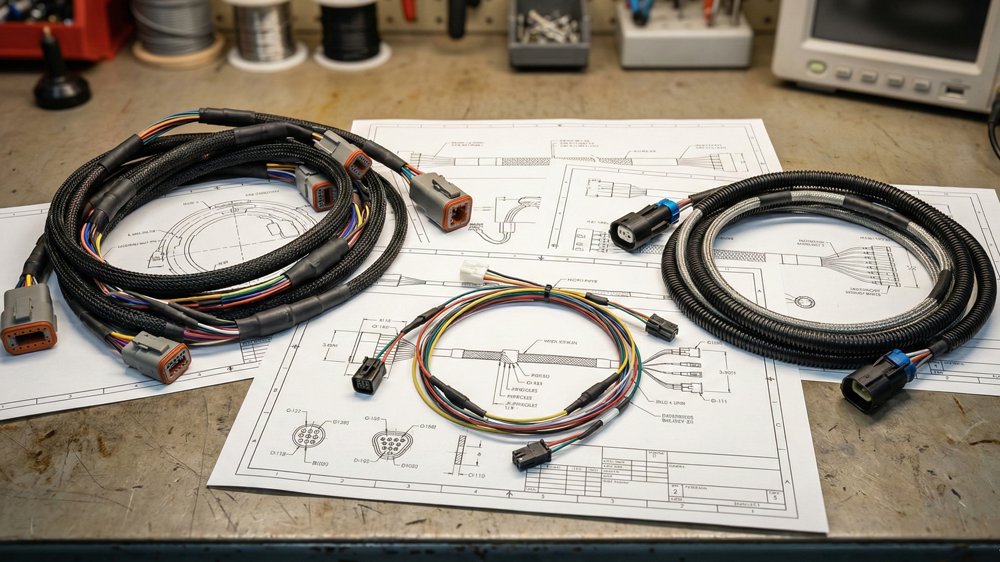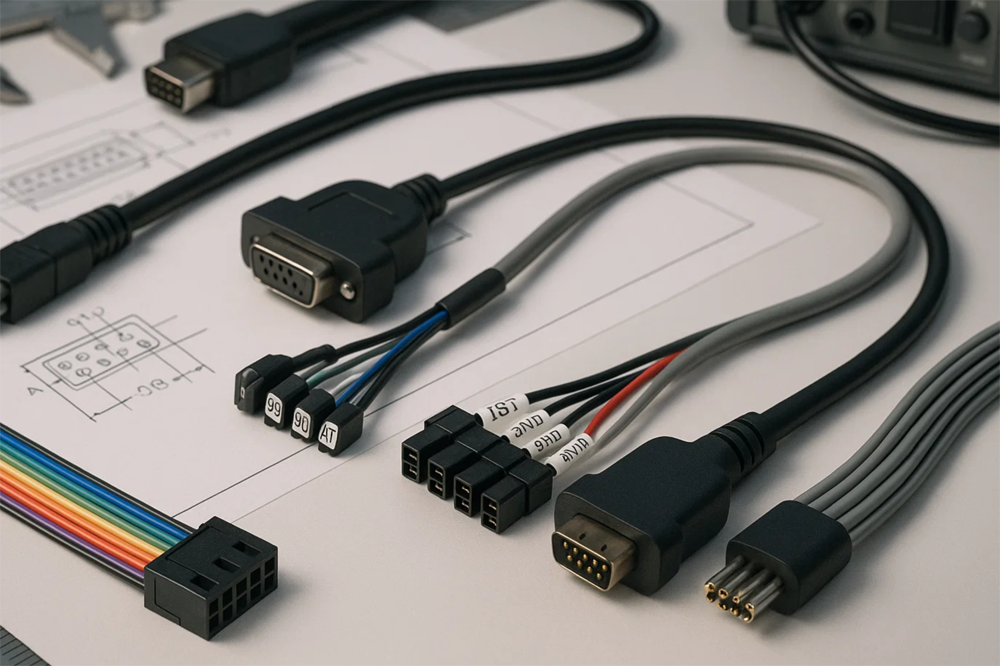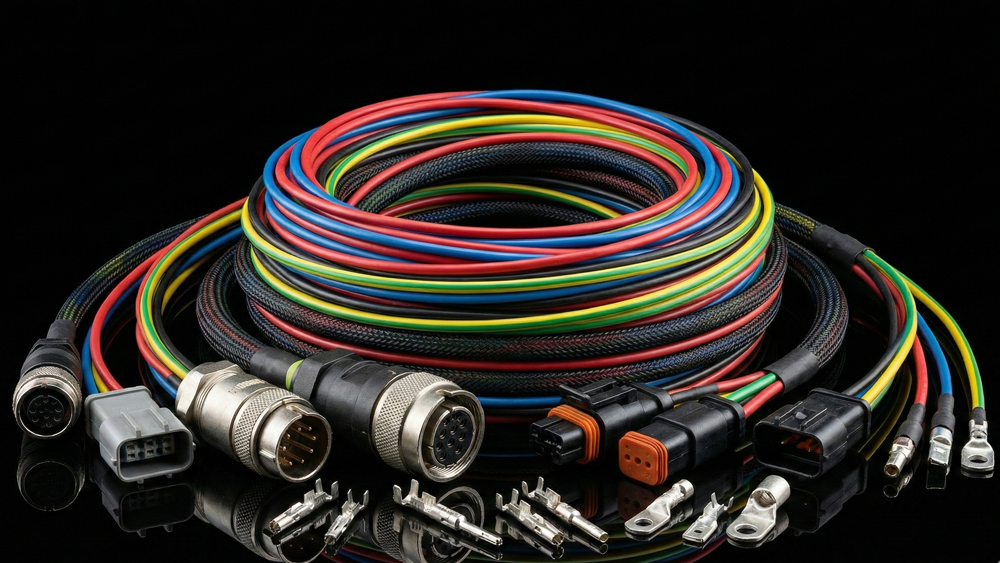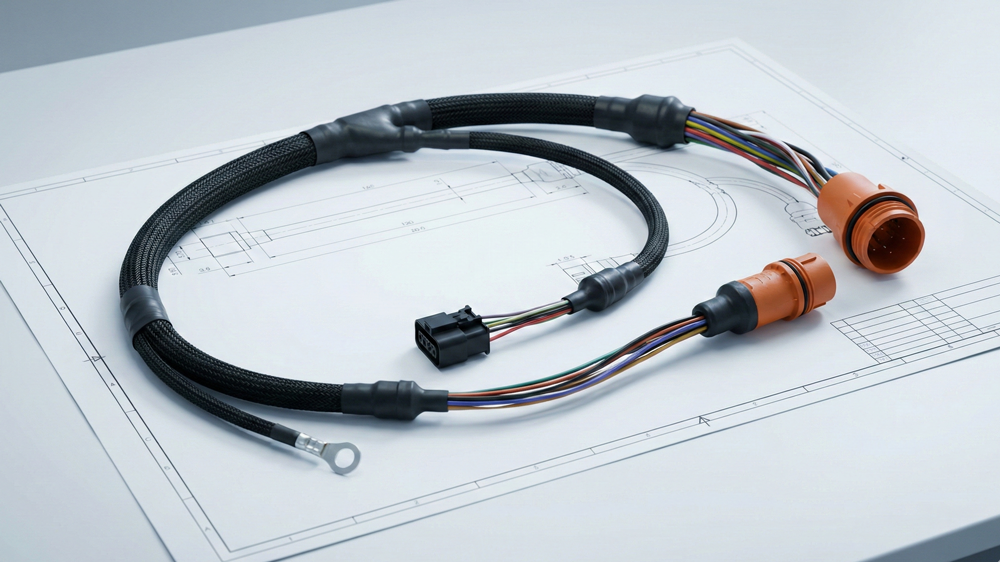
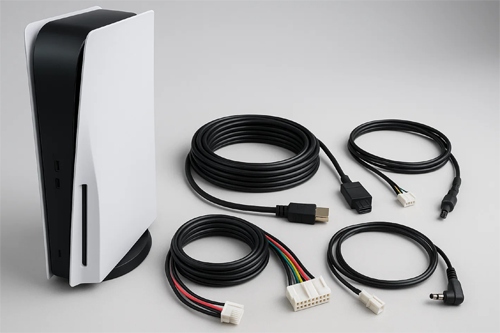
Industrial automation cables live in a world that looks nothing like a lab. They run through cable carriers, flex thousands of times, sit next to motors and drives, get sprayed with oil mist, vibrate, and then get unplugged and re-plugged during maintenance when someone is trying to restore a line at 2 a.m. In that reality, a control cable assembly is not just “a cable with connectors.” It’s part of the reliability system of your machine.
This is why procurement teams who source control cables often learn the hard way that basic continuity testing is not enough, and that “looks correct” is not a reliable acceptance criterion. Failures in control cable assemblies are frequently intermittent: a conductor that opens only when bent, a shield connection that degrades under vibration, or a connector that loosens over time. Those failures are expensive because they masquerade as “random machine behavior.”
This guide shows you how to specify and test control cable assemblies for industrial automation in a way that reduces those failure modes. We’ll focus on the common 24V sensor/actuator ecosystem (PLC I/O), and also cover motion-control and drive-adjacent cables where noise immunity and flex life matter. If you already have drawings and want a quote, submit through Custom Cable Assemblies. If you want to align scope first, start with Cable Assemblies, and use Industrial Robotics as a reference point for the environment assumptions this article addresses. For verification expectations, keep Tests & Inspections in view—because in automation, quality is mostly about controlled process + controlled tests.
Table of Contents
ToggleWhat counts as a control cable assembly in automation procurement
In practice, “control cable assembly” usually means a cable that carries low-voltage control signals or sensor feedback between subsystems: sensors to I/O blocks, I/O blocks to PLC cabinets, encoders to drives, brakes to controllers, limit switches to junction boxes, and similar interconnects. Many are 24V DC circuits, but the assembly environment and mechanical behavior (movement, vibration, abrasion) often dominate reliability more than the nominal voltage.
Control cable assemblies differ from simple power leads because they are often noise-sensitive. They may run next to motor power cables or VFD outputs. They may need shielding, correct grounding strategy, and careful termination. They also differ from RF cables: the core risk isn’t impedance control at high frequency; it’s preventing intermittent opens, ensuring stable shielding effectiveness, and keeping connectors mechanically stable through motion and service cycles.
If your program includes multiple types of cable assemblies—overmolded, RF/coax, ribbon, and control—the capability checklist in Cable Assembly Manufacturers and the dedicated verification flow in Tests & Inspections can help standardize supplier expectations across categories.
The real failure modes in control cable assemblies (what you’re actually trying to prevent)
Most control-cable problems are avoidable when you target the correct failure modes. The most common ones are mechanical and process-driven, not theoretical electrical issues.
One failure mode is conductor fatigue near the connector exit. This happens when the cable bends repeatedly at a tight radius near the connector body, especially in cable carriers or moving arms. The assembly may pass continuity at shipment and fail later when flexed. The prevention strategy is strain relief design and bend management, not “better copper.”
Another failure mode is connector loosening under vibration. In automation, vibration and machine movement can back off threaded couplings or degrade contact stability. The prevention strategy is the correct connector type for the environment and correct assembly torque/locking methods where applicable, plus inspection discipline.
A third failure mode is noise injection or unstable sensor reading caused by shielding issues. In many factories, control cables share trays with noisy power cables. If the shield termination is poor, or if grounding strategy is inconsistent, you can get “ghost” faults that cost hours of debugging. The prevention strategy is correct shield termination and clear definition of what “shielded” means in your build.
A fourth failure mode is mis-installation. Maintenance teams rely on labels and physical differentiation to replace cables correctly. If the cable assemblies are not labeled, keyed, or traceable, field errors rise—even when the cables themselves are perfect. The prevention strategy is variant control and labeling as part of the product requirement, not “nice to have.”
The specification framework: how to write an RFQ that produces stable quotes
A control cable RFQ becomes much easier when you separate requirements into five layers: connector interface, cable construction, mechanical environment, electrical requirements, and verification.
1) Connector interface: define mating and coding, not just “M12”
In automation, connector families like M8/M12 are common, but “M12” alone is not a complete definition. You should define pin count, coding (where relevant), straight vs right-angle geometry, and whether the connection must be field-serviceable. If the cable mates to a specific device port, include that device’s connector interface requirements or part numbers.
If you can specify connector part numbers, do it. If you can’t, specify mechanical constraints: space envelope, cable exit direction, clearance needs, and whether a locking mechanism is required. The goal is to avoid substitutions that “fit” but don’t behave the same under vibration or handling.
If your assembly needs robust strain relief at the connector exit, consider whether a molded boot or overmolding is required. Overmolding is not always necessary, but when durability is critical, it can reduce early failures and standardize mechanical protection. Your internal overmolding scope page Overmolding Services provides the natural link point for that discussion.
2) Cable construction: jacket material and flex rating often matter more than gauge
Many automation buyers focus on conductor gauge and pin count. Those matter, but cable life in moving equipment is often determined by jacket type, flex rating, and how the cable is constructed to survive repeated bending.
If your cable runs through a drag chain/cable carrier, define that explicitly. A “flexible” cable in marketing terms may still fail if it’s not designed for continuous flex. If your environment includes oils, coolants, or chemical exposure, specify jacket requirements; PUR jackets are commonly referenced in industrial environments for oil resistance, but the real requirement is chemical compatibility in your specific environment.
If the cable must survive abrasion, define the abrasion context. If it runs through cable carriers, abrasion can happen at contact points and edges. In those cases, mechanical protection (sleeving, routing strategy) becomes part of the design.
For buyers who want a consistent way to communicate materials, Cable Wiring Materials is the natural internal reference so your spec language doesn’t vary from project to project.
3) Mechanical environment: bend radius, movement pattern, and vibration conditions
This is the layer many RFQs omit—and it’s why control cables fail later. If the cable is static inside a cabinet, your risk profile is different from a cable that flexes with every machine cycle.
Define whether the cable is static, occasionally moved, or continuously flexed. If continuously flexed, define approximate bend radius and cycle expectation if you have it. You don’t need perfect numbers; you need the reality: “runs in a cable carrier” is already far better than silence.
Also define any vibration or shock expectations. A cable near a motor or moving mechanism will see different conditions than a cable in a protected control cabinet.
If your applications look like robotics, referencing Industrial Robotics helps buyers self-identify that flex and durability assumptions should be higher.
4) Electrical requirements: 24V signals, sensors, and noise immunity
For many PLC I/O systems, the control signals are 24V DC and relatively low current. That can create a dangerous illusion that the assembly is electrically “easy.” In reality, the hard part is often noise immunity and reliable contact under motion.
If the cable runs near VFD outputs or motor power cables, specify whether shielding is required and what the grounding strategy is. If your sensors are analog or low-level signals, noise sensitivity increases. If your system uses encoders or feedback lines, shielding becomes even more important.
A supplier who understands industrial control cables will ask about these contexts rather than quoting blindly. If they do not, you can still get a quote—but you might not get a cable that survives in your real environment.
5) Verification: define tests that match failure modes (continuity is necessary, not sufficient)
For control cable assemblies, the baseline is usually continuity and short testing. But for many automation programs, you also care about insulation integrity, especially if cables run through harsh environments or near higher voltage systems. In those cases, insulation resistance or hipot may be relevant. The correct test set depends on application and risk, but the key is to define “tested” as a deliverable rather than an assumption.
If your biggest risk is intermittent opens from flex, electrical tests at shipment cannot fully guarantee life performance. However, you can reduce risk by requiring correct strain relief design and workmanship standards, and by validating flex performance in a representative way if your program is sensitive.
This is where your proof page Tests & Inspections supports buyer trust. It frames testing as a controlled workflow, which is exactly what automation buyers want to see.
Control cable testing: what to ask for and when to ask for it
Rather than asking “Do you test 100%,” a better procurement question is: “What tests do you run for this failure risk profile?”
If your cable is a typical 24V sensor cable with low risk, continuity/short testing plus correct pin mapping may be sufficient—especially if the connector is keyed and the build cannot be assembled wrong. If your cable operates in oil/coolant environments or near higher voltage systems, insulation resistance and/or hipot testing can be relevant depending on customer requirements. If your cable is shielded and you care about noise immunity, you may want to define shield continuity expectations and ensure the termination method is controlled.
You don’t need to demand every possible test. You need to align the test plan with real failure modes and the cost of failure. A supplier should be able to discuss this rationally, and their capability should be visible through their testing workflow in Tests & Inspections and quality commitments in Quality Guarantee.
Labeling and traceability: the overlooked reliability lever in maintenance-heavy environments
Industrial environments are maintenance-heavy. Cables get replaced. Machines get upgraded. Lines get reconfigured. If your control cable assemblies are not labeled clearly, maintenance errors become a major hidden cost. A mis-plugged cable can look like a sensor failure, and troubleshooting time is often far more expensive than the cable itself.
If your program has multiple similar cables, specify labeling requirements explicitly: what information appears, where it appears, and how durable it must be. If you need traceability, define whether you need lot-level traceability or unit-level serialization. Many buyers assume traceability is “standard,” but it isn’t unless you require it.
From a supplier credibility standpoint, documentation and traceability expectations align naturally with quality system evidence like Certificates and broader discipline pages such as Quality Policy.
A sourcing checklist: how to qualify a control cable assembly manufacturer
If you’re qualifying suppliers, focus on whether they can talk concretely about your environment and failure modes, and whether they can translate that into process control.
A strong supplier will ask about movement (static vs carrier), environment (oil, abrasion, temperature), connector interface details, shielding and grounding context, and test expectations. They will propose strain relief strategies that match real bend paths, and they will define what tests are run and what “pass” means. They will also show revision handling discipline and variant control.
If you want an overall capability screen before you go deep into control cables, it helps to use your hub pages: Assembly Capabilities, Cable Assemblies, and Strong Technical Support.
CTA: get control cable assemblies that behave predictably in the factory
If your automation system uses 24V sensors, I/O wiring, motion feedback, or control interconnects, the fastest way to reduce downtime risk is to specify the assembly like the reliability component it is: connector definition, cable construction and jacket, flex/vibration environment, shielding context, labeling, and a test plan that matches failure modes.
When you’re ready, submit your RFQ through Custom Cable Assemblies and include connector part numbers (or drawings), cable requirements (including jacket and flex environment), length definition, and your test expectations. If you want a feasibility review or DFM guidance before freezing the spec, use Contact and describe the actual machine environment. For buyers who need evidence of process discipline, share Tests & Inspections and Quality Guarantee.