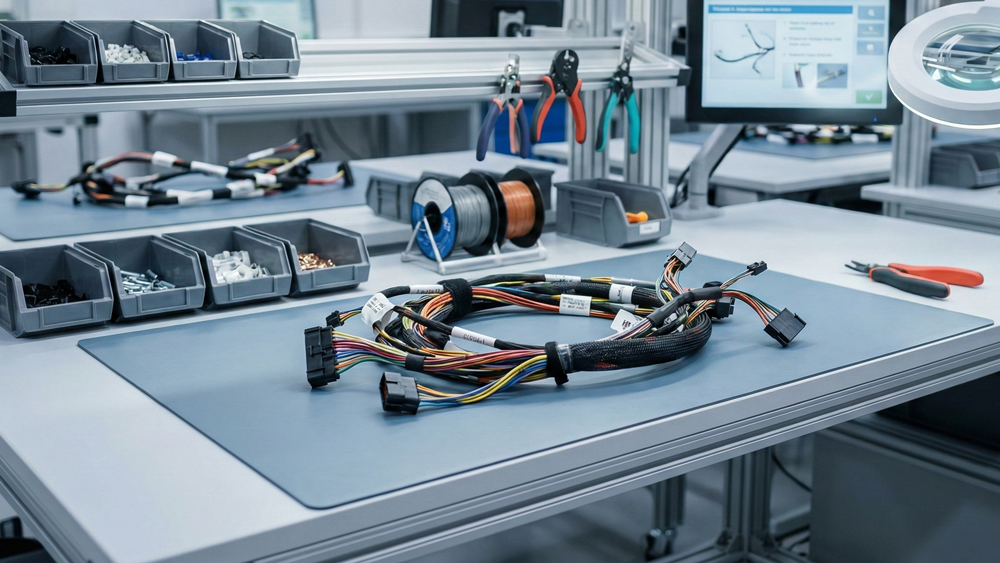
This contact resistance testing guide is written for engineering and procurement teams who need a practical, supplier-auditable way to verify that cable assembly terminations will stay electrically stable in real use. Continuity tests can tell you whether a circuit is open today, but they rarely predict what happens after vibration, thermal cycling, humidity, and repeated mating. Contact resistance trends do.
If you want the full termination system context first, start with the hub article, Crimping and Termination Guide for Cable Assemblies. This guide focuses on resistance measurement methods, fixtures, sampling, and drift triggers you can put into an RFQ, control plan, or supplier quality agreement.
Table of Contents
ToggleWhy contact resistance is a buyer-level risk metric
Contact resistance is the small resistance contribution at the interface between the terminal and the conductor (via the crimp) and between mating contacts (via the connector). In field conditions, it can increase gradually due to micro-motion, corrosion, contamination, or marginal compaction. That increase often shows up as heat rise, signal instability, intermittent faults, or early connector wear.
For procurement, contact resistance testing is valuable because it creates objective, comparable evidence across suppliers. For engineering, it is valuable because it can detect process drift and interface degradation before failures become visible in functional tests.
When you’re sourcing assemblies that will live in harsher environments such as Automotive & E-Mobility or Industrial & Robotics, resistance stability becomes even more important because temperature swings, vibration, and humidity accelerate degradation.
Where resistance “comes from” in a termination system
A cable assembly’s total resistance is not one thing. It is the sum of contributions from conductor length, crimp interface, terminal bulk, mating contact interface, and any intermediate joints (splices, solder joints, welds). Contact resistance testing is most powerful when you isolate which interface you are measuring and keep the method consistent.
In practical supplier programs, you typically test one of these:
Crimp-interface resistance, to validate compaction quality and process stability. Mated-contact resistance, to validate seating, contact condition, and connector interface stability. System resistance, as an end-to-end check to screen gross issues and produce baseline data for trending.
If you do not define which one applies, suppliers will test whatever is easiest to set up—and buyers will end up comparing non-comparable results.
Kelvin measurement method for low milliohm readings
For most contact resistance work, two-wire resistance measurements are not adequate because lead resistance and contact resistance at probes can be in the same order of magnitude as the value you are trying to measure. The method you want is commonly called a Kelvin method, also known as a four-wire measurement.
A four-wire setup separates the current-carrying leads from the voltage-sensing leads. The instrument forces a known current through the test item using one pair of leads, then measures voltage across the interface using a separate pair. Because the sense leads carry negligible current, lead resistance has minimal impact on the voltage reading, and the calculated resistance is far more accurate.
If you include requirements in your supplier quality agreement, define the acronym on first use: Kelvin (4-wire) measurement, and require the supplier to document fixture type and lead configuration in every record.
Test current selection and thermal stability
Contact resistance depends on test current, dwell time, and the thermal state of the interface. A very low current can under-represent issues that show up under load. A very high current can heat the interface and change the measured value, especially if the contact is marginal.
A practical approach is to set test current based on application type:
Low-signal or sensor circuits benefit from stable, low-current measurements with consistent dwell time and clean fixturing. Power circuits benefit from a current level that is meaningful for the interface while still safe for test equipment and fixtures.
What matters most for comparability is that you specify a controlled current, a consistent dwell time, and a consistent “settling” rule before capturing the reading.
The table below is a pragmatic starting point you can adapt to your programs.
| Application type | Typical focus | Recommended measurement approach | What to record |
|---|---|---|---|
| Low-signal / data | drift, intermittents, fretting sensitivity | Kelvin 4-wire, stable fixture, low heat input | current, dwell time, fixture, environment |
| Mid-current | stable interface under normal use | Kelvin 4-wire, moderate current, consistent dwell | current, dwell, connector state (mated/unmated) |
| High-current | heat rise risk, early degradation | Kelvin 4-wire + optional temperature monitoring | current, dwell, temperature at reading |
Fixture design and contact repeatability
Resistance testing can become meaningless if the fixture introduces variability. The most common problem is inconsistent probe contact, which adds uncontrolled resistance and makes readings noisy.
A good fixture does four things:
It applies repeatable contact pressure. It locates measurement points consistently across samples. It minimizes contamination risk by controlling how contacts are touched. It reduces micro-motion during measurement.
For mated-contact tests, define the connector state at measurement: fully mated, with secondary locks engaged where applicable, and using the same mating cycle condition (new, after X cycles, or after conditioning). If you do not control this, you will mix contact wear states and hide drift signals.
If you are working with suppliers who claim mature verification, you can anchor the expectation to their published verification scope under Tests & Inspections. The page itself is not the evidence; it is a starting point for asking, “show me your fixture, your method, and your records.”
Environmental conditioning and drift triggers
Many resistance problems do not show up on day one. They show up after stress. If your program risk justifies it, you can incorporate conditioning steps into qualification or periodic audits.
Common conditioning vectors include:
Thermal cycling to stress interfaces and reveal marginal compaction or plating issues. Humidity exposure to accelerate corrosion risk. Vibration or micro-motion exposure to accelerate fretting and loss of stable contact films. Mating cycle repetition to evaluate wear and contact stability.
You do not need to apply all of these to every program. A practical buyer approach is to define “drift triggers”—conditions that escalate testing intensity. For example, if you see rising resistance trends in routine audits, you may trigger a focused conditioning run to confirm whether the drift is a measurement artifact or a real interface degradation.
Acceptance criteria that procurement can enforce
Setting acceptance criteria is not just choosing a number. It is deciding what you care about: absolute resistance, drift over time, or both.
Absolute limits are useful for screening gross issues and ensuring assemblies ship within a functional envelope. Drift limits are often more predictive of long-term reliability because they detect interfaces that are slowly degrading.
A strong supplier-quality approach defines both:
An initial baseline limit for new assemblies. A drift threshold that triggers containment and corrective action when resistance moves beyond an allowed window over time, across lots, or after conditioning.
Where possible, align baseline limits with connector and terminal manufacturer guidance. When those limits are not available, establish a baseline from qualification testing and lock the method so future readings are comparable.
Sampling plan for B2B supplier control
Contact resistance measurement is slower and more equipment-dependent than visual inspection, so sampling must be strategic. A practical sampling plan typically includes:
Qualification testing during first-article approval, to establish baseline values and confirm the method. Change validation testing after controlled changes such as wire construction changes, terminal plating changes, applicator replacement, or new insertion tooling. Periodic audits on stable production, with frequency tied to program risk and historical drift behavior.
If you already use acceptance sampling language, define acronyms on first use in your supplier documents: AQL (Acceptable Quality Limit) for attribute inspection sampling and SPC (Statistical Process Control) for trending variable measurements. Contact resistance fits more naturally into SPC-style trending than pass/fail AQL decisions, because the trend is often the signal.
Interpreting resistance failures by failure mode
A resistance number alone rarely tells you root cause. You need context: which interface was measured, how it was fixtured, what changed, and what other indicators moved.
These are common patterns and what they tend to indicate:
A sudden step increase across a subset of units often points to a seating/locking issue or a fixture contact problem. A gradual upward trend over lots often points to tooling wear, compaction drift, contamination, or seal integrity issues. A high scatter with no clear mean shift often points to measurement method inconsistency, unstable fixture contact, or inconsistent connector state during measurement.
When resistance issues appear alongside pull test anomalies, you often have a termination process drift problem rather than a connector-only problem. That’s why resistance testing pairs well with Pull Force Test Guide for Cable Assemblies. The pull test helps you separate mechanical retention issues from interface-film and corrosion issues.
For a broader corrective action library, connect resistance findings to Termination Failure Modes Guide, which is structured for supplier problem-solving and CAPA workflows.
Linking resistance trends to crimp process controls
Resistance stability is not separate from crimping. It is one of the clearest outcomes of crimp process health. If you want resistance testing to reduce cost, link it to the process knobs the supplier can control.
In practical terms:
If resistance drifts upward and crimp height trends toward the edge of the window, you likely have compaction drift from tooling wear or press variation. If resistance is unstable and visual inspection shows inconsistent insulation support capture, you likely have micro-motion at the termination caused by poor strain relief rather than compaction alone. If resistance is stable at the crimp interface but unstable at the mated interface, you likely have seating, connector wear, or contamination issues.
For buyer clarity, reference the upstream process framework in Crimping and Termination Guide for Cable Assemblies and the inspection execution discipline in Crimp Quality Inspection Guide. The three articles together form a coherent “requirement → inspection → validation” logic that suppliers can execute.
Special considerations for sealed connectors and overmolding
Sealed systems introduce additional variables: seal compression, insertion force, and environmental protection quality. Resistance may remain acceptable at shipment and drift later if seals are damaged or mismatched to wire OD.
When assemblies include strain relief features such as overmolds, boots, or clamps, verify that the mechanical design actually reduces micro-motion at the interface. Overmolding can improve stability by distributing load and damping vibration, but it can also create hidden stress if the overmold geometry forces bending at the termination boundary. If overmolding is part of the design, align early with Overmolding Services so both mechanical and electrical validations are planned together.
Documentation package buyers should request
If you want resistance testing to be procurement-grade evidence, require that suppliers record the method details, not just results. At minimum, every record should include:
Test type (crimp interface, mated contact, or system). Instrument type and measurement method (Kelvin 4-wire). Test current and dwell time. Fixture ID and contact points. Connector state (mated/unmated, secondary lock state). Lot identifiers for wire and terminals, plus build/work order traceability. Environmental state (room, post-conditioning, post-cycles) when relevant.
This makes resistance records auditable and makes supplier corrective actions faster because root cause analysis starts with reliable data.
If you want this discipline reflected in your sourcing narrative, it should align with your supplier’s published commitments such as Quality Guarantee and Quality Policy. Those pages are not proof by themselves, but they provide a framework for the evidence you will require.
Conclusion
Contact resistance testing is one of the most effective ways to catch termination risk that continuity tests miss. When you standardize the method (Kelvin measurement, fixtures, current, dwell), define sampling triggers (qualification, changes, audits), and enforce drift-based reaction rules, resistance testing becomes a sourcing control tool—not a lab exercise.
Use this guide as your supplier-ready foundation, then pair it with mechanical validation and inspection discipline through Pull Force Test Guide for Cable Assemblies and Crimp Quality Inspection Guide.
FAQ
Do we need contact resistance testing for every program?
Not always. It is most valuable for low-signal circuits, high-current paths, harsh environments, and any program where intermittent faults or heating risk drives high field cost.
Why isn’t continuity testing enough?
Continuity only tells you whether a circuit is open now. It does not detect drift and does not predict how interfaces behave after stress, micro-motion, or corrosion.
What measurement method should we specify?
Kelvin (4-wire) measurement is the practical default for milliohm-level work because it minimizes lead and probe resistance effects.
Should we use absolute limits or drift limits?
Use both when possible. Absolute limits screen gross problems; drift limits are more predictive of long-term reliability and process stability.
What is the fastest way to reduce supplier disputes?
Lock the method and record it: fixture, current, dwell, connector state, and lot traceability. Then resistance results become comparable across lots and suppliers.
CTA
If you want a supplier-ready contact resistance test specification tailored to your connectors and application environment, share your connector part numbers, wire specs, and use conditions. We can propose a measurement method, sampling plan, and drift triggers suitable for OEM/ODM production.
- Review verification capability: Tests & Inspections
- Discuss your program: Contact
- Learn how we support OEM/ODM programs: Why Choose Us
Related articles
- Crimping and Termination Guide for Cable Assemblies
- Crimp Quality Inspection Guide
- Pull Force Test Guide for Cable Assemblies
- Termination Failure Modes Guide