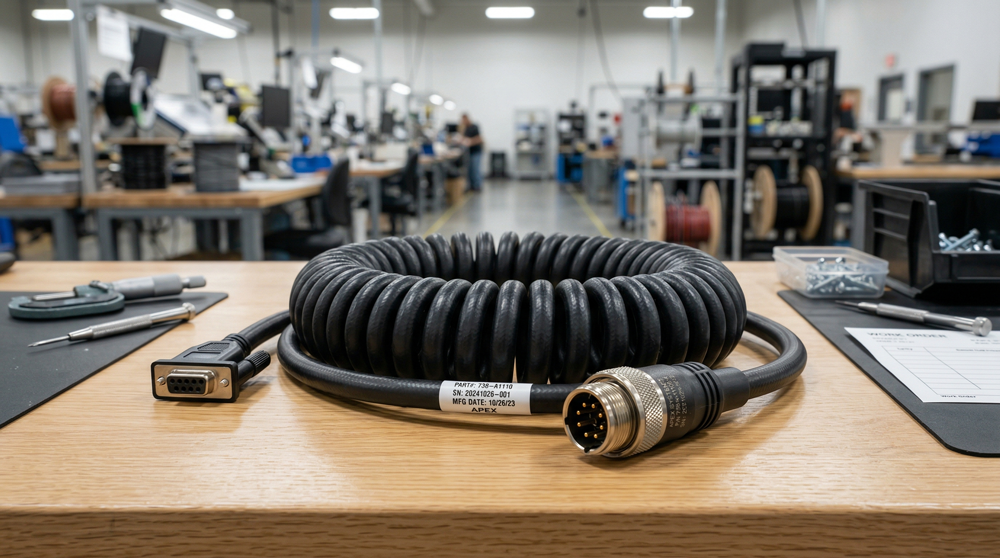
A coil cord rarely fails on paper. It fails in use, after repeated extension, recovery, bending, handling, and environmental exposure. That is why material selection is not a secondary detail in retractile cord design. Meridian states that the outer jacket is especially important because it is the first line of defense against environmental hazards and contributes heavily to how well the cord extends and retracts over many cycles, while your own Coil Cord Assemblies page already frames material choice around oil, temperature, and chemical resistance.
For OEM buyers, the practical question is not “Which material is best?” The better question is “Which material best matches the motion profile, environment, user handling, and cost target of this specific product?” Suppliers in this space consistently offer multiple jacket systems rather than one default answer. Galaxy lists PVC, polyurethane, TPE, neoprene, polyethylene, and Hytrel for retractile cords, while New England Wire notes that custom coil cords may be built with silicone, PVC, polyurethane, polyester, and TPE depending on the application.
Table of Contents
ToggleStart with the application
Material selection for a coil cord should begin with the service environment and the expected motion, not with a catalog preference. Northwire’s retractile-cord design framework starts with environment, and both Galaxy and your own service page present material choice as application-specific rather than universal. That sequencing matters because the same geometry can behave differently once jacket stiffness, elasticity, abrasion resistance, and chemical tolerance change.
A buyer should therefore define a few real conditions first. Will the cord be used indoors or outdoors? Will it see oils, cleaners, moisture, or UV? Is the product handheld, fixed to a cart, or mounted on moving equipment? Does the cord need soft handling and easy recovery, or is ruggedness the first priority? Those questions matter more than simply naming a preferred polymer family. This follows the way cable-jacket guidance is presented by MISUMI and igus, both of which explain material choice in terms of external conditions and application demands.
What the jacket really controls
In a coil cord, the jacket does more than protect conductors. It influences abrasion behavior, chemical resistance, temperature capability, flexibility, and how the finished cord feels during extension and recovery. Igus states that the outer jacket plays a crucial role in protecting the cable from mechanical stress, extreme temperatures, and chemical exposure, and Meridian makes the same point more directly for coil cords by tying jacket choice to extension and retraction performance over repeated cycles.
That means jacket choice affects both reliability and user experience. A cord can be electrically correct and still feel wrong in service if the jacket is too stiff for the intended motion or not durable enough for the environment. For OEM programs, this is why material selection belongs in the design-review stage, not after geometry and connectors are already fixed.
PVC
PVC remains a common coil-cord material because it offers a strong cost-to-performance balance in many standard applications. MISUMI describes PVC as a versatile thermoplastic with strong physical and insulating properties, as well as resistance to oils, acids, abrasion, sunlight, heat, salt, water, and moisture. Igus similarly presents PVC as abrasion-resistant, moisture-resistant, and attractive on price-performance in low-voltage applications.
For OEM buyers, PVC is usually a reasonable choice when the cord lives in a more controlled environment and cost discipline matters. It is often easier to justify in indoor equipment, general control use, and applications that do not impose the harshest chemical or motion requirements. The tradeoff is that PVC is not automatically the best answer when the cord needs the highest abrasion resistance, the best low-temperature behavior, or the most demanding dynamic performance. That positioning is consistent with how igus compares PVC against PUR and TPE in moving-cable applications.
PU and PUR
Polyurethane, often abbreviated PU or PUR, is commonly chosen when buyers need stronger abrasion, notch, and chemical resistance in a moving cable. Galaxy includes polyurethane among its standard retractile-cord jacket options, and igus describes PUR as bend-resistant, strong, notch-resistant, abrasion-resistant, chemically resistant, and suitable for machine tools, plant construction, and automotive environments. Your own service page also points buyers toward PU and TPU when resilience against oil, temperature, or chemicals matters.
In practical sourcing terms, PU is often a better candidate when the cord will be dragged, rubbed, handled heavily, or exposed to tougher industrial conditions. The buyer should still avoid assuming that “PU” alone solves the problem, because the full performance depends on the exact formulation and cable construction. But as a directional choice, PU is often where the conversation moves when PVC starts to look too basic for the environment.
TPE and related elastomeric options
TPE is another important family for retractile cords because buyers often want a material that combines flexibility with resilience under movement. Galaxy includes TPE in its retractile-cord material list, Meridian says commonly used coil-cord materials include TPE and TPR, and igus describes TPE as suitable for flexible cables that must handle mechanical loads, chemicals, extreme temperatures, and continuous movement.
For OEM buyers, TPE-family materials become especially relevant when the application combines dynamic motion with harsher external exposure. They are often worth considering when recovery behavior and repeated use matter more than the lowest initial cost. The exact compound still needs supplier review, but in B2B decision-making, TPE usually belongs on the shortlist whenever the cord must flex often and survive a tougher service profile.
Silicone
Silicone deserves separate attention because it often enters the conversation when temperature becomes the dominant requirement. New England Wire specifically states that it manufactures silicone-rubber-jacketed custom coil cords for high-temperature applications, while your own service page includes silicone among the materials used to match environmental demands.
For OEM buyers, silicone is usually not the generic default choice. It becomes relevant when the environment pushes temperature performance high enough that more common material systems may no longer be the best fit. That makes silicone less of an “everyday” material decision and more of an application-triggered one.
Material choice is not just about the jacket
A coil cord’s field behavior also depends on conductor construction, shielding, and the rest of the cable design. Galaxy states that retractile cords are available with different conductor materials, stranding constructions, insulation and jacketing materials, and shielding types, while your own coil-cord page combines material selection with connector and strain-relief options. That means buyers should avoid treating the jacket as an isolated decision.
This is especially important when the application includes sensitive signals or mixed power-and-signal routing. A buyer may correctly choose a jacket for chemicals or oil exposure and still under-specify conductor flexibility or shielding needs. In coil-cord work, material selection is better understood as a cable-system decision than a single polymer decision.
How OEM buyers should choose
The fastest way to improve material selection is to stop asking for a material by habit and start describing the service conditions in plain engineering language. A better RFQ does not just say “need PU” or “need TPE.” It defines the motion frequency, handling pattern, environmental exposure, temperature expectation, and whether the priority is lower cost, better abrasion resistance, softer feel, or stronger recovery. That recommendation follows directly from Meridian’s advice to communicate requirements and constraints clearly, and from the broader cable-jacket guidance published by MISUMI and igus.
In many OEM projects, material selection becomes much easier when the team narrows the application into one of three broad modes. The first is controlled indoor use, where PVC may remain a sensible candidate. The second is tougher industrial or high-abrasion use, where PU or related materials often deserve closer review. The third is highly dynamic or more demanding environmental use, where TPE-family materials or specialized constructions may make more sense. Temperature-driven edge cases may move the discussion toward silicone. This framework is an inference based on how the cited manufacturers position these materials across dynamic and environmental requirements.
Common mistakes
One common mistake is selecting material based only on cost. PVC may be the better value in many standard applications, but a cheaper jacket can become expensive if the real environment demands more abrasion or chemical resistance than the original quote assumed. MISUMI and igus both frame jacket selection around environment first and economics second, not the other way around.
A second mistake is choosing material without defining the motion profile. In retractile cords, extension and recovery behavior matter, so buyers should not separate material review from the geometry and flex-life discussion. Meridian explicitly links jacket choice to extension and retraction over many cycles, which is exactly why material selection belongs alongside geometry and testing review.
A third mistake is assuming that one successful material on a previous project can be copied directly into a new one. Changes in conductor count, shielding, diameter, temperature, chemical exposure, or user handling can shift the correct answer. Galaxy’s retractile-cord guidance is helpful here because it presents the design as almost always unique to the application.
What to include in the RFQ
If you want fewer sample loops, define the material problem in the RFQ before the supplier guesses. A strong RFQ should describe the environment, expected extension-and-recovery frequency, any oil, cleaner, moisture, or UV exposure, the required feel in use, and whether the priority is cost, abrasion resistance, chemical resistance, temperature capability, or long flex life. Your own Cable Assembly RFQ Checklist for Faster Sourcing already supports this broader logic of removing ambiguity before quotation.
If your team is undecided between PVC, PU, TPE, or silicone, say that directly and ask the supplier to compare them against the actual service conditions. That usually produces a better result than locking a material too early without full application context. Meridian’s advice to communicate requirements and budget or time constraints clearly aligns with that approach.
Final view
For OEM buyers, coil cord material selection is really a question of use conditions and risk management. PVC, PU, TPE-family materials, and silicone each have legitimate roles, but they do not solve the same problem. The right choice depends on how the cord will move, what it will touch, what temperatures it will face, how long it must last, and what tradeoffs the product can accept on cost and durability.
The best buying sequence is straightforward: define the environment, define the motion, define the durability expectation, and then review material options with the supplier. That approach is fully consistent with the way specialized retractile-cord manufacturers describe design and sourcing.
FAQ
What is the best material for a coil cord
There is no universal best material. Suppliers in this segment offer multiple options such as PVC, PU, TPE-family materials, and silicone because the right answer depends on environment, motion, and performance priorities.
Is PVC good enough for coil cords
Often yes, especially in more controlled applications where cost-performance matters, but PVC is not automatically the best option for harsher abrasion, chemical, or dynamic requirements.
When should OEM buyers look at PU or PUR
PU or PUR is often worth considering when the cord needs stronger abrasion, bend, and chemical resistance in tougher industrial service.
When does TPE make sense
TPE-family materials become especially relevant when the cord must tolerate continuous movement, mechanical loads, and harsher external conditions.
When is silicone the right choice
Silicone usually becomes relevant when high-temperature performance is a primary requirement rather than a secondary preference.
If your new program involves a retractile cable, do not pick the jacket by habit. Start with the environment and motion profile, then compare material options against the actual service conditions. You can begin with our Coil Cord Assemblies page, then use How to Specify Coil Cord Geometry for OEM Projects, Coil Cord Testing Guide for OEM Buyers, and Cable Assembly RFQ Checklist for Faster Sourcing to prepare a cleaner sourcing package.
Related articles