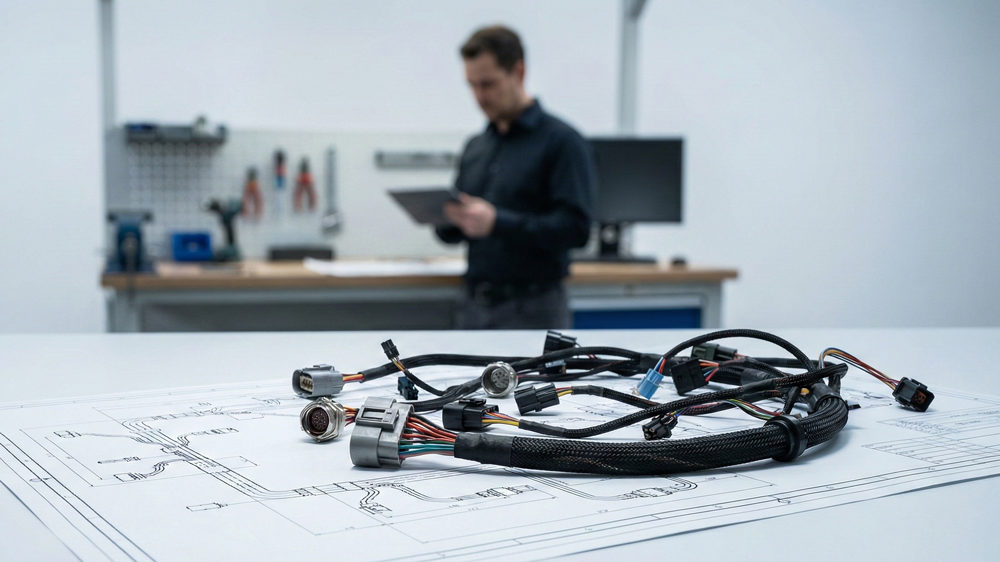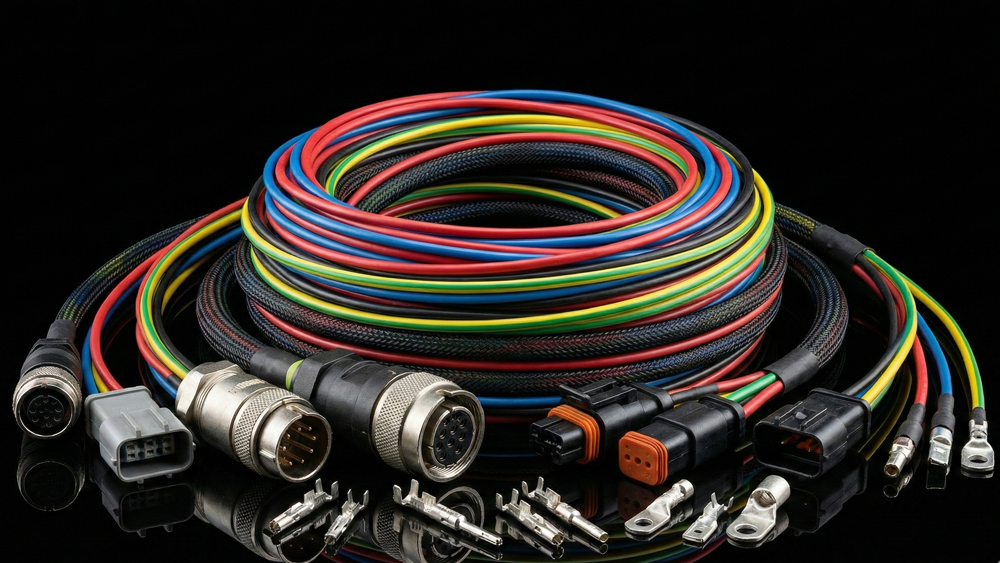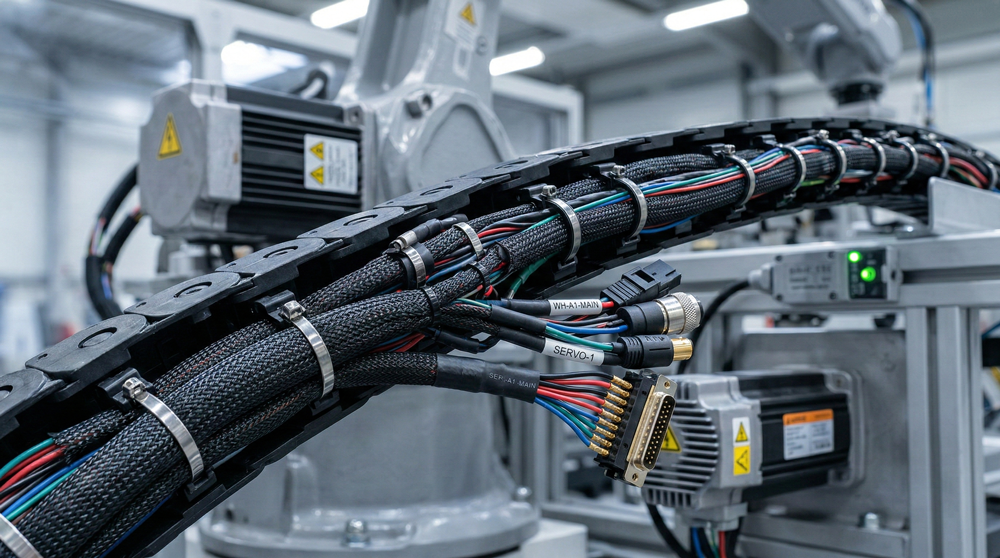
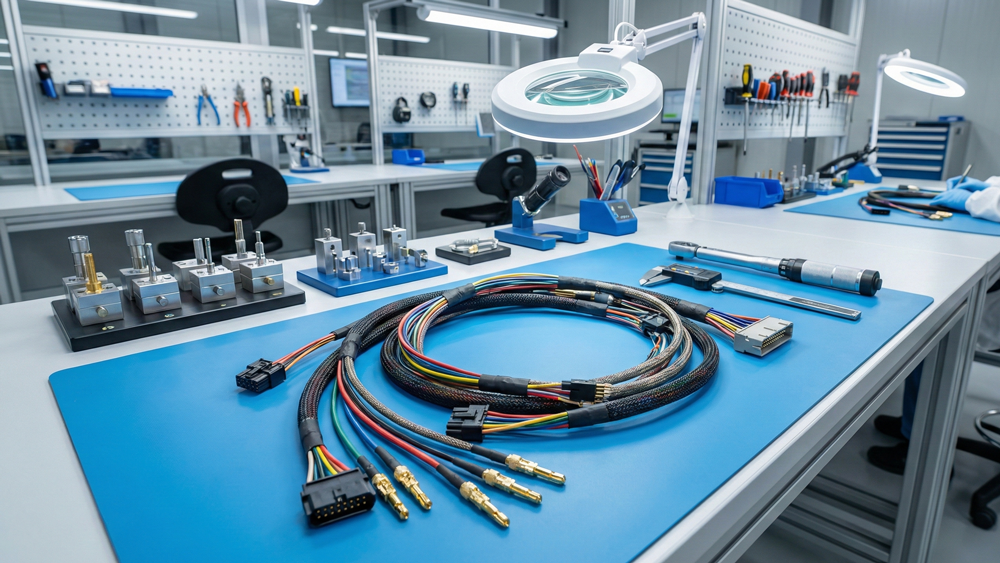
This termination failure modes guide helps engineering, quality, and procurement teams diagnose cable assembly field issues quickly and turn them into supplier-corrective actions that actually prevent recurrence. Termination failures rarely come from a single “bad crimp.” They are usually system failures caused by a chain of variables: wire prep, crimp geometry, seating and locking, sealing, strain relief, handling, and environmental exposure.
If you want the full process context first, start with the hub article, Crimping and Termination Guide for Cable Assemblies. This guide focuses on failure-mode patterns, likely root causes, recommended tests, and corrective actions that reduce rework and field returns in OEM/ODM programs.
Table of Contents
ToggleHow to use this guide
A practical failure investigation should move in a disciplined sequence. Start by describing the symptom in measurable terms, then identify the most likely failure mode category, then run tests that isolate the interface, then lock corrective actions into the supplier’s control plan so the problem doesn’t return.
For sourcing teams, the value is speed and comparability. When your suppliers report failures using consistent failure-mode language, you can compare risk across suppliers and decide where to invest audit time and process tightening.
Failure mode categories
Most termination issues fall into four categories: electrical instability, mechanical retention, environmental degradation, and assembly integration errors. These categories overlap, but they point to different isolation tests.
Electrical instability includes intermittent opens, resistance drift, and heat rise. Mechanical retention includes conductor pull-out, insulation slip, and terminal pull-out from the housing. Environmental degradation includes corrosion-driven resistance growth and seal leakage. Assembly integration errors include mis-seating, secondary lock not engaged, incorrect cavity insertion, and damage during routing or overmolding.
To keep diagnosis fast, tie each category to a small set of repeatable verification methods. If your teams need standardized methods, connect this guide with Crimp Quality Inspection Guide, Pull Force Test Guide for Cable Assemblies, and Contact Resistance Testing Guide.
Intermittent open circuits
Intermittent opens are among the most expensive failure modes because they are difficult to reproduce and often escape functional end-of-line testing. They typically show up under vibration, temperature change, or handling.
The most common root causes are incomplete terminal seating, marginal retention in the housing, micro-motion at the contact interface, or conductor strand damage near the crimp that behaves like a partially broken spring.
A fast isolation approach is to verify terminal seating and lock engagement first, then evaluate strain relief and routing, then measure contact resistance under mild mechanical stimulation (a controlled “wiggle” at a defined location, not random bending), and finally use destructive analysis only if needed.
If suppliers are shipping “good crimps” but you see intermittent opens, push hard on seating verification method definition and evidence, because seating defects are routinely misclassified as crimp defects.
High contact resistance and heat rise
High resistance failures are usually discovered as heat rise under load, voltage drop, unstable signals, or “works cold, fails hot.” They may occur at the crimp interface, at the mated contact interface, or at a contaminated joint.
Root causes commonly include marginal compaction from crimp height drift, contamination at the interface, corrosion due to seal damage, or contact fretting from micro-motion caused by weak strain relief. In some cases, material incompatibility such as plating mismatch or unexpected terminal batch variation drives faster oxidation.
The best isolation test is a controlled Kelvin four-wire measurement, also called Kelvin (4-wire) measurement, because it reduces lead resistance effects and makes milliohm-level readings meaningful. If you see resistance drift, correlate it to crimp height trends and seating verification outcomes rather than treating resistance as a standalone electrical problem.
For suppliers, require trending, not just single-point readings, and tie drift triggers to corrective action rules using Contact Resistance Testing Guide.
Conductor pull-out from the crimp
Conductor pull-out is a classic mechanical failure mode. It can occur immediately (low pull-out force) or after stress (vibration, bending, thermal cycling). If it happens in the field, it usually indicates a marginal crimp process window, incorrect terminal-wire match, or strand damage during stripping.
Root causes tend to be low compaction, misaligned applicator tooling, incorrect strip length causing inadequate conductor capture, or using a terminal family outside its supported wire range. Fine-stranded conductors can be especially sensitive to poor strand capture and inconsistent strip geometry.
The primary isolation test is a standardized pull test with failure-mode recording. Force alone is not enough; you need to record whether the conductor pulled out cleanly, strands broke at the crimp edge, or the wire broke away from the crimp location. Use Pull Force Test Guide for Cable Assemblies to standardize the method and make results comparable across suppliers.
Strand breakage and fatigue near the termination
Fatigue failures often present as intermittent issues first, then hard opens later. They are frequently caused by flex-at-crimp due to poor insulation support capture, weak strain relief, or routing that forces repeated bending at the termination boundary.
Another common driver is strand nicking during stripping. A slightly nicked strand bundle can pass initial pull tests but fail early under vibration because the fatigue crack initiation site is already present.
Isolation should prioritize visual inspection for insulation support crimp capture and evidence of bending at the termination, then review routing and clamp placement, then conduct a controlled bend or vibration screening if your program risk supports it. If destructive analysis is required, cross-section inspection can reveal strand damage, sharp cut-off tabs, or bellmouth geometry issues that concentrate stress.
Terminal pull-out from housing and seating defects
When the terminal pulls out of the housing, the root cause is almost never the conductor crimp. It’s typically incomplete insertion, a secondary lock not engaged, a damaged retention lance, or an incorrect terminal for the housing cavity.
This failure mode is tightly linked to assembly integration and can hide until the harness experiences tension during installation. It also drives electrical intermittents because micro-motion occurs even before full pull-out.
Isolation begins with a seating verification audit: how does the supplier confirm seating on every unit, and what evidence exists. Many suppliers rely on a “feel” method without objective criteria, which is risky at scale. Require a defined 100% check method appropriate to the connector design, and require clear rework rules when seating fails so housings are not damaged by repeated reseating attempts.
Seal damage and environmental ingress
Seal failures create long-tail reliability problems: corrosion, resistance growth, intermittent faults, and sometimes shorting if moisture bridges conductors. Seal damage can occur during insertion, from wire OD mismatch, or from tool misuse. It can also occur later if strain relief is weak and micro-motion abrades the seal interface.
Isolation should include visual inspection of seal placement and damage, confirmation of wire OD compatibility to the seal system, and environmental screening if required by your application. If the program runs in harsh conditions, define qualification conditioning such as humidity exposure or thermal cycling and link it to objective acceptance criteria.
For programs in demanding environments, use sourcing language aligned with application needs such as Automotive & E-Mobility and Industrial & Robotics so supplier validation intensity matches real-world exposure.
Shorts and insulation damage
Shorts often come from overly long strip length, uncontrolled conductor brush, sharp cut-off tabs, insulation nicks, or poor routing that causes abrasion. They can also come from terminal whiskers, loose strands, or damage introduced during rework.
Isolation includes verifying strip length control, inspecting cut-off tab condition, and checking for insulation compromise under magnification. When shorts occur after installation, routing and protection become the prime suspects: verify bend radius, clamp placement, and any abrasion contact points.
Overmolding and strain-relief related failures
Overmolding can reduce micro-motion and improve reliability, but it can also introduce hidden stress if the mold geometry forces bending at the termination boundary, if adhesion is poor, or if molding heat and pressure disturb terminal seating.
When overmolding is part of the design, define whether your tensile validation targets the crimp integrity, the overmold-to-cable bond, or both. Require clear fixturing definitions so test results are comparable. If you need support aligning design and verification, connect requirements early with Overmolding Services.
Symptom-to-test mapping table
Use this table as a fast triage tool during supplier discussions and corrective action cycles. It is designed to narrow the failure interface quickly, before destructive work expands cost.
| Field symptom | Most likely interface | Best first test | Evidence to request | Typical corrective focus |
|---|---|---|---|---|
| Intermittent open under vibration | Seating / micro-motion | Seating verification audit + resistance under controlled stimulation | Seating method + records + photos | 100% seating control, strain relief improvements |
| Heat rise or voltage drop | Crimp or contact interface | Kelvin 4-wire resistance trend | Method, fixture, current, dwell, trend charts | Compaction window, cleanliness, seal integrity |
| Conductor pull-out | Conductor crimp | Standard pull test with failure mode | Force + failure mode + setup logs | Crimp height, applicator alignment, strip length |
| Terminal pull-out | Housing retention | Terminal retention pull test in housing | Seating records + lock engagement proof | Insertion method, secondary lock discipline |
| Corrosion after exposure | Seal or plating | Conditioning + resistance trend + inspection | Seal handling work instruction | Seal selection/handling, contamination control |
| Shorts after assembly | Strip/insulation/routing | Strip length audit + magnified inspection | Strip logs + defect photos | Strip control, cut-off tab maintenance, routing protection |
Corrective actions that actually prevent recurrence
Corrective action fails when suppliers “fix the symptom” instead of locking prevention into process controls. Your goal is to force actions that change the control plan, training, and verification frequency.
A common structure is 8D, which stands for Eight Disciplines, a structured problem-solving method used in supplier corrective actions. Another common structure is CAPA, which stands for Corrective and Preventive Action. Regardless of format, require these elements: containment, root cause verification with objective evidence, corrective action implementation, and validation that the fix holds over time.
For termination failures, validation should include at least one objective measure tied to the failure mode: crimp height trending for compaction issues, seating verification audit results for housing retention issues, pull test failure-mode distribution for mechanical retention issues, and contact resistance drift charts for electrical instability issues.
If suppliers use PFMEA, which stands for Process Failure Mode and Effects Analysis, require them to update PFMEA and the Control Plan when a field failure reveals a missing control. The update should show up on the line as a new check, new reaction rule, or tightened sampling plan.
Procurement controls that reduce termination risk
Engineering can define the physics, but procurement can enforce the system. Practical procurement controls include:
Define a minimum evidence package per lot for high-risk programs, including setup first-article photos, crimp height logs, seating verification method definition, and pull test audit results. Define explicit revalidation triggers for changes in wire construction, insulation compound, terminal plating, applicator tooling, or insertion tools. Require that suppliers maintain measurement discipline and define measurement reliability expectations where relevant.
If you want to anchor these expectations in supplier messaging, align them to the supplier’s stated commitments like Quality Guarantee and Quality Policy, then request operational evidence that proves those commitments exist on the production floor.
Conclusion
Termination failures are rarely mysteries; they’re patterns. When you classify failures correctly, isolate the interface with the right tests, and force corrective actions into supplier control plans, you reduce field returns and stop repeat issues from consuming engineering and sourcing bandwidth.
Use this guide as your failure-mode vocabulary and corrective-action playbook, and pair it with the cluster’s inspection and validation methods so suppliers cannot hide behind generic claims.
FAQ
Why do termination failures often appear “random” in the field?
Many are intermittent first. Vibration, temperature, and handling reveal micro-motion, marginal seating, or early fatigue that does not show up in simple continuity tests.
What is the fastest way to isolate a suspected crimp problem?
Start with objective checks that correlate to process stability: crimp height trend, standardized visual criteria, and a pull test with failure-mode recording.
How do we avoid blaming the crimp when the real issue is seating?
Require a defined 100% seating verification method and evidence. Then separate terminal retention failures from conductor crimp failures in testing.
When should we require environmental conditioning?
When application exposure is harsh or field failure cost is high. Conditioning is most useful in qualification and when drift signals appear in audits.
What evidence should procurement request after a supplier fixes a failure?
Containment results, root cause proof, updated control plan, and validation data showing the fix holds over time across lots.
CTA
If you have a recurring termination issue, share your connector family, wire specs, application environment, and failure symptoms. We can propose a targeted isolation plan and supplier control updates that reduce repeat failures at scale.
- Discuss your program: Contact
- Review verification scope: Tests & Inspections
- Learn how we support OEM/ODM builds: Why Choose Us