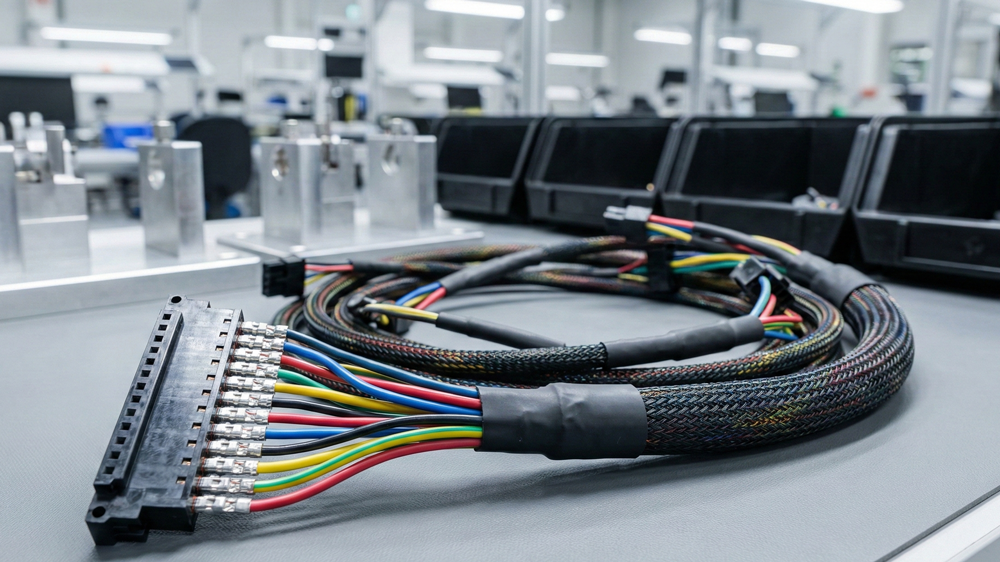
This pull force test guide for cable assemblies is written for engineering and procurement teams who need an objective, supplier-auditable method to validate crimp and termination integrity. Pull testing is not just a “strength check.” When it’s executed with controlled fixtures, a consistent pull rate, and clear failure-mode recording, it becomes a fast indicator of process stability—and a powerful way to prevent rework, field returns, and supplier disputes.
If you haven’t standardized the broader termination controls yet, use the cluster hub article first: Crimping and Termination Guide for Cable Assemblies. This S2 guide focuses specifically on how to run pull tests, how to interpret results, and how to turn pull data into sourcing controls.
Table of Contents
ToggleWhat pull testing proves
A properly designed pull test evaluates the termination system under tensile load and helps answer three buyer-critical questions.
First, does the crimp create adequate mechanical retention between conductor strands and the terminal barrel? A marginal crimp can pass continuity checks today but loosen under vibration or thermal cycling, ultimately increasing contact resistance and producing intermittent faults.
Second, is the wire preparation and insulation support crimp preventing flex-at-crimp fatigue? In many field failures, the conductor crimp is acceptable, but the insulation support is ineffective, allowing motion that breaks strands over time.
Third, is the terminal locked correctly in the connector housing? Many “crimp failures” are actually seating failures. Pull testing, when paired with seating verification, can quickly expose improper insertion, incomplete secondary lock engagement, or damaged housings.
Because pull testing primarily measures mechanical integrity, it is best used alongside visual and dimensional inspection. If your team needs a structured way to grade crimp geometry, document evidence, and make inspection repeatable across suppliers, use Crimp Quality Inspection Guide.
Pull test types
Not all pull tests evaluate the same risk. In cable assembly programs, you typically see three categories.
Crimp pull-out test targets the crimp interface itself. The wire is pulled relative to the terminal; the objective is to confirm the crimp’s tensile retention and to identify weak compaction, strand damage, or incorrect strip length.
Terminal retention test targets the connector system. The terminal is pulled while installed in the housing; the objective is to confirm correct seating and that the primary and secondary retention features are functioning.
System tensile test targets the finished assembly. The load is applied to the cable/boot/overmold region to verify strain relief and mechanical protection features. This is relevant when your assembly includes boots, clamps, or overmolding.
Buyers often blend these into one “pull test requirement,” which creates ambiguity. A better approach is to specify which type applies to which build stage: first-article validation, in-process audits, or final acceptance.
Standards and acceptance logic
Pull force limits are not universal. Your acceptance logic should be derived from the most authoritative source available for your build.
For many programs, the terminal manufacturer provides pull-out force guidance based on wire gauge and terminal family. When those limits exist and the application risk is high, they are the best baseline.
For workmanship governance, many teams reference IPC/WHMA-A-620 (a workmanship standard for cable and wire harness assemblies published by IPC and WHMA, Wire Harness Manufacturers Association). Even when you reference it, you should still define program-specific requirements: what test is run, at what stage, with what fixtures, and how failures are classified.
In procurement terms, your goal is to make pull testing comparable across suppliers. That means you must define: test method, pull rate, fixture type, sample plan, and pass/fail criteria—or explicitly require the supplier to follow terminal-manufacturer guidance and provide evidence.
Test equipment and fixturing
Pull testing can be done with a tensile tester or a calibrated force gauge fixture. The equipment choice matters less than control and repeatability.
A tensile tester with controlled crosshead speed provides the most consistent results and the best data capture. A force gauge can still be acceptable for audits or low-volume programs if the fixture prevents slippage and the pull rate is controlled as closely as practical.
Fixturing is where most “bad data” originates. Strong pull testing requires fixtures that apply load axially and avoid side loading, twisting, or bending the crimp region. The objective is to test the termination, not the operator technique.
In supplier evaluations, ask where pull testing fits into their verification workflow under Tests & Inspections. If the supplier cannot describe how fixtures are maintained and how results are recorded, pull testing becomes a checkbox rather than a control.
Grip selection and slippage control
Wire gripping must prevent slippage without damaging the conductor. This sounds trivial, but it is a common cause of false failures and false passes.
If the grip damages the insulation and causes the wire to break away from the crimp region, you get a misleading “wire break” failure mode. If the grip slips, you get artificially low force readings and inconsistent results.
A practical best practice is to define approved grips by wire type and size. Silicone and soft jackets often require different gripping methods than PVC or cross-linked insulation. For fine-stranded conductors, gripping too close to the crimp can concentrate stress and bias results.
As a buyer, you do not need to dictate every fixture detail, but you should require the supplier to document and standardize grip choices for the program.
Pull rate and alignment
Pull rate affects measured peak force and can change the apparent failure mode. Faster pulls can increase peak force due to dynamic effects; slower pulls can emphasize creep and slippage.
The best approach is to set a controlled rate that matches either the terminal manufacturer’s guidance or your internal validation plan, then apply that rate consistently across first-article, audits, and corrective action confirmation. Consistency matters more than picking a “perfect” speed.
Alignment matters just as much. The pull direction should be axial with respect to the terminal and conductor. Side loads can cause premature bending at the bellmouth or insulation support region and mask the true retention strength of the crimp.
When auditing suppliers, ask them to show how they ensure axial alignment, particularly for small terminals and sealed connectors where the geometry is tight.
Sample plan design
Pull testing is most valuable when it is used strategically, not indiscriminately. A good sampling plan answers: when do we test, how many samples, and what triggers escalation?
A practical approach is to apply pull testing at three stages.
First-article validation is non-negotiable for most B2B programs. The objective is to prove setup correctness and to capture baseline performance data.
Change validation is triggered by controlled changes such as wire supplier changes, terminal plating changes, applicator maintenance events, press replacement, or process parameter adjustments. Change validation prevents “silent drift” from becoming field failures.
Periodic audits detect gradual drift on stable programs. The audit frequency should be tied to program risk, run length, and historical performance rather than a generic time interval.
If your supplier uses statistical tools, define acronyms on first use: AQL (Acceptable Quality Limit) for attribute sampling of defects, and SPC (Statistical Process Control) for trending variable measurements such as crimp height. Pull testing often complements SPC by validating mechanical performance as process indicators drift.
Data to record
Pull testing becomes procurement-grade evidence only when the recorded data is consistent and traceable. At minimum, require that each pull test record includes:
the program and build identifier, wire gauge and construction, terminal part family, the test type (crimp pull-out vs terminal retention vs system tensile), the fixture and grip type, pull rate, peak force, and the failure mode.
Failure mode is critical. Two tests with identical peak force can represent completely different process health. A wire break far from the crimp may indicate strong termination and a weak wire. A pull-out at the conductor crimp suggests compaction or strip-length problems. A terminal pull-out from housing suggests seating/locking issues.
If your supplier is implementing formal measurement reliability practices, define MSA (Measurement System Analysis) in your supplier quality agreement so “calibrated tool” claims are supported by repeatability evidence.
Failure mode interpretation
Pull force is a number. Failure mode tells you what to fix. For engineering teams, this mapping is what turns pull testing into process control.
The table below provides a practical interpretation framework you can use in supplier corrective action cycles.
| Failure mode | What it usually indicates | Common root causes | Typical corrective actions |
|---|---|---|---|
| Conductor pulls out of crimp | Weak conductor crimp retention | Low compaction, wrong crimp height, misalignment, wrong terminal for wire | Re-setup, verify applicator, confirm wire/terminal match, increase inspection frequency |
| Strands break at crimp edge | Excess stress concentration | Strand nicking at stripping, sharp cut-off tab, insufficient bellmouth | Fix stripping tooling, maintain applicator, verify bellmouth and cut-off tab condition |
| Wire breaks away from crimp | Strong crimp, weak wire or biased setup | Grip damage, pulling too close, wire defect | Improve gripping, adjust grip position, verify incoming wire quality |
| Insulation slips from support crimp | Weak strain relief | Incorrect insulation support geometry, wrong strip length, missing support crimp | Correct setup, verify strip length, add visual criteria and training |
| Terminal pulls out of housing | Seating/retention defect | Incomplete insertion, secondary lock not engaged, damaged housing | Enforce seating verification, inspect housings, clarify rework rules |
| Seal damage observed | Environmental integrity risk | Incorrect wire OD, poor insertion method, tool damage | Validate seal/wire match, update insertion method, add seal inspection checkpoints |
If you need a broader library of termination-related failure patterns and corrective actions beyond pull testing, use Termination Failure Modes Guide.
Pass/fail rules buyers can enforce
To avoid disputes, define what constitutes a pass. The simplest pass rule is “peak force must meet or exceed the specified limit, and the failure mode must be acceptable.” Both conditions matter.
For many programs, the acceptable failure mode is not “anything above the force limit.” For example, a terminal pulling out of the housing might still show a high force value, but it indicates a seating defect that can cause intermittent electrical issues. Similarly, an insulation slip may not immediately break continuity but can predict fatigue failures.
When you write pull test requirements into an RFQ or quality agreement, specify:
the acceptance limit source (terminal manufacturer guidance or program-defined), the acceptable failure modes, the sample plan and escalation triggers, and evidence requirements including photos for borderline results.
Sealed connectors and harsh environments
Sealed connectors introduce additional variables that can bias pull testing. Seal compression, insertion friction, and housing retention features can change the load path. Improper seal installation can also add drag that inflates measured forces while hiding seating defects.
For harsh environments, it can be useful to run pull validation after environmental conditioning, especially if the program is deployed in automotive or industrial robotics settings. Your application pages can help define these expectations in procurement conversations, such as Automotive & E-Mobility and Industrial & Robotics.
Overmolded and strain-relieved assemblies
When assemblies include overmolds, boots, or clamps, pull testing should verify that the strain relief feature is doing its job: preventing flex at the crimp and distributing load into the cable body.
System tensile tests for overmolded assemblies should specify where the assembly is gripped, what length of cable is unsupported, and whether the test targets the overmold-to-cable bond, the crimp system, or both. This is easiest to control when overmolding requirements are aligned early with Overmolding Services.
Common mistakes that create bad pull data
Most pull test problems are preventable. The recurring mistakes that buyers should watch for in audits include:
pulling at an angle that introduces side load, gripping too close to the crimp, inconsistent pull rates between operators, slipping grips that under-report force, and unclear failure mode recording.
The simplest fix is to require a standardized pull test work instruction and to insist that pull records include fixture type, pull rate, and failure mode every time.
Pull testing in a supplier quality system
Pull tests are most effective when they are linked to change control and continuous improvement rather than used as an isolated check.
If your supplier uses formal risk tools, define PFMEA (Process Failure Mode and Effects Analysis) so the supplier can show how pull test failures update the control plan and preventive controls. For procurement teams, this is a practical way to verify whether “quality” is a system or a slogan.
If you are evaluating partners for demanding programs, you may also want to align expectations with the supplier’s published commitments and support model through Quality Guarantee, Quality Policy, and their engineering collaboration approach under Strong Technical Support.
Conclusion
Pull testing is one of the fastest, most objective ways to validate termination integrity—when it is standardized. A procurement-ready pull test method defines the test type, fixtures, pull rate, sampling plan, pass/fail limits, and failure mode recording. With those elements in place, pull data becomes comparable across suppliers and becomes a practical control against drift, rework, and field returns.
To connect pull validation back to the complete termination system, keep this guide paired with inspection and electrical validation: Crimp Quality Inspection Guide and Contact Resistance Testing Guide.
FAQ
Should we pull test every cable assembly?
Not necessarily. For many B2B programs, pull testing is most cost-effective at first-article, after controlled changes, and as periodic audits based on risk and run length.
What matters more: peak force or failure mode?
Both. Peak force indicates retention strength; failure mode tells you whether the termination system is healthy and what corrective action is needed.
Can a pull test pass still hide a reliability problem?
Yes. A high force value can still occur with a seating defect or seal damage that later causes intermittent faults or corrosion-related resistance drift.
How do we set limits if terminal supplier data is missing?
Use qualification testing to establish a validated baseline and define limits tied to failure mode and program risk. Document the method and re-validate on changes.
How do we reduce supplier disputes on pull results?
Standardize fixtures, pull rate, and evidence requirements, then require lot-traceable records including failure mode and photos for borderline results.
CTA
If you want a supplier-ready pull test specification for your program, send your connector part numbers, wire specs, and application environment. We can propose a method, sampling plan, and evidence package that fits OEM/ODM production and reduces field-return risk.
- Review verification capability: Tests & Inspections
- Discuss your program: Contact
- Learn how we support OEM/ODM programs: Why Choose Us