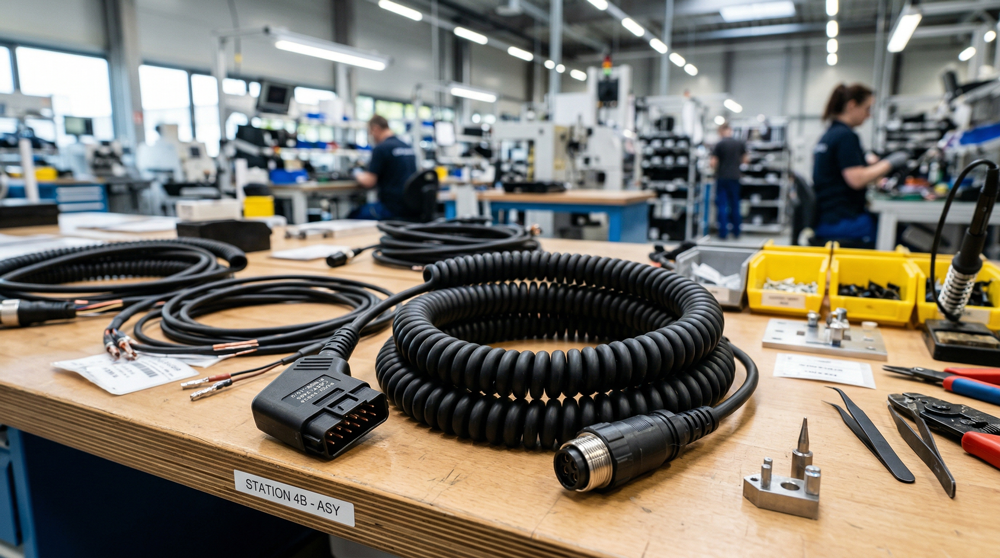
Choosing between a coil cord and a straight cable is not mainly a style decision. For OEM buyers, it is a motion-management decision. A straight cable gives a direct, simple cable path, while a coil cord is intended to extend when needed and retract when not in use. Northwire explicitly positions retractile cords as a better option than common straight cables in applications such as high-flex use, handheld medical devices, safety-sensitive areas, and telescopic equipment. Your own Coil Cord Assemblies page frames the same logic around movement, limited space, and the problems straight cables create when they tangle, snag, or wear in service.
That means the right question is not “Which cable form is better?” The better question is “Which cable form behaves better in this product?” A straight cable is often the more economical and simpler choice in static or protected routing. A coil cord becomes more valuable when the product needs controlled extension, cleaner cable management, reduced slack, and better behavior in repeated user movement. That distinction is consistent with Northwire’s published application guidance and with how coiled-versus-straight comparisons are framed in use-case-specific markets such as EV charging.
Table of Contents
ToggleUse a straight cable when the routing is fixed
A straight cable is often the better choice when the cable path is stable, the installed route is predictable, and excess slack can be managed by clips, trays, or fixed routing features. In those cases, the cable does not need to expand and recover repeatedly, so the retractile behavior of a coil cord may add unnecessary complexity. This is also reflected in recent coiled-versus-straight comparisons that describe straight cables as easier to route through defined paths with fewer mechanical constraints from coil tension.
For OEM products, that usually means straight cables remain strong candidates in enclosed assemblies, panel-to-panel internal routing, fixed industrial wiring runs, and other installations where the operator is not constantly changing the cable’s position. In those scenarios, the main priorities are usually routing simplicity, consistent installed length, and predictable assembly rather than controlled extension and retraction. This is an inference from the use cases Northwire identifies for retractile cords and from the contrast with products that benefit specifically from dynamic movement.
Use a coil cord when movement is part of normal use
A coil cord becomes more compelling when the connected device moves during normal operation. Northwire specifically calls out handheld tools, security-camera movement, telescopic applications, quick adjustments, and handheld medical devices as examples where a retractile cord can outperform a straight cable. Your own service page similarly positions coil cords for medical devices, industrial controls, and mobile electronics where movement and limited space are central constraints.
This is the most important dividing line. If the user, tool, cart, pendant, or moving subsystem needs cable length only during active use, then a straight cable often creates extra slack when the product is idle. That extra slack can drag, snag, rub on surfaces, or simply make the product feel less controlled. A coil cord addresses that exact problem by giving working length only when needed and retracting afterward. Northwire’s materials list reduced trip hazards and quick adjustment as specific reasons to choose retractiles, and EV-charging comparisons describe the same advantage in terms of improved cable management and less slack on the ground.
Use a coil cord when space control matters
Limited space is one of the clearest signals that a coil cord may be the better answer. Your own Coil Cord Assemblies page says traditional straight cables can tangle, snag, or wear out quickly when movement is constant and space is limited. Northwire also describes retractiles as useful in telescopic equipment and other situations where compact cable management matters.
For OEM buyers, this matters in products such as handheld devices, mobile carts, pendant controls, portable lighting, and compact machine interfaces. In these products, a straight cable long enough for full reach may be functionally correct but operationally awkward. A coil cord can keep the cable closer to the product envelope when not extended, which often improves handling and reduces clutter. That conclusion follows directly from the application types and advantages described by Northwire and by your own service-page positioning.
Use a coil cord when safety and housekeeping are part of the product value
One of the most practical reasons to replace a straight cable with a coil cord is to reduce loose cable lying in the work area. Northwire explicitly lists reduced trip hazards as one of the benefits of retractile cords because they snap back into place after use instead of staying on the ground. Similar logic appears in coiled-versus-straight EV cable comparisons, which highlight better cable management and lower trip-hazard risk for coiled designs.
This is especially relevant when the product is customer-facing, operator-facing, or used in narrow work zones. A safer cable form is not just a housekeeping improvement. In many OEM products, it is part of the user experience and part of the overall system impression. That is why safety and tidiness should be treated as real selection criteria, not secondary visual benefits. This is an inference from the cited product-positioning language around trip hazards and cable management.
Use a coil cord when repeated flex and operator handling matter
Northwire’s application guidance specifically describes retractile cords as suitable for high-flex-life applications, including robotic-arm and rotational movement situations, because the coiled portion can handle stress in ways that improve flex life. That does not mean every moving application automatically needs a coil cord, but it does mean repeated extension and user handling are strong reasons to evaluate one.
For OEM buyers, this is most relevant when the cord is constantly picked up, repositioned, extended, and released. A straight cable can work in those situations, but it may require more slack and more deliberate cable management around the operator. A coil cord may reduce that burden by making the motion envelope more self-managing. This conclusion is consistent with Northwire’s emphasis on handheld, quick-adjustment, and dynamic-use applications.
Stay with a straight cable when maximum reachable length is the real priority
There are also clear cases where a straight cable remains the better engineering choice. If the main requirement is the longest practical reach with the simplest mechanical behavior, a straight cable may be easier to live with. Coiled-versus-straight comparisons in EV charging explicitly note that straight cables provide longer usable working length and easier storage in some scenarios, while coiled designs trade some of that simplicity for cable control.
For OEM products, that usually means a straight cable deserves preference when the user needs unrestricted reach, the cable will mostly stay extended anyway, or the routing can be managed reliably without retractile behavior. In those cases, the coil’s recovery force and compact geometry may not add enough value to justify the different form factor. This is an inference based on the cited distinction between longer usable working length and better cable management.
Stay with a straight cable when the application is mostly static
If the cable does not actually need to expand and retract in normal use, then a straight cable is often the cleaner answer. Your current Coil Cord Assemblies page already defines the target environment for coil cords as one where movement is constant and space is limited. By implication, if those conditions are not present, the case for a coil cord becomes weaker.
That does not make a coil cord wrong in a static product. It just means the buyer should be careful not to solve a problem the product does not really have. Coil cords are best when the movement profile creates real value for retractile behavior. Otherwise, a straight cable may deliver the needed function with less design overhead. This is a grounded inference from the application framing in the cited sources.
The best decision framework for OEM buyers
A practical decision framework is simple. First, ask whether the product needs variable cable length during normal use. Second, ask whether loose slack creates a real problem in space, safety, aesthetics, or durability. Third, ask whether the user interaction is dynamic enough that automatic cable recovery improves handling. If the answer to those questions is yes, a coil cord probably deserves serious consideration. If the answer is no, a straight cable may still be the better form. This framework is synthesized from the recurring decision points in Northwire’s retractile guidance and your own coil-cord positioning.
The point is not that coil cords replace straight cables. The point is that they solve a different class of problem. Straight cables are excellent for fixed routing and direct reach. Coil cords are excellent for controlled extension, reduced slack, and products where motion is part of the operating condition. The most effective OEM selection process recognizes that distinction early, before the product team locks in the wrong cable form. This conclusion is supported by the cited use-case descriptions and by the contrast presented in application-specific coiled-versus-straight comparisons.
What to include in the RFQ
If you are evaluating coil cords against straight cables, the RFQ should describe the actual movement profile, parked condition, required working reach, space constraints, safety concerns around loose cable, and whether the product will be handheld, cart-mounted, telescopic, or operator-adjusted. Those factors align with the way Northwire describes where retractile cords outperform common straight cables and with the way your Coil Cord Assemblies page frames the problem around movement and limited space.
This also means the RFQ should not start with a format assumption alone. Instead of saying only “need coil cord” or “need straight cable,” define the use case first and let the supplier validate which form factor best matches it. That recommendation is an inference from the cited design and application guidance.
Final view
OEM buyers should use coil cords instead of straight cables when the product genuinely benefits from controlled extension, reduced slack, better housekeeping, safer cable behavior, or repeated user movement. They should stay with straight cables when routing is fixed, reach is the main requirement, or retractile behavior does not create a real operational benefit. Northwire’s published examples and your own service-page positioning point to the same conclusion: the right form follows the real use pattern.
The most useful way to make that decision is to evaluate motion, space, safety, and handling together. Once those are clear, the choice between a coil cord and a straight cable becomes much easier and much more defensible. This is a practical synthesis of the cited guidance rather than a verbatim claim from any single source.
FAQ
When should I use a coil cord instead of a straight cable
A coil cord is usually worth considering when the product needs variable cable length during use, but less slack when idle. Common examples include handheld devices, telescopic equipment, quick-adjustment setups, and areas where loose cable creates safety or housekeeping issues.
Are coil cords safer than straight cables
They can be safer in applications where loose cable on the floor or in the work area creates a trip or snag hazard, because retractile cords pull back toward the product after use.
Are straight cables better for long reach
In many cases, yes. Straight cables are often easier to use when maximum reachable length is the priority and the cable will remain extended or be routed in a fixed path.
Are coil cords better for moving equipment
Often yes, especially when movement is part of normal operation and the product benefits from controlled extension and cleaner cable management.
Can a straight cable still be the right choice for an OEM product
Absolutely. If the application is mostly static, space is not tight, and retractile behavior does not add value, a straight cable can be the simpler and more economical solution. This is an inference grounded in the cited application guidance.
CTA
If your product team is deciding between a retractile cord and a standard cable, start by mapping the real motion and parked conditions instead of choosing the form factor first. You can connect this article to your Coil Cord Assemblies page, your Custom Coil Cords for OEM Equipment article, and your Cable Assembly RFQ Checklist for Faster Sourcing article to move the reader from application fit to sourcing readiness.