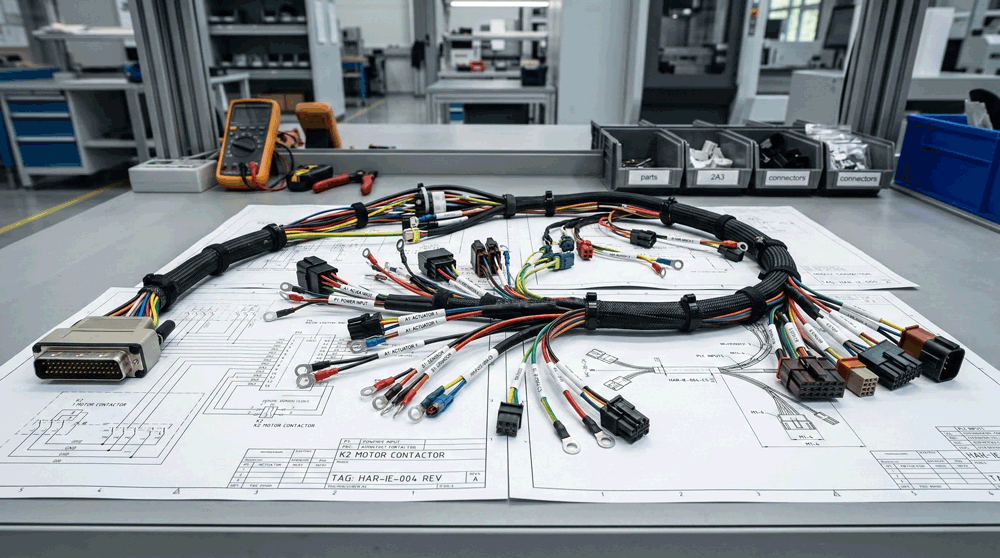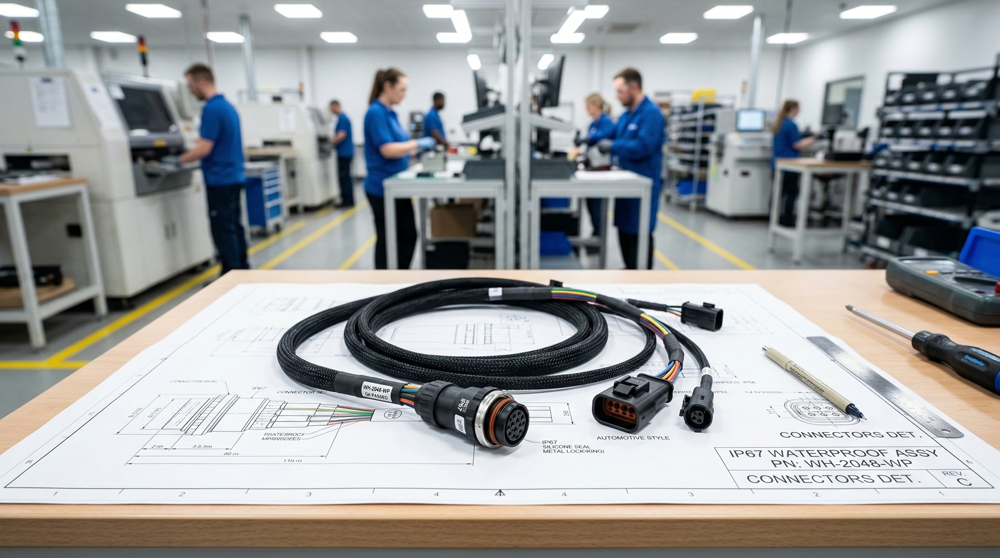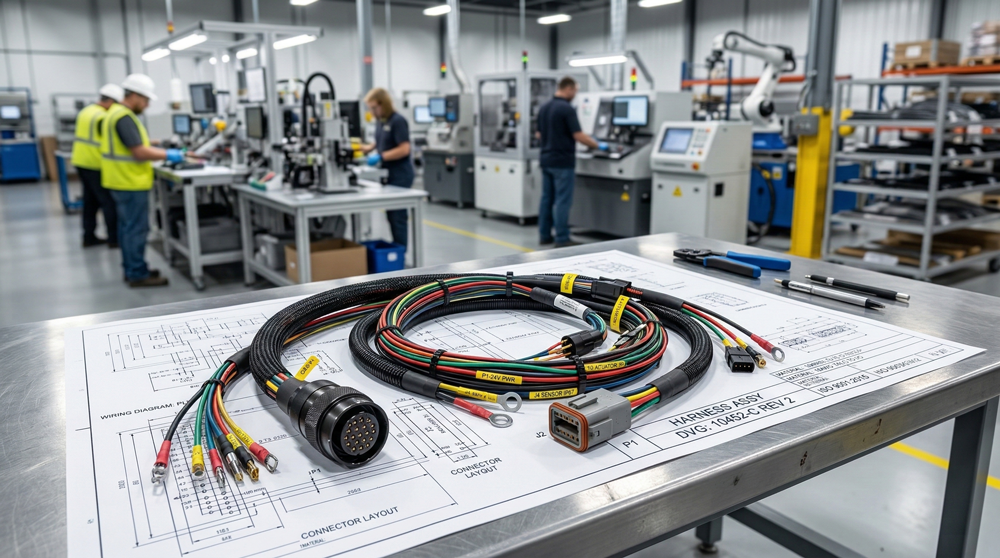
Cable assemblies for robotics and automation have to do much more than complete an electrical connection. In most OEM systems, they are exposed to motion, vibration, repeated bending, tight routing, maintenance handling, and electrically noisy environments. A cable that works in a static cabinet may fail much earlier when installed on a robot arm, linear module, drag chain, end-of-arm tool, or moving automation platform.
For OEM buyers, that means the sourcing decision is not just about connector fit or piece price. It is a reliability, serviceability, and uptime decision. The right cable assembly helps the machine run consistently, supports easier maintenance, and reduces future field issues. The wrong one creates intermittent faults, repair time, and hidden lifecycle cost that is much larger than the original quotation difference.
Table of Contents
ToggleWhy Automation Is Different
Robotics and automation equipment place a different kind of stress on cable assemblies than standard industrial electronics. In many machines, the cable is not sitting quietly in one protected location. It moves with the machine, bends around guide points, twists near joints, or runs through drag chains over long travel distances. At the same time, it may also sit near motors, drives, switching devices, pneumatic hardware, oil mist, dust, or vibration. These combined conditions are exactly what turn a basic interconnect into a more demanding engineering decision.
This is also why automation cable failures can be difficult and expensive. The first problem is often not a total failure. It may start as an intermittent signal, a weak feedback line, a damaged shield, a fatigued conductor, or a connector that loosens slightly during vibration. Those issues are much harder to diagnose than a complete open circuit because the machine may run normally for part of the day and fail only under certain movement or load conditions. In an OEM environment, that kind of fault creates downtime, service pressure, and customer frustration.
For procurement teams, the implication is clear. A robotics cable assembly should be judged by how well it supports machine reliability over time, not just whether it can be built and delivered once. In B2B automation projects, the cable assembly is part of the machine’s operating stability.
Define the Motion
The most important input in many automation cable projects is the motion profile. A cable inside a static cabinet can often use one design logic. A cable on a moving carriage, robot wrist, or energy chain needs another. Before a buyer asks a supplier to quote, the team should understand exactly how the cable moves in service.
The first question is whether the cable is static, flexing, or twisting. The second is where the stress concentrates. In many real failures, the cable does not fail evenly across its full length. The problem starts at the connector exit, at a clamp point, where the cable enters a drag chain, at a breakout, or at a tight repeated bend. The third question is how often the motion repeats. Occasional machine movement and continuous cycle operation are very different duty conditions.
When a supplier understands the real movement, they can recommend more appropriate materials, bend protection, and strain-relief methods. Without that information, the quote may still look complete, but the design is based on assumptions. In robotics and automation, assumptions around motion often become field problems later.
Know the Application
Not every automation system needs the same cable strategy. A robot arm, a gantry, a collaborative robot tool interface, a machine vision cable, and a cabinet harness all face different stresses. Treating them as one generic category usually leads to overdesign in some areas and underdesign in others.
A static cabinet build often prioritizes clear routing, labeling, and terminations. A drag-chain cable prioritizes repeated flex life and jacket durability. An end-of-arm cable may need compact routing and easy replacement. A sensor or communication cable may need stronger shielding and cleaner grounding logic. A mobile automation system may combine motion, vibration, and environmental exposure in one application.
This is why application definition should come before pricing pressure. The better the buyer describes the real use case, the more accurate the supplier’s technical response becomes. That improves not only the assembly design, but also the quality of quotation comparison between manufacturers.
Choose the Right Cable
Cable construction matters more in robotics than many buyers expect. On a BOM, two cable options may look similar because conductor count, nominal size, and shielding style appear close. In machine operation, however, the difference can be significant.
Conductor design affects flex performance. Insulation material affects flexibility, heat tolerance, and chemical resistance. Shield construction affects both noise protection and how the cable behaves under repeated movement. Jacket material affects abrasion resistance, service feel, and routing stability. In robotics and automation, these choices should follow the movement and environment rather than distributor convenience.
A cable that works well in a stationary electrical cabinet may not survive repeated bending in an axis chain. A rugged cable may still be the wrong choice if it is too stiff for a compact robot route. A nominally shielded cable may still create signal instability if the shielding design or termination method is weak. That is why OEM teams should review cable construction as a system decision, not just a material line item.
Select Better Connectors
Connector selection in automation should never stop at mating compatibility. The connector also influences vibration resistance, retention security, routing direction, maintenance speed, and operator handling. In dense equipment layouts, the wrong connector style may create strain at the exit point or make service unnecessarily difficult.
A robotics or automation connector should be reviewed for locking strength, keying clarity, access during maintenance, and cable exit orientation. On moving equipment, a weak locking feature can become a reliability problem. On a compact machine module, connector size and direction can affect the entire routing path. On serviceable modules, a connector that is hard to release may turn a routine replacement into a frustrating repair task.
Connector selection is also tied to signal and power behavior. In mixed systems where control, communication, and power run close together, the connector strategy should support proper separation and shielding rather than create extra noise risk. For OEM buyers, this means the lowest connector cost is not always the lowest system cost.
Control Routing
In automation systems, routing is part of design control, not just installation detail. A cable can be electrically correct and still fail because the routing path creates repeated stress, abrasion, twist, or service difficulty. This is one reason why a good sample alone is not enough. A carefully handled prototype may survive conditions that a production machine will repeat thousands of times.
Good routing starts with realistic bend radius, protection at wear points, and proper support near motion transitions. It should prevent repeated rubbing against edges, avoid over-tight tie points, and reduce concentrated stress near connectors and breakouts. In drag-chain applications, the route must support natural cable movement instead of forcing the cable to fight the machine. In robot applications, routing should avoid unnecessary weight and stiffness at joints and end effectors.
OEM engineering teams should therefore review routing early, not after assembly complaints appear. A supplier with real automation experience should be able to comment on likely wear points and stress locations before production begins.
Improve Strain Relief
Strain relief is often treated as a small construction detail, but in robotics and automation it is a major reliability control. Many cable failures begin where the cable exits the connector or where mechanical load is transferred into the assembly without enough support.
The problem is simple. Connectors are designed to make and hold electrical contact, not to absorb repeated bending and pull forces from machine motion. If the cable leaves the connector and immediately enters a stressed bend, twist, or vibration zone, fatigue begins near the termination area. Over time, this can damage conductor stability, contact performance, or shield continuity.
The correct strain-relief method depends on the application. Some assemblies benefit from boots, overmolds, clamps, or controlled tie-down points. Others need routing support that reduces movement near the connector rather than adding more material. The right answer depends on space, motion, service pattern, and cable construction. What matters most is that strain relief is designed intentionally instead of assumed.
Protect Signal Integrity
Automation systems often place cable assemblies close to drives, motors, switching power devices, servo systems, sensors, and communication networks. That means signal integrity can become just as important as mechanical durability. A machine may appear to have random faults when the real issue is poor shielding behavior, weak grounding practice, or cable routing too close to electrical noise sources.
For signal and feedback assemblies, the buyer should think beyond “shielded” versus “unshielded.” Shield type, termination method, grounding concept, connector design, and route location all influence actual performance. A poorly implemented shield can provide much less protection than expected. Likewise, an otherwise good cable may still show unstable behavior if it is routed carelessly through a noisy part of the machine.
This is especially important in robotics, motion control, and machine vision systems where signal quality affects position feedback, sensor reliability, and communication stability. The cost of getting this wrong is not just a rejected cable. It can become a machine-debugging problem that wastes engineering and field-service time.
Design for Service
Automation equipment must be built for production, but it must also be built for maintenance. A cable assembly that is difficult to identify, disconnect, or replace becomes a hidden service cost over the life of the machine.
Service-friendly design begins with access. Can a technician reach the connector without removing unnecessary surrounding parts? Is the routing path understandable? Are similar-looking branches clearly labeled? Is the cable easy to distinguish from other assemblies in the same zone? In automation service work, these small details matter because maintenance is usually performed under time pressure.
Labeling is therefore not just a documentation issue. It is part of the product. A visible, durable identifier helps machine builders, field technicians, and spare-parts teams work faster and more accurately. If the same cable assembly will later be sold as a service part, then packaging, revision visibility, and installation clarity should be designed from the start.
Prepare a Better RFQ
Many cable assembly RFQs in automation are too thin for the application. They may include connector references, pin definitions, and nominal length, but not enough context about motion, environment, routing, or service use. A manufacturer can still quote from that package, but the quote may reflect internal assumptions rather than the machine’s real needs.
A stronger RFQ gives the supplier a better picture of the application. Useful inputs often include route photos, movement description, expected cycle behavior, environment notes, service expectations, volume forecast, and any known prototype lessons. If the assembly runs near drives or motors, that should be visible. If the cable will be flexed continuously or routed through a robot arm, that should be stated explicitly.
Procurement should also clarify what kind of support is expected. Some projects need only build-to-print execution. Others need engineering review, packaging support, DFM feedback, or documentation readiness for repeat supply. In B2B OEM sourcing, this makes a big difference in how useful the supplier’s response will be.
Qualify for Repeatability
A successful sample proves that one assembly can be built. It does not automatically prove that the design is robust for robotics or automation use, or that the supplier can repeat the same quality across volume. This is why qualification should go beyond continuity testing and visual approval.
The right qualification depth depends on the application, but automation projects often benefit from closer review of routing stability, strain-relief performance, connector retention, shielding implementation, label consistency, and production repeatability. In moving applications, early pilot feedback is especially useful because it shows whether the build remains stable outside a carefully managed prototype event.
Pilot production is where many hidden issues become visible. A supplier may build an excellent prototype by using extra care and manual attention, but pilot reveals whether the same assembly can be produced consistently, packaged correctly, and documented cleanly. For OEM buyers, this is where a strong cable assemblies manufacturer proves long-term usability.
Control Cost Carefully
Cost matters in every automation project, but cost reduction should not damage machine reliability. In many cases, the safest savings come from design simplification, clearer documentation, more efficient assembly steps, or sensible component standardization rather than aggressive material downgrading.
A better branch layout, a cleaner routing scheme, or a more standardized label format may reduce production cost without increasing field risk. By contrast, selecting a weaker jacket, marginal connector, or lower-suitability cable construction may save money in quotation while creating much larger costs in downtime, troubleshooting, or warranty response.
This is why the better sourcing question is not simply “Can you make it cheaper?” but “Where can this design be optimized without hurting motion life, serviceability, or signal stability?” Good suppliers respond much better to that question because it invites engineering judgment instead of pushing the project toward hidden risk.
Choose the Right Supplier
Selecting a cable assembly supplier for robotics and automation is not just about factory capacity. It is also about technical understanding, communication quality, prototype discipline, documentation control, and long-term support. A supplier that understands automation should be able to ask strong questions early and recognize where the real application risk sits.
That includes motion profile, stress points, shielding needs, service expectations, and likely failure modes. A capable manufacturer should not simply quote from a connector list. They should help the OEM clarify where the design is already strong, where it is vulnerable, and where improvements might reduce lifetime risk. In B2B programs, that kind of supplier support often matters more than a small initial price difference.
Commercially, OEM buyers should also think about repeat supply. Can the supplier maintain consistent workmanship, labels, and routing? Can they support revisions cleanly? Can they respond when the project scales or changes? Those questions matter because in automation, long-term usability is part of supplier quality.
Conclusion
Cable assemblies for robotics and automation should be selected according to real motion, environment, signal demands, service needs, and supplier capability rather than only connector fit and piece price. In most OEM automation systems, the cable assembly is directly tied to uptime, troubleshooting effort, and lifecycle cost.
The strongest approach is to define the movement clearly, match cable construction to the real duty, select connectors with service and retention in mind, control routing and strain relief carefully, and qualify the design for repeatability rather than only prototype success. When buyers do that, they are not just purchasing an assembly. They are reducing machine risk.
FAQ
What makes cable assemblies for robotics different from standard industrial cable assemblies?
Robotics applications usually combine repeated motion, bending, torsion, vibration, and tighter routing space. That means cable construction, connector retention, strain relief, and serviceability often matter much more.
Is a static industrial cable suitable for a robot or drag-chain application?
Not necessarily. A cable that works well in a cabinet may fail much earlier in a moving system if it is not designed for repeated flexing or torsion.
What should OEM buyers provide in an automation cable RFQ?
Beyond drawings and pinout, suppliers should receive movement description, route photos, environment details, expected cycle behavior, service expectations, and target volume.
Is continuity testing enough for qualification?
No. In many automation projects, qualification should also review routing stability, strain relief, connector retention, shielding behavior, labeling, and repeatability in pilot production.
How can buyers reduce cost without increasing machine risk?
The safest approach is usually design simplification, manufacturability improvement, and sensible standardization rather than lowering the grade of critical cable or connector materials.
CTA
If you are sourcing cable assemblies for a robotics or automation project, the best place to start is a review of your movement profile, route constraints, environment, and service requirements before comparing price alone.
You can send your drawings, BOM, route photos, annual demand, and project details through Contact. Our team can help review the application and support a more practical OEM sourcing discussion for your next automation program.