Cable assemblies for industrial equipment are rarely selected on connector appearance or nominal electrical fit alone. In real OEM and procurement work, the decision is tied to machine uptime, installation reliability, serviceability, compliance expectations, and long-term supply stability. A cable assembly that works on the bench but fails under vibration, bending, oil mist, repeated mating cycles, or cabinet heat is not a low-cost choice. It is a future downtime event waiting to happen.
That is why OEM buyers should evaluate industrial cable assemblies as part of a full equipment-risk decision, not as a simple purchased component. The right cable assembly supports production continuity, reduces field failures, simplifies maintenance, and gives engineering and sourcing teams better control over revisions and future volume. The wrong one creates hidden cost through troubleshooting time, inconsistent installation, warranty exposure, and difficult supplier conversations later.
Table of Contents
ToggleWhy industrial equipment needs a different cable assembly approach
Industrial equipment places very different demands on interconnect systems than many light-duty electronic products. In a consumer device, a cable may be protected inside a compact housing, handled infrequently, and exposed to relatively stable conditions. In industrial machinery, the cable assembly may sit near motors, moving axes, sharp edges, hydraulic systems, heat sources, chemical splash, outdoor exposure, or continuous vibration. It may also be routed through crowded cabinets, tight enclosures, drag chains, or service panels where incorrect length, poor strain relief, or weak connector retention immediately becomes a practical problem.
For that reason, industrial cable assemblies should be specified according to operating reality rather than nominal signal requirement alone. Procurement teams sometimes begin with the electrical interface and then ask for a quote. That is understandable, but it is only one part of the picture. A factory-ready cable assembly also depends on bend radius, flex frequency, abrasion risk, mating cycle expectations, ingress risk, EMI exposure, mounting constraints, labeling rules, and maintenance access. Once these conditions are ignored early, the program often pays for them later through redesign, rework, or repeated service complaints.
This is also why a custom cable assembly supplier that understands industrial applications brings more value than a supplier that only offers assembly capacity. The supplier should be able to review not just the pinout, but also the equipment environment, routing method, expected service life, and likely failure points. In B2B industrial programs, that engineering conversation is often where cost is controlled most effectively, because many future problems can be prevented before the first production order is placed.
Not all industrial equipment has the same cable risk
One of the most common specification mistakes is treating “industrial equipment” as if it were one environment. It is not. A cable assembly inside a stationary control cabinet faces different risks from a cable on a robotic arm, a test bench, a battery system, or a mobile outdoor machine. OEM buyers should therefore begin by classifying the actual application instead of assuming one general industrial build will suit everything.
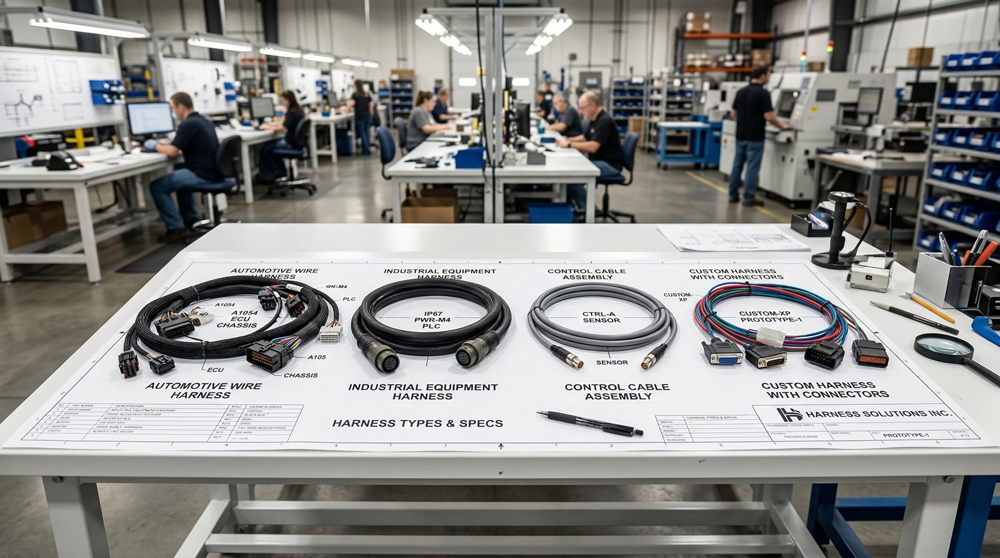
A useful way to think about this is to separate industrial equipment by operating stress and maintenance pattern. A control cabinet harness may prioritize routing clarity, identification, and long-term terminal stability. A robotics cable assembly may prioritize repeated flex life, torsion resistance, and jacket durability. A machine-interface cable may need strong shielding, locking connectors, and strain relief because operators connect and disconnect it regularly. A sensor lead near oil, dust, and coolant may need chemical resistance and sealing performance that a cabinet cable never needs. Even within the same machine, different cable assemblies may require different design logic.
The table below shows how application differences often change cable assembly priorities.
| Industrial application | Primary stress factors | Typical cable assembly priorities |
|---|---|---|
| Control cabinets | Heat, routing density, identification, maintenance access | Clear labeling, consistent lengths, organized breakout, reliable terminations |
| Robotics and automation | Continuous flexing, torsion, motion cycles | Flex-rated cable, robust strain relief, controlled bend radius, jacket durability |
| Machine tools | Vibration, oil mist, coolant, mechanical abrasion | Abrasion resistance, secure locking, chemical compatibility, stable shielding |
| Outdoor industrial equipment | UV, moisture, temperature swings, dirt | Sealing, weather resistance, UV-resistant jacket, corrosion protection |
| Power and drive systems | Current load, heat rise, EMI, installation safety | Correct conductor sizing, insulation margin, shielding, secure grounding |
| Serviceable modules | Frequent mating cycles, human handling | Connector durability, foolproof keying, label clarity, easy replacement |
This kind of application review helps procurement and engineering move beyond generic RFQ language. Instead of asking for “industrial cable assemblies,” the team can define the real environment and let the supplier respond with a more accurate build recommendation.
Start with the equipment environment, not just the connector list
When OEM buyers source cable assemblies for industrial equipment, they often begin with the connector part numbers because connectors are visible and easy to compare. That is useful, but it is not the best starting point. The better starting point is the equipment environment.
A good cable assembly specification should answer several operating questions early. Will the cable remain static or move repeatedly? Will it see torsion, flexing, or vibration? Is it close to motors, inverters, or switching devices that create EMI concerns? Will it be installed in a clean cabinet or exposed to oils, solvents, dust, water spray, or UV? Will technicians unplug it during service, or is it a fixed internal connection expected to remain undisturbed for years? Each answer influences the material set, strain-relief strategy, shielding approach, marking method, and connector retention choice.
This matters because the most expensive failures are often not caused by wrong pinout. They are caused by the right electrical design packaged in the wrong mechanical or environmental solution. A cable assembly can pass incoming inspection and still perform poorly if the jacket hardens in low temperature, the shielding is insufficient near drives, the overmold traps strain poorly, or the connector does not tolerate repeated maintenance handling. Those are application-fit problems, not simple build-quality problems.
For that reason, industrial OEM projects benefit from gathering environmental input before asking suppliers to optimize price. Cost pressure is real, but early under-specification often creates a false economy. A slightly stronger design at the start can reduce far larger service and downtime costs later.
Component selection should reflect industrial duty, not catalog convenience
In industrial cable assemblies, component selection is where many hidden risks are created or removed. It is not enough to choose whatever connector, cable, and protection parts are easiest to source in the moment. The bill of materials should reflect what the equipment actually needs in service.
Connector selection is one example. The right connector is not just the one that fits the mating interface. It should also match the installation pattern, locking requirement, service access, ingress needs, mating cycle expectation, and operator handling risk. In an industrial setting, connector retention and keying often matter as much as contact count. If technicians work quickly in the field or in a production environment, the connector system should help prevent mis-mating and accidental loosening rather than relying on perfect care.
Cable construction is another major decision point. Conductor class, insulation material, shielding structure, overall jacket, and flex rating all influence real-world performance. A cable that is acceptable in a static enclosure may fail much earlier in a moving application. A standard PVC build may be commercially attractive but perform poorly in oil-heavy or outdoor conditions. Shielding may be essential in one machine zone and unnecessary cost in another. The right answer depends on application logic, not on what is cheapest in a distributor search.
Secondary materials matter too. Sleeving, tape, corrugated tube, braid, heat shrink, labels, boots, grommets, and strain relief components all affect assembly stability and service usability. In industrial OEM programs, these so-called small materials often determine whether the final assembly feels professional, installs cleanly, and survives repeated handling. Buyers who review only the main connector and cable line items often overlook where the actual lifetime problems begin.
This is where a capable OEM cable assemblies manufacturer should contribute value. A strong supplier should not simply ask for a completed part list. They should help review whether the chosen materials fit the operating duty and where a change in component strategy may improve reliability, manufacturability, or sourcing resilience.
Wiring design details that industrial buyers should not leave vague
Many industrial cable assembly projects suffer because the design package looks technically complete but leaves too much open to interpretation. A drawing may show connectivity and nominal length, yet still omit the practical details that determine repeatable production and clean field installation.
Length strategy is one example. In industrial equipment, the difference between a usable cable and an awkward one may be only a few centimeters, especially inside cabinets or across moving axes. If the buyer specifies length without defining how it is measured, where the reference points are, or whether breakout lengths are critical, different suppliers may build assemblies that are technically “to drawing” but behave differently during installation. This becomes a bigger issue when multiple branches, breakout points, and protection sections are involved.
Labeling is another overlooked area. Industrial equipment often requires clear cable ID for assembly, maintenance, service, and future troubleshooting. If labels are not clearly defined in content, format, location, durability, and visibility, the final product may still function but create long-term service inefficiency. In B2B machinery supply, poor identification is a real lifecycle cost.
Breakout orientation, shielding termination, drain wire treatment, grounding method, color logic, connector clocking, and protection placement also deserve more attention than they sometimes receive. These are not drafting niceties. They are repeatability controls. A capable supplier can build much more consistently when those details are defined clearly, and a procurement team can compare quotes more fairly when suppliers are pricing the same build reality.
This is one reason internal document discipline matters so much. If your team is evaluating a new project or moving volume to a different supplier, a strong document-review process such as Choosing OEM Cable Assemblies for Different Applications should connect naturally to engineering clarification before sourcing decisions are finalized.
Industrial cable assemblies should be designed for service as well as production
OEM buyers often focus on assembly efficiency during production, which is important, but industrial equipment also needs to be serviced. A cable assembly that is difficult to identify, difficult to remove, or easy to damage during maintenance can create avoidable downstream cost for both the OEM and the end user.
Service-friendly design begins with access. Can a technician disconnect the cable without stressing adjacent components? Are the locking features accessible? Is the mating orientation obvious? Can the cable be routed out and replaced without cutting other ties or dismantling a large section of the machine? In many industrial systems, these questions matter just as much as the original installation.
Labeling and part identification are also central to serviceability. A clean printed identifier, visible at the right location, saves time every time the machine is repaired, upgraded, or inspected. That may sound small, but in field service or production maintenance environments, minutes matter. Good industrial cable assemblies reduce the mental load on technicians. They do not require the technician to guess which similar-looking branch goes where.
There is also a spare-parts angle. OEM buyers should think about whether the same cable assembly design will be used only in initial production or also sold later as a replacement part. If service use is expected, packaging, labeling, part-number visibility, and installation clarity deserve even more attention. A supplier that understands this can help the OEM standardize better documentation and reduce service friction later.
What procurement should prepare before asking a factory to quote
Many sourcing delays happen because the RFQ package is too thin for an industrial application. The supplier can still provide a budgetary quote, but the commercial comparison becomes less meaningful because each factory is filling different gaps with its own assumptions.
A better RFQ package for industrial cable assemblies should include not only drawings and electrical definitions, but also application context. The supplier should understand the equipment type, motion pattern, installation environment, expected production volume, forecast behavior, service expectations, and any customer-specific compliance or documentation needs. Photos of routing space, mating interfaces, and installation constraints can be extremely useful. So can prototype lessons or previous field issues if they exist.
Procurement should also define what kind of commercial support is expected. Is the buyer looking only for piece-part pricing, or also for DFM input, material alternatives, packaging standardization, and long-term supply planning? Is the project low volume with high engineering complexity, or is it moving toward repeat volume where process stability and documentation matter more? These distinctions help the supplier respond more intelligently.
A strong supplier relationship starts when the factory is quoting the real project rather than only the visible connector list. Buyers who provide that context usually get better technical feedback, more accurate pricing logic, and fewer surprises during sample review.
Qualification for industrial equipment should go beyond continuity testing
For industrial equipment, basic electrical continuity is necessary but not sufficient. A cable assembly can pass continuity and still be wrong for the application. OEM buyers should therefore think about qualification in terms of operating risk, not just electrical completion.
The right qualification depth depends on the program, but industrial applications often justify review of dimensional consistency, connector retention, label accuracy, shielding implementation, workmanship quality, and environmental fit. In flexing applications, movement behavior matters. In outdoor or dirty environments, sealing and jacket choice matter. In machinery with noise-sensitive signals, shielding integrity and grounding method matter. In power-carrying assemblies, temperature rise and installation margin matter. The exact mix varies, but the principle remains the same: qualification should reflect service reality.
Pilot builds are especially valuable here. A sample can prove that one assembly can be built. A pilot helps show whether the supplier can build the same assembly repeatedly, identify issues early, package it correctly, and support traceable output. For industrial programs, that repeatability is where long-term supply confidence comes from.
This is also where the supplier’s engineering mindset becomes visible. A professional cable assemblies factory will not treat qualification as a box-checking exercise. They will use it to confirm design interpretation, process stability, documentation readiness, and any remaining risks before volume release.
Cost reduction in industrial cable assemblies should be handled carefully
Every OEM program eventually asks whether cost can be improved. That is reasonable, especially for mature industrial products. But cable assembly cost-down should be approached carefully because many “savings” simply move cost from purchasing into service, quality, or downtime.
The best cost reduction usually comes from design clarity, better manufacturability, sensible component selection, and volume planning rather than blunt material downgrading. A cleaner branch layout, a better labeling approach, a more standard cable construction, or a simplified protective scheme may reduce assembly labor without increasing field risk. By contrast, replacing a suitable jacket with a weaker one, removing useful strain relief, or choosing a marginal connector system may reduce quotation cost while increasing lifecycle cost.
This is why industrial OEM buyers should ask a more useful question than “Can you make it cheaper?” The stronger question is “Where can this design be optimized without creating service risk or shortening equipment life?” Good suppliers respond better to that question because it invites engineering review rather than defensive price negotiation.
It also helps to separate frozen requirements from open areas. If the application demands certain materials or connector systems, that should be clear. If some non-critical elements can be optimized, that should also be clear. The more precise that boundary is, the more productive the supplier conversation becomes.
Choosing the right cable assembly manufacturer for industrial programs
Selecting a cable assembly manufacturer for industrial equipment is not only about capacity and quotation speed. It is about whether the supplier can support the full life of the program. That includes engineering communication, prototype feedback, process consistency, documentation response, revision control, packaging discipline, and willingness to support both low-volume development and future repeat business.
A strong industrial supplier usually shows its value early. They ask better application questions. They look at routing, flexing, environment, and service use, not just the connector BOM. They explain where a design may be vulnerable and where a more robust choice would make sense. They can also distinguish between what should remain frozen and what can be optimized. That is a meaningful difference in B2B OEM work because it reduces the risk of accidental assumptions entering the build.
Commercially, buyers should also think about supply continuity. Can the supplier support forecast changes? Do they understand how to manage alternate materials responsibly? Can they maintain stable workmanship and identification standards across batches? Are they responsive when documentation changes? These are not minor details. They are part of whether the supplier is usable as a long-term manufacturing partner.
Pages such as Why Choose Us and Contact matter only when they reflect real operating behavior. For industrial cable assemblies, the right supplier is the one that helps the OEM reduce risk before the machine reaches the field.
Conclusion
Cable assemblies for industrial equipment should be chosen according to application duty, service environment, maintenance reality, and long-term supply control rather than only connector fit or initial price. Industrial OEM programs demand more from cable assemblies because those assemblies often live in harsher, more variable, and more service-sensitive conditions than standard electronic products. That changes how buyers should think about material selection, design detail, qualification, serviceability, and supplier choice.
For procurement and engineering teams, the most effective path is usually to start with the real machine environment, define what the assembly must survive, prepare a better RFQ package, and work with a manufacturer that can contribute technical judgment rather than only assembly labor. When that happens, the result is not just a cable that works. It is an interconnect solution that supports machine uptime, easier maintenance, cleaner production, and lower long-term risk.
FAQ
What makes industrial cable assemblies different from standard cable assemblies?
Industrial cable assemblies usually face harsher conditions such as vibration, flexing, oil, dust, heat, EMI, and maintenance handling. That means material choice, strain relief, labeling, shielding, and connector retention often matter much more.
Should OEM buyers use the same cable assembly design across all industrial equipment?
Not usually. A control cabinet, robot arm, outdoor machine, and serviceable module may all need different cable strategies even if the electrical function looks similar.
Is continuity testing enough to qualify a cable assembly for industrial equipment?
No. Continuity is only a basic check. Industrial qualification often also needs review of mechanical fit, labeling, workmanship, shielding, environmental suitability, and repeatability in pilot production.
What information should procurement provide when asking for an industrial cable assembly quote?
At minimum, the supplier should receive drawings, electrical requirements, application description, environment details, routing constraints, expected volume, and any service or compliance requirements.
How can buyers reduce cable assembly cost without increasing field risk?
The safest cost-down path usually comes from design simplification, manufacturability improvement, sensible standardization, and controlled material review rather than aggressive downgrading of critical components.
CTA
If you are sourcing cable assemblies for industrial equipment, the best starting point is a review of your application environment, routing conditions, service requirements, and current design package before moving directly into price comparison.
You can send your drawings, BOM, annual demand, equipment photos, and project requirements through Contact. Our team can help review the application, identify potential design risks, and support a more practical sourcing discussion for your next industrial OEM program.