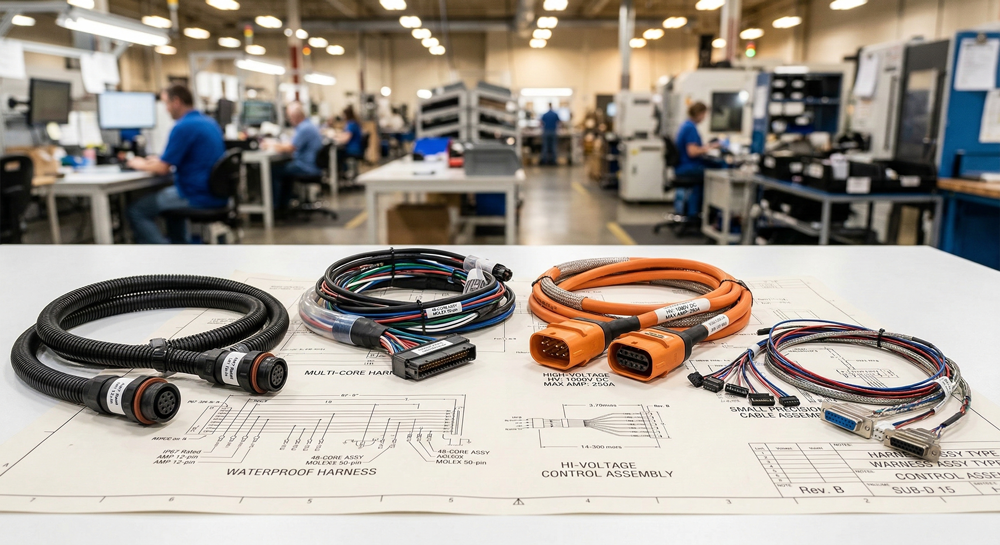
Wire harness second source qualification is one of the most practical ways for OEM buyers to reduce supply risk without creating unnecessary disruption. In many programs, the problem is not that the current supplier has already failed completely. The problem is that the business has become too dependent on a single source for a part category that directly affects production continuity, customer delivery, and field support. Once that dependency becomes visible, the right question is no longer whether a second source is theoretically useful. The real question is how to qualify a second source in a way that protects quality, document control, and execution stability rather than simply adding another name to the supplier list.
That distinction matters. A second source is not valuable merely because it exists. It becomes valuable only when it is genuinely buildable, commercially usable, and operationally interchangeable within a defined control framework. If the second supplier can quote but cannot support revision control, cannot manage approved alternates clearly, cannot match the required test discipline, or cannot hold the same traceability expectations, then the buyer has not created resilience. The buyer has only created the appearance of resilience.
For wire harness programs, that risk is particularly important because interchangeability is rarely as simple as matching a drawing visually. A qualified second source must be able to understand the same released definition, build against the same material logic, support the same approval path, and respond to the same quality expectations under normal production pressure. That is why wire harness second source qualification should be treated as a controlled project, not a reactive purchasing shortcut.
In practice, this topic sits at the intersection of sourcing, engineering, quality, and operations. Procurement may initiate the second-source strategy, but engineering often determines whether the technical baseline is actually transferable. Supplier Quality Engineering (SQE) determines whether the supplier’s controls are trustworthy. Planning and operations determine whether the second source can support forecast reality rather than only small qualification lots. A mature qualification process aligns all of those perspectives early, before urgency distorts the decision.
This article explains how OEM buyers should approach wire harness second source qualification from a B2B project-control perspective. The objective is not just to create supplier redundancy on paper. The objective is to build a second source that can support business continuity, improve negotiation leverage, strengthen program resilience, and still remain controlled enough to avoid document drift, quality surprises, or inventory confusion later.
Table of Contents
ToggleWhy second source strategy matters
Many buyers first think about a second source after a disruption has already happened. Lead times slip, a quality escape reaches the customer, a commercial dispute escalates, or an engineering change becomes harder to implement than expected. At that point, the organization scrambles to find another factory. That reaction is understandable, but it is not the strongest way to build supply resilience. The stronger approach is to qualify a second source before the business becomes dependent on emergency decisions.
A second source matters because single-source dependence creates hidden cost even when supply is currently stable. It reduces procurement leverage. It limits capacity flexibility. It increases the cost of poor supplier response. It can slow engineering changes because the buyer becomes reluctant to challenge a supplier that has no alternative. It also narrows the organization’s options when demand increases suddenly or regional delivery conditions change.
For custom wire harness programs, this issue becomes even more important when the harness is embedded in a larger assembly or customer schedule. A delayed or inconsistent harness can stop a final product line even when the harness itself is a relatively small percentage of the total bill of materials. That mismatch between piece-part cost and business impact is exactly why second source planning belongs in broader project risk management.
There is also a strategic commercial reason. A well-qualified second source improves the buyer’s negotiating position without forcing an immediate supplier replacement. It gives the organization optionality. In some cases, the incumbent supplier becomes better simply because expectations become more credible when alternative capacity exists. In other cases, the second source becomes the future primary source after proving stronger support, better control, or better responsiveness over time. Either way, qualification creates choices, and choices reduce risk.
What second source qualification really means
Second source qualification is often misunderstood as “find another factory that can make the same harness.” That definition is too shallow. A second source should not be qualified only on the basis of sample appearance, quote competitiveness, or one-time test pass results.
Real qualification means the buyer has sufficient confidence in five linked areas. First, the supplier can interpret the released drawing and product definition consistently. Second, the supplier can source and control the required components within approved rules. Third, the supplier can build repeatably rather than only producing a successful hand-held sample. Fourth, the supplier can document conformance and traceability in a way that supports the buyer’s operating model. Fifth, the supplier can respond responsibly when changes, deviations, or nonconformities occur.
That is why second source qualification is not identical to a new supplier trial order. A trial order can be commercially useful, but it does not by itself prove interchangeability. In wire harness supply, interchangeability has to be operational, not merely visual or electrical. The second source should fit into the buyer’s existing approval logic without creating a separate and fragile set of undocumented exceptions.
For OEM teams, this means that qualification must be tied to the same discipline already discussed in articles like Wire Harness Drawing Review, Wire Harness BOM and Part Control, and Wire Harness Prototype Review and Pilot Build. If the baseline is weak, second-source qualification becomes harder. If the baseline is strong, second-source qualification becomes much more predictable.
Start with the right qualification trigger
Not every harness needs a second source immediately. Some parts are low-risk, low-volume, or highly supplier-specific. Others deserve formal dual-source planning much earlier. The buyer should therefore define the trigger for second source qualification rather than treating every part the same.
The best trigger is usually a business-risk trigger rather than a purely emotional one. For example, the harness may support a customer-facing product with tight delivery commitments. The annual demand may be growing beyond one supplier’s comfort zone. The harness may use components with longer lead times, which increases exposure if the supplier’s planning discipline weakens. The incumbent supplier may be acceptable today, but response speed, engineering support, or change-control maturity may no longer match the program’s future needs.
Another common trigger is organizational maturity. As a product line grows, procurement teams often move from opportunistic buying to portfolio management. At that stage, the business starts asking more structured questions. Which harnesses are single-source? Which are revenue-critical? Which have no rapid recovery option if one supplier becomes unstable? Which parts need a qualified second source before the next customer launch? Those are stronger questions than simply asking whether another quote is available.
The important point is that second-source qualification should begin while the organization still has room to think clearly. If the process starts only after delivery has already failed, the buyer is more likely to compress qualification stages and accept avoidable risk.
Define the interchangeability standard first
Before any Request for Quotation (RFQ) goes out, the buyer should define what “qualified second source” actually means for the project. This is one of the most important steps, and it is often skipped.
Some teams assume interchangeability means exact material equivalence with no deviations. Others allow equivalent approved components but require functional and dimensional consistency. Some programs demand shipment-level traceability and formal evidence packs. Others only need a lighter approval model. None of these approaches is automatically right or wrong. The problem begins when the buyer has not decided which standard applies.
A useful way to frame it is to ask four questions. Must the second source match the current source part-for-part, process-for-process, and label-for-label? Or is there controlled room for approved equivalents? Does qualification require only technical approval, or also supply assurance and documentation readiness? Is the second source being qualified for backup capacity only, or for future production allocation as well? And if a difference exists, who decides whether that difference is acceptable?
Once those answers are clear, the team can align qualification requirements more intelligently. Without that alignment, engineering may approve one standard, quality may inspect against another, and procurement may buy against a third. That is exactly how “qualified” suppliers later become operational problems.
Build a clean source transfer package
A second source cannot be qualified consistently with a weak or incomplete information package. Even when the business is not performing a full supplier transition, the second source still needs a reliable technical and documentation baseline.
The source package should begin with the released drawing set and controlled revision status. That seems basic, but many second-source projects still suffer from mixed versions, informal markups, missing notes, or long-standing production practices that never made it into formal documentation. If the current supplier has been building from partially tribal knowledge, the second source will expose that weakness quickly.
The package should also include a structured bill of materials with manufacturer part numbers where relevant, approved alternates policy, wire specifications, connector and terminal definitions, sealing requirements, labels, packaging expectations, and test criteria. If there are customer-owned tools, application tooling constraints, or inspection fixtures that affect repeatability, those should also be addressed early.
This is where disciplined document preparation pays off. A second source qualification project benefits greatly when the buyer has already done the kind of control work described in Wire Harness Drawing Review and Wire Harness BOM and Part Control. The better the package, the more the second-source decision becomes a real capability evaluation instead of a guessing exercise.
It is also wise to clarify what is frozen and what is open for engineering feedback. Some buyers want a pure duplication of the existing build. Others are willing to hear Design for Manufacturability (DFM) suggestions during qualification. Both approaches can work, but they should not be mixed casually. If the supplier is expected to qualify as a second source, the buyer should avoid turning the project into a hidden redesign unless that redesign is explicitly controlled.
Evaluate supplier capability before sample enthusiasm
Buyers often become too optimistic once a new supplier responds quickly and offers a competitive sample schedule. But responsiveness alone is not qualification. Before sample build begins, the team should evaluate whether the supplier’s underlying capability supports second-source requirements.
This evaluation does not need to be bureaucratic, but it should be deliberate. The buyer should assess whether the supplier asks useful technical questions, identifies drawing gaps, challenges ambiguous material definitions, and explains how they will control build records and outgoing verification. The quality team should look for evidence of process discipline rather than only polished presentations. The sourcing team should examine whether component channels are credible, especially when customer-approved connectors, terminals, seals, or wire constructions are involved.
Crimp capability is a good example. A supplier may say they can build the harness, but a stronger qualification question is whether they can control the crimp process in a measurable way, especially when terminal families are sensitive to applicator condition, wire construction, or stripping consistency. That is why capability topics such as Wiring Harness Supplier Crimp Quality Requirements are not merely manufacturing details. They are supplier qualification signals.
The same logic applies to traceability. A supplier may promise that lots are traceable, but the buyer should ask how traceability is actually maintained from incoming materials to outgoing shipments. If the answer is vague, the second source may still be usable for low-risk builds, but it should not be treated as interchangeable with a stronger source for higher-risk programs.
Use staged qualification, not one-step approval
A disciplined wire harness second source qualification usually follows stages. The exact depth depends on risk, but the sequence should move from understanding to evidence, not from optimism to purchase order.
The first stage is document and feasibility review. The supplier examines the package, confirms understanding, raises open points, and identifies any sourcing or manufacturability concerns. This stage tests engineering clarity and supplier attentiveness more than manufacturing skill, but it is still crucial. A supplier that does not surface ambiguity early often creates more expensive questions later.
The second stage is sample interpretation. Here the goal is to confirm that the supplier can read and translate the package correctly into a physical build. The buyer should examine whether labels, branch geometry, material choices, sealing details, and test interpretation align with the defined baseline. A sample is not yet proof of repeatability, but it is useful evidence of technical understanding.
The third stage is qualification evidence. Depending on project risk, that evidence may include First Article Inspection (FAI), crimp verification, dimensional confirmation, test records, packaging verification, and lot traceability demonstration. This is also the stage where the structure of a shipment record package becomes important. For programs with stronger documentation needs, a model similar to the Wiring Harness Quality Evidence Pack Guide can make second-source approval much more operationally useful later.
The fourth stage is pilot or limited allocation. This is where the buyer begins to see whether the supplier can repeat the approved build under ordinary production conditions. Pilot matters because many qualification surprises appear only when order quantity, planning logic, operator variation, and packaging flow become more realistic.
The fifth stage is approved conditional use. At this point, the second source may be added to the Approved Vendor List (AVL) or equivalent sourcing structure, but often with allocation boundaries, defined change-control rules, and continued monitoring.
A simple way to view this logic is below.
| Qualification stage | Main purpose | What the buyer is really checking |
|---|---|---|
| Document review | Confirm technical baseline understanding | Can the supplier read the package correctly and expose ambiguity early |
| Sample build | Confirm interpretation of the released design | Does the harness match drawing, BOM, labels, and material intent |
| Qualification evidence | Confirm measurable conformance | Can the supplier provide records that support approval and traceability |
| Pilot build | Confirm repeatability under real conditions | Does performance remain stable beyond a one-time successful sample |
| Conditional approval | Enable limited business use | Can the supplier operate within the buyer’s sourcing and change rules |
This staged approach helps prevent a common mistake: approving a second source after a good-looking sample but before the supplier has demonstrated operational discipline.
Control BOM, alternates, and component channels
One of the biggest hidden risks in second source qualification is uncontrolled material drift. Two harnesses can appear identical and still differ in ways that matter commercially or functionally. Terminal plating, seal fit, insulation wall structure, label stock, tape system, corrugated tube grade, or connector sub-variant can all affect downstream behavior, approval status, or field performance.
That is why BOM control is central to second-source strategy. The buyer should decide clearly which materials are locked, which are equivalent by specification, and which may be substituted only after review. In some programs, the second source must use the same component manufacturer as the primary source. In other programs, the buyer is comfortable with approved equivalent manufacturers as long as fit, function, compliance, and validation logic remain protected.
What matters most is that this rule is explicit. A second source should not be forced to guess what is commercially sensitive and what is flexible. Likewise, the buyer should not discover after the fact that the second source used a technically workable but commercially unapproved alternate. The more disciplined the alternates policy, the more realistic supplier comparison becomes.
This is one reason Wire Harness BOM and Part Control is such an important foundation for second-source qualification. BOM discipline is not just about quoting accuracy. It is about protecting the definition of what the buyer is actually approving across multiple suppliers.
Define approval and allocation rules early
A second source strategy becomes much more effective when the organization decides early how the approved source will actually be used. Without this step, qualification can become a symbolic exercise that never improves resilience.
Some companies qualify a second source only for emergency backup. Others immediately allocate a small percentage of annual volume to keep the source active. Others assign programs by region, customer type, or harness family. Each model has advantages, but the rule should be visible.
If the supplier will remain inactive after qualification, the buyer should recognize that operational readiness may decay over time. Materials change, staff changes, fixtures are stored, and knowledge becomes stale. A second source that never runs real orders may still look approved in the system while being much less usable in practice than expected.
For that reason, many mature buyers prefer some controlled live allocation, even if the share is small. A limited but recurring order stream keeps documentation current, maintains process familiarity, and gives the supplier a real reason to preserve readiness. It also allows the buyer to compare actual performance metrics, not just qualification claims.
Approval rules should also define change control. If the primary source changes a component, drawing note, label logic, or packaging method, how will the second source be updated? Does every change automatically flow to both sources? Is revalidation required? Who owns synchronization of the approved baseline? Without those rules, dual sourcing can create two drifting product definitions instead of one resilient supply model.
Monitor second-source performance after approval
Approval is not the end of qualification. It is the beginning of a new control phase. Once the second source becomes commercially active, even at low allocation, the buyer should monitor how the supplier behaves under normal conditions.
The most obvious metrics are delivery, quality, and response time. But second-source performance should also be judged on documentation consistency, change discipline, traceability clarity, and ability to close issues without repeated supervision. In many cases, these operational behaviors tell the buyer more about long-term suitability than the original qualification package did.
It is useful to compare the second source and primary source using the same review lens. Are test records equally clean? Are lot references equally traceable? Are packaging and labels equally controlled? Are deviation requests communicated clearly? Can both sources support the same customer-facing documentation expectations? Articles such as Wire Harness Test Reports and Quality Documents and Wire Harness Traceability and Containment become especially relevant at this stage because they show how sourcing resilience depends on record discipline, not just production capacity.
The buyer should also stay alert to a subtle risk: the second source that performs well under small, carefully managed orders but degrades noticeably when demand becomes routine. This is why early live-use monitoring matters. It turns approval into a business-tested capability rather than a frozen qualification memory.
Common mistakes in second source qualification
One common mistake is qualifying a second source too late, only after the incumbent supplier has already become unstable. That timing often compresses review stages and encourages commercial decisions before technical and operational confidence is mature.
Another mistake is assuming that a passed sample equals a qualified source. A sample proves interpretation, not necessarily repeatability, supply readiness, or change discipline. Buyers that stop at sample approval often discover later that the second source was never truly interchangeable.
A third mistake is leaving the interchangeability standard vague. If engineering, procurement, and quality are not aligned on what “equivalent” means, approval becomes subjective and difficult to maintain.
A fourth mistake is neglecting document synchronization after qualification. Dual-source supply only works when both sources follow the same released baseline and the same change-control logic. Otherwise the buyer ends up managing parallel versions of the same part number.
A fifth mistake is qualifying a second source but never using it. Inactive approval can create false confidence. When an emergency comes, the supposedly approved source may need more restarting effort than expected.
These mistakes are avoidable, but only if second source qualification is treated as a structured supply strategy rather than a paperwork milestone.
Conclusion
Wire harness second source qualification is one of the most practical tools for reducing sourcing risk, improving supplier leverage, and strengthening program continuity. But it only works when the second source is qualified as a controlled operational alternative, not just a backup quote or a one-time sample supplier.
The strongest qualification process starts with a clear trigger, defines interchangeability standards early, builds a clean source package, evaluates supplier capability before sample enthusiasm takes over, and uses staged approval to move from document understanding to real production confidence. It then keeps the second source active enough, monitored enough, and synchronized enough to remain genuinely useful when the business needs flexibility.
For OEM buyers, that is the real value of second sourcing. It is not redundancy for its own sake. It is disciplined optionality.
FAQ
What is the difference between a second source and a replacement supplier?
A second source is usually qualified to reduce supply concentration risk while the current supplier may still remain active. A replacement supplier is typically intended to take over all or most of the business after transition.
Is a successful sample enough to qualify a wire harness second source?
No. A successful sample is only one stage of qualification. The buyer should also confirm repeatability, documentation quality, material control, traceability, and change discipline before treating the source as operationally interchangeable.
Should both sources use exactly the same materials?
Not always. Some programs require exact part-for-part equivalence, while others allow approved equivalents. The important point is that the rule is explicit and controlled rather than assumed.
How much business should be allocated to a qualified second source?
That depends on the program and risk profile, but many buyers prefer at least a limited recurring allocation so the source remains active and operationally ready.
What is the biggest hidden risk in second source qualification?
The biggest hidden risk is document and material drift. The second source may appear approved while gradually moving away from the intended baseline through substitutions, outdated revisions, or inconsistent records.
CTA
If you are evaluating a second source for an existing wire harness program, the safest starting point is a structured review of your current drawing set, BOM logic, approval rules, and qualification expectations before you send out the RFQ package.
You can send your drawings, BOM, annual volume, current supplier pain points, and target sourcing plan through Contact. Our team can help review second-source readiness, identify package gaps, and support a cleaner qualification path with references such as Wire Harness Drawing Review, Wire Harness BOM and Part Control, and Quality Guarantee.