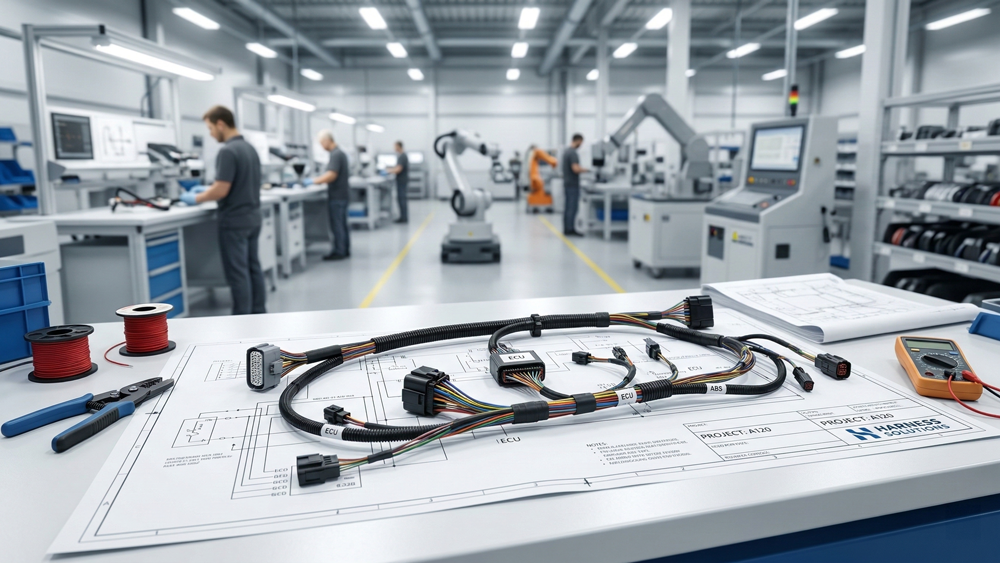
Wire harness IPC and workmanship control sit at the center of how buyers judge whether a harness supplier is truly production-ready. Many projects do not fail because the supplier chose the wrong connector or the wrong wire gauge. They fail because the supplier and the buyer never fully aligned on what “acceptable build quality” actually meant. One side looked mainly at function. The other side expected a repeatable workmanship standard. One side focused on whether the harness passed continuity. The other side cared about crimp form, seal condition, dress quality, label readability, strain-relief execution, and whether the finished assembly would still look and perform consistently across later lots.
That gap is expensive because workmanship problems rarely stay cosmetic. A harness with weak workmanship discipline may still pass a bench test and still create downstream cost through rework, incoming rejection, unstable pilot results, customer complaints, and field-failure suspicion. Even when a visible workmanship issue does not directly cause an electrical failure, it still weakens confidence in the supplier. Once confidence drops, buyers tend to increase inspection, ask more questions, and slow approval decisions. The cost of that extra friction can become much larger than the cost of the original defect.
That is why wire harness IPC and workmanship should not be treated as an internal factory preference. In B2B cable assembly programs, workmanship is part of the commercial agreement between buyer and supplier. It influences how samples are judged, how pilot builds are approved, how incoming quality teams inspect deliveries, how customer audits are handled, and how quickly disputes are resolved if a problem appears later. A supplier who can build to a clear workmanship baseline and explain it well is easier to qualify, easier to trust, and easier to scale with.
This article explains how to think about wire harness IPC and workmanship from a practical OEM and industrial project perspective. The goal is not to turn every harness project into an academic quality exercise. The goal is to define workmanship in a way that supports stable builds, cleaner approvals, and lower total project friction. For the broader logic behind this P16 series, connect this article to Wire Harness Compliance and Certification Guide, where compliance was framed as an operating system for smoother customer approval and supply support.
Table of Contents
ToggleWire harness workmanship value
Workmanship has business value because it reduces interpretation. In many harness projects, engineering believes the design is clear and procurement believes the supplier is aligned, but the actual build standard is still only partially defined. Operators may know from experience what “good enough” looks like. Inspectors may apply a stronger or weaker standard depending on who is reviewing the lot. A customer may approve the first sample because it works, then reject a later lot because visible build quality no longer matches expectations. In each case, the cost comes from inconsistency rather than from a dramatic technical failure.
A defined workmanship baseline reduces that inconsistency. It gives suppliers a more stable production target. It gives buyers a more stable approval basis. It reduces the number of subjective debates around whether the harness is acceptable. And it makes it easier to identify real process drift because the inspection logic is no longer moving from one lot to the next.
This matters especially in OEM and custom harness programs, where the buyer is not only purchasing function. The buyer is purchasing repeatability. A harness that passes today but looks uncontrolled in its build details does not create confidence for tomorrow’s release. That is why workmanship discipline has direct commercial value even when the defect rate is still low.
IPC and wire harness quality
In many wire harness programs, buyers use IPC or IPC/WHMA-A-620 as a reference point because it gives the discussion a shared language. The exact internal standard may differ by company, product class, or customer requirement, but the commercial advantage of using a recognized workmanship framework is clear: it reduces argument about what “acceptable” means.
The practical benefit of an IPC-style workmanship baseline is not that every project must become heavily formalized. The benefit is that the supplier and the buyer can anchor expectations to a known structure rather than to personal opinion. That is especially useful during first-article review, incoming inspection, pilot release, and supplier qualification, where ambiguity creates wasted time. When a supplier says they build to a defined workmanship standard, the buyer gains a more concrete basis for approval than if the supplier only says they have “strict QC.”
At the same time, buyers should remember that citing a standard is not enough by itself. A workmanship framework only creates value if it is translated into actual shop-floor controls, inspection logic, and evidence that can support the project under real conditions. A standard on paper without operational discipline is not a strong quality system.
Wire harness workmanship scope
The first useful step in any workmanship discussion is to define scope. Buyers and suppliers often use the word “workmanship” broadly, but in practice it covers several linked layers. It may include crimp quality, terminal seating, seal handling, conductor preparation, branch dressing, label application, sleeving and protection placement, cleanliness, strain relief, packaging-sensitive handling, and visible acceptance criteria for the finished harness.
That scope matters because some harness programs care more strongly about certain areas than others. A sealed outdoor harness may need especially strong workmanship control around seals, rear-cavity handling, and branch strain relief. A high-flex harness may need more scrutiny around bend points, support transitions, and conductor preparation. A harness for controlled industrial cabinets may care more about label discipline, wire identification, and neat routing consistency than about environmental sealing details.
A strong supplier should therefore not treat workmanship as one flat category. They should understand which workmanship risks matter most for the specific application and reflect that in how they build, inspect, and document the product.
Wire harness acceptance criteria
Acceptance criteria are where workmanship stops being theoretical and becomes operational. If the project cannot state what is acceptable, then the supplier cannot build consistently toward that target and the buyer cannot inspect consistently against it. Weak acceptance criteria are one of the main reasons why samples and later lots feel inconsistent even when the drawing has not changed much.
A good acceptance approach usually answers a few practical questions. What workmanship conditions are explicitly acceptable? What conditions are unacceptable? Which conditions require review rather than automatic reject? Which characteristics are purely visual, which are functional, and which are both? How are borderline conditions handled during pilot versus regular production? If these questions are not answered early, then each inspector, engineer, or customer reviewer may apply a different internal standard.
From a business perspective, clear acceptance criteria reduce two types of cost. They reduce supplier waste caused by over-rejection or unnecessary rework, and they reduce buyer waste caused by arguments, returns, and repeated clarification cycles. That makes them one of the most efficient tools in a compliance-oriented harness project.
Wire harness crimp workmanship
Crimp workmanship is often the most scrutinized workmanship topic because it sits directly at the boundary of mechanical and electrical reliability. A crimp can look visually acceptable yet still be marginal if the process control behind it is weak. It can also be mechanically stable while still creating later resistance drift if strand capture or compaction was inconsistent. That is why buyers should treat crimp workmanship as both a visible quality topic and a process-discipline topic.
A strong workmanship system around crimps should define not only what the finished crimp should look like, but also how the supplier maintains that result across lots. That includes strip preparation, tooling condition, applicator setup, conductor alignment, crimp-height verification where relevant, and clear rejection criteria for visible abnormalities. If the supplier can only describe the visual appearance of a good crimp and cannot explain how they hold that result consistently, the buyer should assume the process is weaker than it appears.
Commercially, crimp workmanship matters because crimp-related issues are costly to investigate and easy to argue about later. A clear workmanship and evidence structure reduces those arguments. It also connects naturally to more method-based validation support when needed, such as pull-force or resistance-stability checks.
Wire harness terminal seating
Terminal seating is another area where workmanship expectations often affect project cost more than buyers initially expect. A harness can use the right connector family and the right terminal and still become unreliable if seating is incomplete or inconsistent. In many cases the symptom appears later as intermittent signal loss, unstable contact, weak retention, or field complaints that are incorrectly blamed on the harness design rather than the seating execution.
That is why terminal seating should be treated as a workmanship control point, not only as an assembly step. The supplier should have a defined way to confirm seating, and the buyer should know whether the process relies on visual checks, tactile confirmation, fixture logic, or some combination of these. The more important the interface, the more valuable it becomes to turn seating quality into something objective rather than assumed.
This has a direct commercial effect. If a buyer is evaluating two suppliers with similar pricing, the one with clearer seating discipline will usually feel lower-risk because the customer can see how a high-cost failure mode is being controlled before the product ships.
Wire harness seal workmanship
In sealed harness programs, seal workmanship deserves special attention because sealing failures often begin as assembly-quality failures rather than material failures. A seal may be present and still be twisted, cut, under-compressed, over-compressed, displaced, or stressed by the way the wire exits the connector. Many of these defects are small enough to pass casual inspection and serious enough to create later field-risk.
That is why seal workmanship should be integrated into both build control and acceptance criteria. The supplier should know what correct seal handling looks like, what common damage patterns matter, how wire outer diameter interacts with seal fit, and which checkpoints are most effective for catching sealing problems before the connector is fully built. Buyers should care about this because a sealed harness that looks acceptable but is not process-stable can create extremely expensive field issues later.
This is one of the best examples of why workmanship matters commercially. The defect may start as a small assembly-quality issue. The cost arrives later as corrosion, resistance drift, intermittent faults, warranty replacement, and broad customer concern.
Wire harness dress quality
Harness dress quality sometimes gets dismissed as cosmetic, but in many projects it has practical value beyond appearance. Consistent branch dress, sleeve placement, tie control, breakout shape, and wire routing discipline improve not only visual quality but also packaging repeatability, installation clarity, and later serviceability. Poor dress quality, by contrast, can create misrouting, local stress, tangled branches, label obstruction, and difficulty in field handling.
For OEM buyers, dress quality also influences perceived supplier maturity. A harness that functions but looks poorly controlled may raise concern that hidden process disciplines are weak as well. That concern is commercially relevant because once a buyer starts doubting the supplier’s build discipline, every later approval becomes slower.
A useful workmanship system therefore treats dress quality as more than visual neatness. It treats it as part of product consistency. That consistency becomes especially important when the same harness must be recognized and handled by different operators, inspectors, customers, or field-service teams.
Wire harness label workmanship
Labels are one of the clearest places where workmanship, compliance, and project usability intersect. A label may be technically correct in content and still weak in workmanship if it is poorly placed, hard to read, easy to smear, inconsistent in orientation, or vulnerable to packaging and handling damage. In practical terms, that can affect incoming inspection, warehouse handling, line-side usage, and traceability retrieval.
That is why label application should be included in workmanship control, not treated only as an afterthought or office-driven print step. The supplier should know where the label belongs, how it should face, what readability standard matters, and how its application interacts with branch shape, sleeving, and later customer handling. If the buyer expects customer-facing labels or traceability labels to be part of the approval package, then label workmanship becomes even more important.
A clear label-workmanship baseline reduces approval friction and gives the buyer more confidence that the harness is not only technically correct but operationally ready.
Wire harness cleanliness
Cleanliness is another workmanship topic that often seems minor until a project encounters a quality issue. A harness can be electrically correct and still create concern or actual risk if it contains debris, damaged insulation surfaces, excess residue, loose strands, tape contamination, or visible handling marks inconsistent with the customer’s product environment.
The required level of cleanliness depends on the application. Some industrial environments tolerate more visible handling evidence than medical or highly controlled electronics environments. But whatever the expectation is, it should be defined clearly enough that the supplier knows what they are trying to deliver. If cleanliness is left vague, then one lot may look very acceptable and another may create unnecessary concern even if both are functionally identical.
From a commercial standpoint, that inconsistency weakens the buyer’s confidence and often triggers extra incoming inspection effort. A more explicit workmanship baseline prevents that cost.
Wire harness workmanship and drawings
A workmanship standard is strongest when it works together with the drawing rather than existing in isolation from it. The drawing shows what the harness is meant to be. Workmanship control shows how that intended product should look and be built in reality. If the drawing and workmanship logic are disconnected, then the project often becomes unstable even if each document looks acceptable by itself.
For example, the drawing may define connector and label positions while workmanship guidance clarifies what acceptable routing and dress around those features looks like. The drawing may define the branch structure while workmanship guidance defines acceptable tie placement or sleeve finish. The drawing may define a sealed connector while workmanship logic defines what unacceptable seal damage or seating looks like. These systems work best when they reinforce each other.
This is why buyers often benefit when suppliers review drawings not only for geometry and materials, but also for workmanship risk. Earlier in the series, Wire Harness Drawing Review showed how document clarity reduces ambiguity. In a quality context, that same clarity makes workmanship easier to standardize and inspect.
Wire harness workmanship and BOM
BOM discipline also affects workmanship more than many teams realize. Certain workmanship outcomes are easier or harder depending on the exact materials chosen. Wire flexibility, label stock, sleeve type, seal material, connector accessories, and terminal choice all influence how easy it is to produce a stable visual and functional result. If these items are loosely controlled, workmanship may drift even when operators and inspectors are trying to hold the same standard.
That is why suppliers who are serious about workmanship usually also have stronger BOM control. They know which material changes can affect visible build quality or process stability. They understand that a change in label construction, sleeve material, or wire outer diameter may alter workmanship performance even if the engineering intent looks similar at first glance.
For buyers, this is an important reminder that workmanship and material control are not separate worlds. They support each other.
Wire harness inspection logic
Inspection logic is where a workmanship standard becomes real on the factory floor. The buyer does not need every inspection detail, but the supplier should have a consistent way to confirm that workmanship expectations are being met and a clear reaction plan when they are not. If workmanship is judged informally or differently from one person to another, then the standard is not fully under control.
A strong inspection approach usually includes clear visual references, controlled examples of acceptable and unacceptable conditions, and enough training that inspectors are not inventing the standard in real time. In pilot and early production, the buyer may also want to understand whether the supplier is using first-article records, sample boards, or documented acceptance references to stabilize interpretation.
The business value here is not only lower defect risk. It is lower argument risk. When the standard is clearly inspectable, both supplier and buyer spend less time debating whether the lot is acceptable and more time solving actual problems.
Wire harness workmanship evidence
Evidence matters because workmanship is often discussed emotionally. One team says the harness “looks fine.” Another says it “doesn’t meet our expectation.” A more mature supplier avoids that type of discussion by building evidence into the process. That evidence may include first-article photos, lot-level visual references, inspection signoff, or other records that help show what approved build quality looked like for that project and revision.
The evidence does not need to be excessive. It does need to be useful. When a buyer receives a pilot lot or a first production lot, the ability to compare current workmanship to a known approved state makes approval much faster and more objective. It also helps later if a field issue or customer complaint raises questions about whether the shipped harness matched the expected build standard.
This is where workmanship control connects directly to the broader quality-document topic in this P16 series. Workmanship is much stronger as a compliance and approval tool when it leaves a usable evidence trail.
Wire harness audit readiness
Audit readiness is one of the hidden advantages of stronger IPC and workmanship control. A supplier who can explain their workmanship baseline, show how it is applied, and retrieve examples or records that support it will usually feel more credible in customer audits, supplier reviews, and internal buyer assessments. The benefit is not only external appearance. The same discipline helps the supplier answer ordinary quality questions faster and more consistently.
This matters because many B2B harness programs do not run formal audits every month, but they still operate in an audit-like environment. Customers ask for explanations, engineering requests samples, procurement compares suppliers, quality investigates visible issues, and field-service teams raise concerns about build consistency. A supplier who can answer those questions with a controlled workmanship framework is much easier to trust.
Wire harness supplier value
A supplier who handles IPC and workmanship well creates value in several ways at once. They reduce ambiguity in sample approval. They lower the chance that a customer rejects later lots for visual or process-consistency reasons. They strengthen confidence in the build even before a field failure ever occurs. They support audits and customer reviews more smoothly. And they make it easier for the buyer to scale the project because the product feels more stable.
That value often shows up indirectly. The supplier may not advertise “workmanship confidence” as a selling point, but buyers feel it in how easy the project is to approve and manage. In competitive B2B sourcing, that ease is important. Many suppliers can build a harness that works. Fewer can build a harness that works and still feels controlled, consistent, and professionally supportable over time.
Conclusion
Wire harness IPC and workmanship control are not cosmetic topics. They are part of the commercial and operational foundation of a stable harness project. Buyers benefit when suppliers define workmanship clearly, align it with drawings and BOM logic, build strong crimp, seating, sealing, label, dress, and cleanliness controls, and support those controls with inspection logic and usable evidence.
That is how workmanship becomes more than a visual quality preference. It becomes a supplier capability that shortens approval cycles, improves lot-to-lot consistency, reduces disputes, and increases buyer confidence that the harness can support the full life of the project rather than only the first sample.
FAQ
Does IPC automatically guarantee good wire harness quality?
No. A recognized workmanship standard provides a shared baseline, but the supplier still needs real process control, inspection discipline, and evidence to make that baseline effective in production.
Why do buyers care about workmanship if the harness passes electrical tests?
Because workmanship affects repeatability, customer confidence, audit results, and often long-term reliability. A harness can function today and still show signs of weak process control.
Which workmanship areas matter most in a harness project?
That depends on the application, but common high-value areas include crimp quality, terminal seating, seal handling, branch dress, label application, and cleanliness.
How does workmanship connect to compliance?
Workmanship shapes how easily the harness can support customer approval, incoming quality review, and audit response. It is part of the project-control system, not just a cosmetic preference.
What makes a workmanship evidence package useful?
It should show the approved build state clearly enough that buyers and suppliers can compare later lots against a known baseline without relying on personal memory.
If your harness program needs stronger workmanship alignment, it is usually better to define that baseline early than to argue about visible quality later. Clear acceptance criteria, inspection logic, and first-article evidence make sample approval and production release much smoother.
Related articles