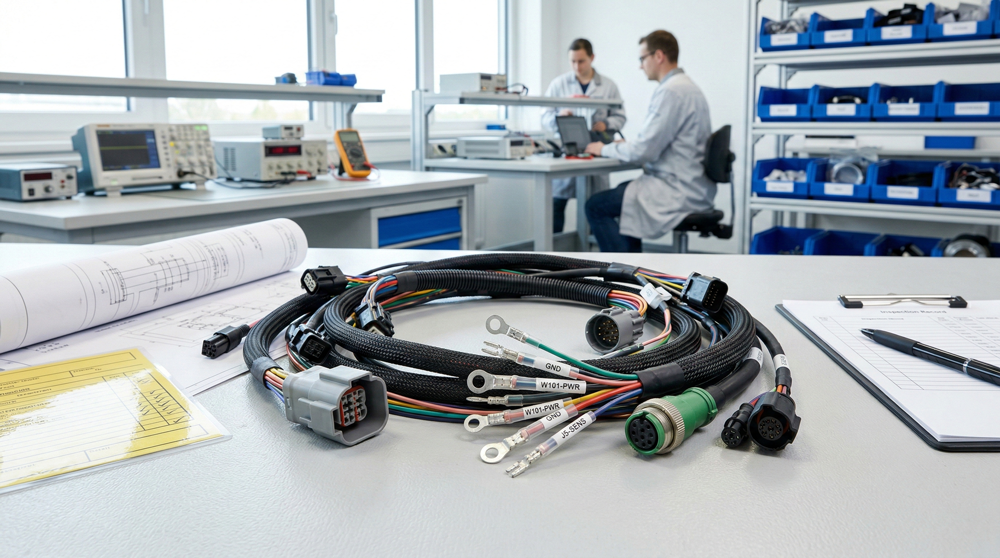
Wire harness RoHS and REACH support is one of the most practical compliance topics in OEM and industrial sourcing because it sits directly between engineering design, material selection, customer approval, and purchasing risk. A buyer may like the supplier’s quote, approve the sample, and feel comfortable with the technical solution, only to discover later that the material-declaration path is unclear, substance-related documentation is incomplete, or the supplier cannot connect the harness BOM to the actual declarations needed for customer approval. At that point, the project no longer has only a technical question. It has a schedule question, a supply question, and often a customer-confidence question.
That is why wire harness RoHS and REACH should not be treated as a late-stage document request handled after the main work is finished. In most serious B2B projects, this support should be built into the approval logic early. Buyers want to know whether the supplier can manage material visibility, whether the declarations can be maintained through changes, whether sub-suppliers are controlled well enough to support future audits, and whether the records tied to the harness are usable in real project conditions rather than only in a sales conversation.
The commercial value is clear. Good RoHS and REACH support reduces approval friction, shortens customer-document response time, lowers the risk of requalification after material changes, and gives procurement stronger confidence that the supplier is not creating hidden compliance debt under the surface of an apparently simple harness. Strong support also makes future change control easier because the compliance baseline is already linked to the approved BOM and material structure.
This article explains how to think about wire harness RoHS and REACH from a project, sourcing, and supplier-management perspective. The goal is not to turn the supplier into a chemicals-law specialist. The goal is to make material compliance practical, traceable, and stable enough that it supports the product through RFQ, sample approval, pilot, launch, shipment, audit, and later change. For the broader logic of this series, connect this article to Wire Harness Compliance and Certification Guide, where compliance was framed as a business-control system rather than just a document set.
Table of Contents
ToggleWire harness RoHS and REACH value
The value of RoHS and REACH support usually becomes visible when a buyer is under time pressure. A customer requests declarations before approving a sample or before allowing a launch to move forward. Procurement asks suppliers for compliant material support but receives inconsistent answers. Engineering believes the harness should be acceptable, yet quality refuses release until substance-related evidence is clear. These are common situations, and they are expensive not because the documents are inherently difficult, but because the project did not build a practical material-compliance path early enough.
That is why buyers should see RoHS and REACH support as a speed issue as much as a compliance issue. A supplier that can retrieve accurate declarations, explain scope clearly, and tie material statements to the approved harness configuration helps the project move faster. A supplier that responds slowly or vaguely forces the buyer to spend time sorting uncertainty rather than moving the product toward approval and supply stability.
In commercial terms, this is one of the easiest ways for a supplier to feel “easy to work with” or “hard to work with” even when the physical harness quality is similar. Buyers remember whether the supplier made approvals smoother or more painful.
RoHS and REACH scope
A major source of confusion in harness programs is that RoHS and REACH are often spoken about as if they were interchangeable. They are related in the sense that both deal with material and substance visibility, but from a buyer’s practical perspective they usually generate different document requests, different internal reviews, and different supplier-response expectations. That means the first step in any serious discussion should be scope clarification.
The buyer and supplier should know what the customer is actually asking for. Is the request focused on restricted-substance compliance in the finished harness? Is it asking for supplier declarations tied to components and raw materials? Is it asking for substance communication related to Article 33 obligations in a broader product chain? Is it asking only for standard declarations at RFQ stage, or for a controlled package tied to production shipments? These are not trivial differences. They affect how deeply the BOM must be controlled, how far down the supply chain the supplier must collect evidence, and how future changes must be reviewed.
A strong supplier does not answer these questions with generic statements. They clarify what support they can provide, what the buyer likely needs, and what level of product-specific control is required for the program to stay stable later.
Wire harness material compliance
Wire harness material compliance depends on one simple truth: the supplier must know what materials are actually in the product. That sounds obvious, but many projects operate with less material visibility than buyers assume. The drawing may be clear enough to build. The sample may work. The quote may be competitive. Yet the project may still be weak at the material layer because wire constructions, seal materials, connector plastics, labels, sleeving, tapes, adhesives, or overmold compounds are not fully linked to a controlled BOM and declaration logic.
That weakness matters because RoHS and REACH support cannot be stronger than the material control beneath it. If the supplier cannot say with confidence which materials were approved, which materials were substituted, and which records belong to which component families, then any declaration becomes less reliable over time. The declaration may still be produced, but it becomes more fragile under audit, under engineering change, or under a later customer request for clarification.
This is why material compliance should not be handled as a separate administrative task. It should sit on top of part control, BOM control, and change control. When those foundations are strong, RoHS and REACH support becomes much more efficient.
Wire harness BOM and declarations
The BOM is the operational heart of most RoHS and REACH support for wire harnesses. A drawing can show intent, but the BOM defines the actual material structure that must be supported through declarations. If the BOM is clean, controlled, and specific, the supplier can build a declaration path that remains stable through samples, pilots, and production. If the BOM is vague or open to informal substitutions, the declaration path will be unstable even if the documents look complete at a glance.
This is why buyers should always think about material declarations and BOM control together. A harness cannot have strong RoHS and REACH support if the material definition is only partial. Connectors without fully controlled accessories, seals without explicit part logic, labels treated as generic consumables, alternate wires approved informally, or packaging materials that matter for the customer but are not tracked clearly—all of these weaken declaration quality.
Earlier in this series, Wire Harness BOM and Part Control explained why BOM discipline reduces ambiguity and cost. In a compliance context, the same logic applies: the cleaner the BOM, the stronger the declaration support.
Wire harness supplier declarations
Supplier declarations are useful only when they are specific enough to support the buyer’s real approval need. A generic statement that “our products comply” may satisfy a very early inquiry, but it usually does not carry enough weight for serious OEM review, customer approval, or later audit response. Buyers often need declarations that reflect either the specific harness, the controlled material set behind it, or at minimum the relevant categories of materials tied to the approved BOM.
This is where supplier maturity becomes visible. A good supplier understands that declarations should be current, controlled, and supported by a retrieval system rather than assembled from scattered files each time a customer asks. The supplier should also understand the difference between a commercial summary and a declaration package that may later be reviewed under time pressure by engineering, quality, or a downstream customer.
A stronger declaration process shortens project cycles. Buyers do not need to ask the same questions repeatedly, and suppliers do not need to rebuild their response every time a new person joins the conversation.
Wire harness component declarations
Many harness programs depend on component-level declarations gathered from upstream manufacturers or sub-suppliers. That includes wire, cable, connectors, terminal systems, seals, labels, tubing, sleeving, tapes, potting materials, and molded compounds. The practical challenge is not simply collecting these declarations. The challenge is maintaining them in a way that keeps them tied to the current approved build state.
This is where projects often become weaker than they appear. The supplier may have declarations from component vendors, but if those documents are not linked to the active BOM, they become harder to trust during change. A buyer may ask whether the declaration still applies after a wire-source adjustment or after a connector-family update. If the supplier’s system cannot answer quickly, the project slows down.
Strong component declaration management reduces that risk. It creates a more reliable bridge between upstream material visibility and downstream customer support. It also helps during audits, because the supplier can show not just that declarations exist, but that they are part of a controlled product-support system.
Wire harness RoHS support
For most buyers, RoHS support in a harness project is valuable because it is practical. It often sits directly in the customer-approval path and may affect whether a supplier can move from sample to approved source without additional documentation delays. That means RoHS support should be framed around usability. Can the supplier provide a clear declaration when needed? Can they explain which parts of the harness are covered by controlled material support? Can they update the declaration if a meaningful BOM change occurs? Can they connect the declaration back to the approved revision and lot logic if asked?
These questions matter more than broad claims of familiarity. A supplier who understands RoHS only at a marketing level is much less useful than one who has built a simple, repeatable way to support the buyer’s approval process. The latter usually wins more trust because the buyer sees that the support is operational, not theoretical.
This is especially true for custom harness projects, where the product may contain customer-specific labels, special protection materials, or tailored branch structures that make generic declaration habits less useful.
Wire harness REACH support
REACH-related support often introduces a different type of buyer concern. In many projects, the challenge is not just whether restricted substances were considered, but whether the supplier can communicate material status clearly enough to support customer due diligence and future audit expectations. That means the supplier’s response needs to be structured and credible, especially in programs where customers expect more than generic declarations.
From a buyer perspective, strong REACH support creates confidence that the supplier can maintain material visibility over time. This is important because REACH-related communication expectations can become more sensitive when supply chains are complex, when the harness uses many material types, or when the customer’s own internal compliance team is especially detail-oriented. In those environments, the project benefits from suppliers who know how to organize material evidence cleanly rather than only reacting when requested.
The commercial advantage is again speed and stability. Buyers want to avoid surprises. A supplier who can support REACH discussions with controlled records helps reduce the chance that material questions will interrupt launch or later customer review.
Wire harness restricted substances
Restricted-substance thinking should be practical, not abstract. Buyers do not need suppliers to recite a regulatory textbook. They need suppliers who understand that certain materials and component categories require stronger visibility and that those categories must be tied to real product control. In harnesses, this often means the supplier should pay particular attention to plastics, elastomers, coatings, platings, adhesives, markings, and specialty compounds that may not be obvious in a high-level product description.
This is another reason why compliance support should be integrated into product engineering and sourcing rather than floating separately. A component that looks insignificant in cost can still matter in a declaration chain. If it is not controlled, the project may face a compliance-document gap later that feels disproportionate to the physical importance of the part. The gap still matters because the buyer must answer customer questions with confidence, not with approximate guesses.
Strong suppliers understand this and build their material visibility accordingly.
Wire harness material changes
Material changes are where many compliance systems are really tested. It is one thing to assemble a declaration package for a stable prototype or early production lot. It is another to keep that package valid after wire-source changes, label-material changes, terminal-plating changes, sealing-material updates, or packaging adjustments that affect the approved state. This is why change control and compliance should always be connected.
Every meaningful material change should trigger a simple but disciplined review. Does the existing declaration still apply? Does the new material require a refreshed supplier statement? Does the revised part alter what the buyer has already provided to their customer? Does the change require internal notification, reapproval, or a new release boundary? If those questions are not built into the ECO logic, the project may drift into a state where the product changed but the declaration set did not.
That creates commercial fragility. A supplier may continue shipping acceptable product while the document baseline quietly becomes obsolete. When the next customer request arrives, the buyer discovers the gap under pressure instead of under control.
Wire harness customer documents
Customer-facing document support is where material compliance becomes operational. The buyer is usually not collecting declarations for internal curiosity. They need them to support quotation approval, internal quality review, customer submission, audit preparation, or long-term supplier qualification. That means the supplier should organize customer documents with the buyer’s workflow in mind.
A useful document package should be clear, current, and connected to the project state. It should not force the buyer to translate between multiple inconsistent formats or to guess whether the files still reflect the actual build. If the harness is tied to a specific revision, pilot state, or production lot, the document package should make that relationship understandable. If the project uses a broader family declaration approach, the supplier should explain that clearly too.
The easier the supplier makes customer-document handling, the easier it is for procurement and engineering to defend the supplier internally.
Wire harness quality documents and material support
Quality documents and material declarations become much more valuable when they support each other. A material declaration tells the buyer what the harness is based on. A quality-document package helps show that the harness was actually built and checked in line with that approved state. When those two layers are disconnected, approval weakens. The buyer may have a declaration that cannot be tied to a shipment, or a shipment record that cannot be tied back to the correct declaration logic.
That is why stronger suppliers build these systems together. A declaration package should not live in isolation from test records, first-article evidence, or traceability. This does not mean every shipment needs an oversized compliance file. It means the project should be organized so that the buyer can move quickly from product identity to material support to quality evidence without rebuilding the logic each time.
This is also one of the reasons buyers value disciplined evidence-pack systems. They make compliance easier to use in real life.
Wire harness RoHS and REACH in RFQ
The RFQ stage is where many later compliance delays can be prevented cheaply. If the buyer knows the project will require RoHS and REACH support, that expectation should be visible early rather than introduced after sampling or pilot. When material-support needs are raised only after the supplier has quoted and built a sample, the project often loses time while the supplier organizes records that could have been planned from the start.
A stronger RFQ approach defines whether the buyer expects declarations, what scope they should cover, and whether they need to be tied to a product-specific baseline or a broader material-control path. This helps suppliers quote and plan more accurately, and it helps buyers compare supplier readiness rather than only supplier price.
It also creates a stronger negotiation position, because compliance support is no longer treated as an undefined free extra. It becomes part of the expected supplier contribution to the project.
Wire harness audit readiness
Audit readiness is one of the hidden benefits of good RoHS and REACH control. A buyer may not be planning an immediate audit, but projects that survive internal customer review, supplier audits, or field-quality escalation more smoothly are usually the projects where compliance support has already been organized well. The supplier does not need to panic, search multiple systems, or send inconsistent declarations from different time periods. Instead, they can retrieve the relevant documents with confidence and tie them to the approved product state.
That capability has strong commercial value. It reduces stress during customer review and gives the buyer more confidence in long-term supplier stability. Even if the project never faces a formal audit, the same retrieval discipline helps during ordinary customer questions and internal quality reviews.
Wire harness compliance as supplier value
A supplier who supports RoHS and REACH well makes the project easier to approve, easier to explain, and easier to defend. That is a real market advantage. In many categories, several suppliers can build the harness. Fewer can support the material-compliance side with enough clarity and consistency to reduce the buyer’s internal workload.
That is why this topic should be treated as part of the supplier value proposition. Good suppliers do not only provide physical output. They help the buyer manage the approval burden around that output. In many OEM and industrial environments, that difference is worth more over time than a narrow unit-price advantage.
Conclusion
Wire harness RoHS and REACH support are strongest when they are built on controlled BOM logic, clear supplier declarations, disciplined component visibility, and change-control awareness. Buyers benefit when suppliers define scope early, connect material declarations to the actual approved build state, and maintain those declarations in a way that remains useful through prototype, pilot, launch, shipment, and later audit or customer review.
That is how material compliance becomes more than a document request. It becomes a project-control system that reduces approval friction, shortens response time, and strengthens buyer confidence that the harness can support the full life of the program rather than only the first order.
FAQ
Are RoHS and REACH the same for a wire harness project?
No. They are related material-compliance topics, but they usually generate different customer questions and documentation expectations. Buyers and suppliers should clarify the exact scope early.
Why do buyers ask for RoHS and REACH documents so early?
Because material compliance can affect supplier qualification, customer approval, and launch timing. It is cheaper to clarify early than to fix a documentation gap after samples or pilot builds.
How does BOM control affect RoHS and REACH support?
A supplier can only provide strong material declarations if the BOM and part-control logic are clear enough to show what materials are actually in the approved harness.
What should a supplier do after a material change?
They should review whether the existing declarations still apply, refresh supplier declarations where needed, and make sure the revised product state remains aligned with the compliance package.
What makes a RoHS and REACH package useful to a buyer?
It should be current, connected to the approved harness state, and easy to retrieve and explain under customer or internal review pressure.
CTA
If your harness project needs stronger material-compliance support, it is usually better to define the declaration scope early than to discover gaps during customer review. Clear BOM control, cleaner supplier declarations, and better change visibility usually save time later.