Long-tail Keywords: wire harness DFM for OEM projects, custom wire harness engineering support, wire harness design for manufacturability, wire harness manufacturability review, cable assembly engineering review, wire harness prototype design review, OEM wire harness supplier support, wire harness drawing review process, wire harness BOM control and approval, wire harness pilot build support, wire harness revision control, custom cable assembly DFM process
Wire harness DFM is one of the clearest ways a supplier creates value beyond simple manufacturing. In many OEM and industrial programs, the real problem is not whether a supplier can build a harness after everything is fully defined. The real problem is that many projects are never fully defined at the moment they need to move. Drawings are still evolving. Connector selections are still being refined. Length references are not completely frozen. Labeling rules are unclear. Packaging requirements are missing. Test expectations exist at a high level but are not yet translated into an executable process. At that point, a supplier can either behave like a passive job shop or like an engineering support partner. The business difference between those two roles is large.
A passive job shop waits for perfect inputs and then quotes against whatever is provided. An engineering support partner uses DFM to identify what is missing, what is risky, what is likely to create cost later, and what should be clarified now so the project can move with fewer revisions and fewer surprises. That is why wire harness DFM matters commercially. It reduces the cost of ambiguity. It shortens the path from concept to stable build. It lowers the probability of repeat sample loops, revision confusion, late-stage change orders, and yield loss after launch.
For buyers, this is not just a technical preference. It is a supplier selection criterion. A supplier who can perform strong manufacturability review saves time for engineering, reduces uncertainty for procurement, and improves launch confidence for project teams. That is especially important in custom cable assembly projects, where the final product often sits at the boundary between design intent and manufacturing reality. If that boundary is not managed well, the buyer eventually pays through schedule drift, rework, and field quality cost.
This article explains how to think about wire harness DFM and engineering support from a business and execution point of view. It shows how manufacturability review should work, what engineering support should look like in real projects, and how the supplier’s role changes from prototype to pilot to production. If your team wants a supplier that contributes more than production capacity, this is the framework that makes that expectation clear.
Table of Contents
ToggleWire harness DFM value
Wire harness DFM creates value by making the project easier to build correctly the first time. That may sound obvious, but in practical B2B sourcing the cost of “buildable enough” versus “well designed for manufacturability” is significant. The first version might still ship. The difference is what happens afterward. A weakly reviewed design often causes repeated engineering questions, long clarification loops, low first-pass yield, extra operator touch time, inconsistent inspection outcomes, and difficult ECO implementation. A stronger design reduces those costs before they appear.
From a buyer perspective, the value of DFM usually shows up in five places. It reduces RFQ ambiguity because the supplier identifies missing or conflicting requirements earlier. It reduces prototype churn because sample feedback is tied to manufacturability rather than only to functional fit. It reduces launch risk because the supplier can highlight unstable process features before volume ramps. It reduces change cost because revisions are managed against a clearer baseline. And it improves total cost of ownership because fewer hidden manufacturing inefficiencies are built into the project.
This is why DFM is not an “extra engineering service.” In strong supplier relationships, it is part of the commercial value proposition. The buyer is not simply paying for harnesses. The buyer is paying for a smoother path to reliable supply.
Wire harness engineering support
Engineering support in wire harness projects should be judged by what it helps the buyer avoid. Good support avoids repeated sample loops. It avoids unclear connector assumptions. It avoids wrong wire selections for sealed systems. It avoids drawings that look acceptable but are difficult to build consistently. It avoids packaging definitions that come too late and cause shipping damage or acceptance delays. It avoids ECO chaos because the project was not structured for change from the start.
A supplier claiming strong engineering support should be able to do more than answer questions after the fact. They should be able to review early-stage information and say where the risks are. They should be able to tell the buyer which connector choices may create insertion difficulty, which bend zones may create fatigue risk, which labels may be difficult to apply consistently, which dimensions are underdefined, and which tests should be considered before the customer finds the problem in the field.
That kind of support matters because most projects are not delayed by one big mistake. They are delayed by many small unresolved details. A supplier who can identify and organize those details creates project momentum. That is especially useful in OEM environments where procurement, design, quality, and production are all moving at different speeds.
Wire harness manufacturability review
A wire harness manufacturability review should start with a simple question: if the current design is released exactly as it is, what is most likely to create cost, delay, or inconsistency? The answer is rarely just one thing. It is usually a mix of unclear documentation, difficult assembly features, inspection weakness, and packaging or routing assumptions that have not yet been validated.
A practical manufacturability review looks first at the design definition. Are connector and terminal part numbers fully specified? Are cavity assignments clear? Is the drawing revision controlled? Are wire types, colors, gauges, shielding details, and length references explicit? If the answer is no, the project is already carrying avoidable risk. The supplier should identify that immediately rather than quoting against silent assumptions.
Then the review moves to assembly difficulty. Are there tight insertion conditions, multi-branch bundle points, awkward label locations, strain-relief challenges, or sealing details that will be hard to execute consistently? If so, the buyer needs to know early whether that complexity is necessary or whether a small design change can reduce labor and improve consistency without affecting product function.
After that comes inspection and validation. Can the critical characteristics actually be checked in a repeatable way? Are the test methods proportionate to the product’s risk? Are there features that are technically specified but practically difficult to verify? A supplier who raises these questions early is helping the buyer reduce future failure cost.
Wire harness drawing review
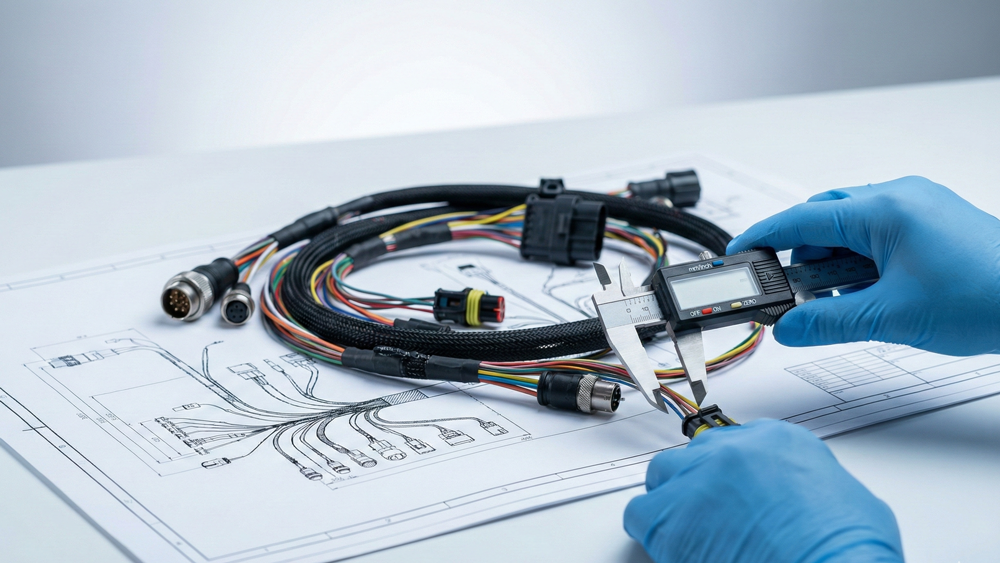
The drawing review stage is where many downstream problems can still be prevented cheaply. A drawing does not need to be beautiful to be buildable, but it does need to be clear enough that different people will interpret it in the same way. If engineering, sourcing, and manufacturing all read a drawing differently, then the project is unstable before production even starts.
A strong wire harness drawing review should confirm part identity, revision status, cavity mapping, branch breakout, label requirements, length references, tolerance logic, and notes related to sealing, test, or packaging. The key point is not document completeness in an abstract sense. The key point is interpretation consistency. The supplier should be able to say, “this requirement is clear and executable,” or “this note can be interpreted in more than one way and will likely create quoting or build variation.”
This is why drawing review has strong commercial value. It prevents the supplier from pricing one interpretation while the buyer expects another. It also reduces the risk that early sample approval creates false confidence because the sample happened to match the buyer’s intention even though the documentation did not define that intention clearly.
Wire harness BOM control
BOM control is one of the most important and least glamorous parts of wire harness project management. Buyers often focus on the assembly drawing because it is visually central, but BOM discipline is what keeps the project stable when sourcing pressure, shortages, substitutions, and ECOs begin to accumulate.
A strong BOM control process should make it clear which items are fixed, which items can be proposed as alternates, which items require approval before any substitution, and how material-level changes are reflected in revision and validation records. For harnesses, that usually includes wire part numbers, terminal variants, connector housings, seals, boots, labels, tapes, sleeves, and any overmold materials where used.
This is commercially important because many “quality” problems are really BOM control problems. If the wrong terminal plating, wrong wire OD, or wrong sleeve material is used, the harness may still look finished and may even pass basic tests. The commercial damage appears later, after the issue reaches the field or collides with another process variable. A disciplined supplier should therefore treat BOM control as part of manufacturability, not only as a purchasing task.
Wire harness DFM for connectors
Connectors are frequently the biggest manufacturability and reliability levers in a harness project. They influence insertion force, sealing complexity, contact stability, rework difficulty, routing stiffness, and packaging sensitivity. A good DFM review should therefore look at connector choice not only from the product designer’s point of view, but from the assembly and service point of view as well.
For example, a connector may technically meet electrical requirements but still be a weak choice if it creates very tight rear-cavity space for seals, if cavity orientation makes assembly errors more likely, or if its locking confirmation is difficult to verify during build. In such cases, the supplier should raise the issue before tooling, validation, and packaging decisions are built around the wrong connector assumption.
This is especially true in custom programs where the harness interfaces with nonstandard routing or enclosure space. Connector selection in those environments is not just about fit. It is about how easily the harness can be built, validated, and supported over time.
Wire harness DFM for terminals and seals
Terminal and seal choices affect manufacturability in ways buyers sometimes discover too late. A terminal can be technically compatible yet create unstable crimp performance if it is highly sensitive to strip length or applicator alignment. A seal can be nominally correct yet create assembly difficulty if the wire OD range is marginal or if insertion damage is easy to cause. These are classic examples of design intent colliding with process reality.
That is why terminal and seal review should be part of engineering support, especially in sealed harness programs. If the supplier sees a risk that the chosen wire and seal range are too close to tolerance edges, or that terminal retention may be difficult to verify consistently, that feedback has high business value. It can prevent a whole chain of failures that would otherwise show up only after customer exposure.
The point of DFM is not to reject complexity automatically. The point is to decide consciously where complexity is necessary and where it is simply hidden cost.
Wire harness prototype review
Prototype review is one of the most useful moments in the project, because it is still early enough to change important things cheaply. A sample harness should not be treated only as proof that the product can be built once. It should be treated as evidence about whether the design, documents, and process assumptions are stable enough to move forward.
A strong prototype review should examine not only whether the sample fits and functions, but also whether it was difficult to build, whether any temporary workarounds were used, whether inspection was straightforward, whether labeling and packaging were already realistic, and whether any features are likely to create variability in later lots. If those questions are not asked during the prototype phase, they usually reappear later as pilot-build surprises or ECO pressure.
This is one reason strong suppliers are valuable before volume exists. They can turn prototype feedback into process feedback, which is much more useful than simply shipping a sample and waiting for the buyer’s comments.
Wire harness pilot build support
Pilot builds are where engineering support becomes operational. A supplier who looked good during quoting and prototype work must now show that the design can be built repeatedly under realistic conditions. This includes actual setup behavior, lot consistency, inspection flow, test records, packaging repeatability, and reaction discipline when something drifts.
Pilot build support should therefore include more than assembly capacity. It should include structured first-article approval, clear evidence records, identified control points, and documented assumptions about what is still evolving. If the supplier discovers during pilot that a feature is difficult to hold consistently, that information should flow immediately back into the engineering and sourcing loop.
This is also the stage where many suppliers reveal whether they are real engineering partners or only reactive manufacturers. A strong partner uses pilot data to improve the process and tighten the documentation. A weaker one waits for the buyer to discover the drift.
Wire harness revision control
Revision control becomes critical as soon as a project starts moving. Early-stage harness programs change quickly, and that is normal. The commercial damage comes not from change itself, but from uncontrolled change. If drawings, BOMs, labels, and test requirements are not tied cleanly to revision boundaries, then samples, pilots, and production lots start to overlap in ways that are difficult to unwind later.
A strong engineering support process should therefore enforce revision clarity. Every project should have a known current revision, a known source of truth, and a known method for releasing updates. The supplier should be able to tell the buyer which build used which revision and how the first lot after each meaningful change was identified and validated.
This is where engineering support intersects directly with change management. If that link is weak, the project becomes vulnerable to version drift, mixed inventory, and confusing quality investigations. If it is strong, the buyer can move faster because changes do not automatically create chaos.
Wire harness DFM and testing
Testing is often discussed only after the design is mostly defined, but from a DFM perspective that is too late. A good manufacturability review should ask whether the harness can be tested in a way that is repeatable, efficient, and aligned with the real risk of the product.
If the design creates difficult-to-access test points, fragile labels that interfere with fixtures, or branch conditions that complicate continuity verification, those issues should be raised early. The same is true for products that need stronger validation for movement, sealing, or environmental exposure. A supplier with strong engineering support should not only say what tests they can run. They should explain which tests are meaningful for the application and which records should become part of the evidence pack.
That is one reason pages such as Tests & Inspections matter commercially. Buyers want a supplier who can translate test capability into project-specific execution, not just a list of general equipment.
Wire harness DFM and packaging
Packaging is often left until late, but from a manufacturability point of view it should be reviewed before pilot and certainly before launch. A harness that is difficult to pack without violating bend radius, stressing a rear seal, tangling branches, or damaging labels is already telling you something important about project risk.
The supplier’s engineering support should therefore include a packaging review that asks whether the final harness can be protected, identified, and shipped consistently. If not, the issue should be solved before volume, not after transit damage starts generating warranty claims. This is especially important when assemblies include fragile connectors, seals, molded transitions, or complex branch layouts.
A supplier that treats packaging as part of the engineered delivery process rather than as warehouse afterthought creates real business value for the buyer.
Wire harness OEM support
OEM buyers usually need more than a price and a promise. They need a supplier who can interact with project management, engineering, sourcing, and quality at the same time. That requires a different kind of support than standard catalog manufacturing. It requires structured communication, early DFM feedback, clearer issue escalation, better revision discipline, and stronger evidence expectations.
In practical terms, strong OEM support means the supplier can participate in design reviews, identify manufacturability risks early, propose documentation improvements, support first-article and pilot approvals, and keep the project coherent through changes. This is where “engineering support” becomes visible not as a slogan but as an operating model.
For buyers, this support reduces project friction. It lowers the number of disconnected conversations and helps ensure that the supplier understands the commercial goals of the project, not just the assembly drawing.
Wire harness DFM as supplier value proposition
A supplier’s DFM capability is one of the clearest ways to differentiate beyond price. Many suppliers can build a harness. Fewer can help a customer prevent cost before the cost appears. That difference matters especially when the customer is developing a new product, switching suppliers, moving from prototype to production, or trying to stabilize a difficult application.
From a commercial perspective, the strongest value proposition is not “we have experienced engineers.” It is “we use engineering support to reduce your sample loops, reduce your launch risk, reduce your ECO chaos, and reduce your long-term supply cost.” That is language buyers understand. It is concrete. It connects technical behavior to business outcomes.
This is also why pages such as Why Choose Us should be supported by content like this series. Buyers trust value propositions more when they can see the mechanism behind them.
Conclusion
Wire harness DFM is not an internal engineering luxury. It is one of the most practical ways to improve project speed, manufacturability, revision control, and long-term supply stability. Buyers gain the most when suppliers use manufacturability review to identify risk early, convert prototype learning into process improvements, support pilot builds with real evidence, and keep revision and BOM logic under control as the project scales.
That is what turns a supplier into a real engineering support partner. In B2B wire harness projects, the most valuable support is often not dramatic. It is the quiet prevention of ambiguity, instability, and repeat work. Over time, those avoided costs become one of the strongest reasons customers stay with a supplier.
FAQ
What does wire harness DFM actually improve?
It improves build consistency, reduces engineering ambiguity, shortens sample loops, and lowers the risk of late-stage issues during pilot and production.
Why is engineering support important if the drawing already exists?
Because many project risks are not obvious from the drawing alone. Connector choice, seal fit, routing stress, test practicality, packaging, and revision control often need supplier feedback.
When should a supplier start providing DFM input?
As early as possible, ideally before the first full sample loop. The earlier manufacturability issues are identified, the cheaper they are to fix.
How is DFM different from quality control?
Quality control checks whether the build meets the defined standard. DFM helps improve the design and documentation so the build is easier to make correctly and consistently in the first place.
What is the commercial value of strong DFM support?
Fewer revisions, faster launch, more stable pilot builds, lower hidden manufacturing cost, and better supplier responsiveness when the project changes.
CTA
If your harness project is still evolving, early DFM review usually saves far more time than it costs. Clear feedback on drawings, BOM structure, connector choices, and pilot readiness can make the path to stable production much smoother.
Contact, review Tests & Inspections, explore Custom Cable Assemblies, or see Why Choose Us.