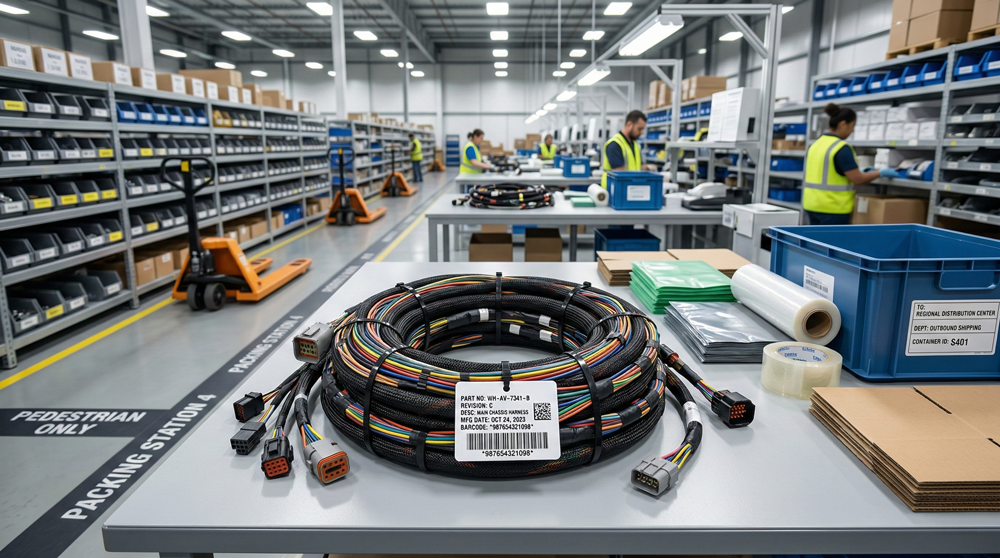
Wire harness traceability is one of the few quality systems that buyers usually notice only after something goes wrong. When a harness program is running smoothly, lot codes, build records, labels, and test references can look administrative. When a field failure appears, those same details become the difference between a manageable containment action and a costly operational event. That is why wire harness traceability should not be treated as a paperwork feature or a compliance box. In B2B cable assembly programs, traceability is a business-control system. It determines how quickly a supplier can isolate affected product, how narrowly the buyer can quarantine inventory, how confidently engineering can identify root cause, and how much downtime the customer suffers before the issue is under control.
The business impact is easy to understand. If a supplier can identify the exact lots, materials, dates, and records tied to a field issue, the buyer may contain only a small number of assemblies and restore operations quickly. If the supplier cannot do that, the buyer is forced to assume the problem is broader than it may actually be. Entire shipments get quarantined. Good stock is held. Replacements are rushed before the true scope is known. Engineering and quality teams spend time asking basic questions that a strong traceability system should answer immediately. The cost grows not because the defect is technically complex, but because uncertainty makes every decision slower and more expensive.
That is why this article pairs traceability with containment rather than treating them as separate ideas. Traceability without containment is just record-keeping. Containment without traceability becomes broad, slow, and expensive. Together, they create one of the strongest practical systems for reducing warranty cost, protecting schedule stability, and strengthening supplier accountability. For the broader business logic behind this series, connect this article to Warranty Reduction Guide for Cable Assemblies, where field-failure cost is framed in operational and sourcing terms rather than as a narrow technical issue.
Table of Contents
ToggleWire harness traceability value
The value of wire harness traceability is not in the data itself. The value is in what the data allows the buyer and supplier to do under pressure. A strong traceability system answers practical business questions quickly. Which shipments used the same terminal lot? Which builds were made before a tooling adjustment? Which customer received assemblies from the affected date range? Which harnesses share the same wire source, same revision, same work order, or same evidence pack?
Without those answers, a quality incident becomes a guessing exercise. Guessing is expensive because the safe choice is always broader containment. Broader containment means more inventory on hold, more rushed replacements, more customer concern, and more internal friction. In contrast, precise traceability reduces the size of the problem even before the technical root cause is confirmed.
This is why buyers should think about traceability as a cost-reduction tool. The system lowers the cost of uncertainty. That is commercially powerful because the cost of uncertainty often exceeds the cost of the defective harness itself.
Cable assembly lot traceability
Lot traceability is the foundation of most practical traceability systems. It links each shipped assembly to the batch-level information that matters most: wire lot, terminal lot, connector lot where relevant, work order, production date window, shift, and test or inspection records. For many cable assembly programs, lot traceability is the minimum level needed to make field containment workable.
A lot-based system is attractive because it balances control and execution. It is usually easier to maintain than unit-level serial tracking, and for many industrial and OEM programs it provides enough resolution to isolate risk efficiently. If a buyer receives a failure report tied to a specific lot, the supplier can immediately identify what other assemblies share the same materials or build window. That allows the parties to quarantine intelligently instead of broadly.
The weakness of lot traceability appears when lots are defined too loosely. If a lot spans too much time, too many material changes, or too much production variability, the containment benefit drops. Buyers should therefore confirm not only that lot traceability exists, but how lots are formed. A strong supplier can explain whether lots are linked to work orders, material receipts, shift windows, or a combination of these. A weak supplier may use lot numbers that look formal but do not actually improve containment precision.
Serial traceability for wire harness
Serial traceability provides unit-level control. Each assembly carries a unique identifier that links it to its build history, tests, materials, and sometimes even the operator or station path used during production. This level of resolution is valuable in high-liability programs, regulated environments, field-service products, and programs where downtime is expensive enough that even lot-level containment is too broad.
The commercial advantage of serial traceability is obvious: when a defect appears, the buyer can isolate exactly which units are affected and which are not. That reduces the risk of holding good stock or replacing assemblies unnecessarily. It also helps during service and maintenance because the unit installed in the field can be tied back to a build record rather than to a broad shipment assumption.
The tradeoff is execution complexity. Serial systems require tighter label durability, stronger data linkage, better scanning discipline, and cleaner document management. Buyers should not insist on serial traceability just because it sounds advanced. They should require it when the cost of broad containment is higher than the cost of maintaining the system. In other words, serial traceability is strongest when the business case is clear.
Cable assembly traceability label
A cable assembly traceability system only works if the identifier stays with the product and remains legible through handling, shipping, installation, and service. That makes the traceability label more important than many teams realize. A code in a database is useless if the physical harness cannot be linked to it quickly and accurately.
A strong cable assembly traceability label should be designed around the real use condition. If the harness is exposed to abrasion, oils, washdown, heat, or repeated handling, the label material and location must survive that environment. If the label is placed where technicians cannot see it without disconnecting the harness, the traceability system becomes less useful during field containment. If the label smears or detaches during shipping, the buyer loses the very control they thought they had purchased.
That is why label specification should be part of the sourcing and first-article process rather than something added at the end. Label content, format, location, and durability should be treated as operational requirements. This also connects directly to packaging and logistics, because a label that survives the production floor but not the shipping chain is still a traceability failure.
Traceability records for harness suppliers
Traceability is only as strong as the records behind it. The identifier on the harness must connect to a usable record set. For buyers, that means the supplier should be able to retrieve at least the following information quickly: the applicable drawing revision, the work order or job identifier, the wire lot, the terminal lot, the connector lot where relevant, the date range of production, and the linked test or inspection records for that build.
What matters here is retrieval speed and record integrity. A supplier who says “we can find that information if needed” but needs several days to gather it is commercially weaker than a supplier who can retrieve it within hours. During a field event, time is cost. Containment decisions are usually made before root-cause confirmation, which means the speed and confidence of the records directly influence how much product gets held and how quickly replacement decisions can be made.
This is also where digital discipline matters more than presentation quality. Beautiful dashboards do not help if the underlying links are incomplete. Buyers should therefore judge the system by operational questions: can the supplier connect a returned unit to its lot? Can they identify all sister units? Can they retrieve the evidence pack and the material trace for that lot without rebuilding the story manually?
Evidence pack for traceability
Traceability becomes more powerful when it is linked to an evidence pack rather than to identifiers alone. A lot number or serial number tells you which product to look at. The evidence pack tells you what was built, what was tested, and what conditions were recorded when it shipped. Together, those two systems make containment faster and failure analysis much more efficient.
In practical terms, the evidence pack should carry the same traceability identifiers that appear on the product and shipping documents. That way, when a buyer sees a problem, they do not need to search through unrelated PDFs or generic reports. They can move directly from the product to the correct validation and test records. This reduces argument and shortens the time between “we found a problem” and “we know what else is affected.”
For suppliers, this is also commercially useful. A strong traceable evidence pack protects them from vague or overly broad claims, because it allows them to demonstrate exactly what was built and how it was verified. That is why traceability and documentation should always be discussed together, not as separate supplier capabilities.
Field failure containment plan
A field failure containment plan is the operational side of traceability. It defines what happens after a failure is reported and how the buyer and supplier narrow the problem before it grows. Without a plan, organizations improvise. Improvisation usually leads to overreaction, underreaction, or delays while teams argue about ownership.
A strong containment plan begins with a small set of immediate questions. What is the affected product identity? What revision is involved? What lot or serial number is known? What symptom was observed? Is the symptom safety-critical, production-stopping, or functionally degraded? Has the issue been seen more than once? Those answers determine how broad the first containment step should be.
The plan should also define which records are pulled first, who owns the initial scope decision, who can authorize a stop-ship, and what replacement strategy applies while the investigation continues. Buyers reduce cost dramatically when these decisions are predefined rather than reinvented for each event.
Wire harness quarantine process
Quarantine is one of the most expensive activities in a field event, not because quarantining itself is difficult, but because it often captures good inventory alongside suspect inventory. A disciplined wire harness quarantine process should therefore aim to be fast, visible, and narrow.
Speed matters because the longer inventory moves while the problem is unclear, the harder it is to control the scope. Visibility matters because every stakeholder—supplier, buyer, warehouse, production, and service—needs to know which material is frozen and why. Narrowness matters because broad quarantine consumes working inventory and creates pressure for emergency rebuilds.
That is why traceability precision directly affects quarantine cost. If a supplier can identify the affected work order, date range, and material linkage in the first response, the quarantine can often be targeted. If not, the buyer may hold every similar harness at every location until more evidence arrives. That difference is often far more expensive than the original defect.
Affected lot identification
Affected lot identification is the core business question in any containment action. It determines whether the response stays manageable or becomes disruptive. A strong supplier should be able to identify not only the suspect lot, but also the logic behind the scope. Was the risk tied to a specific wire lot? A connector receipt? A seal batch? A work order range before an adjustment? A revision boundary? A packaging method used for certain shipments?
The important point is that “affected” should not be guessed based only on part number similarity. It should be justified by traceable production and material logic. Buyers should expect that discipline. If the supplier cannot explain why some lots are at risk and others are not, containment becomes broader by default.
This is why traceability systems should be tested before a failure happens. During supplier qualification or audit, buyers should ask the supplier to simulate affected-lot identification for a recent job. That reveals far more about the system than a generic statement that “all lots are traceable.”
Containment workflow for OEM wire harness
OEM-style programs often require a faster and more formal containment workflow because the cost of delay is higher and the downstream impact is broader. In those environments, containment is not only about quality. It is about production continuity and customer communication.
A good OEM wire harness containment workflow should move in stages. First, establish the symptom and product identity. Second, freeze the clearly affected scope. Third, identify adjacent risk by lot, material, or revision. Fourth, decide what can continue moving and what cannot. Fifth, communicate an evidence-based status to the buyer quickly, even before final root cause is proven. Sixth, update the scope as new data arrives.
This staged approach matters because waiting for perfect root cause before containing the issue is often too slow. At the same time, containing everything immediately without traceability logic is too expensive. The workflow should therefore balance speed and precision, and that balance is exactly where strong suppliers differentiate themselves commercially.
Wire harness recall containment
Recall-level containment is an extreme case, but thinking about it is useful because it reveals whether the traceability system is truly robust. If a buyer had to identify every potentially affected assembly across multiple shipments, customers, or service channels, could the supplier support that quickly and accurately? If the answer is unclear, the traceability system may not be mature enough for high-risk programs.
The practical lesson is not that every harness supplier needs a recall-ready bureaucracy. The lesson is that even ordinary containment works better when the underlying logic could scale upward if needed. Traceability discipline that is good enough for daily control is usually good enough for severe cases too. Weak discipline, on the other hand, tends to break down completely under pressure.
This is why buyers in high-liability or field-service-heavy industries should evaluate traceability not just as a documentation feature but as part of business resilience.
Supplier traceability audit checklist
A buyer can assess supplier traceability maturity without waiting for a real failure. The simplest way is to audit the retrieval logic rather than the written policy. Ask the supplier to show how a shipped harness can be tied back to revision, work order, material lots, and test records. Ask how long that retrieval takes. Ask how they distinguish one lot from another. Ask how labels survive packaging and service handling. Ask what changes trigger traceability review. Ask how they prove the first lot after an ECO is correctly separated from previous builds.
These questions matter more than generic claims of “full traceability.” A supplier may have many forms and still be weak at real containment. Another supplier may use a simpler system that is operationally stronger because the links are cleaner and the retrieval is faster. Buyers should therefore judge traceability by performance under a realistic containment scenario, not by documentation volume alone.
Traceability and change control
Traceability becomes especially important when changes occur. Without strong change control, a part number can silently contain different materials, processes, or validations over time. When a field issue later appears, the buyer may struggle to know whether the affected units were built before or after the change, whether the old and new conditions mixed, and whether the first changed lot carried the right evidence.
This is why traceability and change control should reinforce each other. Every meaningful ECO should create a traceable boundary in production. The first lot after the change should be identifiable. The evidence should clearly show the revised state. Buyers who enforce this discipline reduce the risk of revision mixing and the cost of later investigations. That connection should be governed through Cable Assembly Change Control and ECO Guide, not handled informally.
Rapid containment after field return
Rapid containment after a field return is the practical outcome buyers are really purchasing when they demand better traceability. The best systems do not make failures disappear. They make failures smaller. They make it possible to move from a customer complaint to a controlled scope in hours instead of days. They make it possible to separate clearly safe inventory from suspect inventory. They make it possible to release replacements with more confidence because the supplier can explain what changed and what did not.
That speed has direct economic value. It lowers downtime, reduces emergency freight waste, shortens service cycles, and preserves customer trust. It also changes internal behavior. When teams know the traceability system is strong, they make containment decisions with more precision and less fear. That alone can save a large amount of hidden cost.
Conclusion
Wire harness traceability is far more than labeling. It is the control system that allows buyers and suppliers to isolate risk, narrow containment, and recover quickly when field issues occur. When traceability is connected to clean lot logic, durable labels, evidence packs, and disciplined containment workflows, the business benefits are immediate: less inventory disruption, faster root-cause analysis, lower downtime cost, and stronger supplier accountability.
The best traceability systems are not the most complicated. They are the ones that answer urgent questions quickly and accurately under pressure. In B2B cable assembly sourcing, that is what turns traceability from an internal quality function into a commercial advantage.
FAQ
What is the most practical traceability level for most cable assembly programs?
Lot traceability is often the most practical baseline because it gives strong containment value without the execution burden of full serial tracking. Serial traceability becomes more valuable when downtime cost or liability is especially high.
Why is traceability so important in field failures?
Because field-failure cost is driven by uncertainty. If the supplier can identify affected lots quickly, the buyer can quarantine less inventory, restore operations faster, and reduce dispute time.
What should a cable assembly traceability label include?
At minimum, a stable identifier that links the assembly to build and test records. Depending on the program, that may include lot number, serial number, revision, date code, or a linked work-order reference.
How does traceability connect to CAPA?
Traceability defines the scope of the problem. CAPA explains the cause and prevents recurrence. Without traceability, containment is too broad. Without CAPA, the same failure returns later.
What should buyers ask suppliers to prove traceability capability?
Ask them to trace a shipped harness back to its revision, material lots, work order, and evidence pack, and then ask how quickly they can identify all sister units that share the same risk.
CTA
If your products depend on fast containment and low downtime, traceability should be defined as part of the sourcing system, not added after a failure. Strong lot logic, durable labels, linked evidence packs, and a clear containment workflow make supplier performance much easier to control in the real world.
Contact, review Tests & Inspections, explore Custom Cable Assemblies, or see Why Choose Us.