Wire harness sealing is one of the most underestimated drivers of field reliability. Buyers often focus first on conductor size, connector brand, or electrical test coverage, then assume sealing is automatically “taken care of” if the connector family is labeled waterproof or IP rated. In real programs, that assumption is expensive. A cable assembly can use a sealed connector system and still fail in the field because of small but critical problems: the wrong wire outer diameter, damaged seals during insertion, incomplete seating, poor strain relief, housing mismatch, or packaging and handling that distort the sealing interface before installation.
For B2B sourcing teams, this matters because water ingress and contamination failures are rarely isolated events. Once moisture, dust, or chemicals reach the wrong interface, the cost expands quickly. Contact resistance rises. Corrosion grows. Intermittent faults appear. Technicians replace good parts while chasing the wrong root cause. Containment becomes broad because the buyer no longer trusts that the sealing issue is limited to one harness or one lot. The replacement cost of the assembly is usually the smallest part of the total expense.
That is why wire harness sealing should be treated as a system issue rather than a component feature. Good sealing depends on the connector system, the wire construction, the insertion method, the verification method, the routing and strain relief, and the validation plan that proves the seal remains effective after real environmental and mechanical exposure. This article explains how to think about wire harness sealing and IP protection from a buyer’s perspective, so sealing requirements become part of the sourcing and validation system rather than an afterthought discovered in the field.
For the broader commercial framework behind this topic, connect this article to Warranty Reduction Guide for Cable Assemblies. That hub explains why field failures cost much more than the harness itself and why sealing discipline is one of the most efficient ways to reduce warranty exposure.
Table of Contents
ToggleWire harness sealing risk
Wire harness sealing risk is usually hidden until the assembly sees its real environment. In the factory, a harness may pass continuity, fit the connector housing, and look visually acceptable. In service, the same harness may see washdown, road spray, dust, condensation, pressure differentials, repeated mating, vibration, and chemical exposure. A sealing system that is only marginal at build stage often degrades quickly under those conditions.
The commercial problem is that sealing failures are rarely immediate and obvious. If a connector fills with water on the first day, diagnosis is easy. More commonly, the ingress is small and progressive. Moisture reaches the interface, corrosion begins, contact stability worsens, and the product starts to show intermittent problems weeks or months later. At that point, the buyer is no longer dealing with a simple build defect. The buyer is dealing with downtime, diagnosis cost, field credibility, and the challenge of proving whether the issue is a supplier build problem, an installation issue, or an application mismatch.
From a sourcing perspective, sealing risk is high whenever the assembly operates outdoors, underhood, near splash zones, in agricultural or industrial environments, in washdown conditions, or in any product that experiences condensation and temperature cycling. The more expensive the service event, the more valuable sealing discipline becomes.
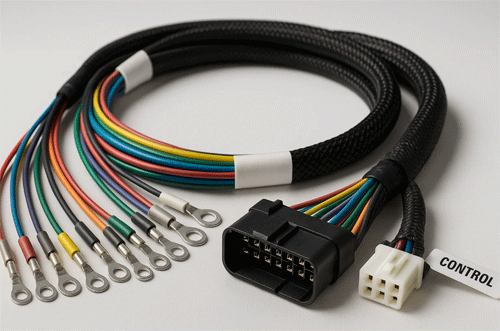
Sealed connector wire harness
A sealed connector wire harness is not simply a harness that uses a connector with seals. It is a harness in which the sealing system works as intended after assembly, handling, installation, and service exposure. That distinction matters because many failures occur at the boundary between connector design intent and harness assembly execution.
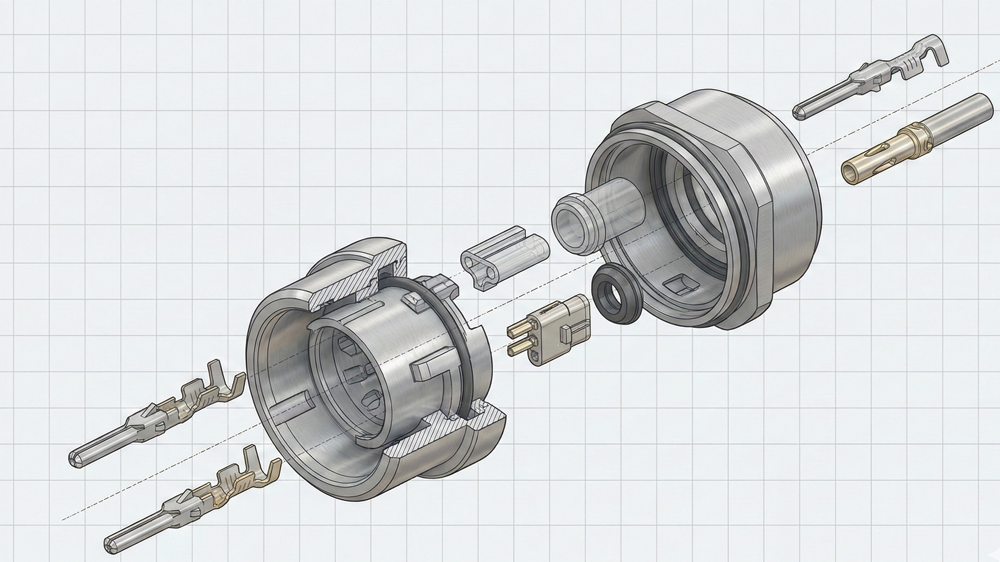
A sealed connector system normally depends on several elements working together. The wire must match the seal range. The seal must be undamaged and correctly positioned. The terminal must be inserted without damaging the seal or displacing it. The terminal must seat fully. The rear cavity must support the wire and seal geometry correctly. The harness routing must not pull the wire at an angle that disturbs the seal after installation. If any of these conditions are marginal, the product may look finished but still be vulnerable.
Buyers should therefore avoid asking only whether the supplier has experience with a connector family. A better question is whether the supplier can describe the sealing controls at each stage of assembly and show method-based evidence that those controls are applied consistently.
Wire OD and seal fit
Wire outer diameter, often shortened to wire OD, is one of the most important and least respected sealing variables. A seal is designed to compress around a wire within a defined diameter range. If the wire is too small, compression is insufficient and ingress risk rises. If the wire is too large, insertion damage increases, seal distortion increases, and long-term stability may still be poor even if assembly appears successful.
This is one reason “equivalent wire” claims can be risky in sealed systems. Two wires may have the same gauge and insulation family yet different outer diameters, different hardness, or different surface behavior. In a non-sealed application, that difference may be manageable. In a sealed application, it can be the entire difference between a robust harness and a future warranty issue.
For buyers, the practical implication is clear: in sealed programs, wire selection cannot be separated from sealing validation. If suppliers propose alternate wire sources, they should verify not only electrical and mechanical compatibility but seal-fit compatibility as well. That verification should be controlled under a formal change process, not handled as an informal material substitution.
Wire harness seal compression
Seal compression is the real mechanical condition that determines whether ingress protection is stable. Buyers often see “seal present” and assume the system is safe. Presence is not enough. A seal can be present and still be under-compressed, over-compressed, twisted, cut, or displaced.
A reliable sealing system achieves the intended compression after assembly and maintains it after vibration, thermal change, and handling. If compression is marginal, the connector may pass an initial ingress check but fail later because movement, material relaxation, or environmental stress reduces sealing effectiveness further.
That is why seal compression should be treated as a controlled assembly outcome. Buyers do not always need numeric compression data from every lot, but they do need evidence that the supplier has defined compatible wire-seal ranges, insertion methods, and verification points that make correct compression repeatable.
Waterproof wire harness design
A waterproof wire harness design is not only about the connector. It also includes routing, strain relief, cable exit geometry, packaging protection, and service conditions. In practice, “waterproof” claims fail when the harness system exposes the connector to stresses the connector alone was never meant to absorb.
For example, a sealed connector mounted in a splash zone may still fail if the harness is routed so that water runs directly along the cable into a stressed rear seal area. A connector with strong ingress performance in static lab conditions may still lose reliability if the harness flexes repeatedly at the back of the connector and slowly abrades the seal interface. A harness that is truly robust in wet conditions is one in which sealing is preserved not only in the connector drawing, but in the installed mechanical reality.
This is where buyer requirements become critical. If the application demands real waterproof performance, the RFQ and review process should define exposure conditions clearly instead of assuming the supplier will infer them. Controlled inputs reduce the risk that the supplier optimizes for apparent fit rather than long-term sealing reliability.
Wire harness ingress protection
Ingress protection in cable assemblies should be defined in terms of where ingress matters and what the consequence is if it occurs. For some products, ingress causes shorting. For others, the more likely issue is long-term corrosion and unstable resistance. In still other systems, the critical risk is contamination that increases connector wear or blocks mating quality over time.
This is why ingress protection should not be reduced to a single code in a brochure. The buyer needs to ask what that protection means in the actual installation, how it was verified, and what assembly conditions are necessary to preserve it. A strong supplier will not sell ingress protection as a generic promise. They will define the connector family, wire compatibility, assembly controls, and validation method that make the claim credible.
Where the application is especially demanding, ingress protection should also be considered together with routing and movement. A static ingress test is useful, but it does not capture the full risk if the assembly later experiences vibration, flexing, or repeated thermal expansion.
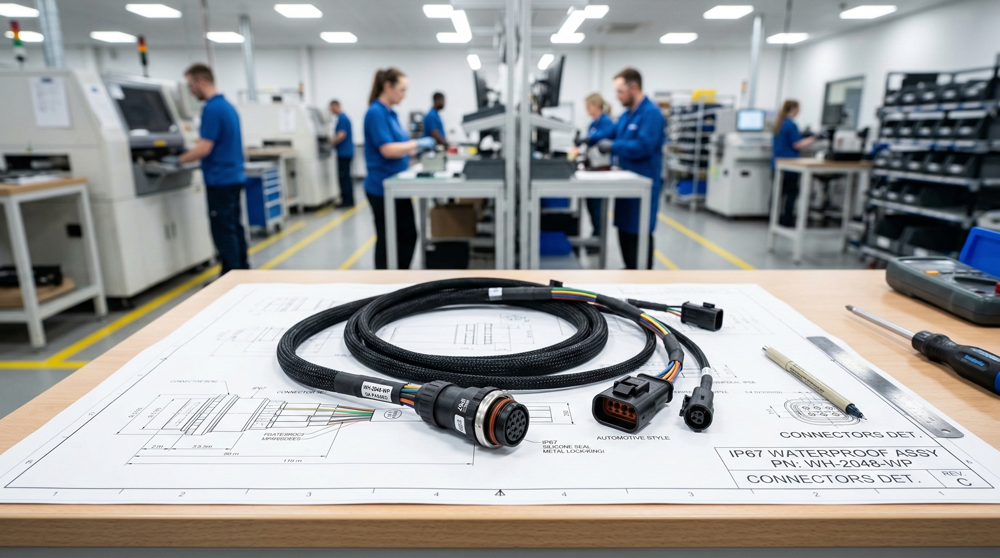
IP67 wire harness testing
IP67 is one of the most commonly discussed ratings in sealed harness conversations, but buyers should treat it as a validation requirement, not a marketing shortcut. An IP67-oriented harness program should define what was tested, how it was tested, and what parts of the system were in scope. If the supplier only validates the connector family in abstract, the resulting harness-level confidence is weak.
A good harness-level ingress test should reflect the built product. That means correct wire, correct seals, correct terminals, correct insertion, and correct assembly geometry. The test should also be tied to acceptance criteria that matter to the buyer. “No visible leakage” may not be enough if the application is sensitive to long-term corrosion growth or electrical instability. In many cases, before-and-after electrical checks provide stronger commercial value than a purely visual inspection, because they indicate whether the interface remained functionally stable after exposure.
The point is not to overcomplicate testing. The point is to make sure the test proves something meaningful about the actual delivered harness.
Wire harness water ingress test
A wire harness water ingress test should be designed around likely field exposure rather than around convenience. If the harness will see splash and temporary immersion, the test should represent that. If the harness will see pressure wash or repeated wet-dry cycles, the test plan should reflect those stresses instead of relying on a one-time static exposure.
From a buyer standpoint, the most useful water ingress test is one that helps separate three questions: did ingress occur, where did it occur, and did it create functional instability. A harness can survive a superficial wetting event and still fail later because moisture remained trapped in a connector cavity and drove corrosion growth over time. That is why buyers should think about ingress testing not just as a pass/fail screen but as part of a broader failure-prevention strategy.
This also connects directly to warranty cost. The more realistic the ingress test, the lower the chance that the customer becomes the real test environment.
Dustproof wire harness design
Dust and particle ingress are less dramatic than water ingress, but they can be commercially just as damaging. Dust can interfere with contact surfaces, mating interfaces, locking features, and long-term electrical stability. In agricultural, industrial, mining, and outdoor equipment, dustproof wire harness design should be treated seriously, especially when the product is exposed to repeated maintenance cycles or connector disconnection in dirty environments.
Dust protection depends on many of the same variables as water protection: correct seal fit, correct insertion, complete seating, housing integrity, and preserved geometry after handling. In some industries, dust is actually a better real-world stressor than water because it is continuous rather than occasional. Buyers should therefore ensure that “sealed” products are not validated only against water while ignoring the contamination environment that dominates real service life.
Waterproof connector sealing failure
A waterproof connector sealing failure rarely has a single simple cause. More often, it is the interaction of small issues: a slightly oversized wire, a seal nicked during insertion, a terminal not fully seated, a rear cavity that sees repeated bending, or a packaging method that preloads the cable at a bad angle before installation.
This is why failure analysis should go beyond “seal failed.” The right commercial question is which upstream control failed: component selection, assembly method, verification method, packaging control, installation condition, or change control. If the root cause is not pushed back into the process, the same failure pattern usually reappears under a different lot or different customer.
A supplier with strong problem-solving discipline should be able to trace sealing failures back to a control gap and then show how the control plan changed afterward. That closed loop is where quality becomes a business advantage instead of just a reactive service activity.
Sealing inspection for cable assemblies
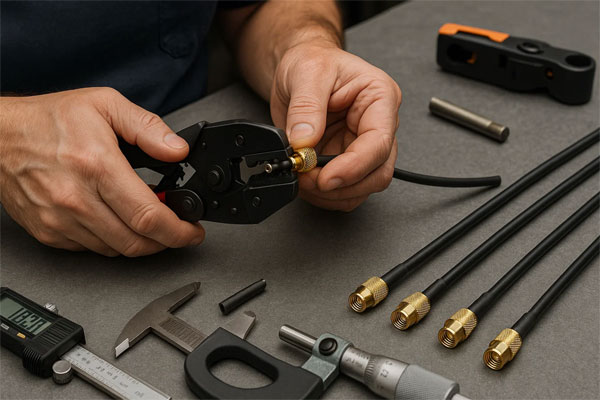
Inspection is necessary in sealed harness programs, but it must focus on the right things. Many suppliers visually confirm that seals exist and stop there. That is too weak for high-risk applications. A stronger inspection logic checks the features that correlate to long-term sealing performance: seal presence, wire-seal compatibility, insertion quality, terminal seating, seal damage, and where relevant, post-assembly alignment.
Inspection also needs to happen at the right stage. Some seal defects are easiest to see before full insertion. Others are visible only after seating. A good assembly process therefore integrates sealing checks into the flow rather than trying to detect everything at the final station.
For buyers, the most practical way to verify inspection quality is through a sample evidence pack and a supplier audit. If the supplier cannot show how sealing is inspected and recorded, they probably do not control it as tightly as the application requires. Documentation expectations should be aligned with Quality Evidence Pack Guide.
Cable assembly sealing failure analysis
When a sealing-related field return occurs, buyers should resist the temptation to classify it immediately as either “bad parts” or “bad installation.” A useful sealing failure analysis asks where ingress entered, which interface failed first, what environmental and mechanical stresses were present, and which build records can isolate affected lots.
In many programs, the most valuable first step is not destructive testing. It is traceability. If the supplier can quickly identify which wire lots, seal lots, assembly dates, and revisions were involved, the containment scope becomes far smaller and the investigation becomes more efficient. If the supplier cannot do that, even a correct technical root cause may arrive too late to save the buyer much cost.
This is why sealing reliability connects directly to traceability and containment. A sealed harness program without lot-level control is still commercially fragile.
Custom wire harness waterproof validation
Custom wire harness waterproof validation should be proportional to the business risk of failure. A low-risk internal machine cable may require only basic ingress checks and visual verification. A field-installed industrial harness or mobility harness may require stronger evidence, including environmental exposure, electrical stability checks, and audit revalidation after changes.
The key is not to test everything endlessly. The key is to create a validation ladder. Qualification establishes the baseline. First-article evidence proves the built design matches that baseline. Periodic audits or change-triggered revalidation confirm that the supplier has not drifted away from the validated condition. That ladder keeps sealing validation practical while still protecting against silent deterioration in supplier execution.
Custom programs should especially define what changes trigger sealing revalidation: wire changes, seal changes, terminal changes, insertion tooling changes, overmold changes, or housing revisions. A waterproof harness is only as stable as the weakest uncontrolled change.
Wire harness sealing and routing
Sealing cannot be separated from routing because movement at the connector rear is one of the most common hidden causes of ingress growth. Even if a seal is perfect at build stage, poor routing can pull the wire at a constant angle, flex the rear cavity repeatedly, or create a whipping motion that degrades the sealing interface over time.
That is why routing reviews should consider sealing consequences as well as mechanical packaging. A route that looks acceptable in CAD may still create long-term sealing risk in service. Buyers should therefore ask how the supplier interprets the installed stress path and whether validation reflects that reality. If it does not, the “sealed” design may only be sealed in the lab.
Wire harness sealing and packaging
Packaging can quietly damage sealing performance before the customer ever installs the harness. Coiling too tightly, forcing the cable into a bend at the connector rear, compressing connectors against hard carton walls, or stacking weight onto rear seal areas can all create hidden sealing risk.
This is especially important in export programs or long logistics chains where the harness may sit in packaging for extended periods before use. Buyers who care about sealing reliability should make packaging part of the sealing conversation. The harness should arrive with its sealing geometry intact, not merely with the correct part number. Packaging expectations should be defined early and aligned to Cable Assembly Packaging and Logistics Cost Guide.
Supplier controls for wire harness sealing
Suppliers who perform well in sealed harness programs usually control the same fundamentals. They define compatible wire-seal combinations. They use controlled insertion methods. They verify seating. They inspect seal condition at meaningful stages. They keep method-defined records. They control packaging that preserves the rear sealing geometry. And they treat changes to wires, seals, housings, or tooling as controlled events rather than informal substitutions.
From a buyer perspective, these controls are more important than broad claims of waterproof experience. Waterproof experience without repeatable controls is not a system. It is a memory. Buyers reduce risk when they qualify suppliers based on method discipline and evidence, not just on confidence or historical anecdotes.
Conclusion
Wire harness sealing is not a connector feature alone. It is a system outcome created by correct wire OD, stable seal compression, controlled insertion, complete seating, sensible routing, protective packaging, and validation that reflects the real environment. Buyers who define those controls clearly reduce water ingress, contamination failures, corrosion-driven resistance drift, and the warranty costs that follow.
The commercial lesson is straightforward. If sealing matters in the field, then sealing must matter in the RFQ, in the assembly method, in the evidence pack, and in the change-control plan. That is how sealing moves from a marketing claim to a reliable part of the delivered product.
FAQ
Why do sealed wire harnesses still fail in the field?
Because connector design alone does not guarantee sealing performance. Failures usually come from wire OD mismatch, damaged seals, incomplete seating, poor routing, or uncontrolled changes.
Is seal presence enough for inspection?
No. Presence is only the first check. The real concern is whether the seal is undamaged, correctly positioned, and compressed within the intended range after assembly.
When should a supplier revalidate sealing performance?
Whenever a controlled change could affect the sealing system, such as wire changes, seal changes, terminal changes, housing revisions, or insertion tooling changes.
How does routing affect IP protection?
Routing can preload the wire at the connector rear, create repeated flexing, or direct water into vulnerable areas. A sealed connector can still fail if routing is poor.
What evidence should buyers request for sealed harness programs?
Method-defined validation records, first-article evidence, ingress-related test reports where applicable, and traceability that links the built harness to wire, seal, and lot information.
CTA
If your product depends on sealing performance, sharing the connector family, wire construction, environment, and exposure conditions early will make validation far more useful. A sealing plan tied to real exposure, controlled assembly, and traceable evidence is one of the fastest ways to reduce field-failure cost.
Contact, review Tests & Inspections, explore Custom Cable Assemblies, or see Why Choose Us.