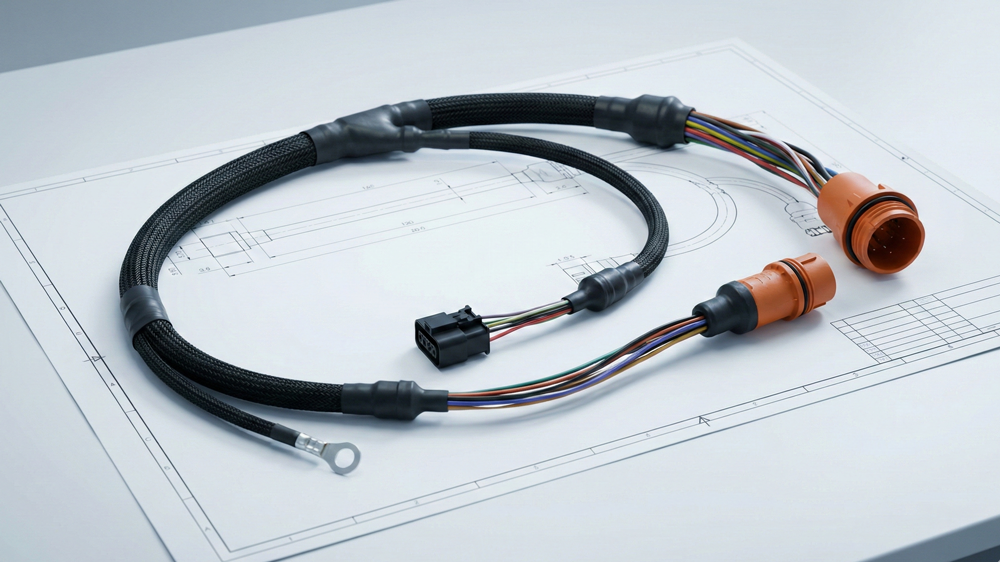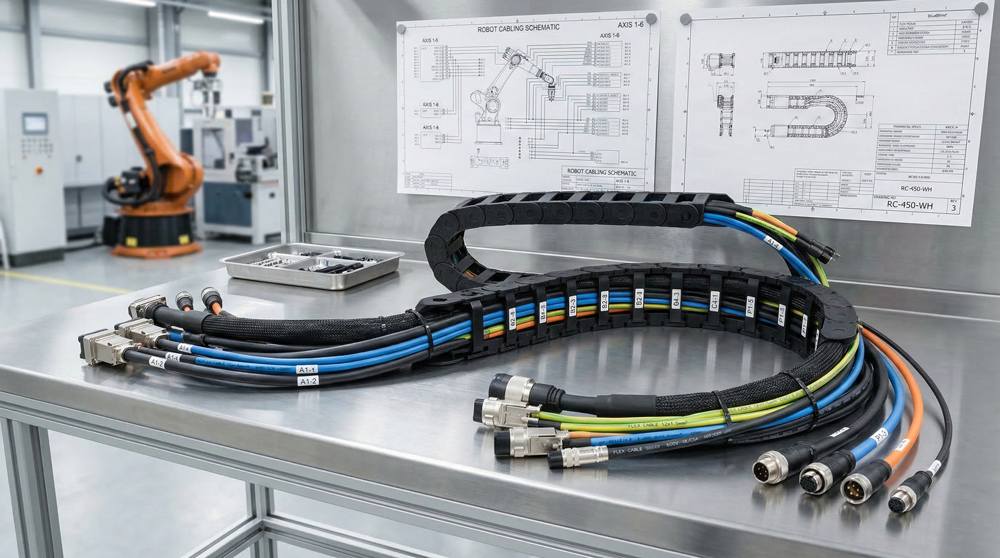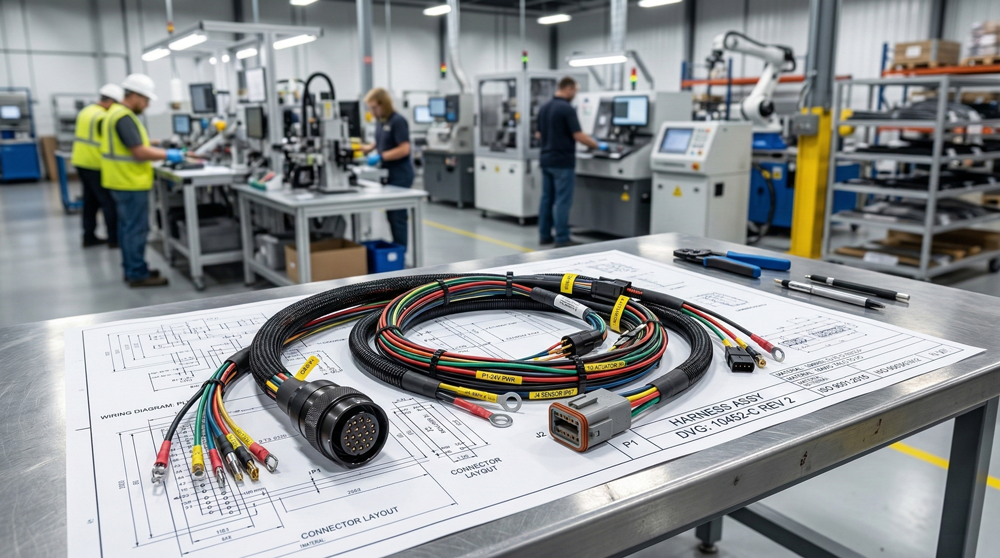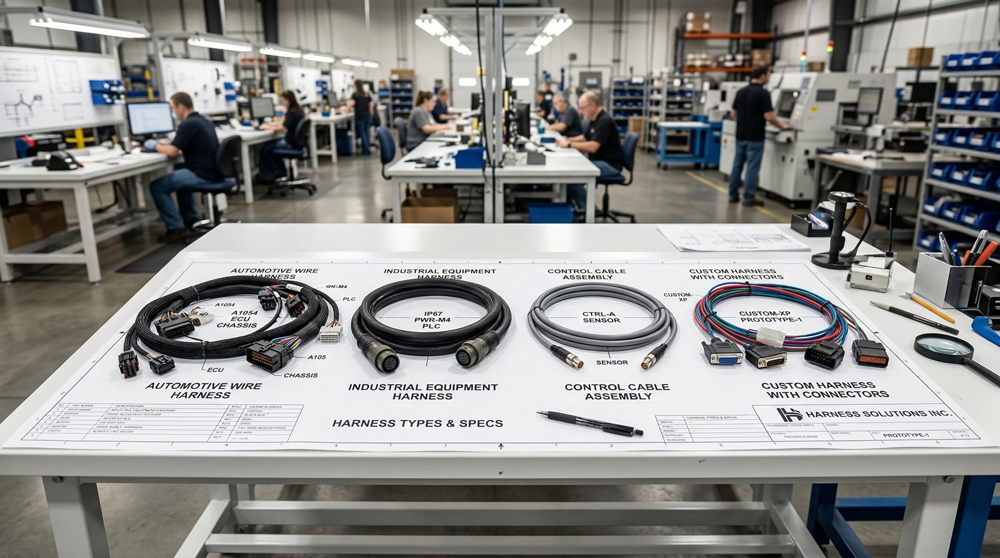
Wire harness vibration reliability is one of the clearest predictors of whether a cable assembly will stay stable in the field or slowly turn into a warranty problem. Many failures do not begin as obvious opens, burnt contacts, or broken connectors. They begin as very small amounts of movement in the wrong place. A cable flexes at the connector exit instead of in a protected loop. A clamp point sits too close to a rigid transition. A terminal stays electrically connected in static inspection but begins to fret under repeated vibration. Weeks or months later, the result appears as an intermittent fault, a resistance jump, or a field return that consumes far more time than the harness itself is worth.
For B2B buyers, that is the real issue. The cost of poor vibration performance is rarely just the replacement assembly. It is the technician visit, the line stop, the delayed machine restart, the sorting of suspect lots, the engineering time spent proving root cause, and the commercial damage caused when a customer loses confidence in the supplier. That is why wire harness vibration reliability should not be treated as a narrow test topic. It is a sourcing, design, validation, and warranty-reduction topic.
This article explains how to think about vibration and flex life from the perspective of procurement, engineering, and supplier qualification. The goal is not merely to pass a lab test. The goal is to build and source cable assemblies that remain electrically stable and mechanically intact after repeated motion, vibration, and flexing in real service conditions. For the broader warranty-cost framework behind this topic, you can connect this article to Warranty Reduction Guide for Cable Assemblies.
Table of Contents
ToggleWire harness vibration risk
Wire harness vibration risk is easy to underestimate because many vibration-driven failures are progressive. A harness can pass incoming inspection, pass end-of-line continuity, and perform correctly during installation, yet still be marginal. The weakness only appears after repeated movement in service, especially when vibration is combined with temperature change, humidity, load, or operator handling. That delay makes vibration-related defects expensive because they escape the factory and turn into field failures instead of internal scrap.
In commercial terms, vibration risk is highest when the harness is installed in moving equipment, mounted near engines or motors, routed across vibrating panels, connected to hinged structures, or exposed to repetitive machine motion. It also becomes significant when the assembly must survive transport vibration, installation stress, and service movement all in the same life cycle. A supplier who only proves the harness at rest is not really proving field reliability.
For buyers, the correct question is not simply, “Do you perform vibration testing?” The better question is, “Where does this harness move in the real product, what are the highest-stress points, and what evidence proves those points remain stable over time?” Suppliers who can answer that clearly are usually the suppliers who understand reliability as a system rather than as a certificate.
Cable assembly flex life
Flex life describes how many movement cycles a harness can survive before performance degrades beyond an acceptable limit. In practice, flex life is influenced by conductor construction, insulation stiffness, outer diameter consistency, bend radius, support geometry, routing, strain relief, and the stiffness transitions created by connectors, overmolds, boots, or clamps. Because all of these variables interact, flex life is never just a materials question and never just a routing question. It is both.
This matters because a harness that looks robust in static form may still have poor flex life if bending is concentrated at the wrong location. A classic example is a cable with fine-stranded conductors that should be highly flexible, but which is clamped too close to a rigid connector rear. The conductor may be flexible, but the system still forces motion into a short, high-stress zone. In the field, the buyer experiences the result as “the harness failed early,” when in reality the problem was a mismatch between material capability and system geometry.
For OEM and custom projects, flex life should be discussed during the quotation and prototype phase, not after release. Programs involving Custom Cable Assemblies are especially vulnerable because the final routing, support method, and service movement are often unique to the application. If those conditions are not translated into a clear validation plan, the supplier will usually validate to a generic internal standard rather than the real field condition.
Wire harness fatigue failure
Most wire harness vibration failures eventually become fatigue failures. The conductor does not normally fail in one sudden event unless there is severe overload or mechanical abuse. Instead, the process is incremental. A small amount of repeated stress begins to damage a few strands. Electrical stability becomes slightly worse. Local motion increases as stiffness changes. Additional strands crack. Eventually the harness becomes intermittent, then unstable, then open.
That is why fatigue-related failures are so difficult and costly in the field. The same harness can test good one moment and fail under motion the next. A technician may replace a connector, reseat a plug, or move the cable slightly and make the problem disappear temporarily. This creates uncertainty, and uncertainty is a major cost driver in warranty work.
Common fatigue locations include the conductor crimp exit, the point where the cable leaves the connector body, the boundary between flexible cable and rigid overmold, the area immediately next to a clamp, and any location where the cable is forced into a repeated small-radius bend. In field-failure analysis, these locations deserve priority because they often reveal whether the weakness came from design, assembly, installation, or a combination of all three.
Wire harness routing
Wire harness routing is one of the strongest real-world determinants of vibration reliability because routing controls where motion accumulates and where stress concentrates. A technically sound harness can still perform poorly if the route creates unsupported spans, abrasion contact, torsion, or repeated bending at rigid boundaries. Buyers often assume routing is an installation detail owned entirely by the end product, but in reality it is part of the reliability system and should be reviewed together with the assembly design.
A good routing review asks practical questions. How long is the unsupported span between supports? Where is the nearest source of vibration? Does the route force the harness to bend immediately at the connector exit? Does the harness move relative to adjacent brackets, metal edges, or housings? Is there enough slack for service movement without creating loop whip? Does the route create a stiff-to-flex transition at the exact location where vibration is highest?
These questions matter commercially because routing-related failures are easy to misclassify. The buyer sees a failed harness and blames the supplier. The supplier sees acceptable harness workmanship and blames installation. That argument is expensive and usually preventable if routing expectations are addressed during prototype review and if validation reflects the final installation condition.
Wire harness bend radius
Minimum bend radius is often written as a design note, but in vibration-critical applications it should be treated as a reliability control. A harness that is bent too tightly during installation, packaging, or service sees higher local strain, which shortens flex life and increases the probability of conductor fatigue, seal stress, or shield damage.
Bend radius should therefore be specified where it matters most: near connector exits, around moving joints, inside service loops, and in any location where the cable is repeatedly flexed. The buyer should also make sure bend radius rules are reflected in packaging and handling instructions. It is not enough to specify a bend radius on the drawing if the harness is later packed in a way that violates it before the customer even receives it.
This is especially important for larger OD cables, shielded constructions, and harnesses with boots or overmolds that create local stiffness transitions. In those cases, what looks like a gentle bend in free space may still create a high-strain condition at the conductor level. When bend radius is important to the product, it should also appear in packaging and logistics rules, which can be structured through Cable Assembly Packaging and Logistics Cost Guide.
Strain relief design
Strain relief design is one of the most effective and most underused tools for improving wire harness vibration reliability. Its function is not merely to make the assembly look tidy or robust. Its real function is to relocate and distribute bending stress away from sensitive electrical interfaces such as crimp transitions, terminal exits, and sealed cavities.
Good strain relief design allows the cable to move in a longer, more controlled section instead of at one sharp point. Depending on the product, that may involve insulation support geometry, boots, clamps, grommets, routing guides, or overmolds. What matters is the mechanical result: the highest cyclic stress should not live at the most vulnerable interface.
Where overmolding is used as a strain relief feature, buyers should verify that it truly reduces stress instead of creating a new stiffness boundary that moves the failure point a few millimeters away from the connector. That distinction is critical. A poor overmold may improve appearance and sealing while making flex life worse. Projects that rely on molded strain relief should align geometry and validation early with Overmolding Services so the design intent and manufacturing execution support each other.
Cable assembly vibration test
A cable assembly vibration test should simulate the real stress path, not just expose the part to generic movement. That means the fixture, support points, orientation, connector loading, and monitoring method must reflect how the harness is actually mounted in the product. If the setup is unrealistic, the data may be clean but commercially weak because it does not predict what happens in service.
A useful vibration test asks whether the harness remains electrically stable during motion, whether seating and retention remain secure, whether strain relief actually protects the termination, and whether the chosen route or support scheme creates hidden stress concentrations. In many programs, continuous electrical monitoring during the test is more valuable than simple post-test continuity. A harness can recover after movement and still be marginal. Dynamic monitoring helps reveal intermittent opens or resistance spikes that disappear the moment motion stops.
For buyers, the practical value of the test comes from method definition. If two suppliers both say they “performed vibration testing” but use different fixtures, different support geometry, and different pass logic, the data is not comparable. That is why the test should be described in method terms, not only by name.
Wire harness bend fatigue test
A bend fatigue test can be more predictive than a general vibration test for harnesses that repeatedly flex at one defined location. This is common in robotics, hinged equipment, service loops, door assemblies, moving machine axes, and portable systems. In these products, the most important question is not broad vibration resistance but repeated bending survival.
A useful bend fatigue method defines the bend radius, flex angle, cycle rate, number of cycles, monitoring method, and pass criteria. Without those details, a “bend test” becomes too vague to support sourcing decisions. The buyer should also confirm that the tested bend location matches the real stress location in the product. A generic bend point in a lab rig may say very little about the actual cable exit geometry or service loop in the final installation.
This is where prototypes and pilot builds should contribute real design knowledge. If the product shows one dominant movement zone, the validation plan should reflect that zone directly instead of hiding behind broad generic testing.
Automotive wire harness vibration durability
Automotive and mobility applications are strong examples of why wire harness vibration durability must be treated as a system issue. These products often combine continuous vibration, thermal cycling, fluids, constrained packaging, and long service life. In that environment, routing, clip strategy, connector retention, and strain relief geometry can be just as important as the raw material selection.
A short unsupported span might appear desirable for packaging efficiency, yet create a high-stress bend at the connector exit. A longer span might reduce local stress but create whip motion elsewhere. A rigid overmold might improve sealing but move fatigue into the cable boundary. None of these tradeoffs can be understood by material selection alone.
For buyers in automotive-style applications, the lesson is clear: vibration durability data should reflect installation conditions, not simply internal bench convenience. If the supplier’s test cannot explain how the harness behaves in the real package space, its value is limited.
High flex wire harness design
High flex wire harness design is often misunderstood as “use a more flexible cable.” That is part of the answer, but not the complete answer. High flex performance depends on conductor strand construction, insulation behavior, termination suitability, routing, support geometry, and the avoidance of rigid stress concentrations. A fine-stranded conductor may improve bend life, but that advantage can be lost if the connector exit, clamp spacing, or strain relief geometry is poorly managed.
Buyers should therefore treat high-flex design as a combined material-and-system decision. If the application includes repeated motion, ask what conductor class is being used, why that conductor class was chosen, how the termination method supports it, and how the routing allows that flexibility to be used safely. A supplier that simply quotes “high flex cable” without defining the rest of the system is not solving the full reliability problem.
Wiring harness intermittent failure
Intermittent wire harness failure is one of the most expensive failure modes because static inspection often misses it and field diagnosis takes time. A harness may pass continuity on the bench and still fail during vibration, bending, temperature change, or load. That forces technicians to chase unstable symptoms, which drives service cost far above the value of the harness itself.
The most common causes are fatigue near the termination, poor strain relief, incomplete seating, contact fretting, or conductor damage from earlier processing. In practice, intermittent failures should be investigated dynamically, not only statically. If possible, the harness should be monitored while it is flexed or vibrated in a controlled manner so the failure can be reproduced under the real trigger condition.
Commercially, intermittent failures are also why buyers value traceability and evidence packs. The faster the supplier can connect the failing product to build conditions, materials, and validation records, the faster containment becomes.
Cable harness fatigue failure analysis
When a harness does fail, fatigue failure analysis should not stop at “broken conductor found.” The real value lies in understanding why the break happened at that location. Was the bend radius too tight? Was the clamp too close? Did the strain relief geometry force bending into the crimp exit? Did a stripping issue create a crack initiation site? Was there combined vibration and temperature exposure that accelerated failure?
A strong analysis connects symptom, location, stress path, and supplier controls. It also generates prevention actions, not only explanations. That is what makes fatigue analysis commercially useful. If the analysis ends with a descriptive label but does not update routing rules, strain relief geometry, validation methods, or change controls, the failure is likely to recur.
This broader closed-loop discipline will be developed later in this series through the dedicated failure-analysis article, but buyers should already view vibration failures through that lens: root cause is only valuable if it changes the next build.
Wire harness test report
A wire harness test report should help a buyer answer three questions quickly: what was tested, how it was tested, and what changed afterward. A report that says only “pass” is not useful for supplier comparison, warranty prevention, or field investigation.
A strong report usually includes product and revision, fixture and support description, orientation, vibration or bend profile, electrical monitoring method, before-and-after measurements, observations, and traceability to the lot and build under test. The goal is not excessive paperwork. The goal is comparability. If one supplier’s report cannot be compared meaningfully to another’s, the buyer loses leverage and clarity.
This is why test reporting should connect to a broader documentation framework such as Quality Evidence Pack Guide. Evidence becomes commercially valuable when it is consistent enough to reduce disputes and shorten failure loops.
Wire harness validation plan
A good validation plan separates qualification from ongoing audit control. Qualification proves that the design and process are fit for the target environment. Audit validation checks that suppliers continue to build to that same standard after lot variation, time, or controlled changes.
For example, prototype validation may focus on identifying weak routing points and proving the preferred strain relief concept. First-article validation may lock in measurements, evidence, and baseline build conditions. Pilot validation may focus on repeatability and lot consistency. Periodic audit validation may be lighter, but it should still be capable of detecting drift after material changes, tooling changes, or process adjustments.
This staged structure makes validation practical. It avoids both extremes: overtesting everything forever, and undertesting until the field becomes the test site.
Supplier controls
Suppliers who perform well in vibration-critical programs usually control the same fundamentals. They maintain clear work instructions for terminations and strain relief. They use stable routing and support methods. They define vibration and bend test methods rather than relying on informal “best effort.” They keep traceable records. And they control changes that might alter flex life, such as wire construction changes, clamp changes, overmold geometry updates, or tooling substitutions.
These controls matter because vibration reliability can degrade quietly. A harness can keep the same part number while losing flex life through a seemingly small material or process change. That is why vibration performance should be linked to controlled re-validation triggers, supported by Cable Assembly Change Control and ECO Guide.
Conclusion
Wire harness vibration reliability is not a narrow laboratory property. It is a system outcome shaped by routing, bend radius, strain relief, conductor construction, termination quality, and realistic validation. Buyers reduce warranty cost when they stop treating vibration as a generic checkbox and start treating it as a field-failure prevention tool.
The most effective strategy is to identify where movement occurs, test the real stress path, require evidence that is comparable across suppliers, and control the changes that can quietly reduce flex life over time. That approach reduces intermittent faults, improves supplier accountability, and lowers the hidden cost of downtime and containment.
FAQ
What usually causes wire harness failure under vibration?
The most common causes are conductor fatigue near the termination, poor strain relief, unstable routing, incomplete terminal seating, and contact fretting under repeated motion.
Is a general vibration test enough?
Not always. Many harnesses fail from repeated bending at one specific location, so a bend fatigue test can be more predictive than a broad vibration profile.
Why are intermittent harness failures so expensive?
Because they are difficult to reproduce. The harness may pass static continuity testing and fail only under motion, which makes troubleshooting, containment, and supplier alignment slower.
How does bend radius affect flex life?
A tighter bend radius usually increases local strain and shortens life, especially near connector exits, clamp points, and rigid overmold boundaries.
What should buyers request after vibration testing?
A method-defined test report with setup details, monitoring method, before-and-after results, and traceability to the specific lot and revision tested.
CTA
If your application involves repeated motion, vibration, or flexing, sharing the routing layout, connector types, and operating environment early makes validation much more useful. A practical test and evidence plan built around the real stress path can prevent expensive intermittent failures later.
Contact, review Tests & Inspections, see Why Choose Us, or explore Custom Cable Assemblies.
Related articles
Warranty Reduction Guide for Cable Assemblies,
Environmental Testing Guide for Cable Assemblies,
Sealing and IP Protection Guide for Cable Assemblies,