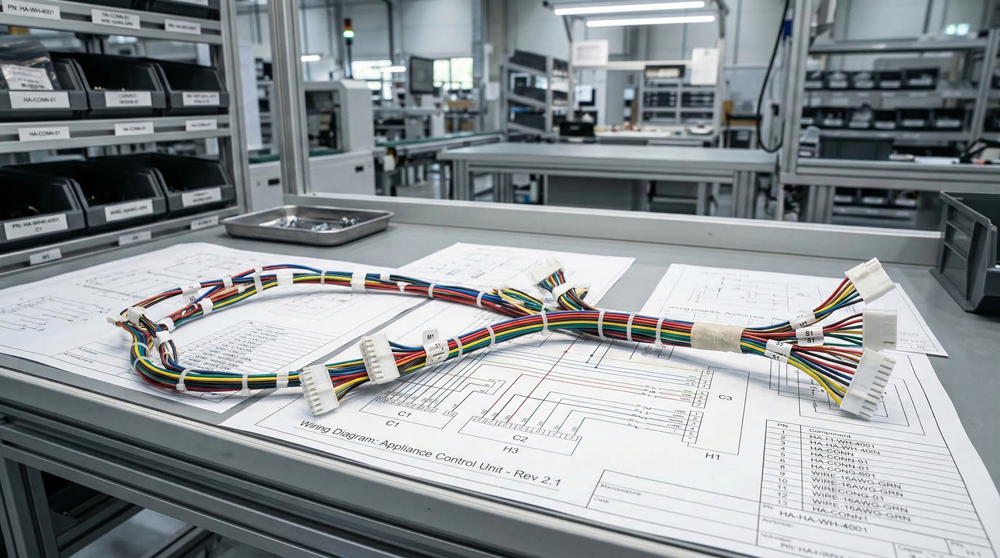

This cable assembly lead time planning guide helps procurement and program teams build timelines that actually hold. In wiring harness sourcing, “lead time” is rarely a single number. It is the sum of component availability, engineering clarification cycles, tooling and setup readiness, test capacity, and evidence-gated approvals. When buyers treat lead time as a simple quote line item, they end up paying the hidden costs later: premium freight, line stops, delayed launches, and emergency engineering support.
The goal of lead time planning is not only speed. It is predictable speed: knowing what the long poles are, defining decision points early, and preventing expediting from becoming a permanent tax on your program.
For the TCO framework behind this, see Total Cost Guide for Custom Cable Assemblies. This S2 article focuses specifically on lead time structure, what buyers can control, and how to reduce lead time variance without increasing risk.
Table of Contents
ToggleWhy lead time variance drives total cost
A two-week slip can cost more than a two-week lead time reduction saves. Variance creates expediting, inventory imbalance, production schedule chaos, and internal firefighting. It also increases quality risk because suppliers under pressure are more likely to bypass controls, rush setups, or rely on unapproved substitutions.
From a commercial standpoint, your goal is to reduce variance through planning and control, not to demand unrealistic “fastest possible” lead times.
If you want a buyer-side mechanism to avoid supplier surprises, connect lead time planning to supplier qualification discipline using Supplier Qualification Guide for Cable Assemblies.
Lead time is a chain, not a quote line
A credible lead time plan breaks the work into stages. Most cable assembly programs have the same underlying stages, even if the supplier labels them differently:
RFQ clarification and requirements freeze. Component procurement and allocation. Tooling and setup readiness. First-article build and approval. In-process production and verification. Packaging, documentation, and shipment.
If any one stage is not planned, lead time becomes a guess. This is also why the quality of your RFQ inputs is a lead time lever. Ambiguity in drawings, length methods, or labeling rules creates clarification loops that push the schedule out long before production begins. Use Cable Assembly RFQ Checklist to remove avoidable RFQ loops.
Component lead times as the long pole
In many harness programs, components—not labor—drive the critical path. Connectors, terminals, seals, and specialty wire can have lead times that dwarf assembly time. Buyers should treat component lead time as a risk category, not as a supplier excuse.
A buyer-friendly lead time plan includes: the supplier’s component sourcing path, whether components are authorized and traceable, whether alternates are acceptable, and how allocation is handled during shortages. It also includes a decision: does the supplier hold safety stock, does the buyer provide components, or does the buyer approve a forecast-based procurement strategy?
If alternates are allowed, they must be controlled. Otherwise, “lead time reduction” becomes silent substitution risk. This is why change control belongs in lead time planning, not just in quality policy. For controlled substitution rules and re-validation triggers, use Cable Assembly Change Control and ECO Guide.
Prototype lead time versus production lead time
Buyers frequently confuse prototype lead time with production lead time. They are different products from an operational standpoint.
Prototype lead time is dominated by clarification cycles, setup, and first-article approval. Production lead time is dominated by component procurement, capacity planning, and steady-state throughput. A supplier who is fast at prototypes is not automatically stable at production, and a supplier who is stable at production is not automatically fast at prototypes.
A strong supplier will tell you which stage is the constraint and will propose different strategies for prototype versus production timelines. If the supplier cannot separate these concepts, lead time promises are likely to break during ramp.
The next supporting article in this series, Prototype to Production Guide for Cable Assemblies, is designed to standardize that transition and reduce ramp surprises.
Evidence-gated approvals prevent late rework
Many schedule slips happen because approval gates are unclear. Buyers often say “we need samples” without defining what evidence must accompany those samples or what constitutes approval. Then the sample arrives, engineering asks for more proof, and the schedule resets.
A lead time plan should explicitly define evidence gates. Typical gates include:
Requirements freeze gate, where drawings, pinouts, length methods, and labeling are confirmed. First-article gate, where initial build evidence is reviewed and accepted. Validation gate, where required tests are completed and recorded. Production release gate, where change control and traceability are confirmed and the supplier is authorized to run production lots.
Evidence gates reduce lead time variance because they prevent late-stage clarifications from colliding with production capacity windows. They also reduce disputes because expectations are explicit.
If you want evidence gates to be operational rather than theoretical, require a consistent shipment evidence pack using Quality Evidence Pack Guide and verify the supplier’s discipline through Cable Assembly Audit Checklist.
Capacity planning and realistic throughput assumptions
Capacity issues are often hidden until the buyer scales volume. Buyers should not ask “what is your capacity.” They should ask, “what is your capacity for this exact type of harness under our schedule conditions?”
A realistic capacity conversation includes:
setup changeover frequency, line balancing model, test station throughput, availability of trained operators, rework handling capacity, and how the supplier handles peak weeks. It also includes the supplier’s plan for adding capacity and how that expansion is validated so quality doesn’t drift.
If your program requires fast-turn shipments, ask how the supplier accelerates without skipping controls. Suppliers who describe quick-turn capability should also show verification discipline under Tests & Inspections.
Lead time levers buyers can control
The buyer controls more lead time than they think. The highest-leverage buyer actions are not expediting; they are planning decisions that remove uncertainty.
Clarify length reference points and tolerance at RFQ stage so the supplier doesn’t rebuild samples multiple times. Confirm connector and terminal part numbers so procurement doesn’t stall on missing details. Define labeling and packaging early so production doesn’t stop waiting for label approvals. Provide forecasts that allow component allocation and staged procurement. Approve alternates only through a controlled workflow.
Each of these actions reduces schedule risk without pressuring suppliers to cut corners.
Expediting without creating permanent chaos
Expediting is sometimes necessary. The mistake is allowing expediting to become routine. Routine expediting creates cost and increases defect risk because it forces suppliers into constant priority switching, rework, and overtime.
A healthy lead time system defines “expedite triggers” and “expedite rules.” For example, expediting may require: buyer approval, written scope (what is expedited and what is not), a controlled split shipment plan, and confirmation that evidence gates are still met.
From a TCO standpoint, the objective is to reduce expedite frequency by improving forecasting and by reducing clarification loops.
If you want a structured way to reduce unit cost volatility while planning lead times, connect your planning to MOQ and Forecast Strategy Guide for Cable Assemblies.
A practical cable assembly lead time template
A buyer-friendly template does not need to be complex. It needs to make the critical path visible.
Below is a pragmatic planning template you can use in supplier discussions.
| Stage | Typical long pole | Buyer input needed | Supplier deliverable |
|---|---|---|---|
| Requirements freeze | RFQ ambiguity and revisions | Final drawing, length method, labels | Confirmed build assumptions |
| Component procurement | connectors/terminals/wire allocation | Forecast, alternates rules | Component lead time plan |
| Tooling/setup readiness | applicator/fixtures/labels | Approval of tooling/NRE | Setup schedule and checklist |
| First-article build | setup + evidence capture | First-article criteria | Samples + evidence pack |
| Validation and tests | method/time capacity | Test requirements | Method-defined test records |
| Production run | capacity + yield stability | Release authorization | Lot records + traceability |
| Packaging and shipping | packaging constraints | Packaging approval | Packing photos + shipment docs |
This template makes it easier to spot where the schedule will break and where buyers can intervene early.
Packaging and logistics timing
Packaging is often the final bottleneck because buyers approve it late. If packaging requirements are undefined, suppliers ship with “best effort” packaging, and you get transit issues or acceptance delays. If packaging is over-specified late, production waits for buyer approval.
Define packaging expectations early and treat them as part of lead time, not as an afterthought. The series companion article Packaging and Logistics Cost Guide for Cable Assemblies provides a procurement-friendly structure for packaging decisions that reduce both cost and schedule risk.
Conclusion
Cable assembly lead time planning is a risk-control discipline. The buyers who win on lead time do not “push harder”; they remove ambiguity, define evidence gates, control change, and plan component long poles with realistic capacity assumptions.
If you want predictable lead time without quality drift, treat lead time as a staged system and build it into RFQs, evidence packs, and supplier agreements. That’s how you reduce premium freight, reduce schedule slips, and reduce total cost.
FAQ
What is the most common cause of cable assembly lead time slips?
Component lead time surprises and RFQ ambiguity. Missing connector/terminal details and unclear length methods often create long clarification loops.
How do we shorten lead time without increasing risk?
Define requirements early, set evidence-gated approvals, and control alternates through change control. Don’t shorten lead time by cutting verification.
Why do prototypes often take longer than expected?
Prototypes are dominated by setup and approval loops. Production is dominated by procurement and capacity. Treat them as different workflows.
What should be included in a lead time plan?
Stages, long poles, buyer inputs, supplier deliverables, and decision gates. If you can’t see the critical path, you can’t control it.
How do we reduce premium freight and expediting?
Improve forecasting, reduce RFQ ambiguity, and plan split shipments with controlled evidence gates. Expediting should be exception-based, not routine.
CTA
If you want a lead time plan that holds through prototype and ramp, share your connector families, target volumes, and launch timeline. We can propose a staged sourcing plan with evidence gates, component long-pole controls, and split shipment options.
- Discuss your program: Contact
- Explore scope: Cable Assemblies and Custom Cable Assemblies
- Verification discipline reference: Tests & Inspections
- Why buyers select us: Why Choose Us