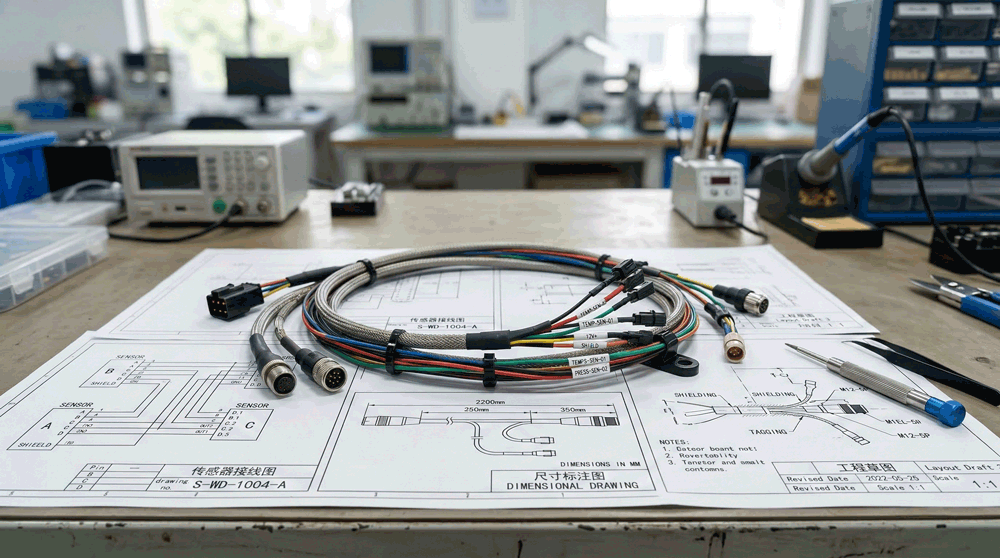
Shielding can reduce EMI, but shielding alone is not enough. In industrial systems, many cable noise problems come from grounding decisions, not from the shield material itself. A shielded cable assembly can still perform poorly if the shield grounding strategy is undefined, inconsistent, or mismatched to the system architecture.
This guide explains cable grounding strategy for shielded cables in industrial systems from an OEM engineering and sourcing perspective. It focuses on practical decisions that affect EMI performance, field reliability, and production consistency.
If you are working through the full shielding design sequence, read our Shielded Cable Assemblies EMI Control Design Guide first, then review Braid vs Foil Shielding for Cable Assemblies and Shield Termination Methods for Shielded Cable Assemblies before finalizing the grounding approach.
Table of Contents
ToggleWhy Shielded Cable Grounding Strategy Matters
A cable shield is not just a metal layer. It is part of an electrical path. The way that path is grounded determines how shield currents return and how well the shield controls noise.
In industrial equipment, the noise environment is often complex. Variable frequency drives (VFDs), servo drives, switching power supplies, relays, motor cables, and long cabinet runs can create multiple coupling paths. In that environment, a shield that is grounded incorrectly can become less effective—or in some cases can even help carry unwanted noise currents.
This is why shielded cable grounding strategy should be defined at system level. The cable supplier can build the assembly, but the OEM engineering team must define how the shield should connect into the actual equipment grounding and chassis structure.
If your project is in motion control or machine automation, your Industrial & Robotics page is a strong internal reference for application context while discussing grounding and EMI risks.
Single-End Grounding for Shielded Cables
Single-end grounding means the cable shield is grounded at one end and left isolated (or intentionally not bonded) at the other end. This method is often used when teams want to reduce low-frequency ground loop current risk between two devices with different ground potentials.
In some signal applications, especially when cable runs are long or the system grounding quality is uncertain, single-end grounding can be a practical way to reduce unwanted circulating currents through the shield. It may be considered for certain low-level analog signals, sensor lines, or control wiring—depending on the actual system design.
However, single-end grounding is not a universal solution. If the dominant problem is high-frequency interference, a one-end-only shield connection may not provide enough shielding continuity in the real installation environment. Teams sometimes apply single-end grounding by habit and then struggle with EMI symptoms that appear only after installation.
The key point is to use single-end grounding by design intent, not by default. The decision should be linked to signal type, cable route, equipment grounding conditions, and noise frequency behavior.
Both-End Grounding for Shielded Cables
Both-end grounding means the cable shield is bonded at both ends so the shield path remains continuous through the full cable run and into the equipment interfaces. In many industrial EMI scenarios, this can provide stronger high-frequency shielding performance.
A continuous shield path is often beneficial when the goal is to reduce coupled noise from drives, motors, switching power circuits, or dense cabinet wiring. In these cases, maintaining low-impedance shield continuity through both connector interfaces can be more effective than leaving one end floating.
The tradeoff is that both-end grounding can allow low-frequency or DC potential differences to drive unwanted currents if the connected equipment grounds are not well controlled. This is where chassis bonding quality, panel grounding, and system grounding architecture become critical.
For OEM teams, both-end grounding should be evaluated together with the enclosure bonding design—not as a cable-only decision. A “both-end grounded shield” on paper can still fail in the field if the chassis bond path is weak or inconsistent.
Single-End vs Both-End Grounding in Industrial Systems
The most common grounding question is not “Which method is correct?” but “Which method matches this system?”
In practice, single-end vs both-end grounding for shielded cables in industrial systems depends on several factors working together:
- Signal type and sensitivity
- Expected interference sources
- Cable length and routing
- Equipment-to-equipment ground potential difference
- Chassis bonding quality
- Connector and backshell design
- Validation results in the real operating environment
That means two similar-looking cable assemblies can require different grounding strategies if they are installed in different machine architectures.
OEM teams should avoid generic rules like “always ground one end” or “always ground both ends.” Those rules can be useful starting points for discussion, but they should not replace application-specific design review and testing.
Shielded Cable Grounding Strategy for Sensors and Control Signals
Sensor and control signal wiring often creates the most grounding confusion because these signals can be sensitive to noise, but they are also affected by system grounding quality and cable routing.
In industrial control systems, sensor lines may run near power wiring, motor leads, or switching devices. If the shield grounding strategy is chosen without considering the installation route, even a correctly built shielded cable assembly may still show unstable readings or intermittent communication issues.
For OEM projects, it is helpful to document:
- Signal type (analog, digital, communication, etc.)
- Source and load device grounding assumptions
- Cable routing near power/noise sources
- Cabinet layout or field installation constraints
- Expected noise symptoms (if already observed)
This project-level context helps the cable supplier recommend a shielded cable construction and termination method that supports the intended grounding strategy. It also reduces the chance of redesign later.
If you are defining complete assembly requirements, align grounding decisions with your Shielded Cable Assemblies and Custom Cable Assemblies sourcing path so material, structure, and grounding are specified together.
Shielded Cable Grounding Strategy Near VFD Drives
VFDs are one of the most common EMI sources in industrial equipment, and they often expose weak grounding strategies quickly. Motor drive switching noise, cable routing proximity, and cabinet bonding quality can all affect how shielded signal cables perform.
A shield grounding method that works in a quiet lab setup may fail when the same machine is installed next to VFD-driven motors and high-current switching circuits. This is why grounding strategy for shielded cables near VFD drives should be reviewed in the actual system environment, not only in schematic form.
When VFD-related noise is suspected, OEM teams should check more than the cable type. Review shield termination continuity, connector shell bonding, panel grounding, cable separation from motor leads, and whether the shield grounding intent is implemented consistently at both ends.
The grounding strategy must be supported by real mechanical and electrical interfaces. Otherwise, teams may keep changing cable constructions while the root cause remains in the cabinet grounding path.
Shield Grounding and Chassis Bonding for Cable Assemblies
Shield grounding and chassis bonding must work as one system. A correctly terminated shield can still underperform if the connector shell, backshell, panel interface, or enclosure bond is weak.
In many industrial designs, EMI performance depends on the continuity of the entire path:
- Cable shield
- Shield termination hardware
- Connector shell or backshell
- Panel or chassis contact
- Enclosure bonding path
- Equipment grounding architecture
This is why shield grounding should be reviewed together with connector interface design. If the connector shell is non-conductive, poorly bonded, or mechanically unstable, the intended shield grounding strategy may not function in real operation.
For teams evaluating manufacturability and repeatability, it helps to review Assembly Capabilities and Strong Technical Support before freezing the RFQ, especially when connector-backshell-chassis interfaces are part of the EMI design.
Common Shielded Cable Grounding Mistakes in Industrial Systems
Several grounding mistakes appear repeatedly in OEM projects.
One common mistake is copying a grounding rule from a previous project without checking whether the new equipment has the same grounding architecture. Another is defining the shield type and termination method, but leaving shield grounding intent unspecified in the drawing or RFQ.
Some teams also troubleshoot noise by changing cable materials first, while ignoring chassis bonding and panel grounding quality. In many industrial systems, the real issue is not the shielded cable itself but how the shield path connects into the machine structure.
Another costly mistake is validating grounding only on the bench. A cable assembly may look stable in a short test setup but fail after installation because routing, cabinet bonding, and nearby noise sources are different in the field.
OEM Shielded Cable Grounding Specification Guide
OEM buyers can reduce EMI risk by documenting shield grounding strategy clearly in the RFQ and design package. Do not rely on shorthand phrases such as “shielded cable” or “ground shield as needed.”
A practical grounding specification should describe:
- Intended shield grounding method at each end
- Whether the shield bonds to signal ground, chassis ground, or specific hardware points
- Connector shell and backshell assumptions
- Chassis or panel bonding expectations
- Routing constraints near major noise sources
- Validation or inspection requirements
- Known EMI symptoms or risk conditions (if available)
This level of clarity helps suppliers build the cable assembly correctly and helps internal teams review the design against the actual machine architecture.
For buyer-side qualification and verification planning, your Tests & Inspections and Quality Guarantee pages are useful internal references.
How to Validate Shielded Cable Grounding Strategy
Grounding strategy should be validated in conditions that resemble real installation as closely as possible. A continuity test alone does not confirm that the selected grounding method is effective for EMI control.
A stronger validation approach typically combines cable checks and system-level observation. Depending on the project, this may include checking shield continuity, connector-shell bonding, chassis contact quality, and functional behavior when nearby drives or switching loads are active.
If the product has known EMI symptoms, test with those conditions present. If the product is still in development, simulate the most likely noise environment as early as possible. The goal is to validate the grounding strategy, not just verify that the cable is electrically connected.
This article should be followed by your testing article, Shielded Cable Testing Guide for OEM Buyers, so grounding decisions and validation criteria are defined together.
Conclusion
Cable grounding strategy for shielded cables in industrial systems is a system-level EMI decision, not a cable-only detail. Single-end grounding and both-end grounding can both be valid, but each method works only when it matches the signal type, noise environment, chassis bonding, and equipment grounding architecture.
For OEM teams, the most reliable path is to define shield type, termination method, grounding strategy, and validation plan as one connected design package. That approach reduces rework, improves field stability, and makes supplier collaboration more effective.
FAQ
Should shielded cables in industrial systems be grounded at one end or both ends
There is no universal rule. Single-end grounding may help reduce ground loop current risk in some systems, while both-end grounding may provide better high-frequency shielding continuity in others. The correct choice depends on signal type, noise environment, and chassis bonding quality.
Why does a shielded cable still have noise after grounding the shield
Noise can remain if the shield grounding method does not match the system, if the shield termination is poor, if the connector shell or backshell bond is weak, or if chassis bonding and cable routing create additional coupling paths. Grounding the shield is necessary, but not sufficient by itself.
Is single-end grounding always better for sensor cables
Not always. It can be useful in some sensor and low-level signal applications, but it should not be applied by default. The decision should be based on the actual equipment grounding conditions, routing, and observed EMI behavior.
Can both-end grounding cause ground loop problems
Yes, it can in some systems if there is a significant ground potential difference between connected equipment and the grounding architecture is poorly controlled. That is why both-end grounding should be evaluated with chassis bonding and system grounding design.
What should OEM buyers include in an RFQ for shield grounding strategy
At minimum, define the grounding intent at each end, connector and backshell assumptions, chassis bonding expectations, routing constraints near noise sources, and validation requirements. This reduces ambiguity and improves supplier execution.
CTA
Need Help Defining Shielded Cable Grounding Strategy for an OEM Project
If your team is deciding between single-end and both-end shield grounding in an industrial system, we can help review the cable assembly design before the RFQ is finalized.
We can support:
- Shield grounding strategy review by application and EMI risk
- Shield termination and connector interface review
- Chassis bonding and hardware path review
- Manufacturability and consistency review
- OEM validation and inspection planning
If you already have drawings, connector part numbers, or installation details, contact us through our Contact page. You can also review our Shielded Cable Assemblies, Industrial & Robotics, and Tests & Inspections pages before starting the discussion.