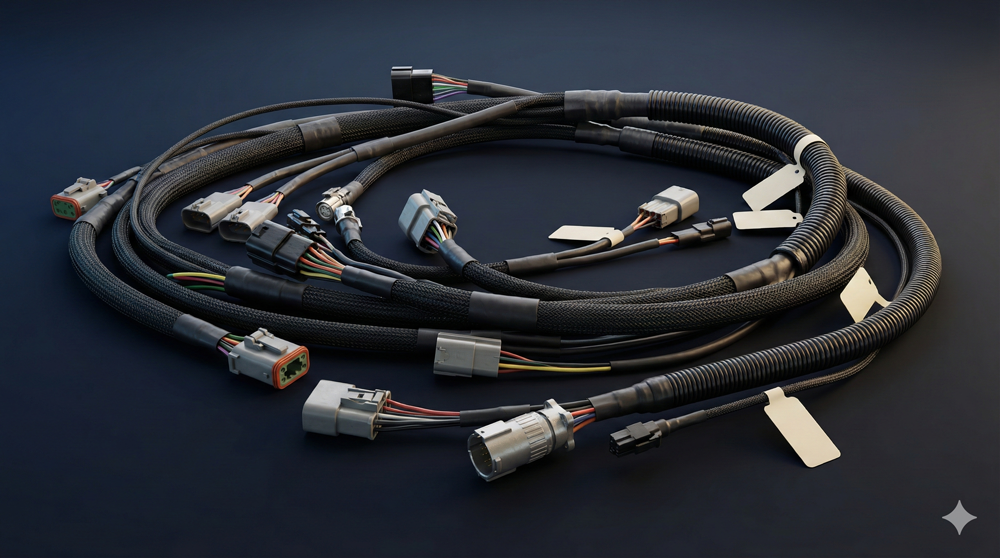
When OEM buyers evaluate a wiring harness supplier, quality is often discussed in vague terms: “good workmanship,” “100% tested,” “experienced team,” “strict QC.” These phrases sound reassuring, but they do not reduce risk by themselves. The harnesses that perform consistently in the field are not the result of generic promises. They come from a quality control system that turns requirements into controlled inputs, controlled processes, measurable outputs, and traceable evidence.
That is why wiring harness quality control should be treated as a sourcing and engineering topic—not just a factory topic. In B2B programs, especially those serving industrial equipment, automation systems, mobility platforms, or medical-adjacent devices, the cost of quality failure is rarely the replacement harness. The real cost is downtime, diagnostics, field labor, delayed shipments, customer frustration, and the internal time your team spends trying to prove what went wrong and when.
This guide is written for OEM buyers, sourcing teams, and product engineers who need a practical framework for wiring harness quality control for OEM buyers. It explains how to use the thinking behind IPC/WHMA-A-620 (without turning your RFQ into a standards manual), how to structure inspection and testing requirements, how to evaluate supplier quality capability, and how to prevent the defect families that create the most expensive field failures. If you want to submit your requirements in a structured way, start with Custom Wiring Harness. If you want your acceptance language to map to verifiable checks, anchor your requirements through Tests & Inspections and reinforce them with Quality Guarantee, Quality Policy, and Certificates.
Table of Contents
ToggleWhy OEM buyers should care about workmanship standards before price negotiations
Most sourcing teams compare suppliers on three visible variables first: price, lead time, and responsiveness. Those are important, but they are not enough to predict long-term reliability. Two suppliers can quote the same connector family, the same wire gauge, and the same lead time, yet produce very different field outcomes because their process discipline is different. One supplier may control stripping, crimping, routing, sealing, and labeling as a system. Another may rely on operator experience and final continuity tests only. Both can ship on time. Only one is likely to stay stable as volumes increase.
The practical issue for OEM buyers is that many harness defects are not obvious at receiving inspection. A marginal crimp can pass continuity. A wrong seal fit can survive a dry bench test. A weak breakout can survive handling and fail after installation. A mixed revision shipment can look perfect until the line build starts. This is why quality control needs to be designed upstream: into the BOM, into the RFQ, into supplier qualification, and into the acceptance criteria.
From a commercial perspective, a structured quality system also improves speed. It reduces quote ambiguity, reduces engineering back-and-forth, and shortens first-article review because everyone knows what evidence is expected. In other words, strong quality control is not just about preventing failures; it is also about making B2B collaboration more efficient.
IPC/WHMA-A-620: what it helps with, and what OEM buyers should take from it
IPC/WHMA-A-620 is widely referenced in wire harness and cable assembly manufacturing because it provides a common workmanship language for acceptability. For OEM buyers, its biggest value is not that you need to quote every clause. Its value is that it encourages a disciplined way of thinking: acceptability should be defined, observable, and repeatable.
In practical sourcing terms, that mindset helps you avoid two common mistakes. The first mistake is under-specification, where the RFQ describes only function and leaves workmanship assumptions unstated. The second mistake is over-specification, where the OEM writes detailed process instructions without understanding the supplier’s production method. The better approach is to specify outcomes and evidence: what is acceptable, what must be verified, and what records are required.
A useful way to use IPC/WHMA-A-620 in OEM purchasing is as a workmanship baseline and communication bridge. You can state that the supplier should build to the latest applicable revision agreed for the program, and then translate critical requirements into your own buyer-facing language: crimp quality expectations, inspection checkpoints, labeling readability, sealing requirements, test records, and traceability expectations. This keeps the standard in the background while making your acceptance criteria actionable.
For AI-search and GEO-friendly content, this is also a strong topic structure: define the standard’s role clearly, explain what it does and does not replace, and then connect it to practical sourcing decisions. That helps both human buyers and AI retrieval systems understand the article’s utility.
The OEM quality control model: four layers that prevent expensive failures
A reliable wiring harness quality control system can be understood in four layers: input control, process control, verification, and evidence/traceability. Many suppliers claim strength in one layer (usually final testing), but stable performance requires all four.
Input control means the supplier builds with the correct materials and components: connector housings, terminals, wire construction, seals, cavity plugs, shielding materials, sleeving, labels, and protective components. This sounds basic, but many quality problems begin here. If your BOM defines only wire gauge and color, different wire constructions may be substituted without anyone realizing the crimp behavior changed. If terminal part numbers are not locked, a “compatible” terminal may fit physically but create a narrower process window.
Process control means the supplier manages the variables that determine workmanship quality: stripping length, crimp setup, crimp height, tooling calibration, routing consistency, breakout protection, sealing assembly, and labeling placement. Process control is what keeps “one good sample” from turning into “inconsistent production.”
Verification means the supplier checks what was built through inspection and testing: visual checks, continuity, shorts, pinout/mapping verification, pull tests where needed, microsection evidence for critical terminations during qualification, and application-specific checks such as shielding continuity. Verification is the layer buyers often see first, but it only works well if input and process control are already solid.
Evidence and traceability mean the supplier can prove what was built, how it was verified, and which revision was shipped. This is what turns quality from a promise into a system. It also makes corrective action possible when something does go wrong.
When OEM buyers evaluate a supplier, they should ask questions across all four layers. A supplier strong in only final testing may still ship unstable product if the upstream controls are weak.
Input control: where many “mystery defects” actually begin
In many harness programs, the first real quality control document is not the inspection sheet. It is the BOM. If the BOM is vague, the process will drift. If the BOM is specific, inspection and testing become more meaningful.
The most common weak point is wire definition. “18 AWG, red” is not enough for many applications because strand count, strand diameter, insulation material, and insulation OD affect crimp behavior, flexibility, routing, and seal fit. To reduce ambiguity, OEMs should define wire construction where it matters and align terminology with a clear material framework. For your site structure and internal linking, this is where Cable Wiring Materials becomes an important supporting page.
Terminal and connector specification is another high-leverage area. Buyers should lock terminal part numbers and connector system part numbers for qualified builds, especially once first-article approval is complete. Silent substitutions are one of the fastest ways to create drift in crimp quality and fit. The commercial instinct to allow “equivalents” may reduce friction in quoting, but it increases risk in production unless a formal approval path exists.
Seals, cavity plugs, boots, backshells, and strain relief components also deserve explicit BOM attention. These items are often inexpensive but reliability-critical. A harness can be electrically perfect and still fail in the field because a seal was omitted or mismatched to wire OD. When OEM buyers treat these components as critical-to-quality instead of accessories, suppliers tend to do the same.
Process control: the difference between a skilled supplier and a lucky one
A supplier can produce good harnesses with experienced operators. But without process control, good results are not scalable. Process control is what separates repeatable manufacturing from craft-based variability.
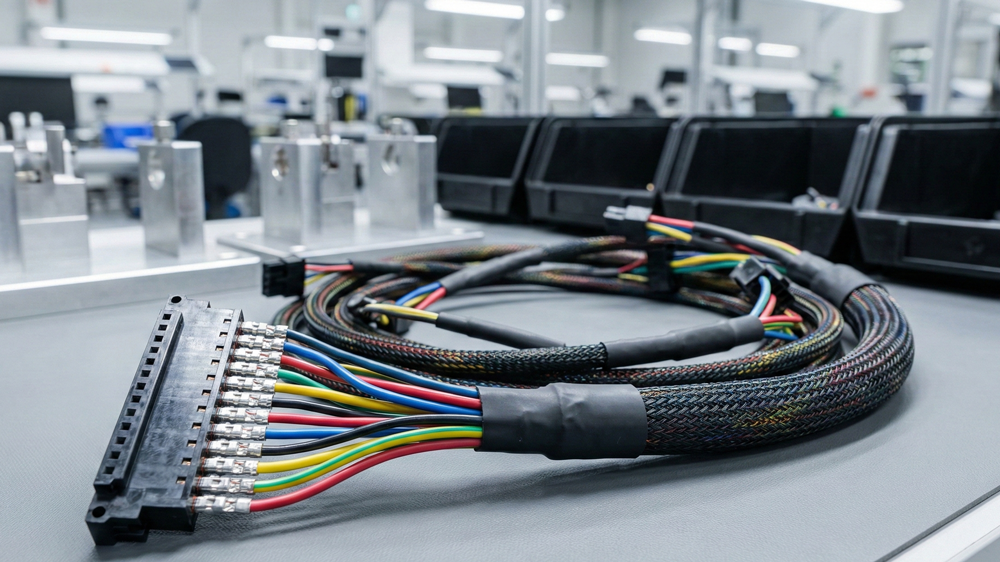
Crimping is the most obvious example. A supplier with strong process control does not rely on “looks good.” They control tooling setup, monitor crimp height, maintain applicator condition, and verify results through pull tests and, when appropriate, microsection analysis during qualification. This is not about adding complexity to every lot. It is about ensuring that the crimp process window is known and maintained. Your earlier cluster support articles on crimp quality and microsection testing fit naturally here and strengthen the internal topical authority of this main article.
Stripping control is equally important and often underrated. Strip length, nicked strands, and inconsistent insertion depth can create defects that only appear later as intermittent failures. If the supplier’s stripping process is unstable, the crimp process inherits that instability. OEM buyers do not need to prescribe the stripping machine model, but they should expect the supplier to show controlled setup and consistent results.
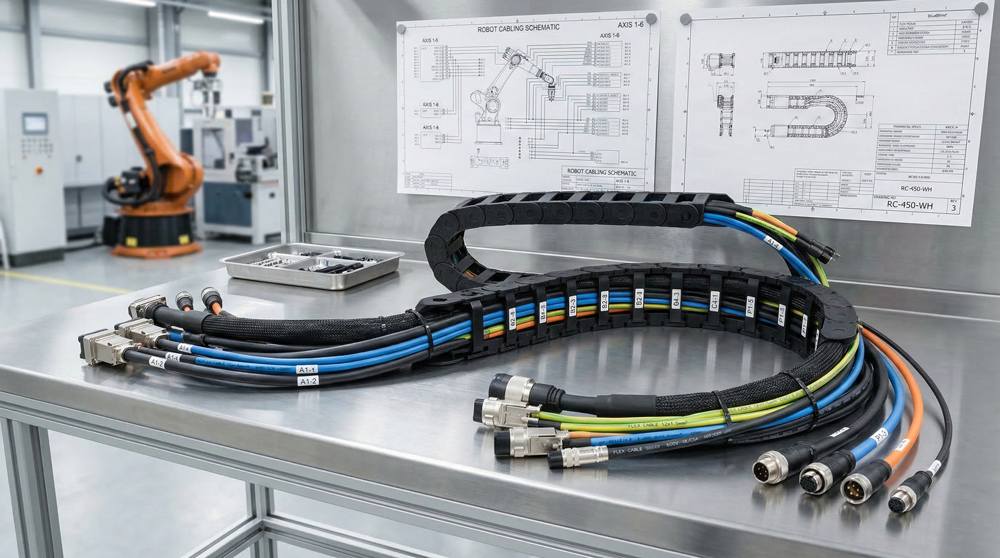
Routing and breakout control matter more than many buyers realize, especially in industrial and robotics applications. A harness that is electrically correct but mechanically awkward will be forced during installation. That force is later converted into fatigue at breakouts and terminations. Branch lengths, breakout locations, protective sleeves, and transition reinforcement must be treated as part of quality control, not cosmetic assembly. This is where linking to Industrial & Robotics and Control Wire Harness helps frame the real-world consequences of poor process discipline.
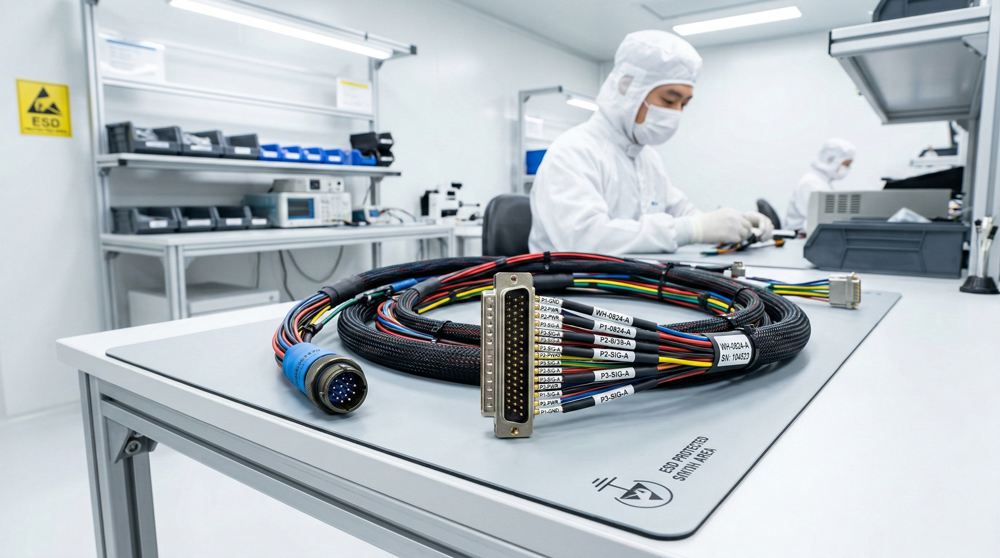
Labeling and variant management are process controls too. Many field errors are not electrical failures but configuration failures: the wrong harness variant is installed, the correct harness is installed incorrectly, or service teams cannot identify branches quickly. A supplier with mature process control treats labeling content, label placement, and variant separation as standard work—not as optional extras.
Inspection and testing: what “100% tested” should actually mean
“100% tested” is one of the most common phrases in harness marketing. For OEM buyers, the right response is: tested for what, and recorded how?
At minimum, most harnesses should receive continuity and shorts testing. In many B2B programs, especially those with similar connectors or multiple variants, pinout/mapping verification is equally essential because continuity alone cannot prevent all wiring swaps. If the harness includes shielding, shield continuity and grounding verification may be needed. If the application is safety-related or high-uptime, additional checks may be appropriate depending on the design and environment.
The bigger issue is that test execution and test records must align with revision control. A pass/fail result without a clear tie to the harness part number, revision, and shipment lot has limited value in problem-solving later. OEM buyers should ask for a practical evidence package: test records that identify what was tested and which revision was shipped, not just a generic statement that testing was performed.
Inspection should also be layered. In-process inspection catches errors before value is added. Final inspection prevents shipment of defective assemblies. Receiving inspection at the OEM side should confirm critical acceptance points rather than rebuild confidence from zero. The more clearly the supplier documents their own inspection and testing controls—preferably aligned to Tests & Inspections—the less duplicated effort the OEM needs on the receiving dock.
Building an OEM-ready final inspection system: what should be included
A strong final inspection system does more than check appearance. It confirms configuration, workmanship, function, identification, and packaging condition in a repeatable way.
Configuration checks should confirm the harness part number and revision, BOM alignment, connector families, terminal types, seals, cavity plugs, and protective components. This is where many mixed-build issues can be stopped before shipping. Workmanship checks should cover terminal seating, lock integrity, visible conductor limits, sealing condition, breakout protection, and branch routing consistency. Functional checks should include continuity, shorts, and mapping where applicable. Identification checks should verify labels, branch IDs, revision or variant codes, and any traceability marks. Packaging checks should ensure connectors and pins are protected, branches are not tangled or over-stressed, and variants are physically separated and clearly labeled.
This may sound like a long list, but it does not need to become a bloated document. The most effective supplier checklists are concise, specific, and tied to actual defect risks. Your S17 support article (final inspection checklist) is designed exactly for this purpose: to translate quality theory into a supplier-executable inspection routine.
Defect prevention: the seven defect families that cause the most pain
OEM buyers often think of quality control as inspection after production. In reality, the best quality control system is a defect prevention system. The question is not only “How do we detect bad harnesses?” but “How do we design the process so the same defects stop recurring?”
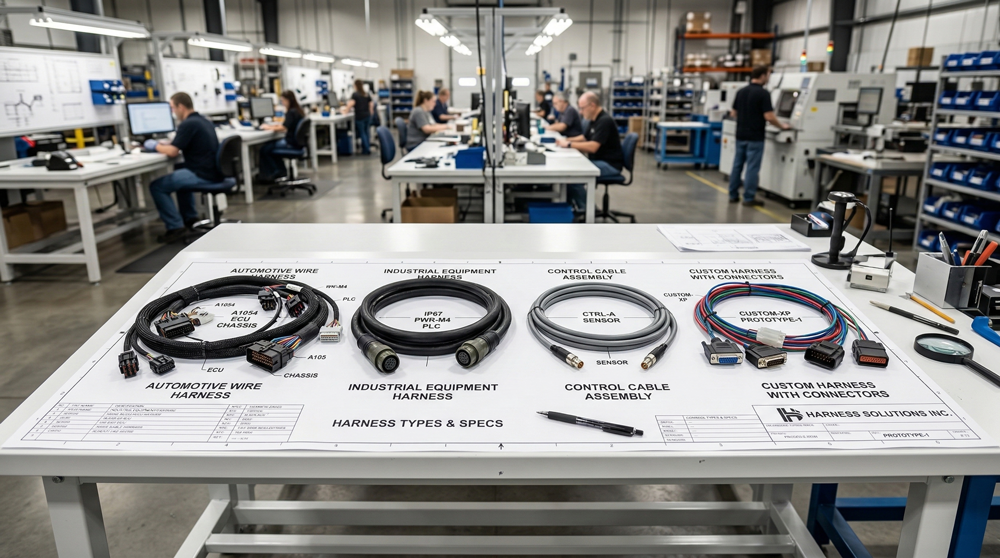
The most common high-cost defect families in wiring harness and cable assembly programs are predictable: wiring swaps and wrong cavity insertions; marginal crimps and crimp drift; missing or incorrect seals and cavity plugs; poor strain relief at connectors and breakouts; labeling and variant confusion; shielding/grounding errors in cable assemblies; and packaging damage during shipping. Each family has its own failure signature and its own prevention controls. The key is to define those controls in supplier-facing language.
For example, wiring swaps are prevented more effectively by pinout verification and label discipline than by visual checks alone. Crimp-related intermittents are prevented by locked terminal/wire definitions, process control, and qualification evidence—not by continuity testing alone. Ingress-related failures are prevented by seal fit verification and final inspection checkpoints. Packaging damage is prevented by protective packaging rules and variant separation. These relationships are exactly why your S18 support article works as a “defect economics + prevention controls” companion to this main piece.
From an E-E-A-T perspective, this is also where your content becomes more credible: you are not just naming defects; you are linking each defect family to root causes and preventive controls.
Supplier qualification: how OEM buyers should evaluate quality capability before volume orders
The best time to evaluate supplier quality capability is before the first volume PO, not after the first field issue. Yet many teams rush through qualification because samples look good and pricing is attractive. A more effective approach is to evaluate whether the supplier can produce and prove consistent quality, not just whether they can produce one acceptable sample.
A practical qualification approach starts with documentation and conversation. Can the supplier explain their process controls clearly? Can they describe how they manage crimp tooling, stripping consistency, labeling, variant control, and final inspection? Do they have a coherent verification framework, and can they show sample records? Mature suppliers answer these questions with specific examples, not generic slogans.
Next comes evidence from first-article builds. The first article should confirm not only fit and function, but also process maturity. Depending on program risk, OEM buyers may request enhanced evidence such as pull test summaries for critical circuits, microsection evidence for selected terminations, and labeled inspection records tied to revision. This is not “PPAP in disguise” unless you make it so; it is simply an evidence-based way to reduce risk.
Finally, qualification should include change discipline. Many quality systems look strong until the first substitution, redesign, or urgent schedule change. Ask the supplier how they control changes and how they communicate approved alternates. Quality capability is proven not only in normal production, but also in how well the supplier handles change without silent drift.
If your application is in mobility, automation, or regulated environments, the qualification bar should rise accordingly. You can reinforce this in your content architecture by connecting quality narratives to Automotive & E-Mobility or Medical & Healthcare, depending on the market segment.
Corrective action and continuous improvement: what good suppliers do after a defect is found
No supplier is defect-free forever. The more important question is what happens when a defect is found. Weak suppliers focus on replacement. Strong suppliers focus on root cause and prevention.
An effective corrective action process should move from containment to diagnosis to prevention. Containment protects current shipments and affected lots. Diagnosis identifies the real cause (not just the symptom), whether that cause is input-related, process-related, inspection-related, or documentation-related. Prevention updates the system: revised work instructions, adjusted tooling maintenance intervals, added inspection points, clarified labeling rules, improved packaging, or tightened substitution control.
OEM buyers should look for two signals here. First, does the supplier produce corrective actions that are specific and testable? Second, do those actions feed back into their standard process, or do they remain one-time exceptions? A supplier that treats every defect as an isolated incident will repeat the same defect family. A supplier that uses defects to strengthen process controls will become more reliable over time.
This is where your quality pages and blog cluster together become more than SEO assets. They become a public explanation of how your organization thinks about quality: evidence, process discipline, and prevention—not just inspection slogans.
How to write quality control requirements into an RFQ without overcomplicating the process
One reason OEM buyers hesitate to define quality requirements is fear of making the RFQ too heavy. The solution is not to avoid quality requirements; it is to write the right ones clearly and concisely.
Start by defining build control: the supplier must build to the referenced BOM and drawing revision, with no substitutions without written approval. Then define critical workmanship and verification expectations: continuity and shorts testing (and mapping if needed), final inspection checklist categories, labeling and variant identification rules, and packaging protection requirements. For higher-risk programs, add qualification evidence requirements for selected features, such as pull tests or microsection evidence for critical terminations. Finally, define records: what test and inspection evidence must be retained or provided, and how it will be linked to revision and shipment.
This keeps your RFQ commercially practical while still making supplier quotes comparable. Suppliers can still propose production methods, but they cannot quietly lower quality assumptions to reduce price.
If you want a structured intake path for this information, direct buyers and engineers to Custom Wiring Harness and use Contact for pre-RFQ engineering review when needed. This improves both lead quality and project conversion because the quote request arrives with stronger technical context.
FAQ
What does wiring harness quality control mean for OEM buyers?
It means defining and verifying a complete system: correct materials/components (input control), stable production methods (process control), inspection/testing (verification), and records tied to revision and shipment (evidence/traceability).
Is continuity testing enough for wiring harness quality control?
Usually no. Continuity and shorts testing are essential baselines, but many programs also need pinout/mapping verification, and some need additional checks such as shielding verification, pull tests, or qualification microsections for critical terminations.
How should OEM buyers use IPC/WHMA-A-620 in sourcing?
Use it as a workmanship baseline and communication framework. You do not need to write a standards manual into the RFQ. Instead, translate key acceptability expectations into supplier-executable inspection, testing, and evidence requirements.
What are the most common wiring harness defects in B2B projects?
Wrong cavity insertions, marginal crimps, missing seals/cavity plugs, poor strain relief, labeling/variant confusion, shielding mistakes, and packaging damage are among the most common high-cost defect families.
What quality records should a wiring harness supplier provide?
At minimum, test results tied to the harness part number and revision. For higher-risk programs, add traceability (lot/serial) and qualification evidence such as pull-test summaries or selected microsection reports.
CTA: Turn quality from a claim into a measurable supplier system
If you want stable deliveries, fewer field failures, and faster troubleshooting, treat wiring harness quality control as a defined supplier system—not a generic promise. Lock critical inputs, require process discipline, verify with the right tests, and request evidence tied to revision and shipment.
To request a quote with clear quality requirements, submit your BOM + drawing + circuit list through Custom Wiring Harness. If you want an engineering-first review before quoting—covering workmanship expectations, inspection scope, test strategy, and supplier qualification evidence—reach out via Contact. We can align the project with Tests & Inspections and document an OEM-ready quality control framework from the start.